💻 LyShell
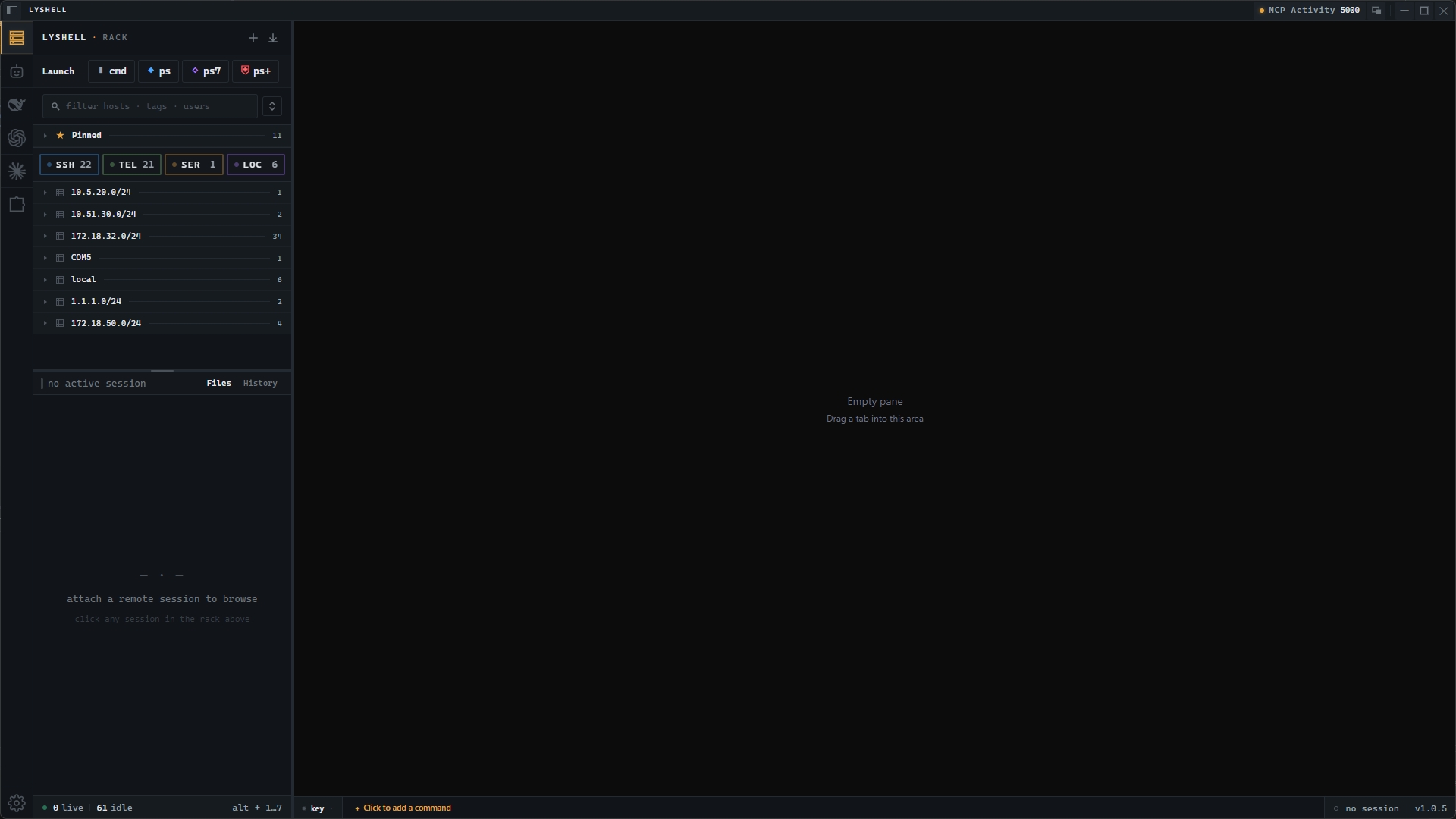
🔌 Your terminal, now AI's terminal too. LyShell is a Windows terminal with a built-in MCP server — letting Claude Code and other AI clients drive your SSH / Telnet / serial / local PTY sessions directly. Plus DeepSeek Harness workspaces (TUI + embedded Web UI), AI Agent launcher, plugin system, and Python scripting.
English | 简体中文
✨ Highlights · 🐋 DeepSeek Harness · 🔗 MCP · 🤖 AI Agents · 🧩 Plugins · 🚀 Quick Start · ❓ FAQ
✨ Highlights
|
|
| 🔗 MCP Server — Expose your terminals to Claude Code and other AI clients, with per-session authorization and audit log |
🤖 Agent Launcher — Run Claude Code, Aider, Copilot CLI, or any custom CLI in a clean transient terminal |
| 🧩 Plugin System — Extend with Python or Node.js plugins, each running under granular permissions |
🐍 Python Engine — Script terminal automation through a built-in LyShell API |
| 🐋 DeepSeek Harness — Manage workspaces with variable sets & model presets, launch TUI and embedded Web UI side by side |
🔐 Embedded Web UI — Run dsh web in an in-app <webview> tab, loopback-locked and URL-validated |
📥 Install
Download the latest portable build from Releases — no installation needed, just download and run.
| Platform |
Format |
Architecture |
Requirements |
| 🪟 Windows |
Portable (.exe) |
x64 |
Windows 10 / 11, 64-bit |
🚧 Currently Windows only — macOS and Linux builds are not yet available.
🔗 MCP Integration
This is what makes LyShell different. It serves as an MCP server, letting external AI clients like Claude Code control terminals via the MCP protocol — listing sessions, sending commands, reading output, transferring files, and managing connections.
📖 Configuration — see MCP Configuration. In most cases you don't configure anything by hand: launch an agent from the Agent Launcher and ask it to configure LyShell as its MCP server itself. Registration configs are emitted in JSON / CLI / TOML to fit different clients.
Tools
| Tool |
Capability |
Description |
list_sessions |
read |
List sidebar sessions |
send_input |
interactiveWrite |
Send text, autoNewline support |
send_and_wait |
interactiveWrite |
Send and capture response, strips echo + ANSI |
execute_command |
execute / localExecute |
Run via independent exec channel (SSH only) |
run_on_sessions |
execute / localExecute |
Broadcast command, max 50 sessions, concurrency 10 |
read_output |
read |
Read N lines of terminal output |
upload_file / download_file |
fileWrite |
SFTP file transfer |
read_file / stat_file / list_files |
read |
Remote file inspection, recursive + glob |
create_session |
sessionControl |
Create/reuse saved session, auto-dedup by target |
reconnect_session |
sessionControl |
Reconnect dropped connection |
close_session |
sessionControl |
Disconnect without deleting the saved session |
open_connection_dialog |
sessionControl |
Open the new-connection dialog for user input |
read_session_notes |
read |
Read session summary, notes, tags |
write_session_notes |
sessionMetadataWrite |
Update summary, notes, tags |
wait_for_prompt |
read |
Wait for shell prompt or regex |
tail_until |
read |
Poll output until pattern matches |
Security
- 🔑 Per-session authorization — each terminal gets its own scoped permission
- 🚪 Capability gates — enforced server-side on every endpoint
- 🛡️ Destructive-command check — scans for
rm -rf, dd if=, fork bombs
- 🔒 Shared PTY locking — MCP vs human input never collide
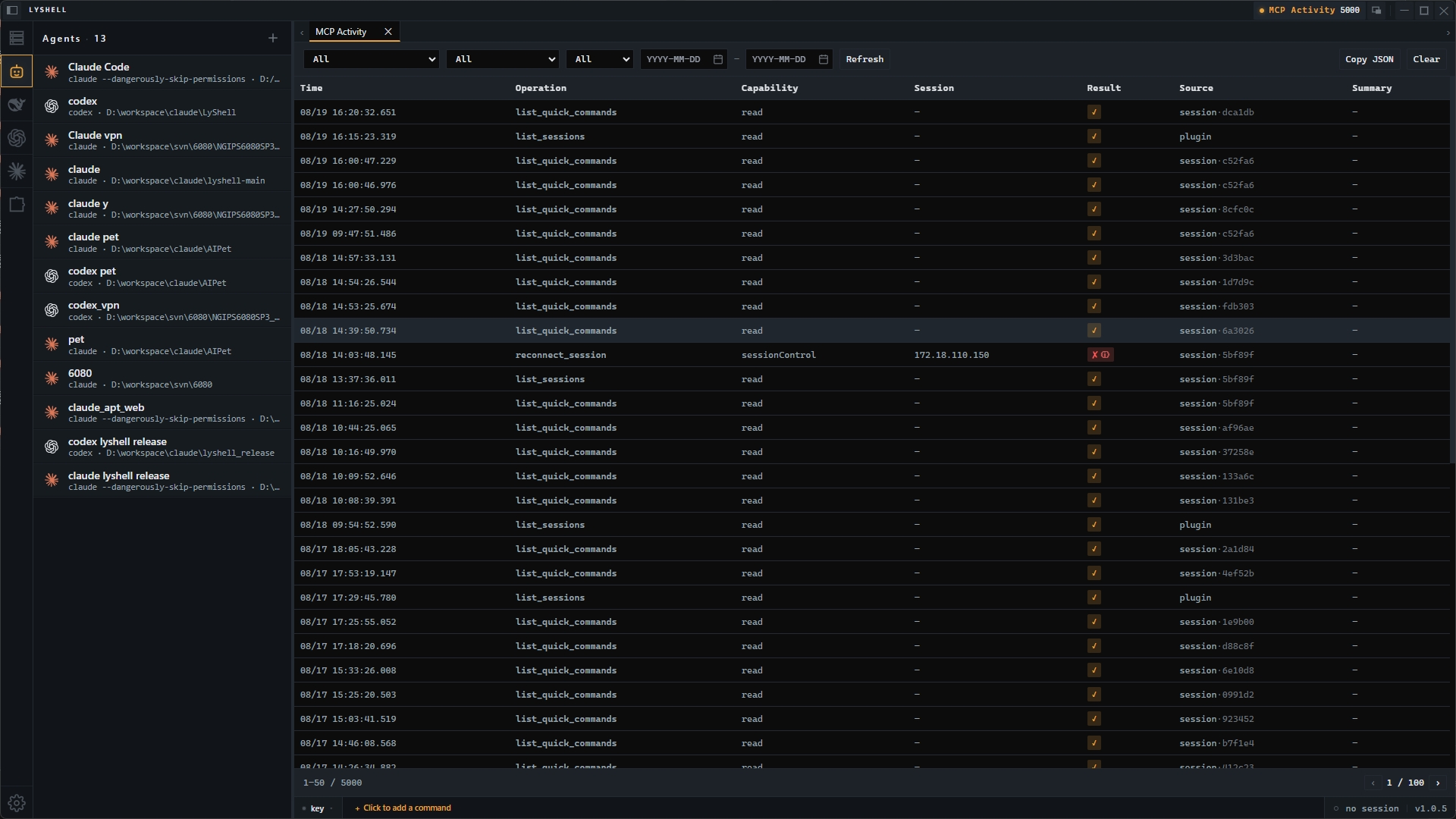
- 📊 Audit panel — calendar + filter + pagination, accessible from the title bar
⚠️ Full-screen TUI apps (vim, htop, less) are not supported over MCP — ANSI stripping garbles alternate-screen sequences. Use the LyShell UI native terminal instead.
🤖 AI Agents
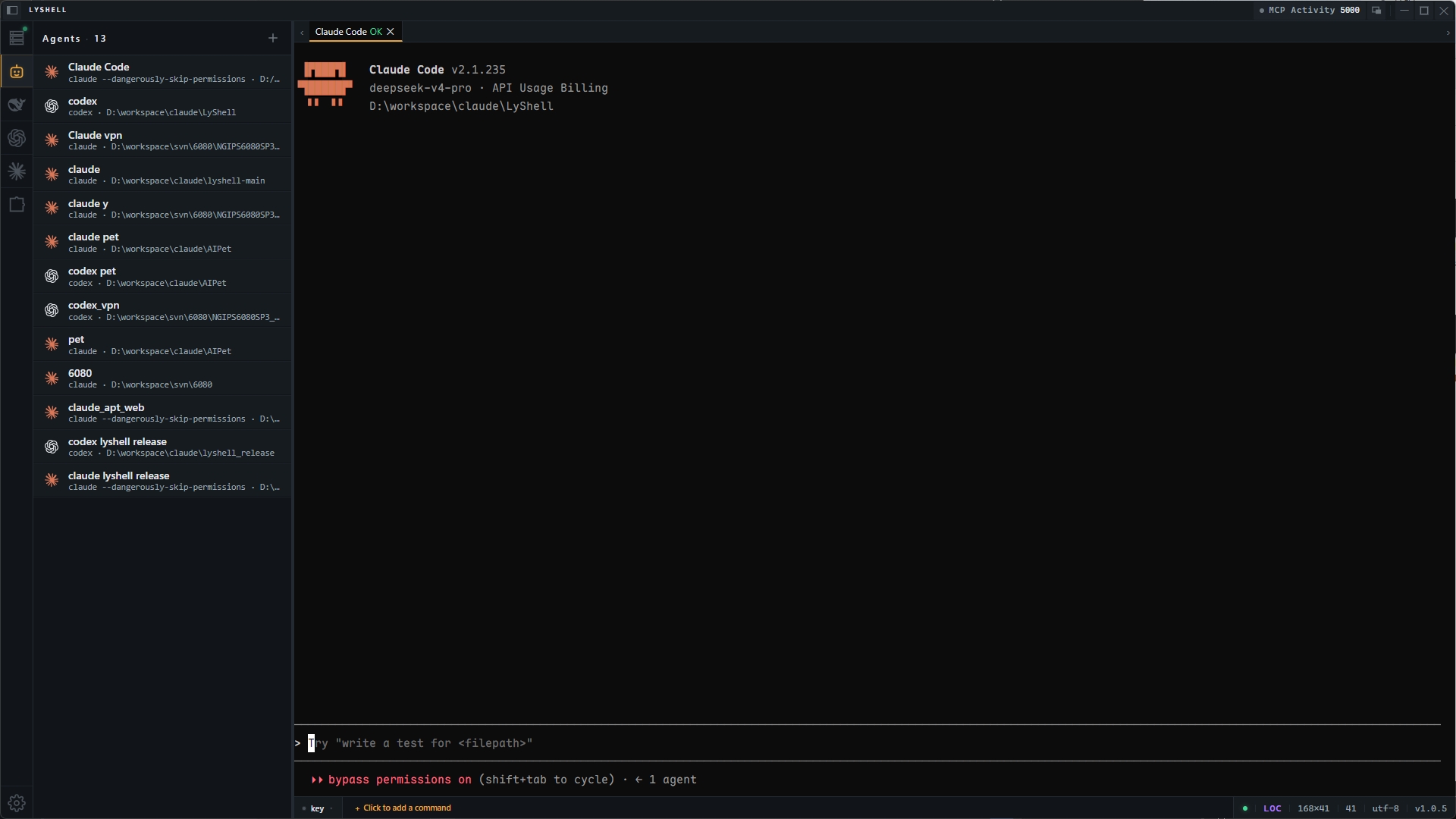
Agent-agnostic terminal — no lock-in to any AI tool. Launch any CLI agent and it runs in a regular terminal with full scrollback, split panes, and IME support.
| Agent |
Command |
| 🧠 Claude Code |
claude |
| 🛠️ OpenAI Codex |
codex |
| 🤝 Aider |
aider |
| 🐙 Copilot CLI |
gh copilot |
First-class Harness agents — dsh, codex, and claude are first-class in the Harness panel: each gets its own left-rail tab, a dedicated workspace list, dependency detection, and per-workspace model & environment variables (model passed as --model, with OPENAI_API_KEY / ANTHROPIC_API_KEY defaults).
Custom agents: Any CLI tool can be registered — name, command, icon, working directory, env vars. Sessions are transient: close the tab, it's gone.
🐋 DeepSeek Harness
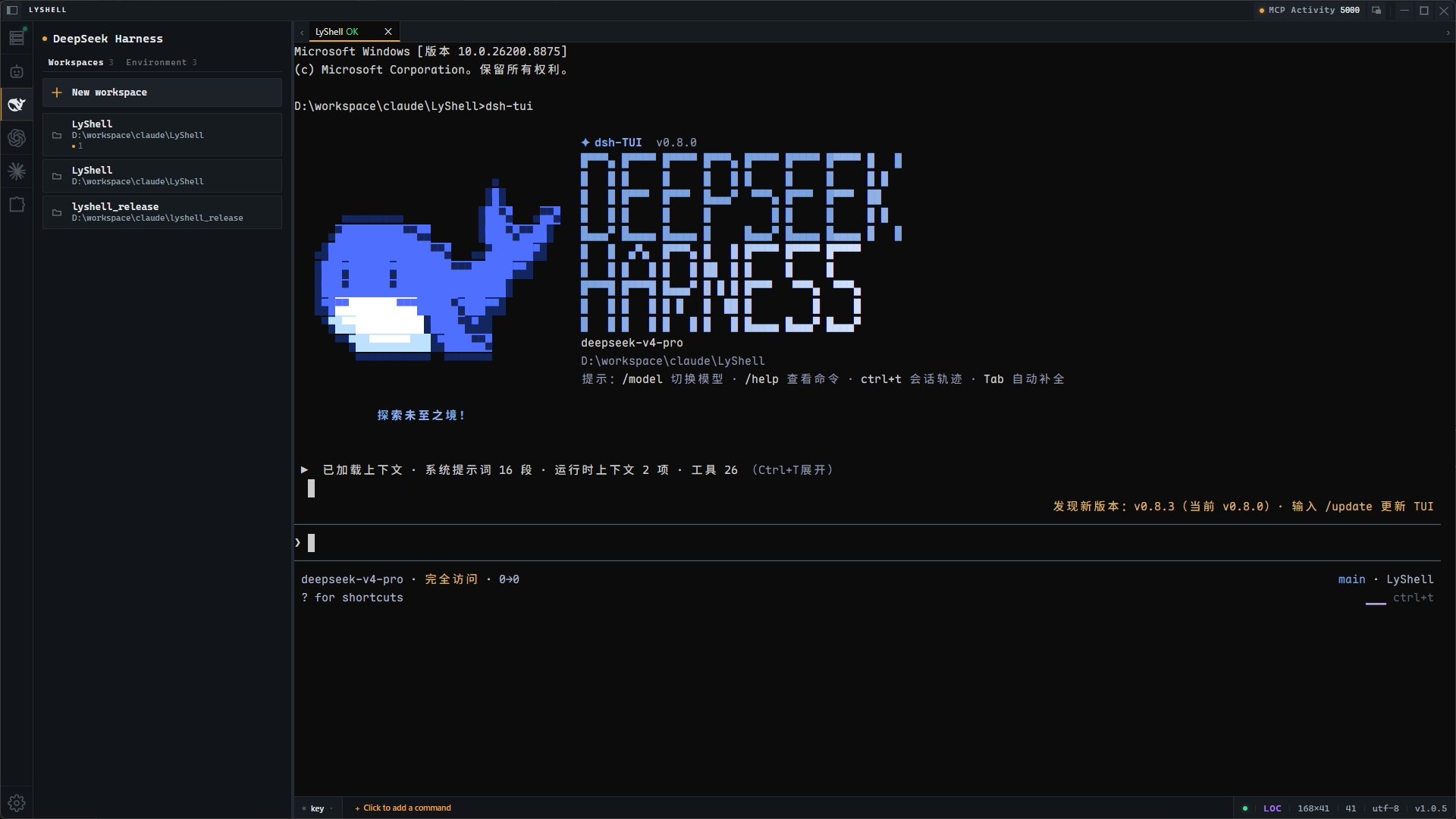
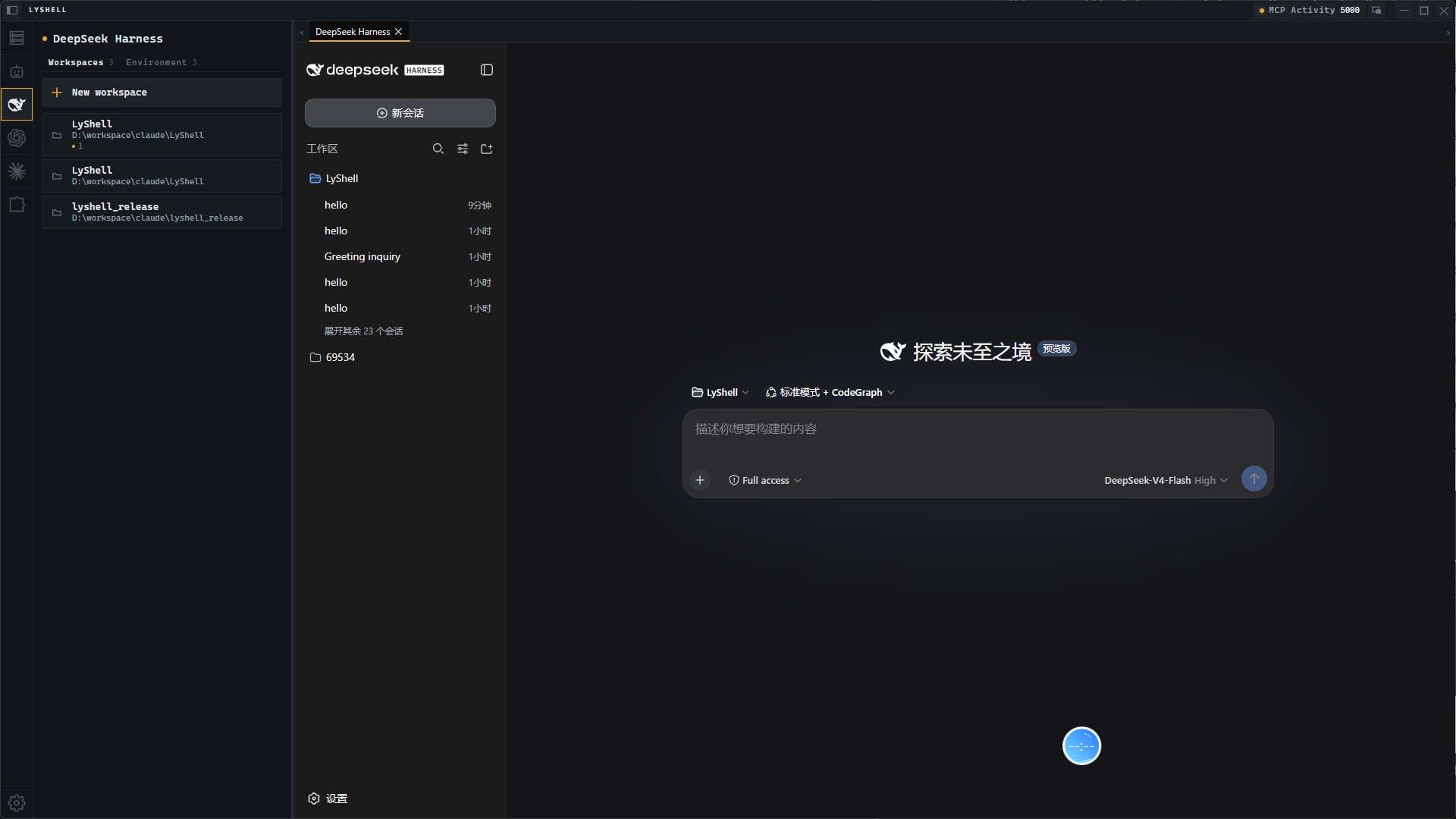
A first-class home for DeepSeek Harness workspaces. Manage every workspace in one dedicated panel, then launch each one as a terminal TUI or an embedded Web UI — inside LyShell, not a separate browser window. The two can even run side by side in split panes.
|
|
| 🗂️ Workspace panel — create, edit, delete |
🔧 Variable sets — pre-configure env sets, switch the enabled one |
| 🎛️ Model presets — save & switch models per workspace |
🖥️ TUI launch — dsh-tui in a native terminal tab |
Dependency detection & install
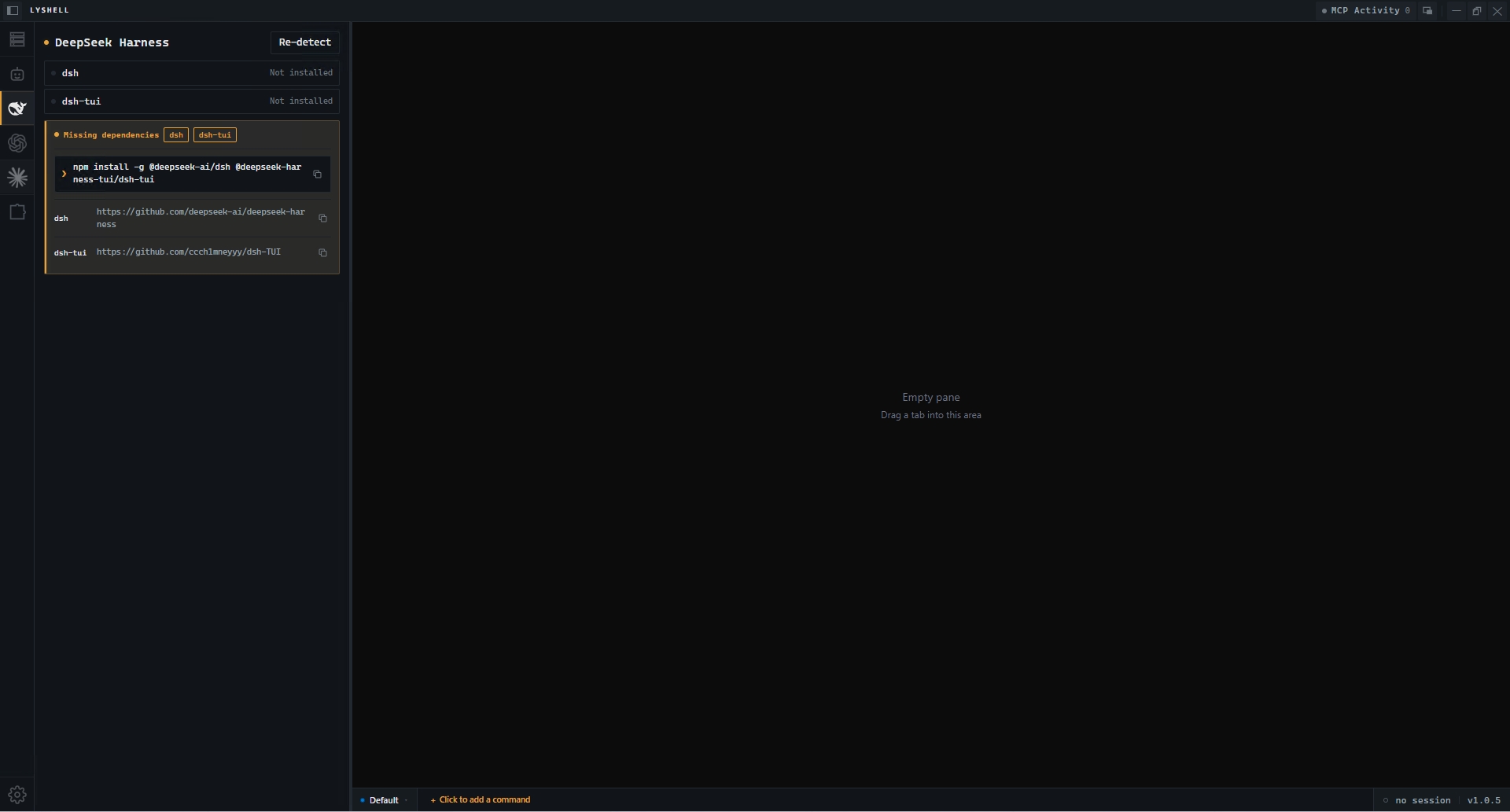
Each Harness tab auto-detects its CLI dependencies on open — dsh + dsh-tui for DeepSeek Harness, codex / claude for the others — by scanning PATH. When something is missing, the panel shows which dependency is absent, its one-line install command, and the source-repo link — it never installs anything for you. A Re-detect button re-scans on demand, and PATH is read live from the registry, so a freshly installed CLI is picked up without restarting LyShell.
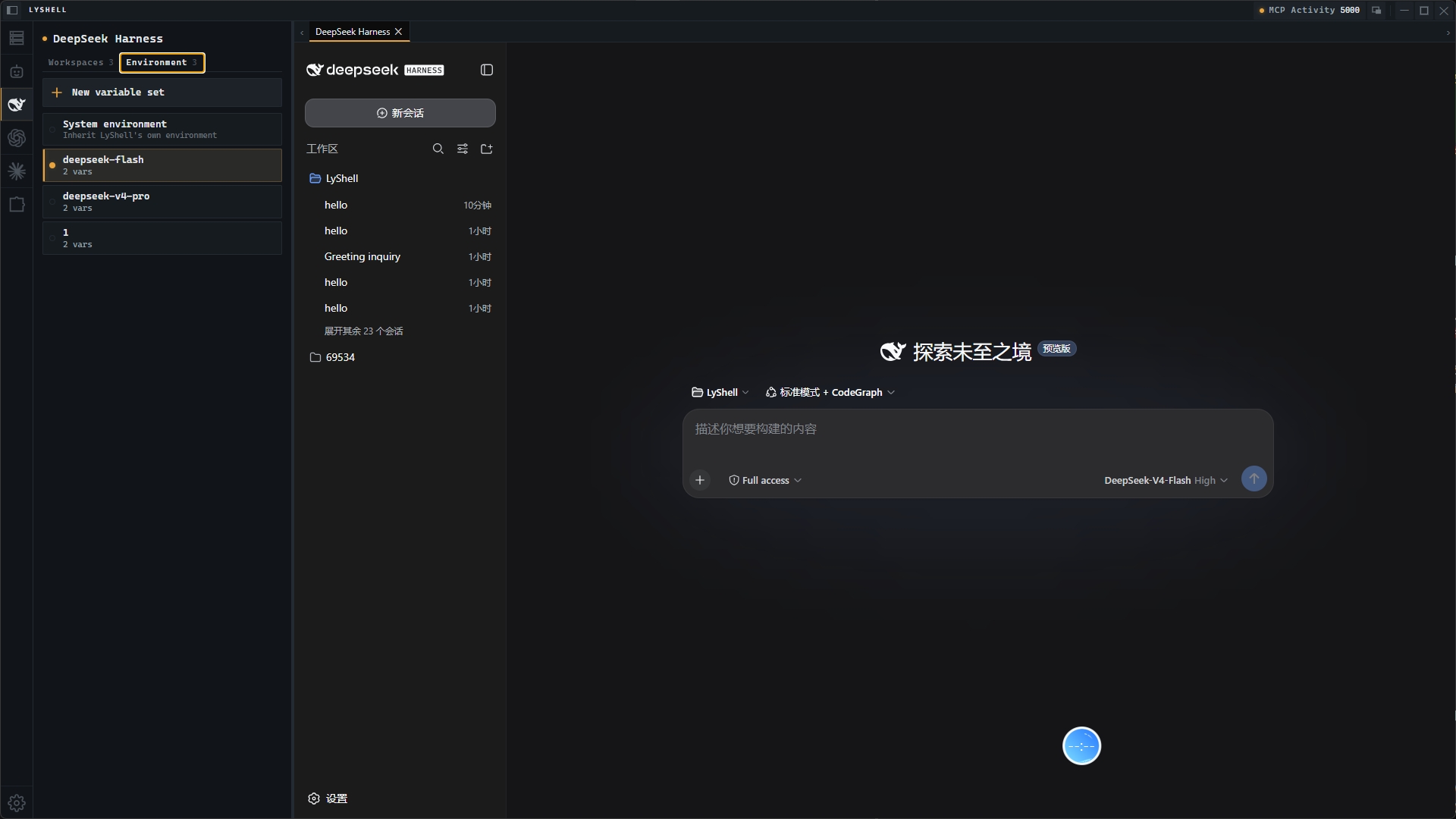
Environment tab: pre-configure, then switch
The panel splits into Workspaces and Environment tabs. In the Environment tab, pre-configure named variable sets — collections of KEY=VALUE (DEEPSEEK_API_KEY, DEEPSEEK_BASE_URL, DSH_HOME, …). At most one set is enabled at a time; click a set to switch to it, or click the always-on System environment slot to fall back to LyShell's own process environment.
Each workspace can bind to a specific set, or follow the enabled set — pick nothing and it inherits whichever set is currently enabled (or the system environment when none is). Enter secrets once, then switch between environments without touching each workspace.
Launch: TUI or Web UI
Every workspace opens two ways:
- Terminal TUI —
dsh-tui runs as a standard terminal tab with full scrollback, split panes, and IME support.
- Embedded Web UI — spawned as
dsh web --port 0; LyShell parses the real port from stdout and renders the app in an in-app <webview> tab. No browser, no manual port juggling.
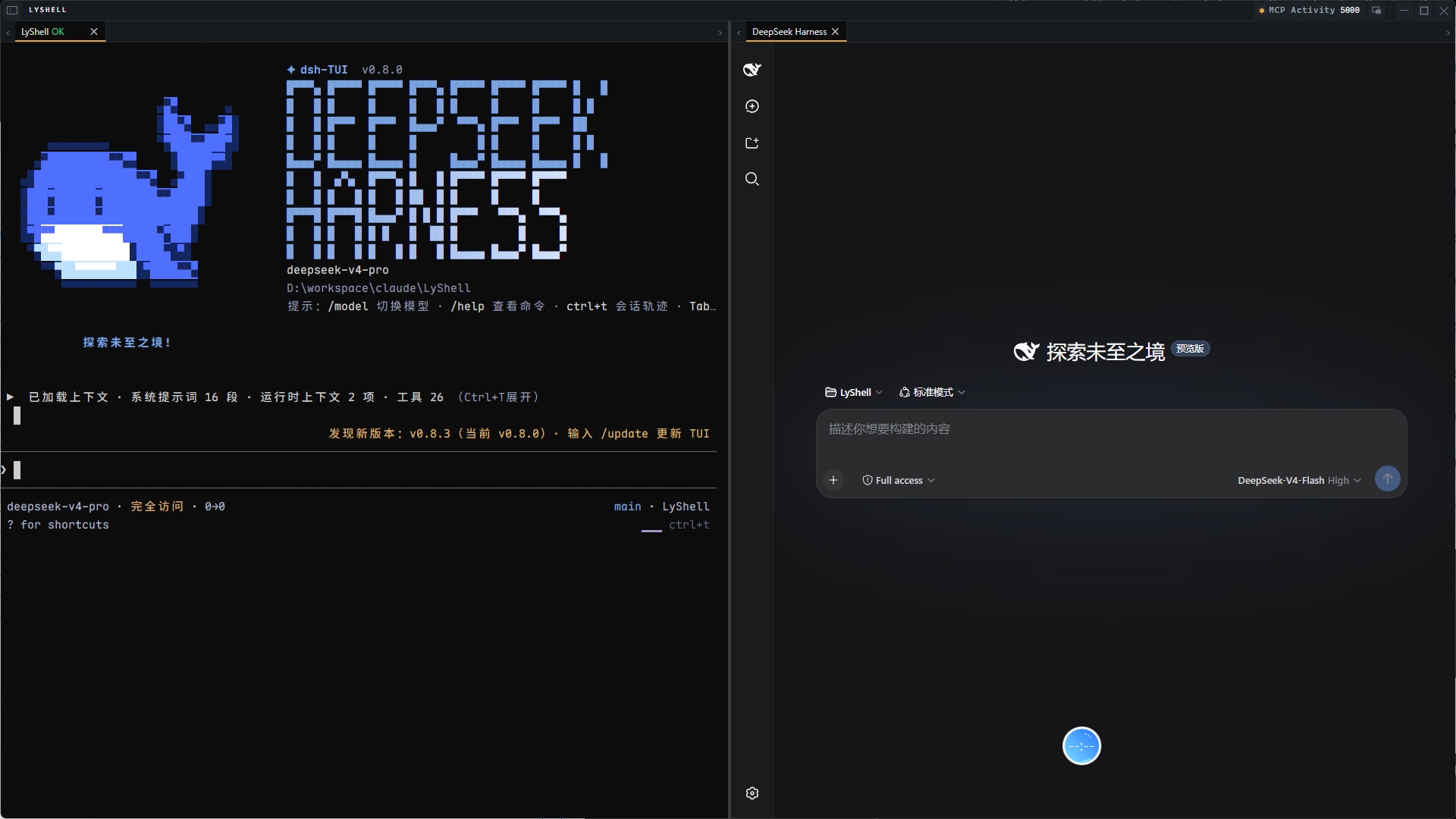
TUI + Web UI, side by side
Drag the Web UI tab to a pane edge to split it into its own pane — the TUI and the embedded Web UI run in the same frame, side by side. Drag it back onto a pane's center to remount it as a regular tab.
Web UI acts like a terminal tab
- ✕ close — only ✕ tears the tab down and terminates the subprocess.
- Switch away — switching to another tab hides the Web UI but keeps the page state and the
dsh web subprocess alive; switching back resumes instantly.
Security
- 🔒 Loopback-locked — navigation and popups are pinned to the workspace's loopback origin.
- ✅ Validated URL — the echoed URL is checked (loopback + explicit port, no embedded credentials) before the
<webview> ever loads it.
🧩 Plugin System & Python Scripting
Plugins
Permission-gated host for Python (one-shot / persistent) and Node.js (persistent) plugins. Install from local directory, ZIP, or remote URL. Each plugin runs with its own scoped authorization — granular permissions (read / write / execute / file / session control) with path safety, destructive-command confirmation, and shared-PTY locking.
⚠️ Plugins activate on startup (onStartup) today. Event-based activation and declarative UI contributions are not wired up yet.
📦 Ready-to-run examples in examples/.
Python Engine
Embedded Python with LyShell API for terminal automation:
session = LyShell.get_current_session()
LyShell.execute("ls -la")
LyShell.send("hello\n")
LyShell.wait_for("prompt$")
Environment variables: LYSHELL_SESSION_ID · LYSHELL_SESSION_TYPE · LYSHELL_HOST · LYSHELL_PORT.
Python path auto-detected from system PATH, configurable in settings.
💡 For long-running or scheduled tasks, consider Node.js plugins via the Plugin System — they're a better fit.
🚀 Quick Start
First Connection
- Click + at the top of the session list → SSH
- Fill in host, port, username, password/private key
- Click Connect — tab turns 🟢 green
💡 For network devices needing shell → enable, add those in Shell Enter Commands — LyShell sends them sequentially.
Quick Connect
Ctrl+Alt+F from any app → search → Enter to connect.
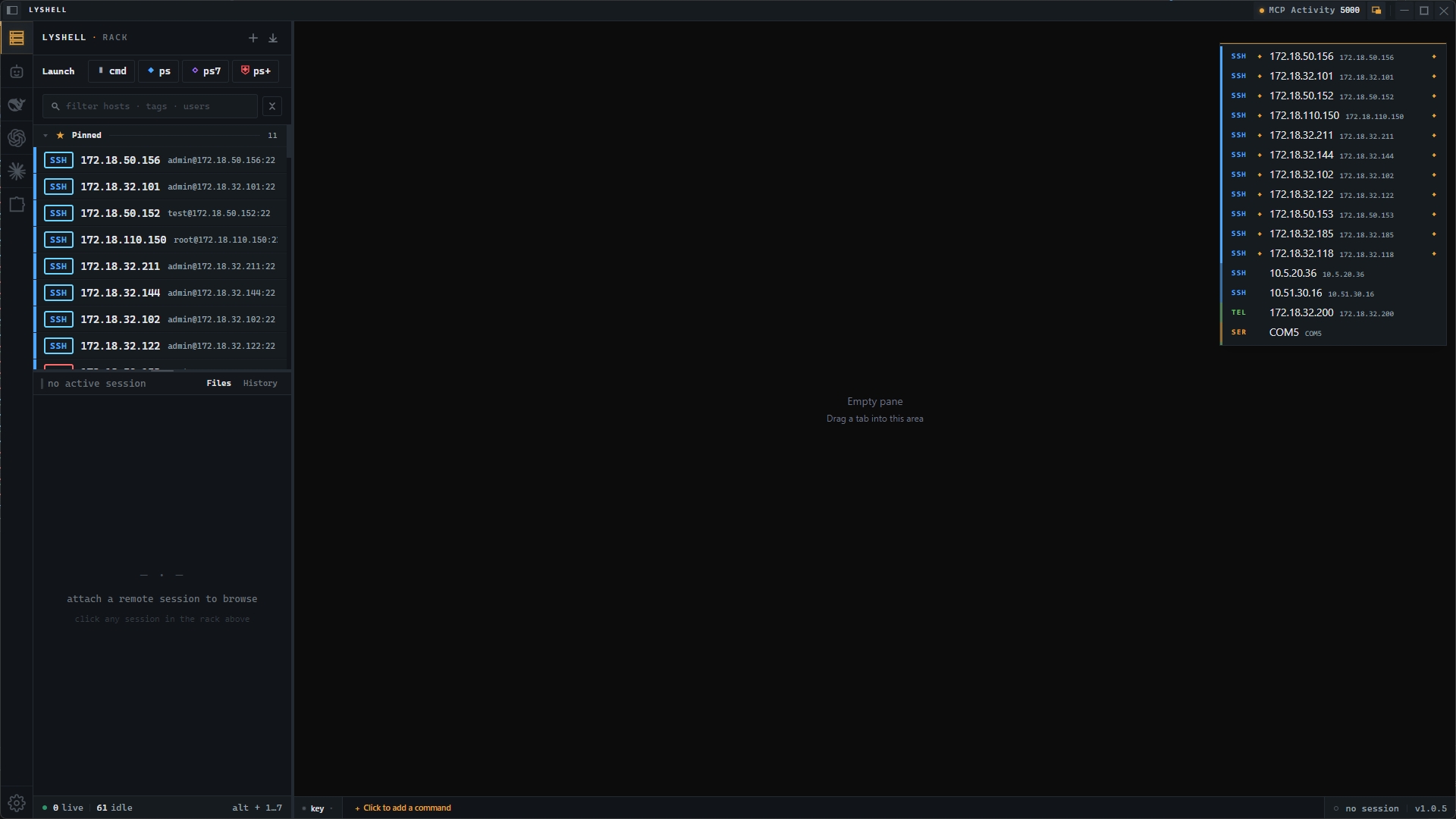
Multi-Server Monitoring
Click a session → Ctrl+Shift+V to split vertically → click another session. Layout auto-saves.
File Transfer
- Upload — drag from desktop to File Panel
- Download — double-click remote file or right-click → Download
- Progress — real-time speed + ETA, auto MD5 on completion
- History — file, size, path, MD5 recorded; supports re-download
- Security — independent SSH connection (never blocks terminal), SFTP or TCP-over-SSH tunnel; no plaintext fallback even when
AllowTcpForwarding is disabled
- Download directory — default
~/Downloads/LyShell/, optional auto-create server subdirectory for archiving
Quick Commands
Right-click the quick commands bar → Edit Group → add commands like tail -f /var/log/syslog. Trigger with Ctrl+F1–F12. Up to 12 commands × 5 groups.
Session Management
- 📌 Pin — hover card → click 📌
- 📋 Clone session — double-click tab left half
- ⚡ Clone channel (no re-auth) — double-click tab right half (SSH only)
- 🔍 Search — type name/host/tag in search box
Terminal Tips
- Select text → auto-copy · Right-click → paste · Middle-click → search bar
Ctrl+F → in-terminal search (regex, case-sensitive, cross-tab)- Encoding issues → edit session, switch UTF-8 / GBK / GB2312
- Click
cols × rows in status bar → clear screen
- Click buffer count → scroll to bottom; double-click → clear scrollback
🔌 Connection Types & Terminal
| Type |
Key params |
Notes |
| 🖥️ SSH |
password or private key; port 22 |
Post-login commands, keepalive; dual-click clone |
| 📟 Telnet |
host + port 23 |
Full IAC negotiation |
| 🔌 Serial |
COM port, baud 115200 (9600–921600), 8N1 |
Auto-detects ports |
| 💻 Local PTY |
cmd.exe / PowerShell |
Configurable working directory + env |
Terminal: GPU-accelerated rendering, full ANSI + 256 colors. Scrollback up to 100,000 lines. Split panes (horizontal/vertical), drag-to-split. Quick commands bar Ctrl+F1–F12. Tab status: 🟢 Connected · 🔴 Error · ⚪ Disconnected · 🔵 New output.
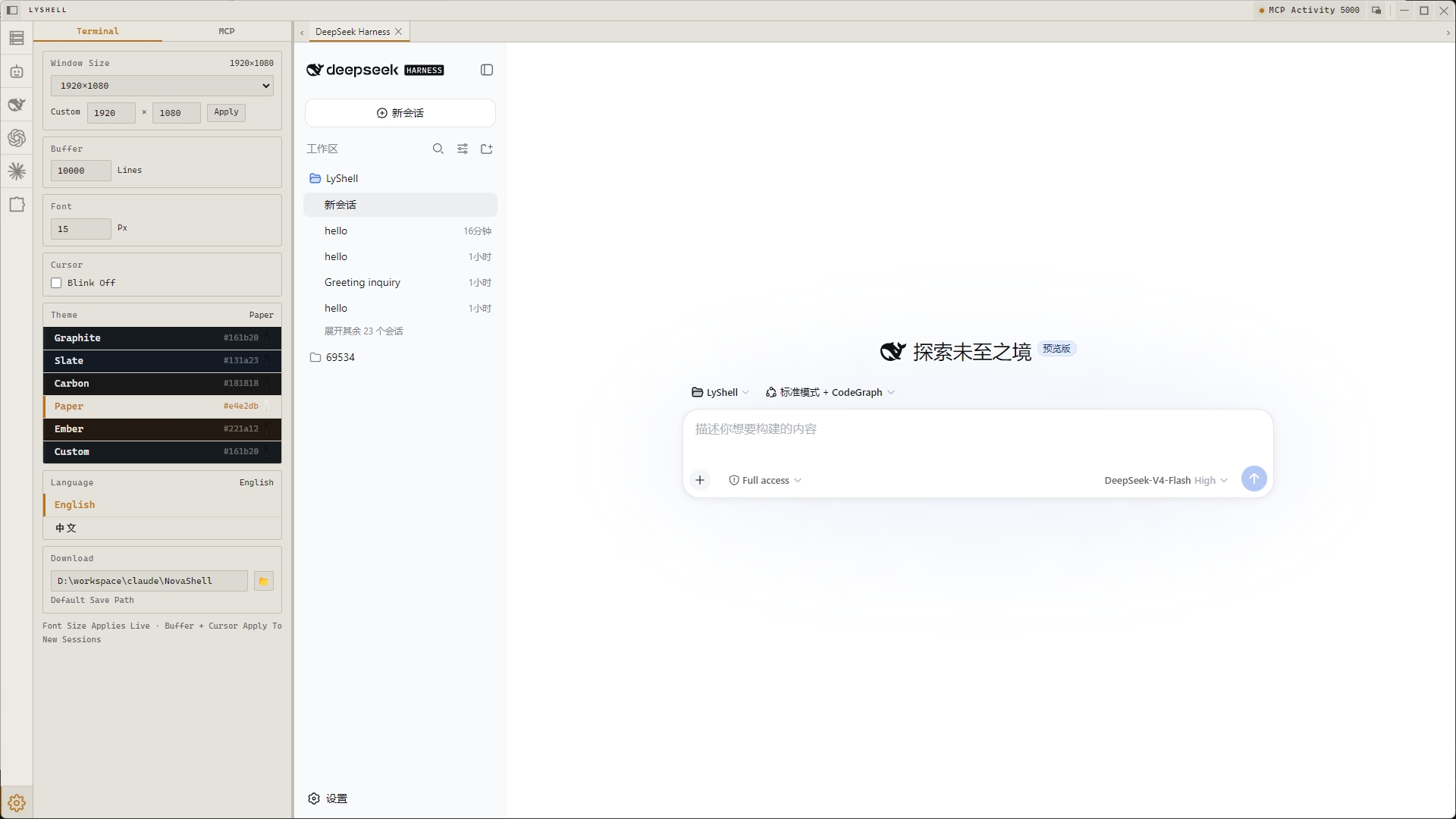
🎨 Themes
5 presets + custom. Instant switch, no restart.
| Theme |
Style |
Mode |
| Graphite |
Deep graphite + tungsten amber (default) |
Dark |
| Slate |
Blue-tinted slate, amber accent |
Dark |
| Carbon |
Neutral charcoal, no blue cast |
Dark |
| Ember |
Warm walnut brown + warm amber |
Dark |
| Paper |
Natural warm paper, graphite ink |
Light |
Custom: pick a background and accent color, LyShell auto-builds a complete harmonious theme.
⌨️ Keyboard Shortcuts
| Shortcut |
Action |
Ctrl + Alt + F |
Toggle float window |
Ctrl + F |
Terminal search |
Ctrl + F1 ~ F12 |
Quick command 1–12 |
Ctrl + Shift + H |
Horizontal split |
Ctrl + Shift + V |
Vertical split |
| Right-click |
Paste |
| Middle-click |
Search bar |
⚙️ Configuration
JSON files in %APPDATA%\lyshell\:
sessions.json · preferences.json · quickCommands.json · agents.json · download-history.json · download-config.json · mcp-server.json
AES-256-CBC encrypted export/import for sessions and quick commands.
❓ FAQ
SSH garbled Chinese characters?
Edit session, switch encoding from UTF-8 to GBK or GB2312.
Serial port no output?
Verify port + baud rate → check no other program uses it → some devices need Enter to activate.
File manager not showing?
SSH sessions only. Ensure the active tab is an SSH connection.
How to reset all configuration?
Delete all JSON files in `%APPDATA%\lyshell\` and restart.
Ctrl+Alt+F not working?
May be taken by another app. Reconfigure in LyShell settings.
Where are downloaded files?
Default `~/Downloads/LyShell/`. Change in settings.
📄 License
LyShell is free to download and use, but the source code is not yet open. Reverse engineering and redistribution of the binary are not permitted without prior permission. See LICENSE.
© 2026 liangyou. All rights reserved.
GitHub ·
Issues ·
Releases ·
Changelog ·
Contributing