
其他
完整应用

deepseek-harness
deepseek-ai
DeepSeek Harness: Everything is a Plugin.
PROJECT TOPICS
INSTALL REFERENCE
dsh plugin --profile web add github:lecutu/dsh-slide-reflex
该命令指向仓库当前默认分支;尚无绑定当前 commit 的完整验证结果。
PROJECT README



 [
[ ]()
[
]()
[ ]()
]()
ppt-reflex is a vision-free engine that lets LLMs produce correct PowerPoint decks — plus a DeepSeek Harness (DSH) plugin with a live PNG preview panel and a click/box-select feedback loop.
Blind LLMs — DeepSeek first, but any text-only model — cannot see the .pptx they generate. ppt-reflex inverts that pipeline: the AI never writes a coordinate and never guesses how anything looks. It declares layout intent — an archetype, parameters, a recipe, a skin — and a deterministic constraint-solving engine computes every coordinate, measures every glyph, and returns structured text diagnostics.
Three things replace vision:
The AI reads diagnostics, edits its declaration, and re-runs. CircuitBreaker watches for mechanical micro-adjustments and forces a design-level rethink before the loop burns itself out.
The preview panel shows real engine-rendered PNGs — the same output the .pptx will contain. Click an element or drag-box-select an area to give feedback; the feedback loop is fully wired.
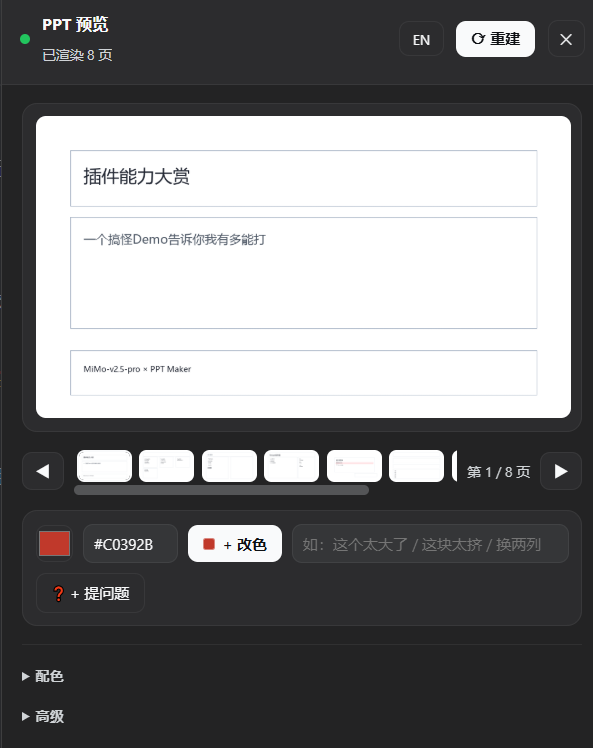 Live preview panel (slide 4/8) with recolor palette and area-feedback visible
A ppt-maker preset agent session in DeepSeek Harness. The input bar left side shows the PPT Preview button; the agent declares deck intent, the watcher auto-builds + renders, and the panel updates in real time.
 Agent session: "PPT 制作" preset selected, PPT Preview entry button visible in the input bar
            ┌─────────────────────────────────────────────┐
            │                LLM AGENT                    │
            │      (no vision — reads JSON, not pixels)   │
            │                                             │
            │   ① declare intent                          │
            │      archetype + params + recipe + skin     │
            │   ② read diagnostics + L0/L1/L2 ASCII       │
            │   ③ decide fix → declare_direction()        │
            └───────────────┬─────────────────▲───────────┘
                            │                 │
              declaration   ▼                 │  diagnostics (JSON)
                            │                 │  + three-tier ASCII
            ┌───────────────▼─────────────────┴───────────┐
            │            ENGINE (deterministic)           │
            │  resolve archetype → phase1 layout →        │
            │  collision → composition → WCAG contrast →  │
            │  PIL text metrics → freeze → roundtrip      │
            │  + auto-render PNG (_render_vision/)        │
            │  CircuitBreaker guards the fix loop         │
            └───────────────┬─────────────────▲───────────┘
                            │                 │
                  build()   ▼                 │  fix_slide() / rebuild()
                            │                 │
             .pptx written — ok:true = visually correct
             .png written  — panel shows the real result
Not "AI generates, human fixes." It is "AI declares, engine computes + renders, AI reads, AI decides, loop." Every LLM can read JSON. That is the whole trick.
Design philosophy — the engine speaks the AI's own language. The declaration layer is deliberately HTML/CSS-isomorphic: the model's deepest muscle memory. grid_cards reads like CSS Grid, fit_mode accepts contain/cover like object-fit, density accepts comfortable/spacious, recipe works like a component class. This is not HTML→PPTX conversion; the engine only borrows the vocabulary so a blind LLM can drive layout with knowledge it already has. The mapping lives in one place: ppt_reflex/grid/agent_vocabulary.py.
python-pptx calls. It declares what it wants — archetype, params, recipe, frame/rail/corner_mark — and the engine solves where.text_metrics.py measures glyph advances with PIL/FreeType against Microsoft YaHei (CJK-capable), falling back gracefully. Overflow is caught before the file is written.{slide, phase, kind, severity, message, options} per issue, deduplicated and batch-collapsed.L0 structure map · L1 element map (# overlap, ! overflow) · L2 numeric text table.geometry_ok and harmony_ok — both verifiable floors, never taste.CircuitBreaker escalates: same direction → WARN, three times → BLOCK; mechanical tweaks → BLOCK.tokens.json / recipes.json hold tiered values; recipes pre-resolve token values.| Change | What it means |
|---|---|
| PNG-based panel preview | Panel shows real engine-rendered PNGs (_render_vision/slide_XX.png), not a canvas re-draw of frame-stream data. What you see is what the .pptx will contain. |
| Watcher auto-render | Every watcher build now renders PNGs automatically — render_png: true is injected into the build request. No manual renderSlides call needed for preview. |
| New RPCs | previewState (PNG list + per-slide element geometry) and slideImage (single page as base64 PNG). The panel polls previewState and loads images via slideImage. |
| Frames demoted | _frames_auto.jsonl is no longer the panel's rendering source — it serves as the element-geometry source for click/box-select hit-testing only. |
| Direct-fetch communication | Panel talks to the host gateway directly (no typert remotes mount chain). ctx.interval replaced with native setInterval. Errors show in the status bar instead of being swallowed. |
| Change | What it means |
|---|---|
| OKLCH colour core | grid/oklch.py — sRGB↔OKLCH, hue distance, chroma/lightness helpers |
| Two-channel diagnostics | violations → error/warning (block ok); signals → advisory (never trimmed) |
| Area-based colour ratio | 60-30-10 bands measured by filled area |
| Focal-point uniqueness | exactly one focal element per page |
| Hue harmony | mono / analogous / complementary / triadic, all OKLCH; ≤2 high-chroma families |
| Entry discipline | strict_tokens=True by default |
| CSS-isomorphic vocabulary | contain/cover, comfortable/spacious |
| Region diagnostics | inspect_slide(idx, elem_ids) + runner --inspect |
| Dual gate | geometry_ok and harmony_ok must both pass |
| Persistent circuit breaker | build_count in _breaker_state.json across processes |
| Watcher auto-build | deck file change → auto-build (no manual runner invocation) |
ppt_build tool |
host-registered: build / renderSlides / inspect |
git clone https://github.com/lecutu/dsh-slide-reflex.git && cd dsh-slide-reflex
pip install -e .
Python 3.10+. Two runtime dependencies: python-pptx and Pillow.
from ppt_reflex.builder import PPTBuilder

b = PPTBuilder(template="business", style="corporate_minimal")
b.add_slide("Why This Exists",
    archetype="content",
    elements=[
        b.title("python-pptx Is Blind"),
        b.bullet("Text overflow and invisible text are silent failures"),
        b.box("Every LLM can read JSON.\nNo vision required.", recipe="card"),
    ],
)
result = b.build("output.pptx")
print(result["summary"])python _dsh_ppt_runner.py < deck_request.jsonuser says what they need
│
▼
agent questionnaire → generate deck (archetypes + params + recipes + skins)
│
▼
write D:\ppt\_deck_auto.json ──► host watcher auto-builds + renders PNGs
│
▼
panel polls previewState → shows real rendered PNGs
│
▼
feedback loop: click element · drag-box select · recolor · ask question
│
▼
agent edits deck ──► watcher rebuilds + re-renders ──► panel updatesBuild trigger = writing the deck file. The host watcher watches _deck_auto.json; on change it runs the engine AND renders PNGs — the panel shows the result without any manual renderSlides call.
Workflow file bridge:
| File | Purpose |
|---|---|
_deck_auto.json |
Deck plan — the only file the agent touches |
_render_vision/slide_XX.png |
Rendered PNGs (panel's live data source) |
_frames_auto.jsonl |
Element geometry for box-select hit-testing (not the visual source) |
_feedback_auto.json |
User problem feedback from the panel |
_selection_auto.json |
Element selection (click / drag-box) |
_palette_auto.json |
Panel palette (merged by runner, never by the agent) |
_breaker_state.json |
CircuitBreaker persistence across processes |
For full plugin documentation, maintenance notes, and troubleshooting: see plugins/dsh-slide-reflex/README.md and docs/.
| API | Signature | Purpose |
|---|---|---|
PPTBuilder |
PPTBuilder(template, style, overrides, page_w=960, page_h=540) |
AI entry point |
add_slide |
add_slide(title, *, archetype, params, regions, elements, arrows, frame, rail, corner_mark) |
Declare one slide |
title / subtitle / text / bullet / footer |
(text, *, style, region) |
Text primitives |
box |
(text, *, recipe, ...) |
Card component |
shape |
(shape_id, *, ...) |
20 shapes |
image |
(path, *, fit_mode, ...) |
Contain-fit image |
table |
(headers, rows, *, region) |
Auto-sized table |
build |
(path) |
Full build |
fix_slide / rebuild |
(idx, ...) / (changed_slides, path) |
Incremental rebuild |
inspect_slide |
(idx, elem_ids) |
Region inspection |
set_render_frame_hook |
(fn) |
Streaming preview callback |
declare_direction |
(direction) |
Fix strategy for CircuitBreaker |
list_templates / list_style_presets / list_archetypes |
() |
Catalogs for the agent |
12 archetypes: title_cover · content · two_column · comparison · data_showcase · grid_cards · image_hero · conclusion · section · quote · timeline · blank.
6 templates: academic · business · minimal · data_report · teaching · product. 6 style presets: academic_rigorous · corporate_minimal · tech_dark · editorial_magazine · creative_vibrant · government_solemn.
The engine is a floor, not a ceiling. Three layers let the agent take back control:
regions=[...].pw/ph, fill_color, corner_radius, align_h, font_size.python-pptx or the officecli skill for one slide.tools/golden_harvest.py)columns/gap/density-style parameters for more archetypeslayout_extractor.py into register_archetype()#/! clickable to its JSON diagnosticppt-reflex is MIT licensed. Built for AI agents. Blind-proof by design — ok: true means the file is correct, and no one had to see it.
docs/slide-reflex-engineering.md — full engineering maintenance documentdocs/preview-panel-deepdive.md — preview panel root-cause analysisplugins/dsh-slide-reflex/README.md — plugin developer docs.claude/skills/ppt-maker/SKILL.md — agent operating manualCLASSIFICATION EVIDENCE
系统优先读取 GitHub Topics,再与站内分类词典和词根规则比对。当前命中: skill、skills。
deepseek-ai
DeepSeek Harness: Everything is a Plugin.

anywhere-labs
为 DeepSeek Harness (DSH) 插件生态打造的现代化桌面端解决方案。万物皆「插件」,桌面本身也是「插件」。

walkinglabs
Harness engineering beginner tutorial, from 0 to 1