

模型与 MCP
待识别

rea
morluto
Reverse engineer anything with agents, from app behavior down to native binaries.
PROJECT TOPICS
INSTALL REFERENCE
dsh plugin --profile web add github:kvenux/dsh-decode
该命令指向仓库当前默认分支;尚无绑定当前 commit 的完整验证结果。
PROJECT README
English · 简体中文
Agent     Refactor the session layer?     > yes
Agent     Change 23 files?                > yes
Agent     Delete the old retry logic?     > yes
Agent     Option A or B?                  > you pick
Agent     Tests pass. Merge?              > gogogo

Lines written: +4,117
Lines read:    0

Reviewer  Can you explain this code?      > yes
                                          > no.
An illustration, not a measurement.
Yes Engineer. GoGo Engineer. Cognitive surrender, with a job title.
"You didn't review the code. You ratified it." — Addy Osmani, Cognitive Surrender
Decode is a DeepSeek Harness plugin. You ask about your repository in your own words. It answers with text, a diagram, files and code, all linked, and with evidence you can check.
Be the master of your own understanding. Learn your repository from a higher level.



https://github.com/user-attachments/assets/cd28159f-6df6-4d27-8112-482d2d9be9ab
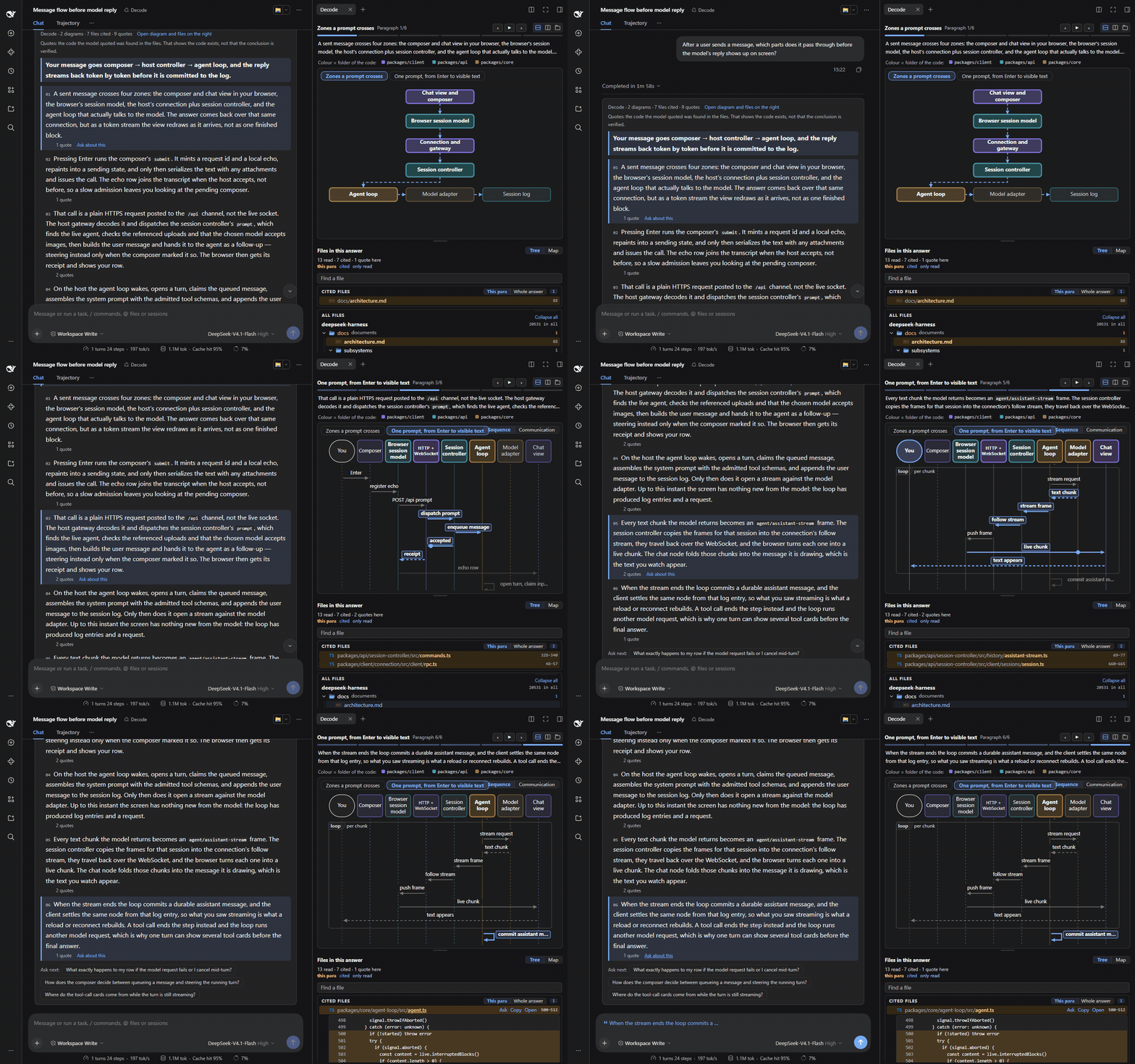
Above: in the deepseek-harness repository, "After a user sends a message, which parts does it pass through before the model's reply shows up on screen?". Each paragraph in turn; the diagram on the right highlights what the paragraph is about; then the cited code opens, and "Ask about this" puts the paragraph into the input box (nothing is sent).
dsh web or the desktop app: Plugins → Add plugin → enter dsh-decode@preview → Install. Then pick Decode in the session's mode menu.
Command line:
dsh plugin --profile web add dsh-decode@previewThen restart dsh web. Needs dsh 0.2.1-rc.5 or a newer 0.2.x. To upgrade, remove the plugin and add it again.
After a user sends a message, which parts does it pass through before the model's reply shows up on screen?
If the format of the events in the session log changes, which parts are affected?
How do the Standard, PTC, Minimal and Creator modes differ?
Decode is good for flows across modules, state changes, the impact of a change, how several approaches compare, processes and deployment. To look up one place in the code, the standard mode is faster.
Ask in English and the answer is in English; ask in Chinese and it is in Chinese.
| You do this | The page does this |
|---|---|
| Hover a paragraph | The diagram follows |
| Click a step in the diagram | The text goes to its paragraph |
| Change a sequence diagram to Communication | The same steps show who talks to whom |
| Point at a folder in the diagram's colour key | Its parts light up in the diagram and the map |
| Open the map | You see where the files live in your repository |
| Open a quote | You see the exact lines |
| Type in Find | The list changes on each key |
| Click Ask about this | The paragraph goes into your input box. Nothing is sent. |
It even warns you. This line is always at the top of the card:
A quote found shows the code exists, not that the conclusion is verified.
Question: Which processes take part when you run dsh web, and how do they communicate?
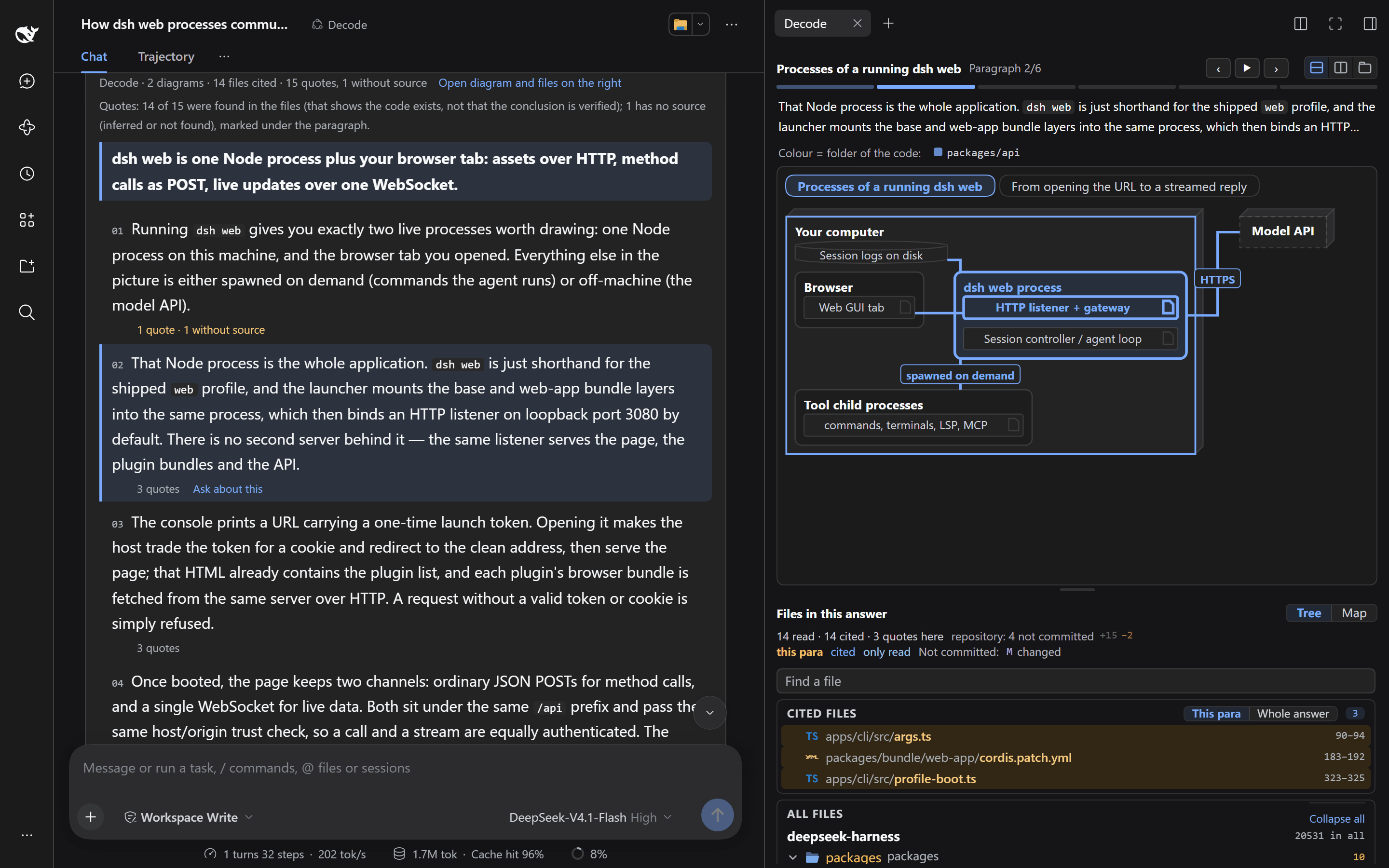
Above the answer, the count: 14 of 15 quotes were found in the files, and the one without a source is marked under its paragraph. On the right, the deployment diagram lights up what paragraph 2 talks about.
Question: Before the agent runs a command or changes a file, which permission checks and approvals does it go through?
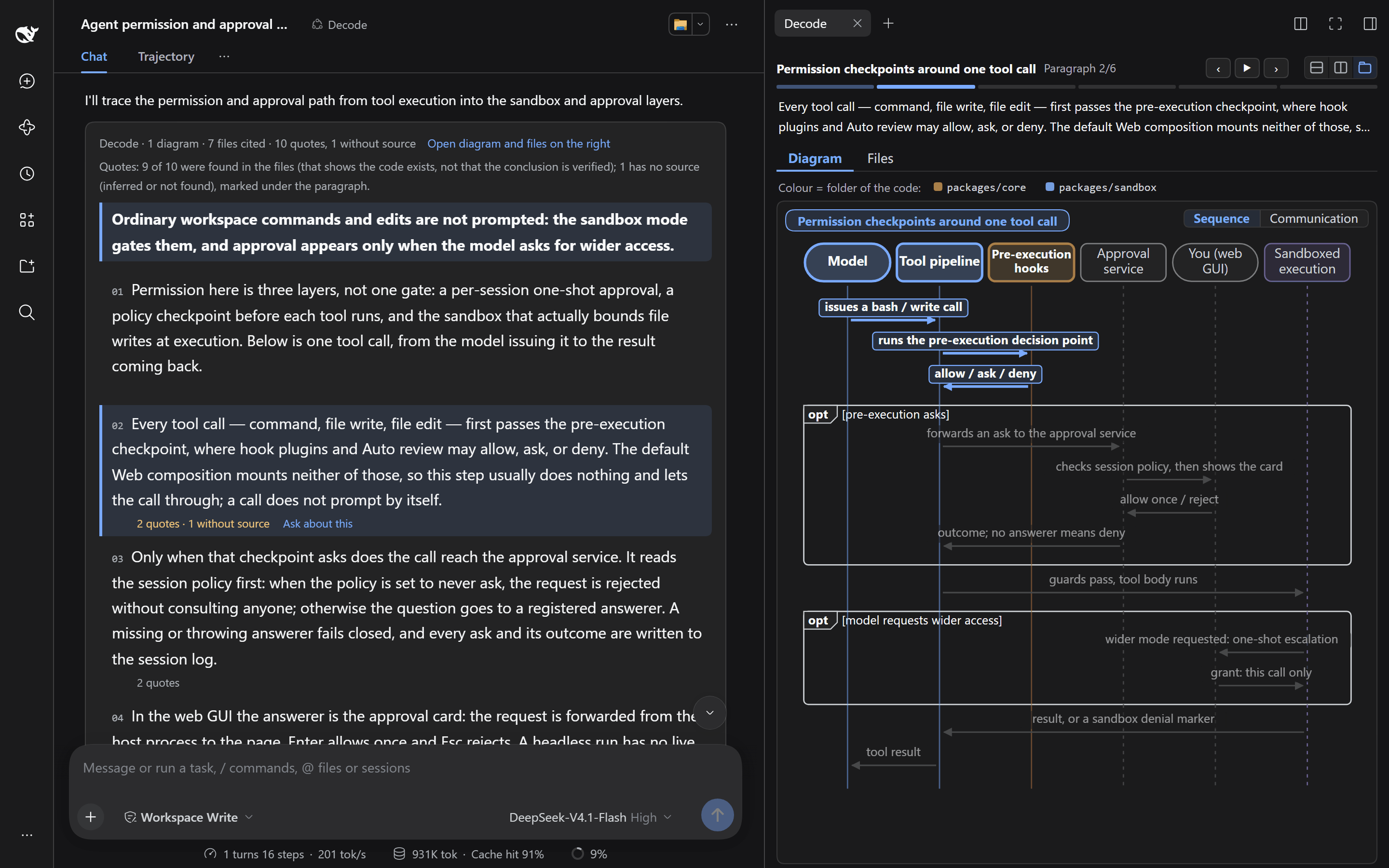
The sequence diagram on its own tab. The steps of paragraph 2 are lit; the opt blocks are the paths taken only when a check asks.
Open a quote, and you see the lines of code it rests on:
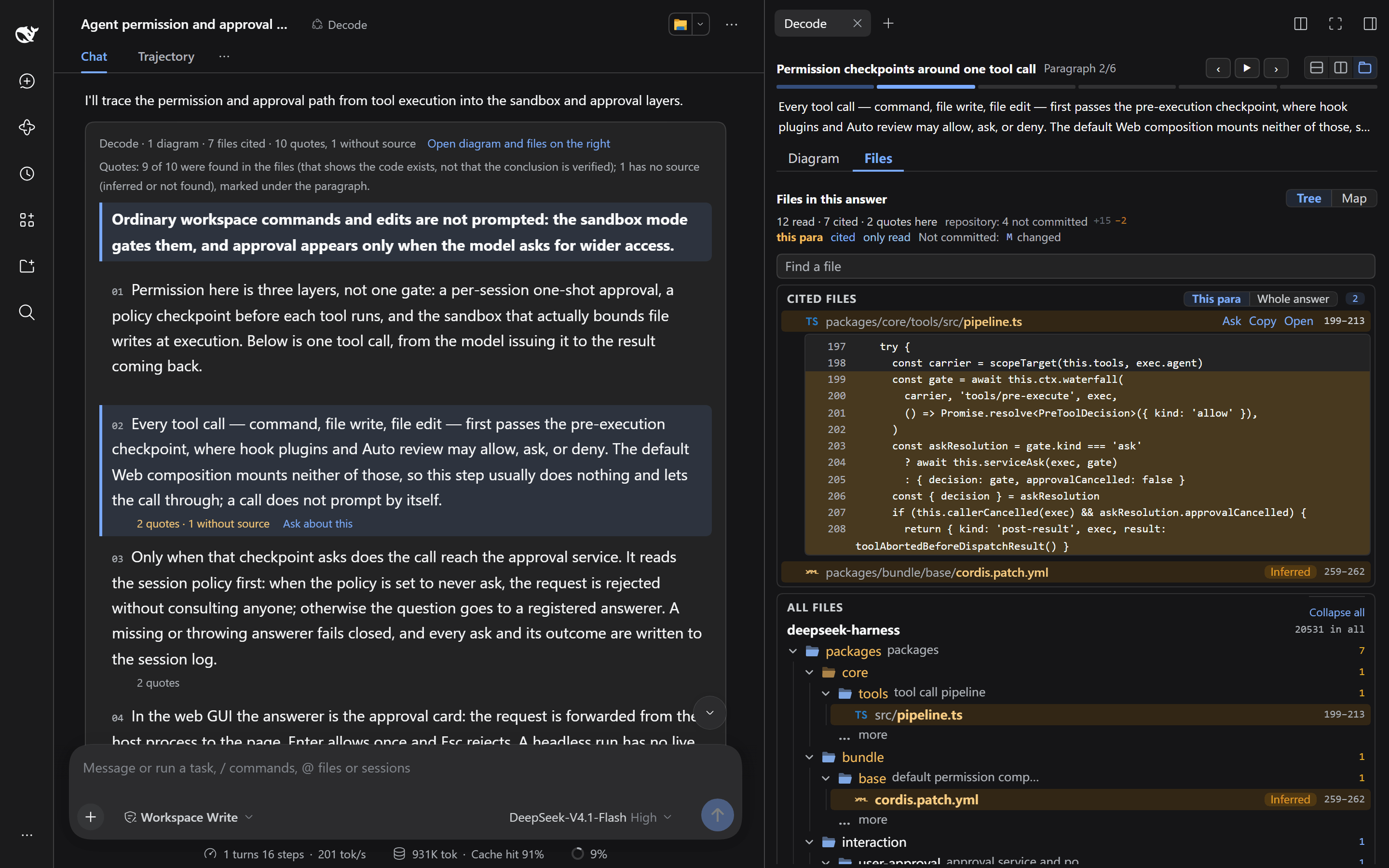
Below it, a second piece of evidence is marked Inferred: the model quoted no code there, and the page says so.
You do not surrender when you write code, because writing keeps you in a loop of guess, fail and fix. Reading agent code has no such loop:
Each yes makes the next one easier. Your picture of the system goes wrong in places you cannot point to, and no dashboard shows it: throughput counts approved work the same as understood work.
Osmani's article gives the habits that stop surrender. Decode builds them into the tool:
| Habit against surrender | What Decode does |
|---|---|
| Write down what you expect before you look | You ask first; it does not lecture. You frame the question. |
| Have it explain before it generates | The mode explains. The model gets no file write or edit tools. |
| Ask for evidence, not "looks right" | Each paragraph quotes code, checked against the files; a quote it cannot find is marked. |
| Do not take its authority on trust | The warning above stays on the card. The sign-off stays yours. |
| Correct on the surface ≠ correct for the system | A diagram across modules follows the current paragraph; a folder tree and a map put the files back into the repository's layout. |
| Collaborate, do not delegate | "Ask about this" only fills the input box. The next question is yours. |
To be told and to be able to check are two different things. An ordinary answer asks you to trust it or not. Decode gives you where the evidence is, how the parts call each other, and a map. You can check it, find your way, and ask the next question.
License: MIT
CLASSIFICATION EVIDENCE
系统优先读取 GitHub Topics,再与站内分类词典和词根规则比对。当前命中: deepseek。
morluto
Reverse engineer anything with agents, from app behavior down to native binaries.

deepseek-ai
DeepSeek Harness: Everything is a Plugin.

nexu-io
The 1st Collaborative AI Design Agent Workspace. Local-first and open source. Create motion, prototypes, websites, apps, dashboards, presentations, images, and videos with your team and AI agents. Share work, exchange feedback, and iterate together in one workspace.