
安全与治理
插件

dsh-redteam-model
SeaOf0
基于dsh web实现的多种模式,目的是服务于redteam进行授权的安全研究,覆盖渗透测试、红队评估、代码审计等范围领域,请勿用于非法行为。(允许二开,赋予模块各位自己的业务逻辑,方法论只有自己熟练的才好用,好的方法论=好的生态)
PROJECT TOPICS
INSTALL REFERENCE
dsh plugin --profile web add github:kipozannaki/DSH-PDR-Plugin
该命令指向仓库当前默认分支;尚无绑定当前 commit 的完整验证结果。
PROJECT README
Plugin Detection and Response for DeepSeek Harness.


English · 中文
Every plugin you install runs with the same privileges as the host: it can read your credentials, open sockets, and spawn processes. Reviewing its source answers what it could do — and only until the next update.
DSH-PDR answers a different question: what did it actually do?
When the host is started through its launcher, it observes the running process, attributes the
fs / network / subprocess calls plugins make to the plugin that made them, judges those calls
against what the plugin claims to need, and shows you the result. Everything stays on your
machine. Attribution is best-effort, not a guarantee — see Limitations.
行为监控 tab in the web UI's view bar: per-plugin call stats, red-line tags and a live timeline (auto-refresh), fed by the plugin's own in-host APIdsh-pdr doctor prints the last session's verdict offlinecredential-exfil catches a credential read followed by egress in the same breathDSH_HOME, hardened timeout — a separate process, not a sandbox)json, Slack and DingTalk payload formats# 1. install into a profile
dsh plugin --profile <profile> add file:/path/to/dsh-pdr-plugin
# or, directly from this repository:
dsh plugin --profile <profile> add github:kipozannaki/DSH-PDR-Plugin
# 2. start the host through the launcher (not `dsh` directly — see below)
dsh-pdr --profile <profile> web
# 3. confirm the preload is in place
dsh-pdr --pdr-checkRequirements: Node ≥ 22.12 (for require(esm)), DSH ≥ 0.1.7, pnpm (used by
dsh plugin add).
Why the launcher? A DSH host formalises several
node:*ESM facades very early, so a probe installed from inside a plugin misses a large slice of calls. Measured on one real session:earlyInstallalone attributed 0 of 3 target-plugin calls (926 events, all fell back tohost); adding the preload attributed 3 of 3 (5 192 events). The preload is a requirement, not an optimisation —docs/DESIGN.md.Where the launcher comes from, and where it works.
dsh plugin addlinks the package'sbininto<profile>/node_modules/.bin/, so after installing you can call it asnpx dsh-pdr …from that profile's context, ornode <profile>/node_modules/dsh-pdr-plugin/bin/dsh-pdr.cjs …directly — either way it setsNODE_OPTIONS=--require …/preload.cjsand forwards everything else todsh. The DSH Desktop app does not go through a shell, so the launcher cannot inject into it; for Desktop, attribute nothing rather than assume this plugin is watching — the health card and the offlineaudit/aggregatecommands still work, and a--import-based hook (host-level, no launcher) is the tracked next step (#1).
Nothing installed? The UI runs on demo data:
node src/client/serve.js # http://127.0.0.1:3123/firewall/| Stage | Capability | Where |
|---|---|---|
| Before install | Health card: capability surface, red-line combinations, PASS / WARN / BLOCK | src/inspector/ |
| Before install | Trust score: weighted, auditable formula (red lines −30 each, credential access −5, network −3, subprocess −2) → bands 良好 / 注意 / 谨慎 / 高危 | src/inspector/trust-score.js |
| Runtime | Behaviour probe: network / fs / subprocess, attributed per plugin | src/probe/ |
| Runtime | Red-line alerts: credentials+network, credentials+subprocess, cleartext egress | src/probe/ |
| Runtime | Boundary judge: contract × path class × baseline → normal / observe / suspicious / boundary | src/judge/ |
| Runtime | Contract inference: observe a cold start → draft → human confirmation; an inference never launders an observed red line | src/judge/infer.js |
| Runtime | Block mode: pre-execution check, violation stopped in place (opt-in; alarm is the default) |
src/guard/ |
| On change | Snapshot & rollback of the profile manifest trio (package.json, pnpm-lock.yaml, cordis.patch.yml) |
src/store/snapshot.js |
| On change | Update guard: capability diff + trial install in an isolated child process | src/update/ |
| Overview | Security-centre UI: plugin list, trust score, red-line banner, filterable timeline | src/client/ |
| Overview | Audit report, SARIF 2.1.0 / CSV compliance export, multi-source aggregation | src/report/ |
| Overview | Red-line webhook push — off by default, deduped, rate-limited, never self-recording | src/alert/ |
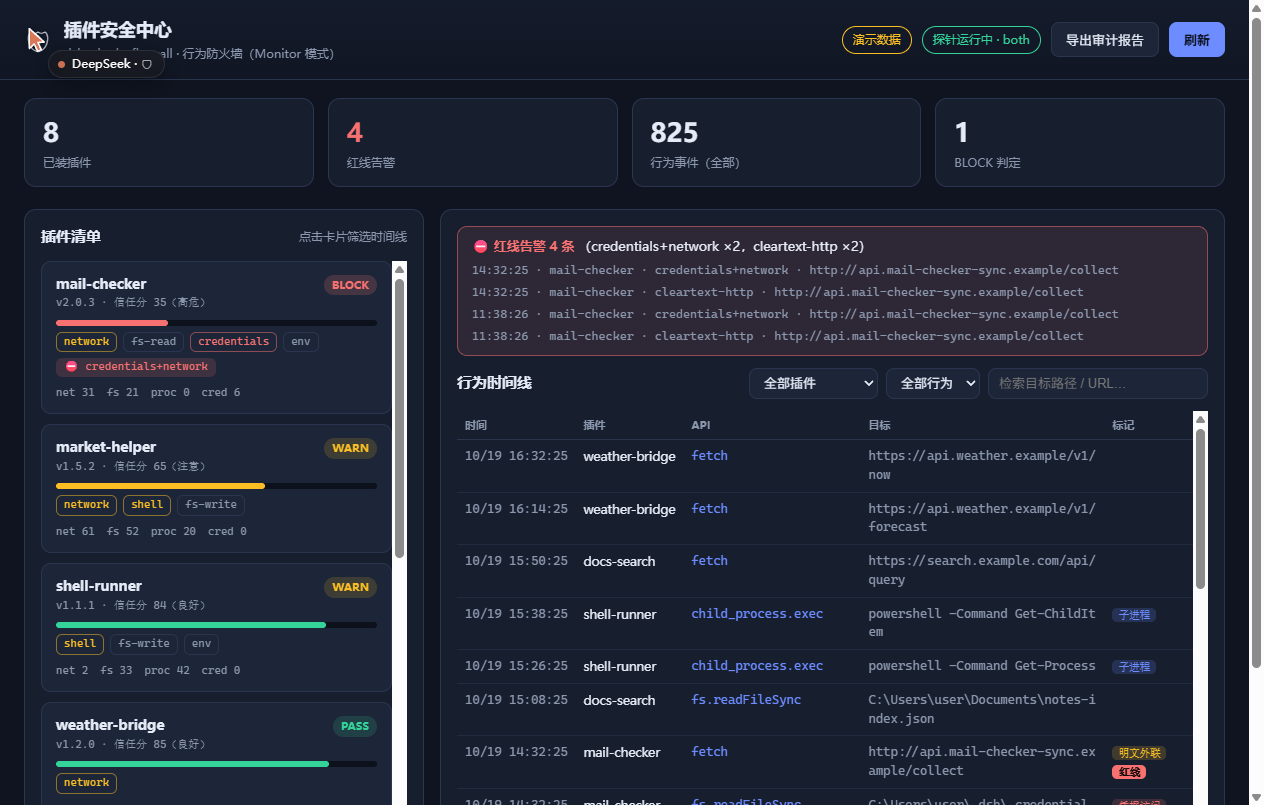
node src/client/serve.js                     # demo data
node src/client/serve.js --jsonl <path>      # replay a real probe log ($DSH_HOME/firewall/events.jsonl)
Plain index.html + app.js + style.css — no framework, no build step. The standalone server and
the in-host mount share one route table (src/client/api-handlers.mjs), so the preview behaves
exactly like the mounted panel.
config materialises ── earlyInstall expression installs the probe
        │
preload ────────────── dsh-pdr sets NODE_OPTIONS=--require …/preload.cjs  ← beats ESM facades
        │
probe ──────────────── layer 1 property patch + layer 2 binding patch
        │             attribution: ALS → stack walk → 'host'
judge / guard ──────── contract × path class × baseline → allow / alarm / block
        │
store / report ─────── JSONL on disk, audit export, optional webhook
The probe wraps RegistryService.prototype.plugin before any plugin is instantiated, so plugin
entry points run inside an AsyncLocalStorage context and the calls they start are attributed —
including calls made through injected host services. This is the cheap path: measured on a real
session (~5 600 hooks), stack-based attribution costs ≈ 1.9 % of wall clock against ALS's
≈ 0.05 % (per-op: 114 µs vs 2.9 µs), so als is the default. What als does not cover —
calls that never cross a wrapped entry point, the named-import gaps listed under
Limitations — falls back to host rather than being silently misattributed.
Full architecture, hook-coverage matrix and the honest list of residual gaps:
docs/DESIGN.md.
# the profile's cordis.patch.yml
- id: dsh-pdr-plugin
  config:
    dataDir: ~/.dsh/firewall     # default
    probeMode: als               # als (default) | stack (slower) | both
    maxBytes: 8388608            # rotate events.jsonl at 8 MB, keep 3
    policy:
      mode: alarm                # alarm (default) | block
      rules:
        credential-exfil: block
    alerts:
      enabled: false             # off: not one byte leaves the machine
      url: https://your-webhook.example/hook
      rules: []                  # empty = every red line
format: json # json | slack | dingtalk// package.json
"firewall": {
"hosts": ["api.example.com"], // declared destinations; going outside → scope violation
"grants": ["global-credentials"] // explicit authorisation for sensitive targets
}A contract is declared freedom: staying inside it is silent, leaving it is recorded. When nothing is declared, the contract is derived from the health card's capability surface.
dsh-pdr web                        # = dsh web, with the preload
dsh-pdr headless "run tests"       # any dsh subcommand
dsh-pdr --pdr-check                # print which preload is in use

# offline export — no host, no hooks, just reads the JSONL
dsh-pdr audit --format md
dsh-pdr audit --format sarif --out audit.sarif
dsh-pdr audit --format csv   --out audit.csv
dsh-pdr audit --format json  --out audit.json

# multi-source aggregation (several profiles / machines / archives)
dsh-pdr aggregate --format md
dsh-pdr aggregate --source prod=/m1/.dsh/firewall --source dev=/m2/.dsh/firewall
aggregate reads rotated files too (events.jsonl.1/.2/.3), de-duplicates across sources and
reports the counts, and counts unparsable lines instead of dropping them silently. Measured on 4
files / 127 000 events: 1 252 duplicates found.
Other plugins can inject the firewall service:
const api = ctx.firewall;

api.getEvents({ actor: 'some-plugin', flag: 'credentials-access', limit: 100 });
api.getRedFlags();                 // red-line alerts
api.getSummary();                  // per-plugin counts + red lines + probe health
api.healthCard(pluginDir);         // static card: PASS / WARN / BLOCK
api.getVerdicts();                 // boundary verdicts + contracts
api.inferContracts();              // drafts from observed behaviour (never auto-applied)
api.adoptContract(name);           // confirm a draft
api.setPolicy({ rules: { 'credential-exfil': 'block' } });
api.getUpdateDiff(before, after);  // what changed in this update
api.trialInstall(pluginDir);       // isolated trial, crash/hang contained
api.getAuditReport();              // JSON report
api.getSarif(); api.getCsv();      // compliance formats
api.eventLogPath; // local JSONL — nothing is uploaded$DSH_HOME/firewall/. No telemetry.Stated plainly, because a security tool that overstates its coverage is worse than none:
process.binding, patching the probe) can evade it. The goal is continuous,
attributable visibility.dsh-pdr (or another host-level preload), the
in-plugin probe installs too late and attribution collapses — measured 0 of 3 on a real
session with everything falling back to host. The DSH Desktop app cannot be launched
through the launcher, so its sessions are currently outside attribution; the health card and
the offline audit / aggregate commands are unaffected. A host-level --import hook is the
tracked next step.child_process / http / net when the facade predates the
probe. fs is covered on both hook layers.DSH_HOME,
a hard timeout and SIGKILL on hang, so a crashing or hung plugin cannot take the host down —
but a plugin is still running with your user's privileges inside it.dsh-h3 adapter follows a contract measured on a live
community plugin and is covered by 11 injected-runtime assertions, but dsh-h3 is a Typert
virtual module that cannot be resolved offline. Until it is verified in a live host the panel
falls back to serve.js.dsh-pdr-compat/1; their schema is not
public, so mapping it is still outstanding.npm test # all 22 suites (PASS / SKIP / FAIL; any failure exits 1)
npm run test:list # what would run
node test/smoke.mjs # one suiteSuites that need a real environment (a real plugin, a profile, an external baseline) print
SKIP: <reason> and how to restore them, and exit 0. They never pretend to pass. Any failing
assertion exits 1.
What each suite covers: docs/TESTING.md.
file: dependencies are copied into the profile, not symlinked — changing code or bumping the
version does not reach it, and add answers "Already up to date". Remove then add:
dsh plugin --profile <p> remove dsh-pdr-plugin
dsh plugin --profile <p> add file:/path/to/dsh-pdr-plugin| Document | Contents |
|---|---|
docs/DESIGN.md |
architecture, attribution, hook coverage, residual gaps |
docs/TESTING.md |
every suite, what it asserts, environment variables |
docs/LESSONS.md |
findings that changed the implementation |
CHANGELOG.md |
what changed, when |
For plugin marketplaces: screenshots are declared in
screenshots.json and shipped in assets/. The package publishes no
postinstall / prepare script, so a source install never needs a pnpm build approval.
MIT — see LICENSE.
CLASSIFICATION EVIDENCE
系统优先读取 GitHub Topics,再与站内分类词典和词根规则比对。当前命中: security。
SeaOf0
基于dsh web实现的多种模式,目的是服务于redteam进行授权的安全研究,覆盖渗透测试、红队评估、代码审计等范围领域,请勿用于非法行为。(允许二开,赋予模块各位自己的业务逻辑,方法论只有自己熟练的才好用,好的方法论=好的生态)

dhicoc
Complete reverse-skill (88 SKILL.md) as a DeepSeek Harness (dsh) Cordis plugin — reverse engineering, authorized pentesting and security research skill pack.

delta-box
Lightweight, agent-native sandboxing with diff, commit and abort