
开发工具
待识别

treg
superdesigndev
OpenRouter for agent tools. Join community here: https://discord.gg/6mQYYfFMAn
PROJECT TOPICS
INSTALL REFERENCE
dsh plugin --profile web add github:keli-wen/agy-staff
该命令指向仓库当前默认分支;尚无绑定当前 commit 的完整验证结果。
PROJECT README








Hire Google's Antigravity CLI (agy) as a staffer for Claude Code, OpenAI Codex, DeepSeek Harness, Pi, and OpenCode.

Bench · Install · Examples · Core design · Build your own · Upgrade
agy-staff pairs your senior agents with agy, which ships  Gemini 4 Carbon,
 Gemini 4 Argon, and fast
 Gemini 4 Hydrogen. Two orchestration modes (
lead and brain), five personas (staffer, researcher, reviewer for code and plans, implementer, ask), and a model-facing jobs skill. Claude Code uses /agy:<skill> and Codex uses $agy:<skill>.
GPT-6.1-Sol is slow even with fast mode on; Claude Code is quicker, but Fable quota is too scarce to spend grinding through every survey and review. agy gives you both a fast worker and a second brain: Hydrogen handles quick second opinions, research, reviews, and scoped implementation off to the side, while Carbon and Argon are strong enough in design and world knowledge to pair with Astra or Fable as a peer orchestrator — proposing routes from a second model family while your host checks assumptions and delivers.
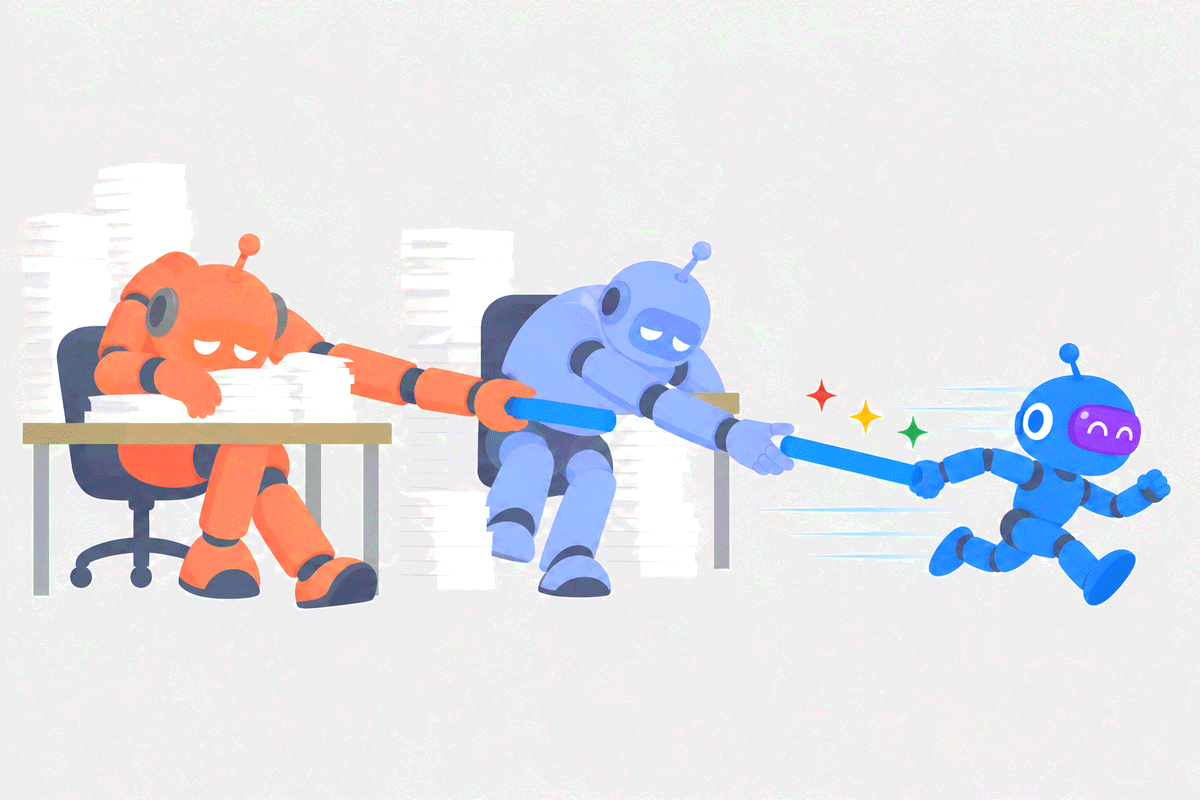
agy-staff gives you opinionated, task-named skills ready out of the box. If you prefer unopinionated primitives — essentially staffer plus jobs — for flexible, bidirectional delegation across agy, codex, claude, and dsh, see cospan.
 Bench — Harness & Orchestration
agy-staff Bench v1 runs Claude Code and Codex on three benchmarks, each task three ways: alone, with their own subagents, and with agy through lead.
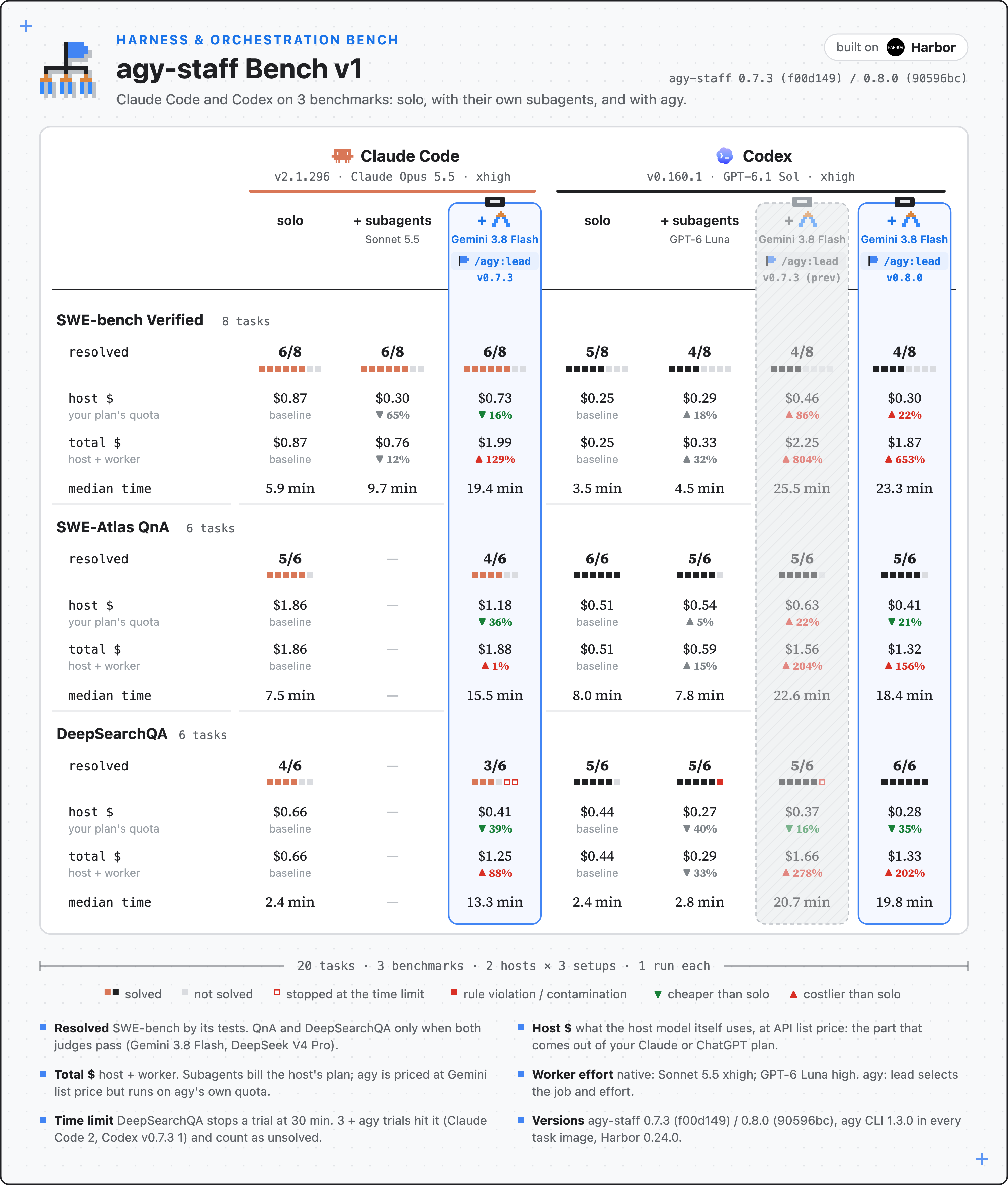
[!NOTE] Why a bench. It runs the same tasks on different hosts, with and without agy, to answer three questions:
- When to delegate. Which tasks and which hosts gain from handing work to agy, and which are better left solo. The answers become best practices for using agy-staff.
- What to fix in agy-staff. Each run shows where delegation wastes time or tokens. Those findings go back into the plugin as fixes, and later bench versions check whether the fixes worked.
- How harnesses differ. Same prompt, same worker, different host. Gaps in the results trace back to design choices in each harness.
What v1 says (one run per task and setup, so a first baseline, not a verdict):
Method, caveats and versions → bench/README.md
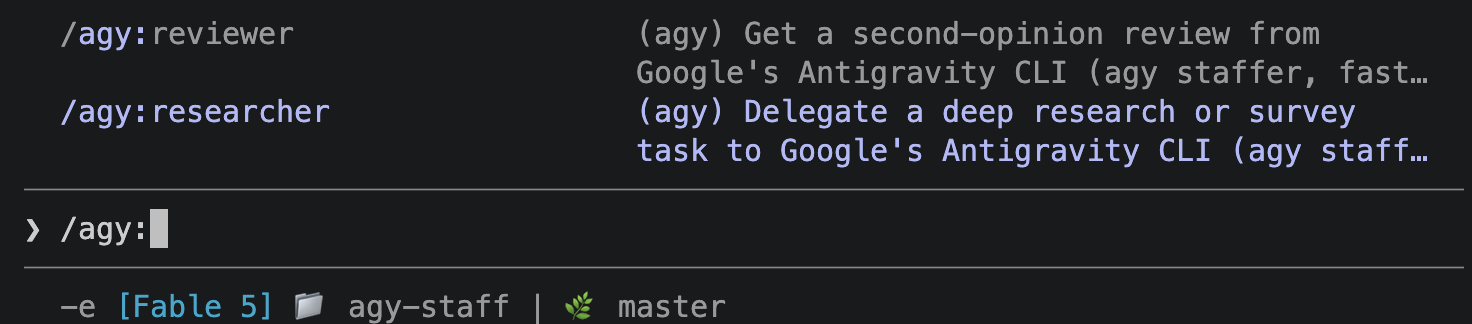
Type /agy: in Claude Code and the orchestration modes and personas are right there:
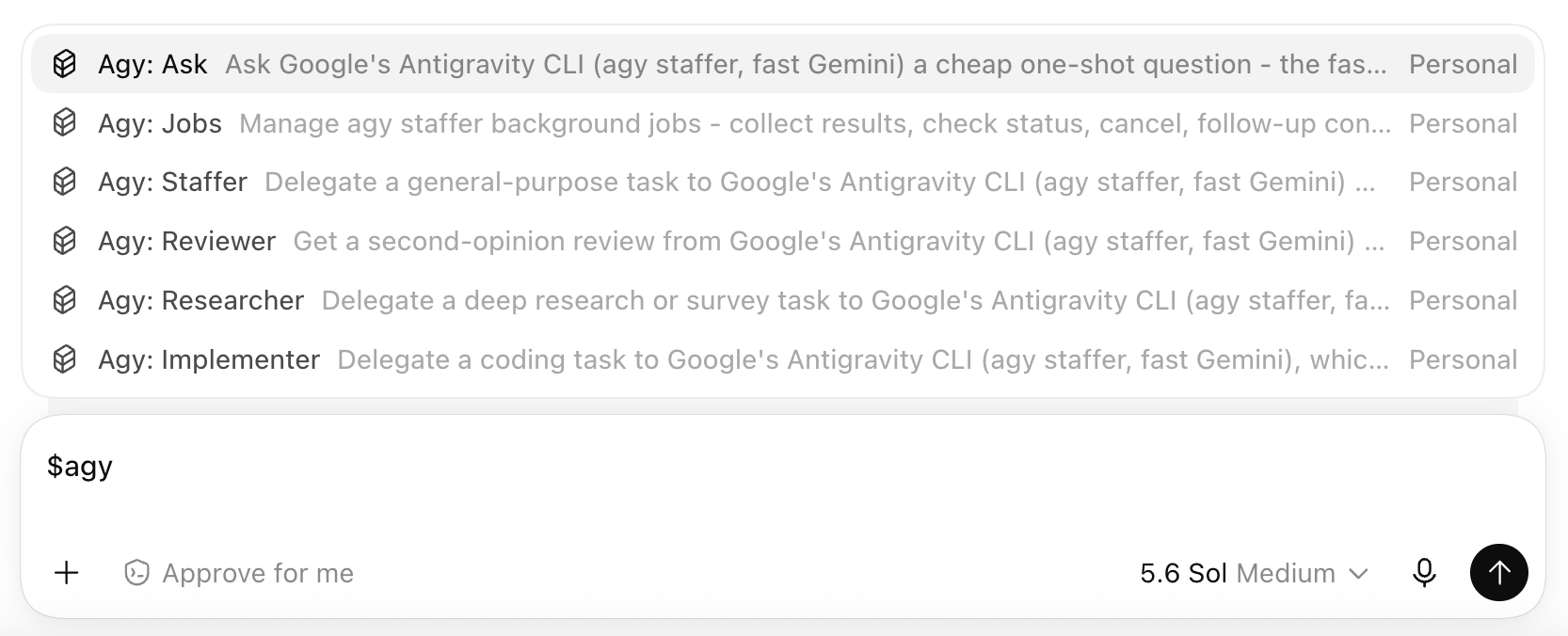
Same plugin in Codex, invoked with $agy:
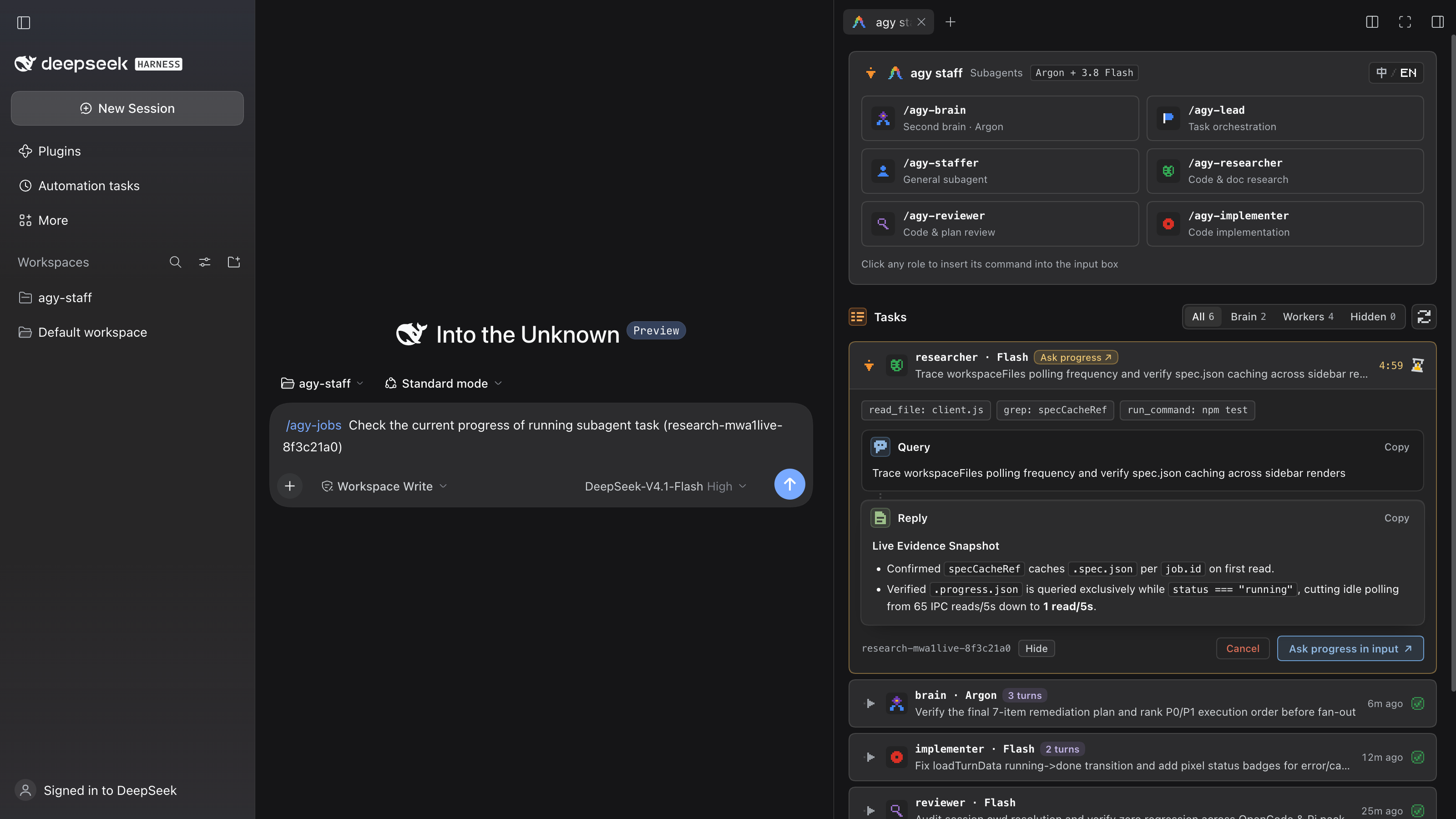
In DeepSeek Harness, with the visual agy staff subagent sidebar and /agy-* role cards:
Step 1 — install the Antigravity CLI (official docs), then verify with agy --version. Node.js is also required:
curl -fsSL https://antigravity.google/cli/install.sh | bashStep 2 — install the plugin into your harness:
claude plugin marketplace add keli-wen/agy-staff
claude plugin install agy@agy-staff
codex plugin marketplace add https://github.com/keli-wen/agy-staff
codex plugin add agy@agy-staffInstall in the DeepSeek Harness desktop app (Plugins in the left sidebar → install from package spec github:keli-wen/agy-staff), or from the terminal:
dsh plugin --profile desktop add github:keli-wen/agy-staffFor a local checkout during development, run dsh plugin --profile desktop add /absolute/path/to/agy-staff (use --profile web if running the web profile). pnpm, Node.js, and an authenticated agy on PATH are required.
Once enabled, the plugin mounts the agy staff visual subagent right-sidebar, native Cordis tools (agy_brain, agy_worker, agy_job), and all eight /agy-* skills (/agy-brain, /agy-lead, /agy-staffer, /agy-researcher, /agy-reviewer, /agy-implementer, /agy-ask, /agy-jobs). Upgrade with dsh plugin --profile desktop add 'github:keli-wen/agy-staff#<tag-or-commit>'.
Install: pi install git:github.com/keli-wen/agy-staff.
Skills are prefixed as /skill:agy-<persona> (e.g. /skill:agy-ask reply with OK), including /skill:agy-lead, /skill:agy-brain, and /skill:agy-jobs for job management.
Update with pi update --extension git:github.com/keli-wen/agy-staff, then run /reload.
With OpenCode V1 (verified on 1.18.34), install the package through its native plugin manager:
opencode plugin 'agy-staff@git+https://github.com/keli-wen/agy-staff.git' --globalRestart OpenCode, then run /agy-ask reply with OK. The plugin automatically registers all eight agy-* skills and their native slash commands, including /agy-lead, /agy-brain, and /agy-jobs. No separate skills path or command wrappers are needed. Node.js and an authenticated agy are required, as above.
OpenCode caches the complete package spec. Restarting does not refresh an unchanged Git spec. To upgrade, choose a newer Git tag or commit and run opencode plugin 'agy-staff@git+https://github.com/keli-wen/agy-staff.git#<tag-or-commit>' --global --force, then restart. See the reference for config and local development. OpenCode V2 is not covered by this adapter.
Restart Claude Code or Codex afterwards. First run: /agy:ask reply with OK (Claude Code) or $agy:ask reply with OK (Codex). Ask is tool-free and needs no setup.
[!IMPORTANT] There is no mandatory setup step.
staffer,researcher,reviewerandimplementerrun unrestricted by default: agy can inspect the repo, run commands, and edit files. agy-staff keeps that practical with prompts that adapt to the current repo state. For example, whenimplementerstarts in a dirty workspace, the companion tells agy which files already had changes and reminds it not to overwrite or deliver unrelated user work. If the task asks for a commit, push, or PR, agy can do that delivery; otherwise it leaves a working-tree diff for review. These prompt instructions do not provide permission isolation.setup+--restrictedis optional hardening for untrusted input — per run (--restricted) or as a per-repo default (setup --restrict review,research).setupdry-runs and asks before writing anything ("set up agy" triggers it); read the permission notes first — the allowlist is prefix-matched, applies machine-wide, and a restricted run can return less than an unrestricted one.
Paste this into any coding agent:
Read the raw text of https://raw.githubusercontent.com/keli-wen/agy-staff/master/docs/INSTALL_FOR_AGENTS.md (curl it — do not
work from a summary) and follow it to install and verify the agy-staff plugin for the harness you are running in.
Respond in the user's language.Claude Code and Codex install a copy, so a new version only reaches you when you pull it in yourself:
claude plugin marketplace update agy-staff && claude plugin update agy@agy-staffcodex plugin marketplace upgrade && codex plugin add agy@agy-staff # then restart CodexClaude Code and Codex cache per version directory, so an upgrade lands only if the plugin version changed; restart the harness afterwards. If a fix does not show up, see upgrading — it has the force-refresh command.
Examples below use Claude Code's /agy:…; in Codex use $agy:…, in Pi /skill:agy-…, and in DeepSeek Harness or OpenCode /agy-….
| Use case | Invocation |
|---|---|
 Lead an ongoing task |
/agy:lead investigate the options, draft a proposal, and revise it with my feedback |
 Ask Carbon / Argon to propose the route |
/agy:brain design a migration; check the assumptions before implementing |
| Quick second opinion | /agy:ask what's your backend model |
| A general task | /agy:staffer summarize the open TODOs in this repo |
| Generate an image | /agy:staffer generate a pixel-art robot mascot, save it as assets/mascot.png |
| Review the working tree | /agy:reviewer Review the current working tree |
| Review a PR | /agy:reviewer Review PR #730 |
| Review a plan or decision | /agy:reviewer Challenge the migration plan in docs/plan.md |
| Survey a topic | /agy:researcher how does auth work in this repo |
| Implement a scoped fix | /agy:implementer fix the flaky retry test |
| Job ops (wait/status/cancel/continue) | natural language: "is the agy job done?", "continue: also check the error path" |
reviewer is fully prompt-based: you describe the subject and agy gathers the evidence itself (gh pr view, git diff, reading the file) — there is no flag for handing it a diff. It has two flavors, routed by subject: code review (severity-ranked findings) and general review (a multi-angle challenge of a plan, design, or decision).
staffer also covers agy's native tools without a dedicated specialist persona, including image generation (generate_image). A trial on agy v1.1.15 produced a 1024×1024 PNG in about 30 seconds; actual time depends on the task and environment.
lead adds task orchestration guidance for your current agent. Within lead, orient enough to frame the assignment, delegate substantive work to staffer by default, wait for the result, then assess it and integrate or follow up. Specialists provide dedicated guidance when useful, while ask is reserved for testing. The host owns cross-task decisions, acceptance, integration, and delivery, using the existing jobs workflow.
With brain, Carbon (or Argon via --model argon) proposes the route first. The host supplies the goal and evidence, challenges assumptions before execution, and owns verification. See the brain skill.
ask answers in the same call. The other personas return a job id and a collection command, such as wait <id> --timeout 10m. Your agent waits using the host's available capabilities, with one independent background wait per job where supported.
The main agent waits for the final result by default. If you explicitly ask about progress, it can use observe to read a snapshot of recent tool activity and response text; it does not query progress for routine updates. Once the task finishes, wait or result delivers the full report. Expiring a wait leaves the worker running.
The timeline below follows a background task from delegation to completion. The host agent waits for the final result by default (or advances already-identified independent work), checks progress when asked, and collects the report.

Jobs have a separate execution deadline: default 60 minutes, configurable at launch with --timeout up to 120 minutes. Use cancel to stop execution, or explicitly request continue or restart after inspecting the existing work. The host harness controls when your agent receives a background result.
Full reference → docs/REFERENCE.md (flags, permission model, jobs/state, troubleshooting, upgrading). Release notes → docs/releases/.
agy-staff's design is portable: bash plus skills, with no hard dependency on a host, a worker CLI or a runtime library (cospan already generalizes its staffer and jobs primitives across agy, codex, claude, and dsh). docs/DESIGN.md writes the pattern down as best practice. To build a dedicated tool like this for another agent CLI, give your coding agent this prompt:
Read the raw text of https://raw.githubusercontent.com/keli-wen/agy-staff/master/docs/DESIGN.md
(curl it — do not work from a summary). Then design an integration that lets this host agent delegate
work to <CLI> the same way. First read `<CLI> --help`, map what the CLI supports to the section
"What depends on the worker CLI", and list the principles it cannot support before writing any code.
Ask me before any call that spends model quota. Respond in the user's language.
Before writing any code, the agent lists the principles your CLI cannot support, so you know up front where the tool will degrade.
Contributions are welcome — issues, bug reports and pull requests all help.
A few things worth knowing before you open a PR:
npm test. The standard suite uses temporary repos and HOME directories with fake agy, plus focused module tests. Keep regression tests offline and independent of personal settings. Real AGY validation is a separate opt-in suite described in tests/README.md.README.md / README.zh-CN.md and docs/REFERENCE.md / docs/REFERENCE.zh-CN.md are kept in sync. Change one, change its counterpart.companion/: the entrypoint handles modes and job commands; separate modules handle streaming execution, observations and state locking. Skills call the companion, and templates/ holds the shared prompts.skills/, never in pi-skills/ or opencode-skills/. Run npm run generate:skills to generate both host entrypoints, and npm run check:skills to verify consistency. The existing generate:pi and check:pi commands remain available. Use npm run pack:checked to check freshness before packing; publishing also runs the check.Adding a mode or a flag changes the public surface, so please open an issue first and we can agree on the shape.
MIT — see LICENSE.
CLASSIFICATION EVIDENCE
系统优先读取 GitHub Topics,再与站内分类词典和词根规则比对。当前命中: developer-tools。
superdesigndev
OpenRouter for agent tools. Join community here: https://discord.gg/6mQYYfFMAn

T-Auto
A toolkit for low-level operations in DSH, designed to reduce token usage and task execution time / DSH 底层操作工具插件,旨在减少 Token 消耗与任务耗时

crafter-station
A public gallery of animated pets for Codex, Claude Code, DeepSeek Harness, Hermes, OpenCode, Gemini CLI, and more.