
模型与 MCP
待识别

rea
morluto
Reverse engineer anything with agents, from app behavior down to native binaries.
PROJECT TOPICS
INSTALL REFERENCE
dsh plugin --profile web add github:jhuanxx44/dsh-sseye
该命令指向仓库当前默认分支;尚无绑定当前 commit 的完整验证结果。
PROJECT README
The LLM debug console inside DeepSeek Harness — capture every model call, see everything.
English | 简体中文
dsh-sseye is a DSH plugin that taps the harness-native llm/stream waterfall to capture the full content of every LLM call — complete messages, system prompt, tool schemas, streaming response blocks, usage, the real wire protocol and endpoint — and presents it in a DevTools-style viewer docked inside the harness. No proxy, no certificates, no extra setup, and full agent semantics: every capture carries turn / step / session / compaction attribution.
It is the harness-internal sibling of SSEye — same diagnostic philosophy, different observation layer.
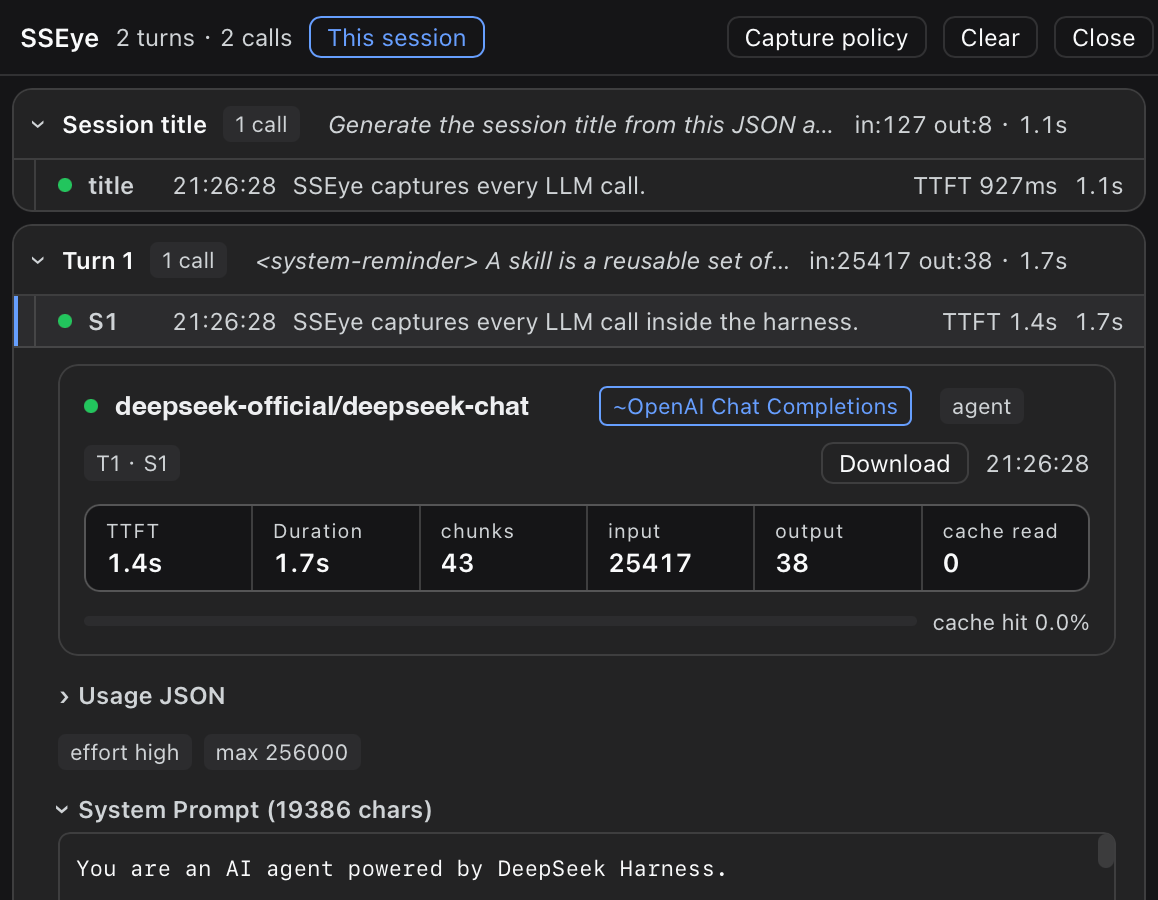
From npm (prebuilt — no build-approval step):
dsh plugin --profile web add dsh-sseyeOr straight from the source repo:
dsh plugin --profile web add github:jhuanxx44/dsh-sseyeRestart the harness; the SSEye button appears in the session header. (Git-hosted installs build via the package's prepare script; allow the build key pnpm prints if it blocks, then re-run. Pre-built lib/ is committed, so a blocked build is harmless.)
Uninstall:
dsh plugin --profile web remove dsh-sseyeThe Electron app owns its desktop profile and the CLI refuses to touch it (profile "desktop" is managed exclusively by the Electron application), so there is no dsh plugin --profile desktop … form. Install from inside the app instead: open the sidebar's Plugins page and add dsh-sseye (it runs pnpm add in the profile for you), then restart the app. The same page uninstalls it.
SSEye runs on DSH 0.2.0-rc.2 (the current desktop build) as well as on the 0.1.x CLI line: the capture waterfall, the /__sseye/* routes, and the right-column tab contract are all verified against both.
The UI is English by default. To switch the panel (and the truncation
markers embedded in captured content) to Chinese, override the plugin row's
config in your profile's patch layer — ~/.dsh/profiles/<profile>/cordis.patch.yml:
- id: sseye
  config:
    locale: zh-CN
Restart the harness after editing. Any value starting with zh selects
Chinese; everything else (or no config) is English.
GenerateOptions (system prompt, messages, tools, sampling params) plus every stream chunk of the response — captured at the llm/stream waterfall and tapped through unchanged: chunk identity, ordering, backpressure, cancellation and thrown errors are preserved.agent/request turn/step coordinates (shared AbortSignal identity) and are classified by source — agent loop / compaction / session-title / other.openai-completions, anthropic-messages, google-generative-ai, …) resolved from the provider's settings profile; routes without a declared protocol fall back to a guess table, clearly marked with ~.role:"tool" messages, reasoning replays as reasoning_content on tool-call turns, reasoning effort resolves to the thinking object.config.locale (see above).The panel is a tab in the shell's right column. Since DSH 0.1.5-rc that column is a tabbed dock (dsh-client-ui-sidebar-right), so SSEye registers a tab type plus a body and opens it with ctx.sidebarRight.openTab('sseye'); the shell draws the strip, divider, collapse rail, and float/dock controls around it. A stock install opens the column at 45% of the frame (drag ceiling 70%); that width belongs to the shell and is shared by every occupant, so this repo narrows the default with a one-line harness patch — docs/harness-patches.md §1.
N messages, not captured), never silently blank.sk-… → ***).Full visibility, zero persistence by default. Captures live in a bounded in-memory ring buffer; process exit burns them. Export happens only on explicit user action. The llm/stream layer never sees API keys — they live inside the adapters — and redaction applies before buffering.
Observation is the base; the differentiators come next:
ctx.llm.stream(), compare responses side by side.| SSEye | dsh-sseye | |
|---|---|---|
| Observation point | Network (mitmproxy) | Inside the harness (llm/stream waterfall) |
| Sees | Any SDK / app on the machine | The DSH process only, but with full agent semantics |
| Setup cost | Proxy + CA trust | One plugin install |
pnpm install
pnpm build        # tsdown → lib/
pnpm test         # node --test
├── src/
│ ├── index.ts # Host half: llm/stream capture, ring buffer, /__sseye/* HTTP routes
│ └── client/ # Client half: session-header trigger + right-column tab body (React)
├── lib/ # committed build artifacts (rebuilt by `prepare` on git installs)
├── docs/ # platform field notes + local harness patches
├── cordis.patch.yml # bundle patch: inserts the `sseye` plugin row into the profile
└── tsdown.config.ts # client bundle contractHost ↔ Client transport is same-origin HTTP on the webServer service (/__sseye/*). See AGENTS.md for the behavior contract and architecture invariants, and docs/prototype-field-notes.md for DSH platform field notes.
Local install from a checkout: dsh plugin --profile web add .. Releases are tag-triggered: bump version → commit → tag v* → push the tag.
MIT
CLASSIFICATION EVIDENCE
系统优先读取 GitHub Topics,再与站内分类词典和词根规则比对。当前命中: llm-debugging、deepseek-harness。
morluto
Reverse engineer anything with agents, from app behavior down to native binaries.

deepseek-ai
DeepSeek Harness: Everything is a Plugin.

nexu-io
The 1st Collaborative AI Design Agent Workspace. Local-first and open source. Create motion, prototypes, websites, apps, dashboards, presentations, images, and videos with your team and AI agents. Share work, exchange feedback, and iterate together in one workspace.