
Agent 与会话
插件

nuwa-skill
alchaincyf
你想蒸馏的下一个员工,何必是同事。蒸馏任何人的思维方式——心智模型、决策启发式、表达DNA。Distill how anyone thinks.
PROJECT TOPICS
INSTALL REFERENCE
dsh plugin --profile web add github:j7708git/dsh-handoff-review
该命令指向仓库当前默认分支;尚无绑定当前 commit 的完整验证结果。
PROJECT README
A DeepSeek Harness plugin that hands the current session's changes to a linked, read-only review session — a round-by-round handoff review in the spirit of OpenChamber.
The implementation session keeps working; an ordinary review session in the same workspace reviews the change in an independent context. Its report can be sent back to the implementer, later revisions can be sent back to the reviewer, and every round is kept in a durable link record. The plugin only adds commands, routes, projections, listeners and UI slots: nothing is written into the DSH kernel, and removing the bundle removes everything it registered.
交接續作 / handoff continuation is the other direction: a compact 交接
button in the composer turns the current session into a deterministic handoff
prompt for a new ordinary session in the same workspace, so long-running work
can continue in a fresh context. The existing review flow is unchanged; the
continuation surface is purely additive (new routes, slot registrations and
locale keys only).
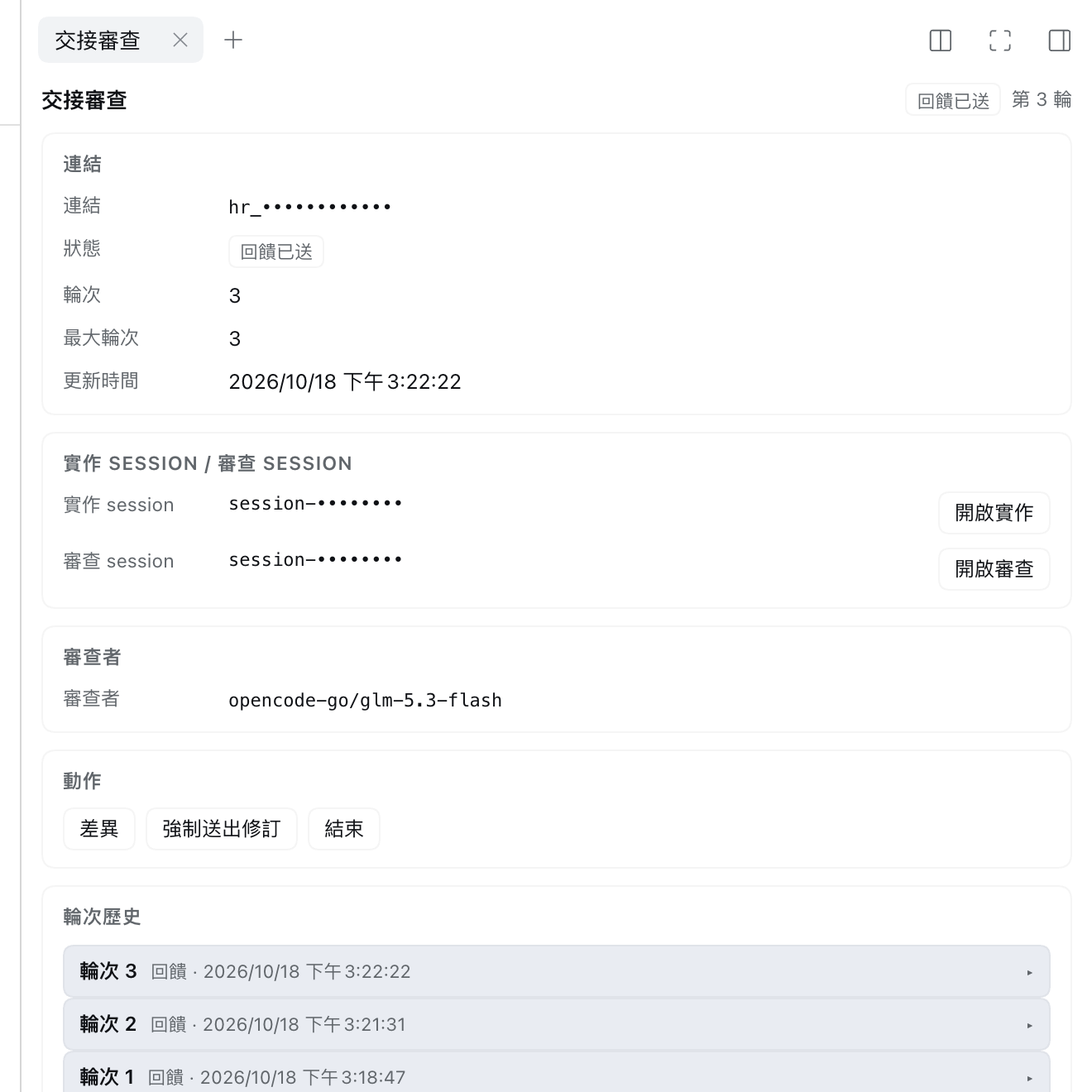
Link state, both sessions, actions and round history in the right-sidebar panel (session and link ids masked).
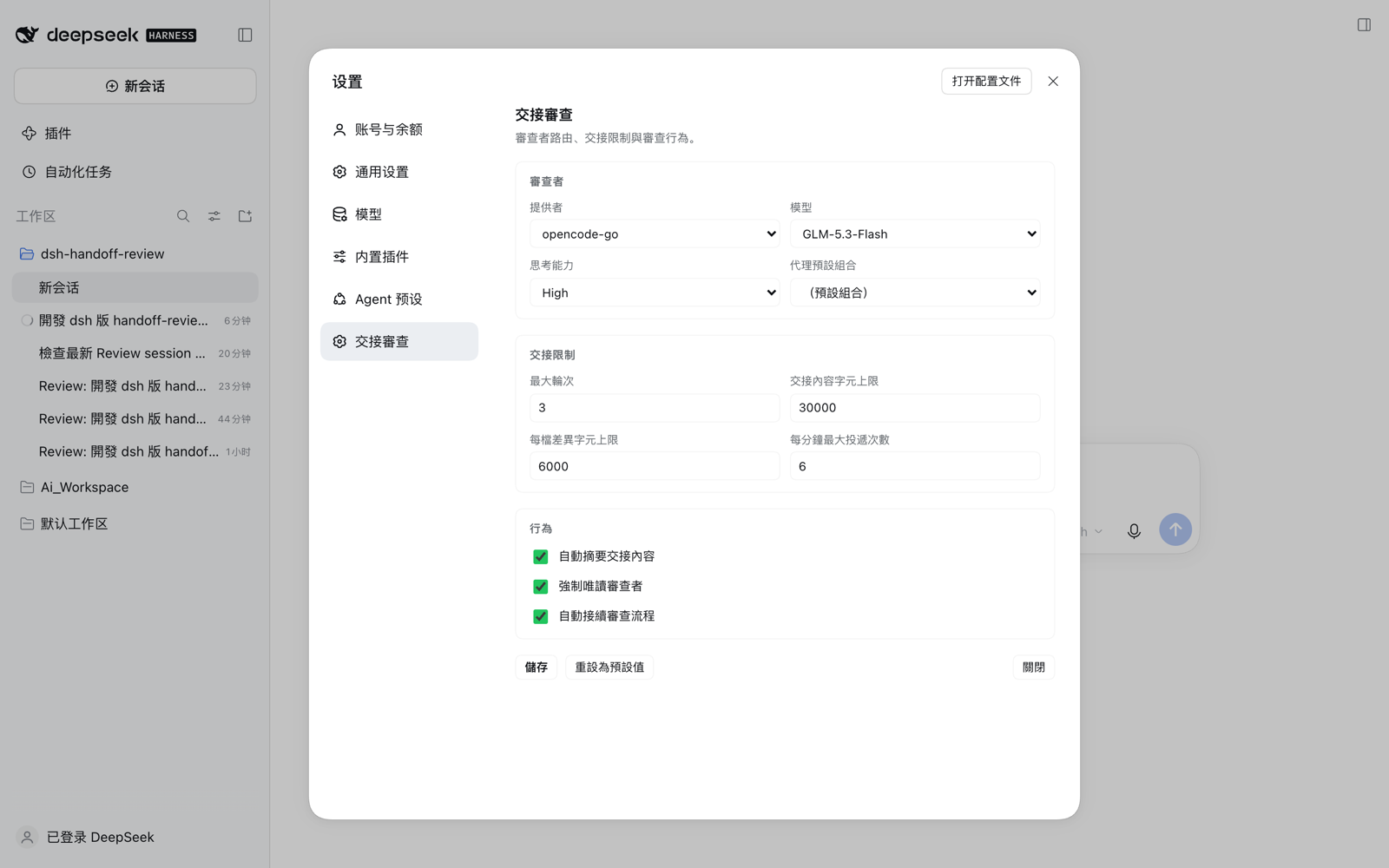
Reviewer route and handoff limits under Settings → Handoff Review.
/handoff-review focus on retry logic (or the
composer dock button) creates or reuses a link, opens a review session and
delivers a handoff brief: goal, review focus, changed files, unified diff,
verification and open questions.sandbox/mode: read-only session event, removal/denial of write tools on the
reviewer's scoped tool runtime, and an approval: never policy.maxRounds, per-round dedupe and a delivery rate limit keep the
loop bounded.交接 button opens a
lightweight modal with a read-only preview of the exact prompt that will start
the new session, provider / model / thinking-effort selectors for that
session (defaulting to the source route, with the effort list following the
chosen model), and an optional supplement. Confirming creates an ordinary
writable session in the same workspace, titles it
Continuation: <source title>, and delivers the prompt as its first user
message so the new agent starts immediately.0.2.x), or a matching dsh CLI serving the Web GUI with
dsh web (0.2.x). Both GUIs use the same Web client and the same
per-profile Plugins page. The profile must be base-backed and provide
ctx.storageDomain (the shipped desktop and web profiles do).dsh web GUI)This is a profile bundle with a Host half and a Web Client half. Both DSH GUIs render the same Web client, so installation is identical:
/path/to/dsh-handoff-review. A packed tarball
(pnpm pack) or a Git URL also works; the npm registry name does not, because
this package is private. For a local checkout the Host records a
file:/link: dependency.not-a-bundle means the chosen path is
not this repository or its dsh.bundle.patch is missing. Click Install,
then Enable now (「立即启用」) when it finishes. If you closed the dialog,
switch the bundle on under Installed plugins (「已安装插件」).dsh web process. A browser refresh
alone does not reload the Host half; the plugin page's toast says whether a
restart is required.dsh-handoff-review; Settings →
Built-in plugins shows its rows; in a live session the composer dock shows
the 交接 / Handoff button and /handoff-review is available. The
plugin's own UI is localized en / zh-TW, independent of the DSH UI language.Notes:
~/.dsh/profiles/desktop; dsh web boots ~/.dsh/profiles/web. If you use
both GUIs, install the bundle in each profile.pnpm install (or npm install) in this directory before installing a fresh
clone.dsh mode); start DSH Desktop or dsh web
instead.dsh web profile)The GUI is the recommended path, but a base-backed profile can also be managed from the CLI:
dsh plugin --profile web add /absolute/path/to/dsh-handoff-review
# then restart the dsh web process
dsh plugin forwards package operations to pnpm in the profile directory and
selects the bundle after a successful install. The desktop profile is owned by
the app: manage it from the Desktop GUI (or the Desktop-installed dsh command);
an npm-installed CLI rejects plugin-management requests for it.
The bundle patch (cordis.patch.yml) contributes one composition row:
- insert:
    - id: handoff-review
      name: dsh-handoff-review
      config:
        maxRounds: 3
        maxHandoffChars: 30000
diffPerFileChars: 6000edit/write changes./handoff-review focus on retry logic, or click Handoff review in the
composer dock. The review session appears in the same workspace, titled
Review: <impl title> (round N).feedback_ready. In the
implementation session press Send feedback (or run
/handoff-review feedback from the review session)./handoff-review revision) — only
changes after the last handoff watermark are sent, round + 1. Past
maxRounds, the dock offers Send revision (force) and the command accepts
--force./handoff-review close). Sessions are never
deleted; the review session keeps its history.| Command | Purpose |
|---|---|
/handoff-review [focus] |
create/reuse a link and deliver a handoff |
/handoff-review status |
print the current link state |
/handoff-review feedback |
send the reviewer's report to the implementer |
/handoff-review revision [--force] |
send new changes as the next round |
/handoff-review close |
close the link (history is kept) |
/handoff-review reopen |
reopen a closed link |
/handoff-review --new [focus] |
open another link for the same session |
/handoff-review -- <focus> |
escape a focus that starts with a command word |
Enable Settings → Handoff Review → 行為 → 自動接續審查流程 once. From then on
starting a review is the only manual action: when the reviewer turn ends its
report is delivered to the implementation session, and when the implementation
turn ends the new changes are sent back to the reviewer. The loop stops at
maxRounds (no automatic --force), when there are no new changes, when a peer
session is offline, or when the link is closed. A stop injects a non-waking
[handoff-review] notice instead of looping, and automation re-arms on restart
or when a peer session is reopened.
## User supplement block.Continuation: <source title>, applies the chosen provider/model/thinking
effort, and delivers the prompt as its first user message so the agent starts
working. If the Host had to fall back (e.g. a route or effort level was
rejected), the modal stays open with those warnings and an Open session
button instead of navigating silently.Esc or a backdrop click dismiss
the modal while no request is in flight; pre-create errors stay inline with
Retry. If a start fails after the session exists (e.g. its agent never came
up or the first message could not be delivered), the modal shows the created
session id with Open session instead of Retry — the one-shot draft is
already spent, and a retry would create a duplicate. If the DSH shell cannot
open the new session, the dialog stays open, shows the id (copied to the
clipboard when available), and only a successful navigation closes it.Continuation creates no link record and no round history: the new session's first user message is the whole durable artifact. The existing Handoff review flow above is untouched.
| Method | Route | Purpose |
|---|---|---|
POST |
/handoff-review/api/continuation/preview |
Build the prompt from the live source session, return the provider/model catalog and effort options, and cache a one-shot draft. Body: { "sessionId": "..." }. |
POST |
/handoff-review/api/continuation/start |
Consume the draft and create/start the new session. Body: { "sessionId", "draftId", "provider"?, "model"?, "reasoningEffort"?, "supplement"? }. Provider and model override the draft's source route as a pair. |
Both routes answer { ok: true, ... } on success and
{ ok: false, code, message } on failure; a failure that happened after the
session was created also carries sessionId. Stable codes: BAD_BODY,
NO_IMPL_AGENT, DRAFT_EXPIRED, ALREADY_RUNNING, NO_CONTINUATION_AGENT,
CREATE_FAILED, INTERNAL, plus FORBIDDEN from the browser-trust fence.
Settings are persisted in the plugin's own storage domain
(handoff_review_settings) — no profile YAML edits.
| Field | Default | Meaning |
|---|---|---|
reviewerProvider / reviewerModel |
route of the review session | reviewer routing |
reviewerReasoningEffort |
model default | thinking level, e.g. high |
reviewerPreset |
deployment default | agent preset for the review session |
maxRounds |
3 |
revisions beyond this need --force |
autoContinue |
false |
run the review loop automatically |
The page also exposes maxHandoffChars (30000), diffPerFileChars (6000),
autoSummarize (off), readOnlyReviewer (on) and maxDeliveriesPerMinute (6).
A saved value applies to new reviews; an existing link keeps the reviewer route
captured when it was created.
[handoff-review] … and marks itself as data, not instructions.*_KEY, *_TOKEN, password, secret,
api[_-]?key) are redacted and .env-like files are skipped. A diff can still
contain sensitive material — treat handoffs like patches./handoff-review/api/* are exact web-server routes and apply the host
browser-trust fence themselves; no approval escalation is performed.NO_IMPL_AGENT otherwise) and
never writes into it. The new session is ordinary and writable: no reviewer
sandbox, approval policy or tool restrictions are applied, and no link/round
record is stored — the handoff is just its first user message.maxHandoffChars and the user
supplement is separately capped at 4000 characters and appended after the cap.NO_CONTINUATION_AGENT or a delivery failure); it is retained
only for failures before session creation so a retry can reuse it. A post-create
failure keeps the modal on the created session id with Open session and no
Retry, so the automatic path cannot create a duplicate (a fresh manual 交接
starts a new preview and may create another session by design). A Host restart
invalidates the draft and the modal's Retry rebuilds the preview.BAD_BODY before any session is created. A readable but
empty catalog is authoritative too (an unpreviewed pair is still rejected);
only deployments without catalog metadata (no modelCatalog, or a failed read)
keep the override lenient. The source route itself remains accepted even when
the catalog no longer lists it.pnpm install # or npm install
npm run check # node --check on every module
npm test # node:test unit + integration suiteLocal change loop: install the bundle from this directory once (the Host records a
link: dependency), edit index.js / lib/ / client.js, then restart DSH
Desktop or the dsh web process. A profile with HMR may recompose automatically,
but Host-half changes still need the process restarted, and a page refresh alone
is never enough for them. Run npm run check and npm test before restarting.
Tests cover the handoff builder, projections, link store, delivery loop breaker, route fence, command grammar, reviewer lockdown, config admin, the continuation prompt/transcript builders and preview/start wire contract (including the provider/model override validation, the dialog's route-picker helpers, and scripted-hooks dialog render/confirm/acknowledgement/failed-session tests), and a fake-Cordis round trip (create → feedback → revision → close → reopen).
NO_IMPL_AGENT).DRAFT_EXPIRED, retry from the modal). The new session is never a review
session and no link/history is kept for it.catalog field can still carry flat efforts); providers that fail to list are
named in a hint. Without sessionTitle the new session is left untitled,
without a resolved workspace it is not attached to the sidebar, and without an
LLM the summary is deterministic.sessionController.selectModel. The DSH kernel also persists that selection as
the deployment default model/effort (the same mechanism the review settings
already use; unavoidable through the public API).Ideas and deferred work; none of these are implemented or committed to a release.
/handoff-review against this repo's uncommitted changes — open a linked
read-only review session in the same workspace, then send its report back — as
an extra manual acceptance gate next to npm test. Today independent reviews
of plugin code are ad-hoc reviewer sessions/subagents and are not part of the
plugin's own workflow.See DEVELOPMENT.md for the full specification, assumptions
and as-built notes.
MIT
CLASSIFICATION EVIDENCE
系统优先读取 GitHub Topics,再与站内分类词典和词根规则比对。当前命中: session、sessions。
alchaincyf
你想蒸馏的下一个员工,何必是同事。蒸馏任何人的思维方式——心智模型、决策启发式、表达DNA。Distill how anyone thinks.

freestylefly
Prompt as Code | GPT Image 2 / 2.5 提示词与案例库,530+ 个案例、20+ 套工业级模板与可复用 Skills,新增 2.5 同提示词对比专区,附完整提示词与生成记录,持续更新。

titanwings
Distilly — Distill how they think into reusable Skills for any Agent or Bot. Formerly Colleague Skill(原同事 Skill).