
其他
完整应用

deepseek-harness
deepseek-ai
DeepSeek Harness: Everything is a Plugin.
PROJECT TOPICS
INSTALL REFERENCE
dsh plugin --profile web add github:imchangchang/dsh-llm-provider
该命令指向仓库当前默认分支;尚无绑定当前 commit 的完整验证结果。
PROJECT README
中文说明 · English

A plugin for dsh (DeepSeek Harness). It replaces four entries of dsh's plugin tree — the pi-ai adapter (llm-pi-ai), the native DeepSeek adapter (llm-deepseek), the model selector (ui-model-selection) and the official Models settings page (ui-settings-models) — and adds quota lookups and provider management on top.
What you get:
The UI strings are Chinese; the plugin ships no English UI yet, so the English screenshots below show English app chrome around the plugin's Chinese panels.
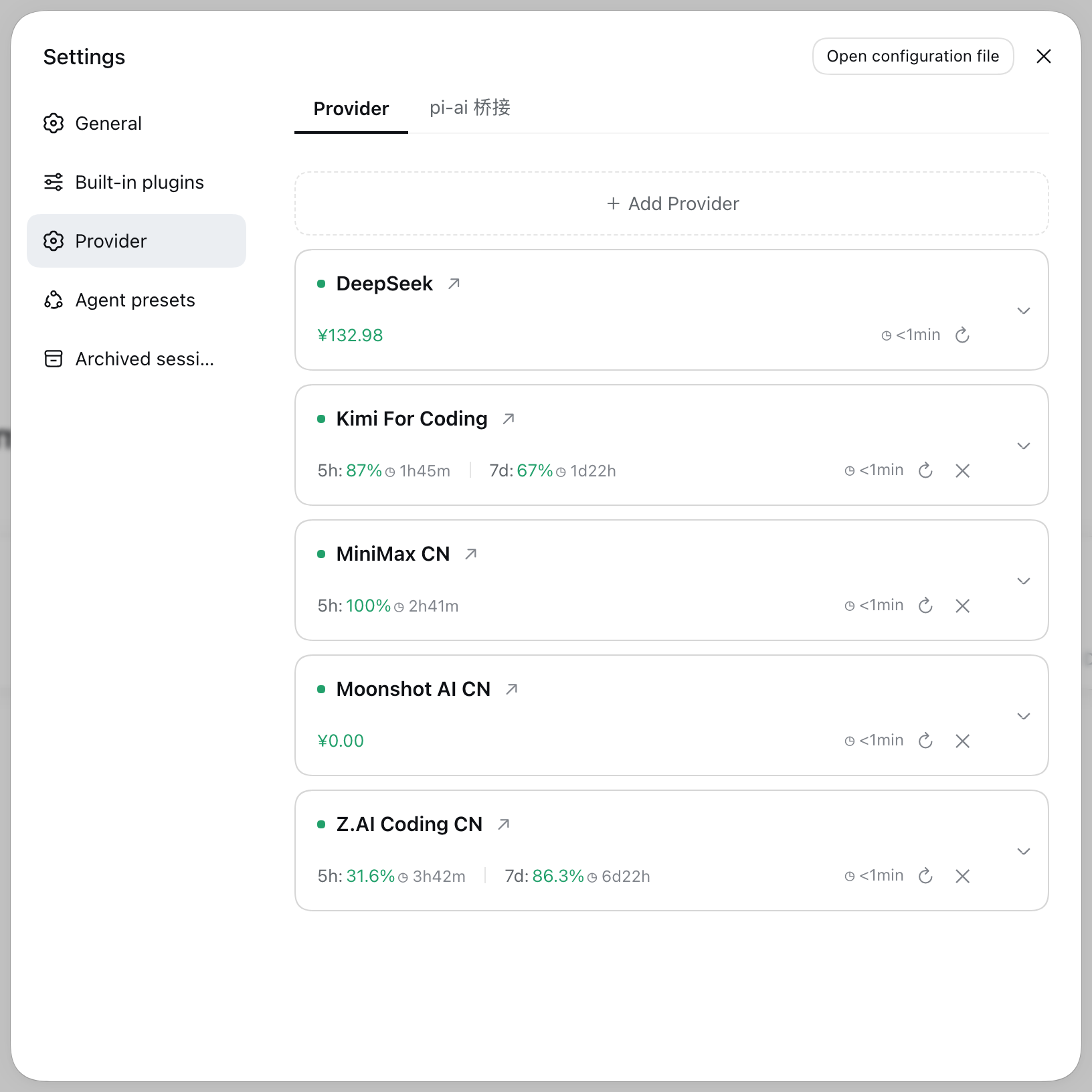
Every image comes from scripts/capture-screenshots.sh: a real dsh instance in a disposable sandbox, driven by headless Chromium through test/e2e/specs/screenshots.spec.mjs, once per shell language (*.png for English, *.zh.png for Chinese).
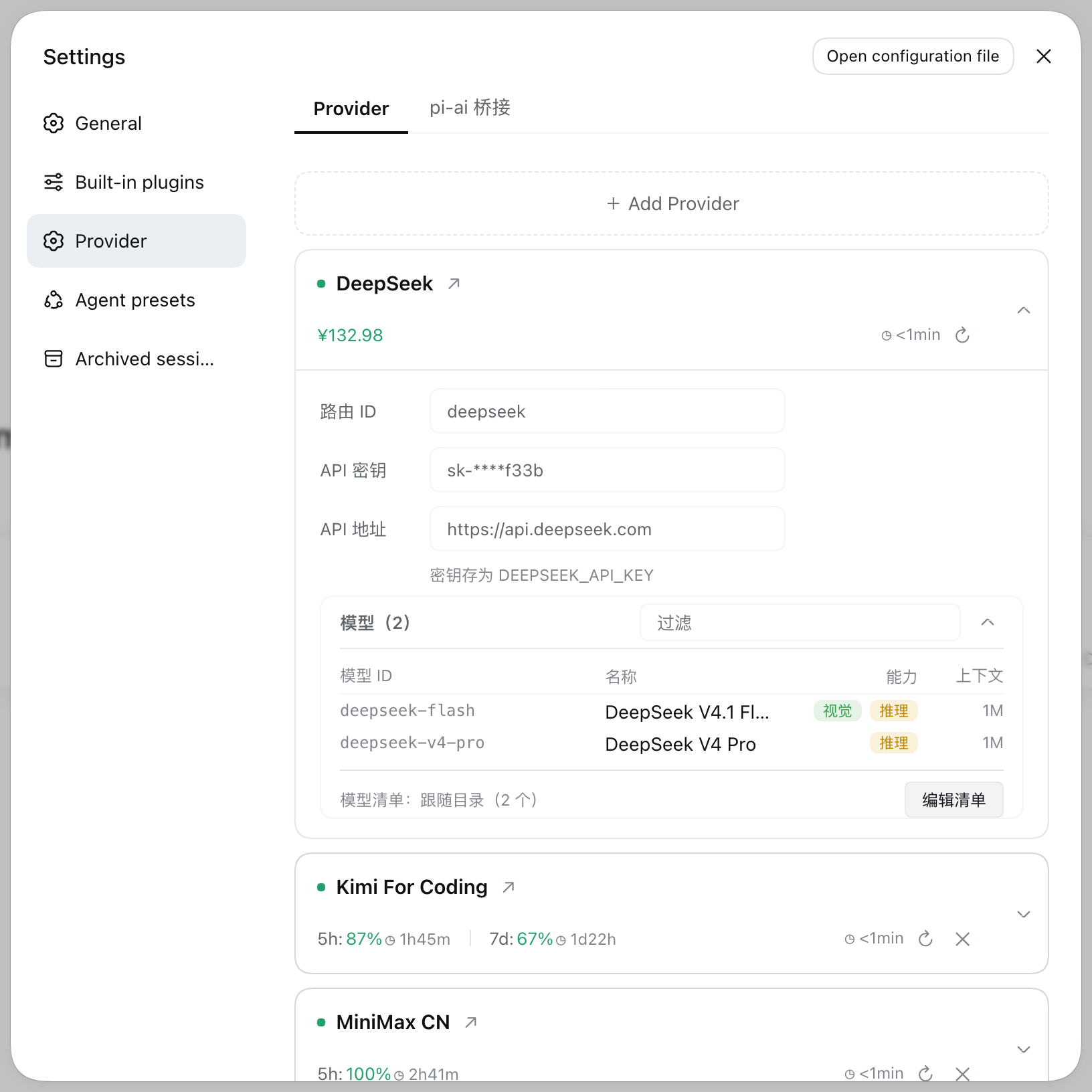 Card body: route id, stored key, endpoint, credential name, and the model list of that route. |
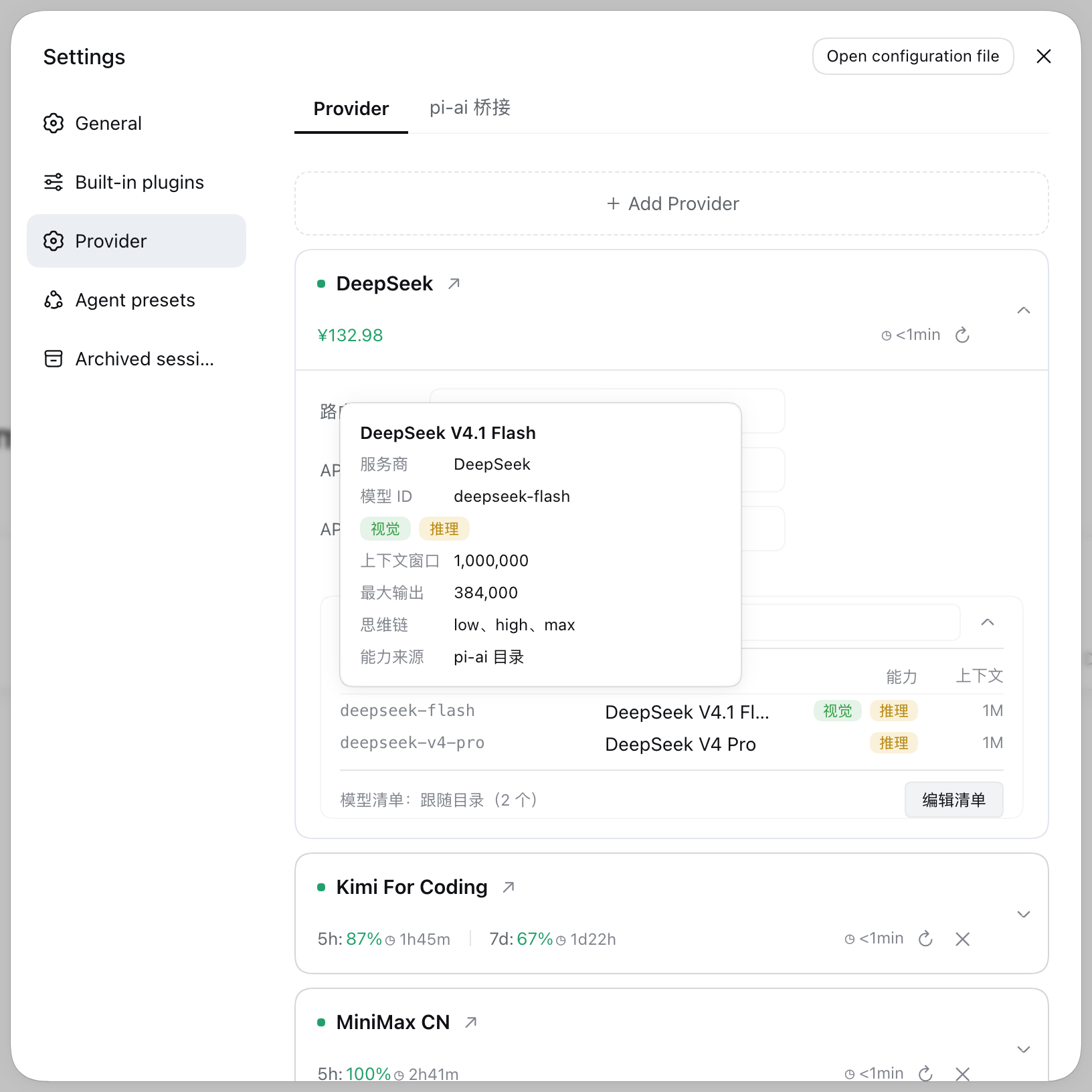 Model detail card on hover: provider, model id, capabilities, context window, max output, reasoning efforts, and which of the three sources the capability came from. |
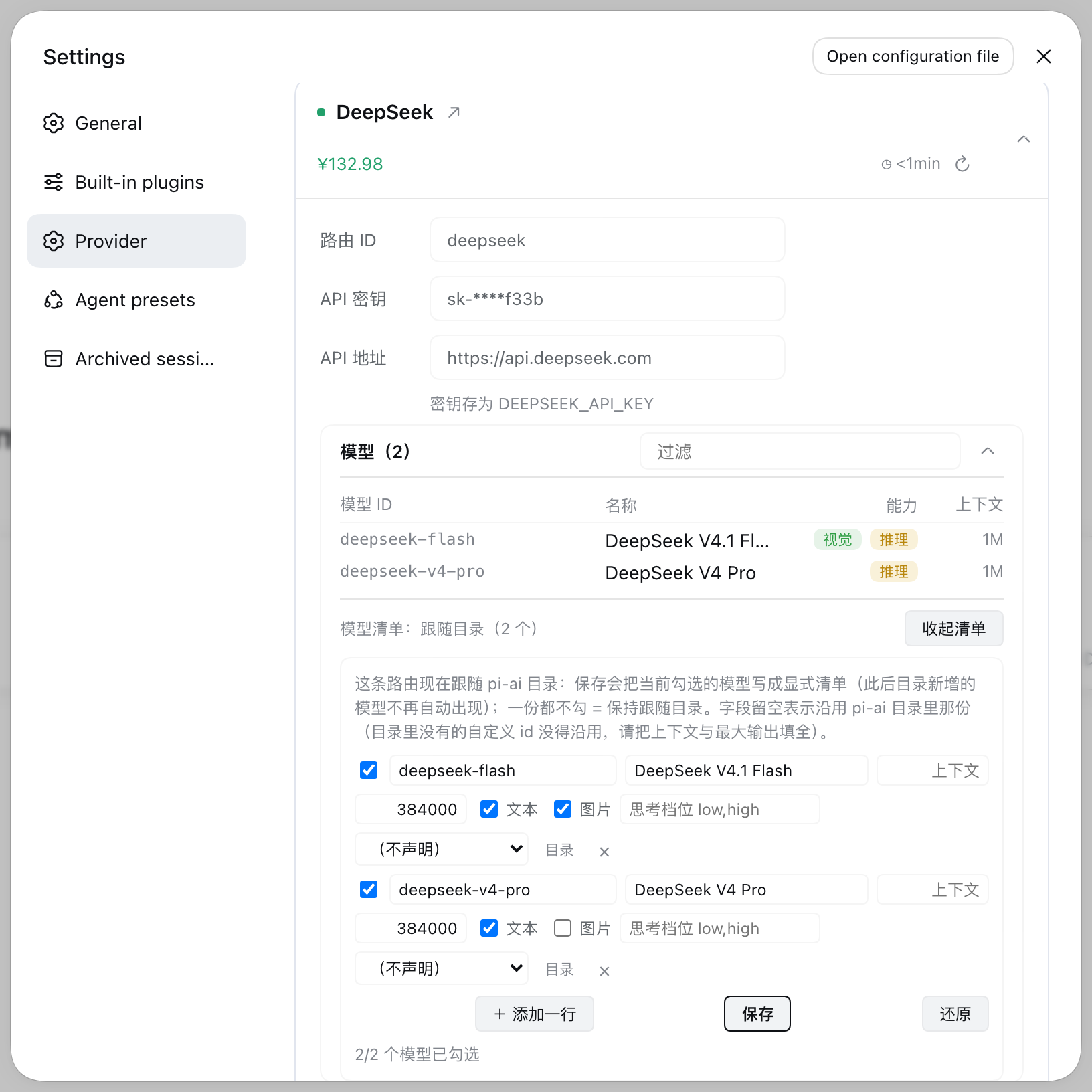 Model list editor: tick models and edit fields per row; ticking none goes back to following the pi-ai catalog. |
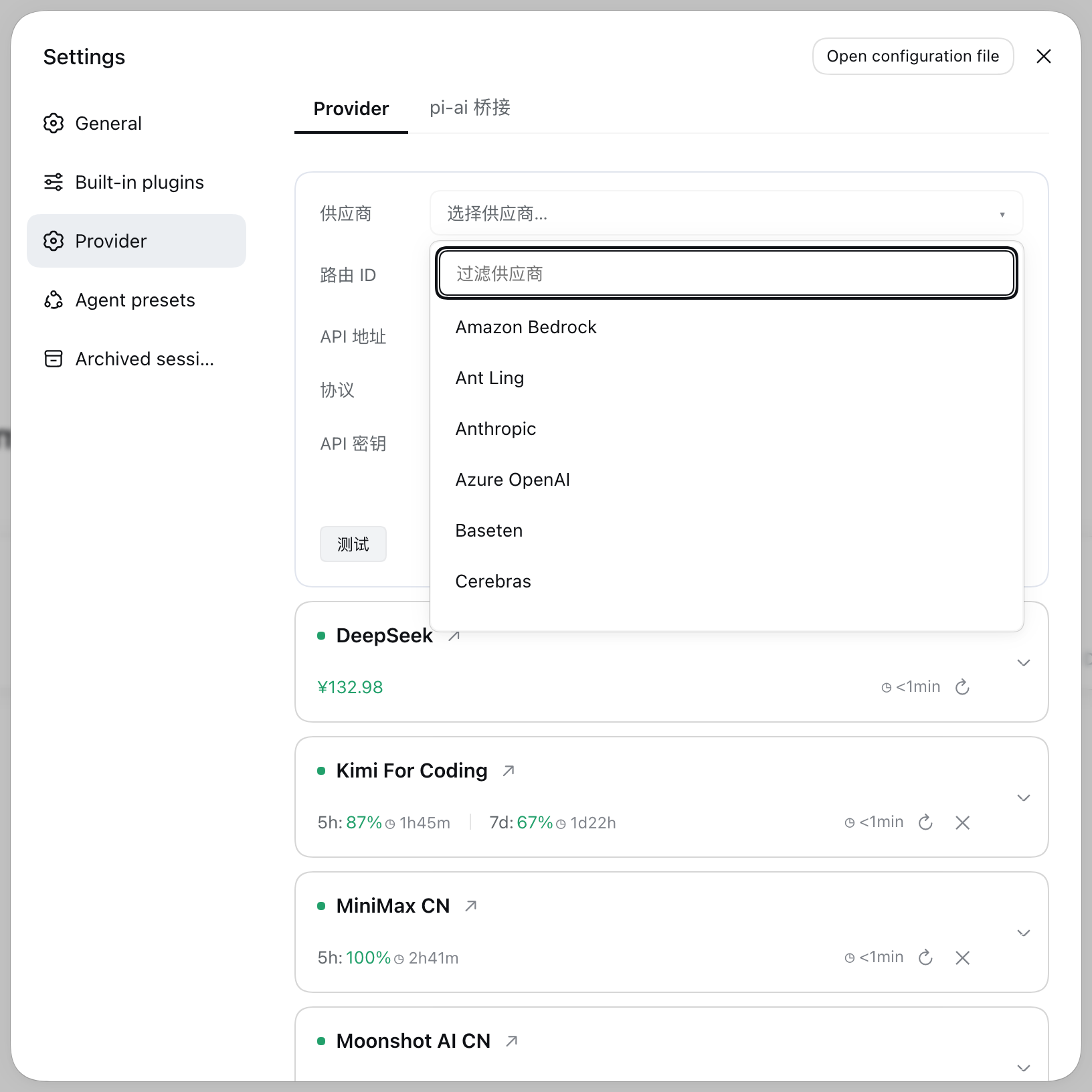 Adding a provider: 43 presets behind a filter box, endpoint and key, and a test that must pass before the write. |
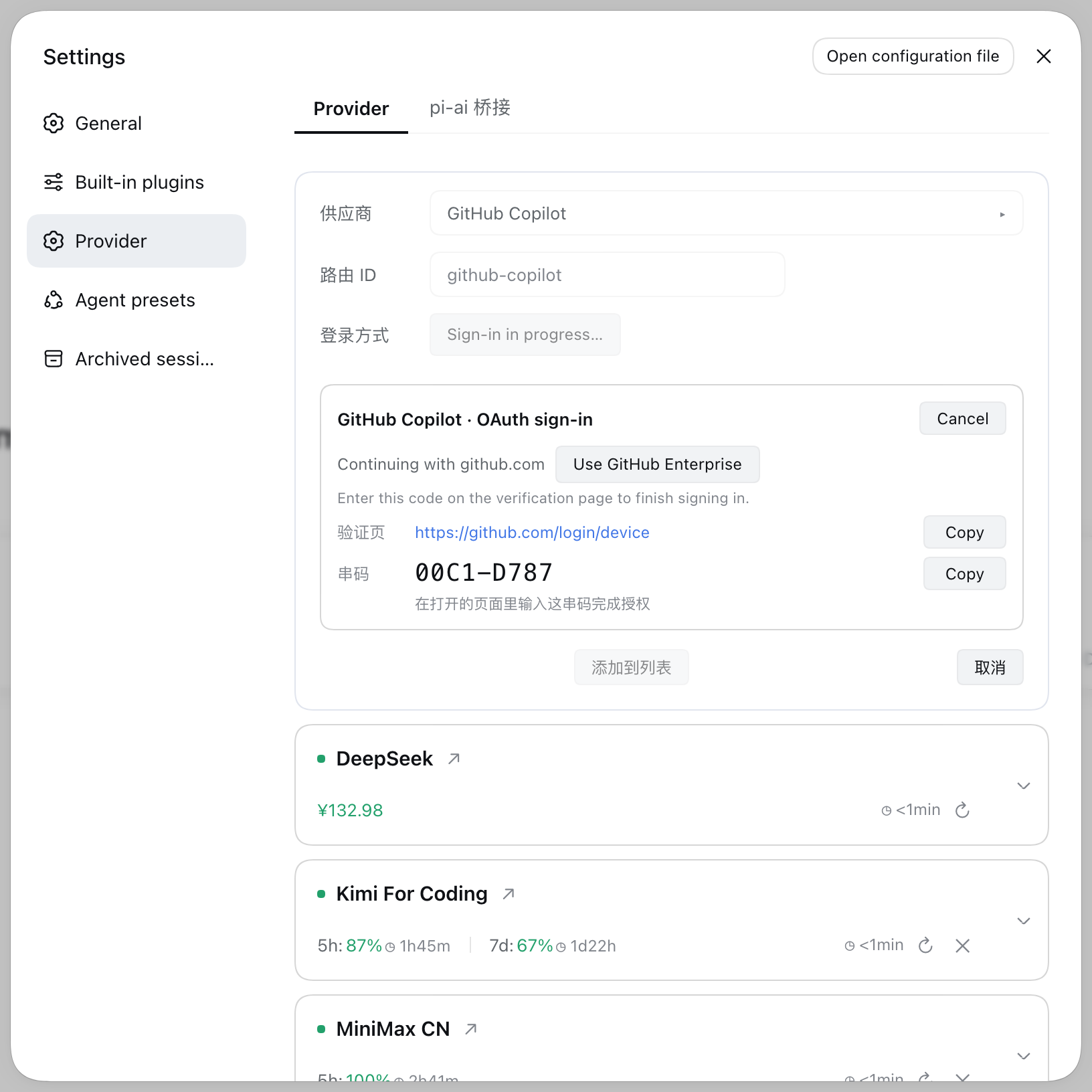 OAuth sign-in: subscription providers use a device code and land in the same credential store. |
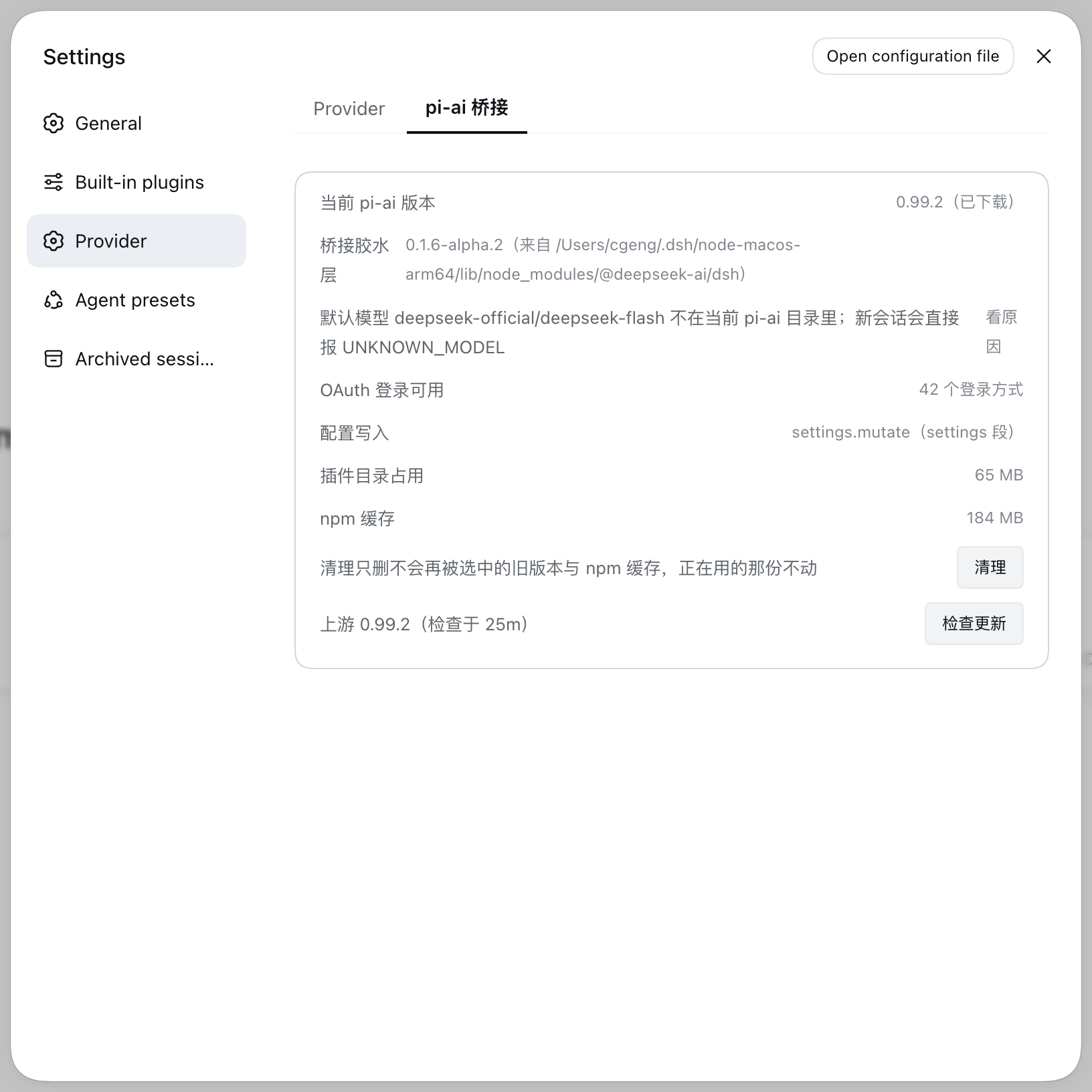 pi-ai bridge: which pi-ai is in use and where it came from, whether upstream has a newer one, in-place swap, and disk usage. |
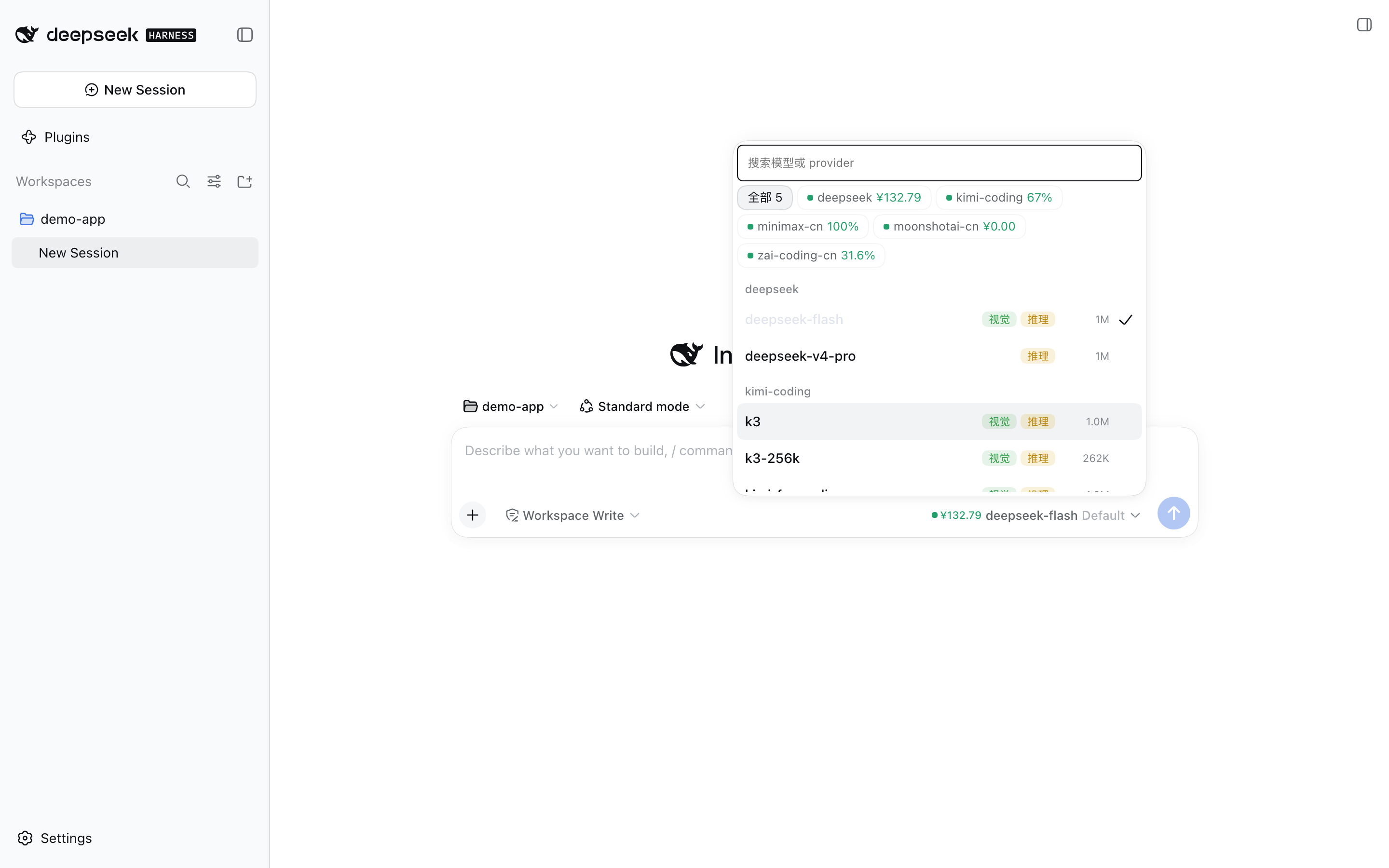
Model selector: the provider filter row carries the same quota snapshot, model rows carry capability badges and context size, the current model is ticked.
From npm:
dsh plugin --profile web add @dsh-one/dsh-llm-provider
dsh web     # restart required: the plugin tree changed
Add @<version> to the package name to install one specific version.
Upgrading an already-installed plugin requires restarting the dsh process; refreshing the page is not enough. The plugin's cordis.patch.yml is re-read from disk on every mount, but the module code is cached by Node per path, and under pnpm's hoisted layout that path does not change between versions (node_modules/@dsh-one/dsh-llm-provider) — a refresh recomposes the entry tree without re-importing the module, so the code loaded at process start keeps running. If a new version seems to change nothing, look here first.
Requires dsh 0.1.6-alpha.1 or newer, including the 0.2 line. The plugin declares
@deepseek-ai/dsh-authorization as an optional peer, and dsh 0.2 checks that range
against the running dsh version at install/boot — a plugin whose range excludes the
runtime is refused with an incompatibility error.
To work on this repository, link the checkout into the profile instead:
scripts/install-deps.sh   # install dev dependencies
npm run build             # lib/ is build output and is not committed
# link ~/.dsh/profiles/<profile>/node_modules/@dsh-one/dsh-llm-provider -> this checkout
# and set "@dsh-one/dsh-llm-provider": "link:<path>" in the profile's package.json dependencies
cd vendor && npm install  # optional: a pinned pi-ai kept in the checkout
dsh web                   # restart required: the plugin tree changed
Published packages ship neither vendor/ nor its lockfile, so the pinned pi-ai only exists in a checkout. It is optional either way: a source that isn't installed is skipped and the plugin falls back to the pi-ai that ships with dsh. A missing directory means "not installed", not "incompatible", so nothing about it appears in the UI.
The plugin declares a DeepSeek route in its own config (llm-pi-ai.providers.deepseek, credential name DEEPSEEK_API_KEY), because the built-in llm-deepseek entry is disabled. A new install therefore shows a DeepSeek card with no key:
Keys are stored through dsh's own credential service under the route's apiKeyEnv, so they are the same credentials the official stack reads. Nothing here needs a plugin config file.
Providers come from llm-pi-ai.providers in settings.yaml. With no route there, the quota panel is empty — add one from the settings page as above. Keys are resolved by dsh's credentials service through each route's apiKeyEnv.
One plugin serves both host generations, choosing its path from runtime capabilities, never from a version number:
| Capability | 0.1.x (e.g. 0.1.6-alpha.2) | 0.2.x (0.2.0-rc.2 onward) |
|---|---|---|
| Where configuration lives | the llm-pi-ai section of settings.yaml |
the plugin's own entry config in the profile patch (a settings namespace is the id of a loaded entry) |
| Read | settings.get/section('llm-pi-ai') |
the legacy section is read from the loader entry list (the row whose id is llm-pi-ai, via options.config; not the include entry's own {path, patches}); UI writes live in the entry config |
| Write | settings.mutate('llm-pi-ai', ops) |
ctx.configEditor.edit(entry, change) (writes the profile patch and lets Loader reload) |
| Providers the official bundle sees | the config passed in is registered by settings.installSection as the composition base, and resolution is mergeLayers(base, user section); so only the built-in defaults and the entry config are handed over, and the user's routes come from the settings user layer |
only the config passed in (config.providers.get()); it no longer reads the llm-pi-ai section, so it gets the complete merged result |
The bridge copy (the glue layer) is taken from the tree the host itself runs: on Desktop that is the copy inside app.asar, on the command line the one in the install tree — and those two differ both in dsh-llm-pi-ai and in the pi-ai beside it (measured: Desktop 0.2.0-rc.2 + pi-ai 0.87.1, CLI install tree 0.1.6-alpha.2 + 0.85.1), while model ids change with the pi-ai version (the same model is deepseek-v4-flash in 0.85.1 and deepseek-flash in 0.99.1). Picking the wrong one shows up as "the model in my session suddenly does not exist", so the choice matches on the host tree plus the glue generation (0.1.x uses settings.installSection, 0.2.x uses settings.configure) and falls through otherwise. The pi-ai row in the bridge tab names the tree it came from (Desktop / dsh-install / profile / vendor) and the tooltip shows the package directory that was actually loaded.
Which tree the host runs is asked of the process, not guessed from directories: the plugin reads process.argv[1] to find the dsh that is running it (resolving symlinks first — on the command line that is the bin/dsh symlink, not lib/bin.js inside the package) and, once it confirms the entry lives inside the @deepseek-ai/dsh package, uses it as the first clue, right after Electron's bundled copy. So where dsh is installed does not matter: a sandbox installed with --dsh-version, a custom prefix in a container, a profile inside some project directory — the tree that is actually running wins. When that clue is unavailable (Electron's argv[1] is not guaranteed to be the dsh entry) it simply drops out and the other clues still apply.
When the plugin has been reinstalled while dsh keeps running (installing swaps the package directory and takes vendor/ with it), the live process still remembers the old path. The plugin therefore re-checks the disk before every catalog read: if that pi-ai is gone it falls back to reading the model catalog and provider presets from the host's own tree — instead of the silent "add-provider list only has the custom gateway and every model badge is gone" state — and shows a row in the pi-ai bridge tab saying the running directory is no longer on disk and a dsh restart is what fixes it. The running bridge itself is still the in-memory copy; a restart is what brings the two back in sync.
Model-id mismatches are reported up front instead of on send: when the session's current model is not in the loaded catalog the model selector shows a notice at the top (listing ids that are available for that provider), and when the agent-default-model row points at a missing id the pi-ai bridge tab shows a warning row.: the disabled flags in the patch are !!js expressions ("disable the official row only while this plugin's entry is present and enabled"), evaluated by the Loader on every check, so flipping the plugin toggle propagates. There is no "plugin off, official disabled, no models at all" dead end; when the expression fails it never disables the official row (official plugins stay usable).
On the very first mount that expression cannot see this plugin's entry: the Loader evaluates each row's disabled synchronously in list order, and our row is appended last by the bundle patch's insert. So on a cold start the guard answers "did not find myself" → the official rows mount anyway → mounting our bridge then hits "same provider declared twice" (LlmError: configurable provider "..." is already declared) and the whole plugin entry fails to activate (observed on Desktop 0.2.0-rc.2). This plugin therefore disables those four rows itself at startup (src/official-rows.ts, in-process only, nothing is written back) and mounts the bridge once they are disposed; after any reload the patch guard works normally. If the bridge still cannot be mounted, the plugin itself stays active and the reason shows up in the pi-ai bridge tab instead of the whole plugin going dark.
The two host generations merge differently, because they differ in which layer is writable:
llm-pi-ai section is the writable user layer, and the official bundle reads mergeLayers(composition base, user section). We follow the same rule: built-in defaults and the entry config form the base, the user section is layered on top, merged field by field, recursively. What the UI shows is therefore what actually takes effect, and a route the user deletes in the UI does not come back from the base. (That was a real trap: handing over the whole merged set as the base made mergeLayers keep every key in it forever — after unsetting apiKeyEnv the official adapter still threw MISSING_CREDENTIAL, and a deleted route reappeared on the next read.)providers key (not by the route count): deleting every last route writes providers: {}, which still counts as taken over, so an empty set must not bring the defaults and the legacy section back. The first UI write persists the whole set as it was (built-in defaults included), so ordinary use never loses the default route; conversely, hand-writing (or restoring) an entry config without deepseek means deliberately not having that default route.Both write strategies stay in place and are chosen by capability, with an automatic switch to the other one and a memory of which works (self-healing): host upgrades or downgrades, a disabled entry, or a profile patch overridden by a home patch need no configuration change. A "configuration writes" row in the pi-ai bridge tab names the path in use, where providers came from, and any warning that did not clear. A path that simply does not exist on this host (0.1.x has no configEditor; on 0.2.x settings.mutate cannot write the old namespace) is not reported as a warning — that is a version difference, not a failure.
What gets written is a field-by-field merge: omitting a field does not delete it. Deletions have to be stated explicitly (the unsets field of a merge op over HTTP, the fix actions on a card in the UI) — clearing apiKeyEnv after an OAuth sign-in goes through this path, because leaving that ref in place makes the official adapter resolve only it and throw MISSING_CREDENTIAL, which kills the sign-in that just succeeded.
The providers handed to the official bundle are a live accessor: on 0.2.x a change to our entry's config takes Loader's volatile fast path and does not remount the plugin, so a snapshot taken at mount time would leave the official side (config.providers.get()) on the old value — configuration written in the UI would only apply after a dsh restart. Every read therefore merges again, and reuses the same object only when the content is unchanged (compared structurally), so the official identity-based memoisation still works.
Both write paths now behave identically: merge merges field by field, unsetFields deletes only the fields named (an emptied route is kept as {routeId: {}}, which is a valid profile and exactly the shape of an OAuth-only route), and only unset removes a whole route.
A live accessor alone is not enough: the official bundle's own loader/volatile-update listener sits on its child fiber, and cordis filters events by owner.fiber === fiber, so it never sees a volatile update of our entry — additions and removals in the route set are not re-registered, and chatting after adding a provider hits NO_ADAPTER until a restart. The plugin therefore catches that event itself and disposes then re-mounts the bridge child fiber: the old registrations go away with the fiber, and the fresh mount declares them again from the current config, which is what makes the route set line up.
pi-ai updates are triggered two ways: once in the background at plugin startup (throttled to 6 hours, DSH_PROVIDER_UPDATE=off disables it) and by the 「检查更新」 button on the provider page (POST /provider/update).
Either way, nothing is replaced before it passes both checks: the tarball integrity from the registry (dist.integrity) and the compatibility check. Only then is the new version marked as pending a restart, and a version you already run is not downloaded again — the manual "check for updates" button compares against the version in use first. A new pi-ai version can be swapped in place without a restart: once a verified download is pending, the pi-ai bridge tab offers "立即切换" (POST /provider/swap). The host loads the new one first and only then disposes the old, and rolls back to the previous copy if any step fails (a failure is a message, not a dead bridge). Restarting dsh still works too.
A downloaded pi-ai costs around 80 MB, so only versions newer than the one dsh ships with are kept: a duplicate at the same version or older is removed after an install, and the npm cache lives in the system temp directory (<tmpdir>/dsh-llm-provider-npm-cache) instead of the plugin directory. The "pi-ai bridge" tab shows the current footprint (vendor/ total plus npm cache) next to a "clean up" button (POST /provider/prune) that removes versions that can no longer be selected and the cache; the version in use and any version already downloaded and waiting for a restart are left alone.
scripts/test-profile.sh        # start the plan-test profile (port 3081) and open a browser
scripts/test-profile.sh stop   # stop it
The test instance uses a separate profile, so instances can run side by side: PORT=3082 PROFILE=plan-test-foo LOG=/tmp/dsh-plan-foo.log scripts/test-profile.sh. It sets DSH_PROVIDER_TEST=1, which makes the browser half append · 测试 to the page title and stamp 「测」 on the favicon. The generated profile also links a second local plugin, dsh-sidekick ($DSH_HOME/workspaces/dsh-mobile/plugin); edit those lines in the script on a machine that doesn't have that checkout.
node lib/adapters/run.js all            # run every quota adapter (keys from env or ~/.dsh/.credentials.yaml)
node lib/adapters/run.js kimi-coding --key sk-xx

npm test                                # build + 15 offline tests; this is what finishing and merging run
npm run typecheck                       # tsc --noEmit (npm test does not include it)
The 14 tests cover route discovery, the credential check, the patch layer, the pi-ai compatibility check, directory-link removal (unlinking must not touch the target), the retention rule for pruning old versions, the multi-source merge of model capabilities, provider configuration across both host generations (including self-healing), namespace adaptation for model discovery, the provider preset list, the vendor state merge, the OAuth routes (including mounting and degrading the authorization service), the GitHub Copilot quota parsing, and the browser half's wiring. AGENTS.md describes the development workflow (no coding on main, everything in a worktree).
dsh's model catalog comes from the pi-ai version it was built with. The bridge makes it run on a version the plugin maintains:
dsh-llm-pi-ai bundle is copied to vendor/llm-bridge/, with a link next to it pointing at vendor/pi-ai/<version>/. Node resolves bare specifiers from there, so the copy picks up the newer pi-ai.api/*.lazy, providers/all) are lazy imports and all come from the new version; the dsh bundle copy only provides the stable glue.llm-pi-ai entry is disabled in cordis.patch.yml; the plugin takes over its settings section, model discovery and catalog.Which pi-ai gets used is decided by the compatibility check before anything is loaded. Rolling back needs no link edit: delete the downloaded version and the next start falls back to the next source.
loadBridge() lists candidates in priority order, checks each one and takes the first that passes:
| Source | Directory | Used when |
|---|---|---|
| Downloaded | vendor/pi-ai/<version>/ (newest first) |
the updater downloaded it and it passed the check |
| Pinned dependency | vendor/node_modules/@earendil-works/pi-ai |
optional; used when installed (cd vendor && npm install) |
| Bundled with dsh | found along the official bundle's node_modules chain (no hardcoded path) |
neither of the above is installed, or fails the check |
Sources that are not installed are skipped silently. A source is only listed as skipped, with a reason, when it exists but fails the compatibility check. The pi-ai that ships with dsh follows dsh's own release cycle and is not necessarily older than upstream.
A duplicate at the same version never takes the hot-update slot: a downloaded version that is not newer than the best local source (dsh's own copy, the pinned dependency) is ordered after both local sources — it is the same code, so the local copy is reused and the 80 MB duplicate plus a needless restart are avoided. Only a strictly newer version sorts first.
Neither of the last two directories is hardcoded. The official bundle is resolved along the module resolution chain in this order: the profile's node_modules, the dsh installation tree (including the node_modules nested inside the dsh package), then this plugin. pi-ai is resolved the same way, starting from the bundle that was found. A different dsh layout (bundle inside its own install directory, dependencies hoisted elsewhere) therefore does not make a source disappear.
vendor/package.json pins the version of the optional dependency, and the two do not overwrite each other: updates only ever write to vendor/pi-ai/<new version>/. Both live under vendor/ because the bridge copy at vendor/llm-bridge/ resolves upwards into vendor/node_modules first, so choosing that source needs no link.
The bridge copy's imports of pi-ai (subpaths and named exports) are extracted from its source, a probe file is generated from them in the plugin's own temporary directory with a link to the candidate, and that file is required. The resolution rules match the copy exactly, but the module URL differs, so one failing candidate does not affect the next and does not pollute the real copy.
The extraction covers named imports and re-exports, dynamic import(), side-effect and namespace imports, and export *. Checking before loading is required: Node keeps a half-initialized record for an ESM file that failed to load, and requiring it again only reports not yet fully loaded. There is no "load first and fall back on failure" path.
Candidates that fail the check are listed in bridge.rejected from /provider/status. When the imports cannot be extracted at all the check cannot run, and the chosen source is accepted on the grounds that its directory exists — that case is reported as probeUnverified: true. The updater likewise only replaces a version that passes the check.
Takes over the composer's conversation.input.model slot and the /model command (the official ui-model-selection entry is disabled in cordis.patch.yml):
<provider-id>/<model-id> · reasoning effort) → root panel with 「模型」 and 「推理等级」 rows → model panel → effort panel. Choosing a model or an effort closes the menu.session/modelCatalog, switching from session/selectModel, quota from /plan/status. The official modelDirectories client service is used when it is present, and the plugin's own RPC otherwise.defaultEffort the catalog declares; when it declares none, the official Default label is shown.Default among the choices; the already-checked level is clickable too — that click is the confirmation). The initially selected level is inherited from the previous one: a direct hit on the new model's level table reuses it, otherwise the index is mapped proportionally through interval centres (5-level #3 → 3-level #2). A new model without reasoning metadata shows an empty state with an "OK" button that submits a level-less selection.deepseek-official route, which no longer exists. That selection is mapped to its current route (deepseek) for display and quota, and the seat rewrites the session's record once — the host refuses to send a prompt while the recorded provider has no adapter. The rewrite only happens when the target route and model are both in the catalog.provider + id (the same model id belongs to several providers and a bare-id index mixes them up); when none of the three sources has an answer no badge is shown, the detail card says the capability is unknown and names the source it did use.availableModelIds); the host exposes it as availableModels on /plan/status and both the picker and the card filter by it. The static catalog and the entitlement are different things — the Copilot catalog lists 28 models while one account may only use 6, and picking outside the list earns a 400 model_not_supported. The currently selected model stays listed even when it falls outside, so it never looks like it vanished.min(560px, 60cqw), and the full name is always in its title.Adds a 「模型服务」 tab to the settings page (the official ui-settings-models entry is disabled), with two sub-tabs: 「服务商」 and 「pi-ai 桥接」.
5h: 84% ◷ 3h7m | 7d: 30% ◷ 3d20h), and refresh time, per-card refresh and delete on the right. The expanded body shows the route configuration (route ID, masked key, credential name, plus the API base URL and protocol — the protocol appears only when the route declares one, while an empty address shows the catalog default endpoint) and that provider's model list with filtering and a detail card.llm-pi-ai.providers via settings/mutate and to the credential store via credentials/set, the same storage the official page uses. When the route already exists, only the fields the form owns are written (baseURL, apiKeyEnv, and api for a custom gateway); hand-written models, compat and retryPolicy are left alone, because a whole-object set in dsh-settings replaces the entry.llm-pi-ai.providers.<id>.models; details and limits are in Known gaps.One file per provider under src/adapters/, one registration line in registry.ts, the contract in shared.ts; node lib/adapters/run.js runs them standalone. Every adapter except qwen issues a free GET; none needs a browser session. Most use the provider's API key, while github-copilot uses the GitHub token obtained through OAuth sign-in (OAuth providers have no apiKeyEnv, so the plugin reads it from the credential record).
| Adapter | Data source |
|---|---|
| deepseek | api.deepseek.com/user/balance |
| kimi-coding | api.kimi.com/coding/v1/usages |
| moonshot | api.moonshot.cn/v1/users/me/balance (.cn or .ai, following the base URL; the catalog default applies when the route declares none) |
| glm | open.bigmodel.cn/api/monitor/usage/quota/limit |
| minimax | api.minimaxi.com/v1/api/openplatform/coding_plan/remains (.io on the international site) |
| opencode-go | opencode.ai/zen/go/v1/usage |
| zenmux | the baseURL itself (quota_5_hour / quota_7_day in the response; this provider is not in the catalog, so only the user can supply an address) |
| openrouter | openrouter.ai/api/v1/credits |
| github-copilot | api.github.com/copilot_internal/user (quota_snapshots on paid plans, monthly_quotas on free; wants the GitHub token, not the api.githubcopilot.com one) |
| qwen | no public endpoint: no request is sent, the card shows a 「看控制台」 link |
Numbers and presentation follow CC Switch (farion1231/cc-switch, a desktop tool that switches provider configs for coding CLIs): the fields it shows, and no others. Plan tier fields are dropped before they reach the browser, and the Kimi top-up balance is not shown because the figure disagrees with CC Switch and looks unreliable.
Which providers appear in the quota panel and in the preset list comes from two sources:
llm-pi-ai.providers in settings.yaml — the pi-ai routes the user configured.ctx.llm.listConfigurableProviders() (such as deepseek-official): they carry a default apiKeyEnv without a settings entry, and that default is not readable through the service, so routes.ts matches them against a NATIVE_ROUTE_DEFAULTS table.A display name is the route's own displayName when it has one, otherwise the name from the *Provider() factory in the pi-ai registry (pi-ai-names.ts, cached), otherwise built from the id. Outside that registry only one entry is kept: Custom Gateway. Model IDs and route IDs are always shown as they are, matching the keys in settings.
The host compares keys while resolving them for each provider and warns in the UI when two providers use the same key. dsh itself does not do this, and the configuration UI never sees key values, so elsewhere this mistake only shows up as one provider that keeps failing. Key values are compared in-process and never leave it.
| Route | Purpose |
|---|---|
GET /plan/status |
quota snapshot for every provider (60s cache, ?refresh=1 bypasses it) |
GET /provider/status |
bridge status, route table, update status, disk footprint, test-instance flag |
POST /provider/update |
trigger one upstream check and update |
POST /provider/swap |
swap in a downloaded, verified pi-ai without restarting; rolls back to the previous copy on failure |
POST /provider/prune |
remove pi-ai versions that can no longer be selected and the npm cache (the one in use or pending a restart is untouched) |
GET /provider/models |
model metadata merged from three sources: input declared by the route → the pi-ai catalog → adapter self-report (listModels/resolveModelInfo, only for providers the catalog does not cover, with per-call and total timeouts). 60s cache (?fresh=1 bypasses it); used by detail cards and capability badges |
GET /provider/presets |
provider presets available for adding (with configured flags) |
POST /provider/refresh |
refresh one card's quota (live query, updates the global snapshot) |
POST /provider/discover |
draft model discovery (the "add provider" test button); tries the namespace for the dsh version (llm-pi-ai on 0.1.x, the plugin entry id on 0.2.x) and self-heals |
POST /provider/mutate |
write provider configuration (merge / unset / unsetFields); the host picks the write path for the dsh version and self-heals. merge merges field by field, so omitting a field does not delete it — list it in unsets instead (that is how apiKeyEnv is cleared after an OAuth sign-in) |
POST /provider/remove |
remove a provider (route and credential) |
POST /provider/test |
query one provider's quota with the stored key (read-only, does not update the snapshot) |
GET /provider/oauth/flows |
list the flows registered on ctx.authorization (same source as preset.oauth on /provider/presets) |
POST /provider/oauth/begin |
start one attempt and return its attemptId immediately; the flow runs in the background and pushes events onto the SSE bus |
GET /provider/oauth/stream |
SSE stream: data: {kind:'notice'|'prompt'|'settled',...}. 404 for an unknown attempt; an already-settled attempt gets its settled frame at once |
POST /provider/oauth/respond |
the browser's answer to a prompt, routed to the pending resolver by attemptId + promptId |
POST /provider/oauth/cancel |
withdraw an attempt (aborts the local signal and calls authorization.cancel(key) so the in-flight slot is released) |
The add-provider form does not call /provider/test; it runs the official llm/discoverModels draft probe instead.
These are plain routes rather than official Typert Remotes: that generator only understands the monorepo layout (packages under <root>/packages/, @Remote sources inside registered packages), which does not fit a single-package plugin. That leaves no type-safe call sites, so the offline tests cover the routes.
npm run build      # tsdown: host src/*.ts -> lib/*.js (unbundled); browser src/client/index.ts -> lib/client.js (single CJS file with the window.__ModuleLoader__ wrapper)
npm run watch      # rebuild on change
npm run typecheck  # tsc --noEmit
The host half is translated file by file, and the output paths match the package.json exports. The browser half inlines everything under src/client/ into one file; the three loader lines are added by the build's banner/footer/intro and are not in the source.
The plugin runs from lib/, so a source change without a build runs the old code.
Dependencies are installed with scripts/install-deps.sh, not npm install directly: node_modules/@deepseek-ai is a link into the host profile, and npm would follow it, try to reify the two hundred packages inside and fail. The script moves it aside, installs, and puts it back.
vendor/ (downloaded pi-ai, bridge copy, status files, some of which are written at load time) and explicit user actions in the UI (adding or removing a provider, editing a model list, fixing fields on a card) — and those go through the host's own configuration write path (settings.mutate on 0.1.x, configEditor.edit on 0.2.x), never by editing files directly. Nothing host-side is written at startup; a legacy llm-pi-ai section is only merged into the in-memory view and moves into the plugin entry with the first UI write.cordis.patch.yml (llm-pi-ai, llm-deepseek, ui-model-selection, ui-settings-models); everything else official is untouched. The plugin's own model seat registers with priority: -10, which is what would shadow an official occupant at the same slot.0.0.0.0 exposes balances and credential names through /plan/status. A production Desktop instance additionally requires a token at the host layer (403 without one), while an isolated instance started with dsh web --port <port> --no-open has no such layer — measured on the same port, /plan/status, /provider/status and /provider/presets answer 200 without a token, so "loopback only" is a weaker assumption under that startup mode.The plugin changes neither the system prompt, the tool schemas nor the message content. It decides which models are available, which wire protocol each one uses, and how the reasoning effort setting maps onto request parameters; the last two are implemented per model in pi-ai's wire code, not here.
Default) no reasoning_effort is sent. Whether a thinking switch is sent, and with what value, follows pi-ai's implementation for that model.reasoning_effort field for some, a budget_tokens value for providers that bill thinking by budget, adaptive thinking for others.Quota lookups are separate free HTTP calls and add no tokens to model requests. Switching pi-ai versions swaps the model catalog and the usage figures with it. Switching model or provider changes the request prefix, so KV cache hits start from zero; switching effort within the same model only changes thinking parameters. The plugin does not rewrite session content; its own caches are the 60-second quota and model-metadata snapshots listed above.
Release cadence: 0.2.x carries fixes only; the two items marked "0.3.x" are feature work scheduled for 0.3.x.
Honest notes (not verified / not implemented):
On 0.1.x the built-in default route (DeepSeek) cannot be deleted. It sits in the composition base we hand the host, and the user layer above a base cannot express "delete" (mergeLayers only merges, so any key in the base survives); removing it from the writable legacy section still leaves it in the resolved value. Keeping that default also makes the default model (deepseek) work out of the box, so it is left as is. The UI offers no delete action for it (the account the host returns has deletable: false) and POST /provider/remove refuses with an explanation — so a credential is never cleared while the route survives. 0.2.x does not have this problem: after the entry takes over, the built-in defaults are no longer added back, and the route can be deleted.
Multi-endpoint and multi-protocol providers have no live verification. The decision logic follows the official fallback chain and offline assertions cover it, but no key was available for OpenRouter / Fireworks / opencode / opencode-go / Cloudflare / Bedrock, so no real request was ever sent through them (single-endpoint ones like Copilot and DeepSeek were exercised live).
The available-model list is a login-time snapshot. pi-ai records availableModelIds when an OAuth sign-in completes and the model list is filtered by it; entitlement changes (a newly opened model, an upgraded plan) only show up after signing in again.
Switching an existing OAuth route back to an API key: the add form offers both paths, but the card has no "switch back to a key" action — that requires deleting and re-adding the route.
The OAuth token field names are pi-ai internals: the quota adapters read refresh / access out of the credential record (the Copilot quota endpoint wants the long-lived GitHub token). A rename upstream has to be followed here — the bridge pins the pi-ai version, and the pi-ai health check surfaces upgrades.
Capabilities the official entries have that this plugin does not:
src/client/model-editor.ts): tick the models to expose, or replace the whole list with a custom one, editing id / name / contextWindow / maxTokens / input (text, image, video) / reasoningEfforts / compat.thinkingFormat per row and saving back to llm-pi-ai.providers.<id>.models. Differences from the official editor: the official one builds per-provider forms from a schema, this is one generic table; in configuration reasoningEfforts is a {level: wire value} map, written here as text such as low,high=max (empty = inherit the installed pi-ai catalog, false = no reasoning). Rows are validated before saving (empty ids, duplicates, non-positive integers and unknown levels are refused), because the host parses the list strictly and one bad entry makes the whole route unusable. The panel shows up for llm-pi-ai routes only — a native route's models do not live in that settings section — and input is written only when the capability was actually resolved or the user touched the checkbox, so saving before the details arrive cannot pin a placeholder text over the catalog's vision capability.ui-model-selection greys out the composer when the current model cannot be routed. With that entry disabled, the input stays active even when the current provider is not configured.Not implemented yet:
On 0.2.x the old llm-pi-ai section becomes a leftover. The first UI write migrates its routes into the plugin entry, but the section itself (the llm-pi-ai row in the profile patch) cannot be removed — its entry is disabled by this plugin's patch, so the host refuses to write it. It is history from then on; what takes effect is the plugin entry's copy. Cleaning it up means editing the profile patch by hand (~/.dsh/profiles/<profile>/cordis.patch.yml).
A dead bridge is only reported locally (a global banner is scheduled for 0.3.x). When every candidate fails (corrupt directory, permissions, an upstream export rename) the plugin falls back to "billing only", the four official entries stay disabled by the patch and the model list goes empty; the only signal is one error row in the "pi-ai bridge" tab (bridge.active === false), with nothing near the composer. A global banner would make this obvious at a glance; it is not implemented.
A sidebar entry and a global quota badge via shell.overlay.
Live usage and failure attribution inside a session (reading usage from llm/stream and session/event, and quota/rate-limit failure codes from llm/retry). Quota data is polled from endpoints, which answers "how much is left on the account", not "what did this request cost and why did it fail".
Out of scope:
The dsh-authorization seam owns the prompt vocabulary, the AuthInteraction relay and the commit check; the official llm-pi-ai registers a flow for every provider in the pi-ai catalog (key-based, subscription-based, and OAuth-only Codex — the exact split moves with the pi-ai version). Two pieces were missing: nobody mounted the service, and there was no browser-side wire.
Piece one: stock dsh does not mount the authorization service. The patch layer of both official bundles (dsh-base, 86 rows; dsh-web-app, 70 rows) mounts @deepseek-ai/dsh-credentials-local (the credential store) and not @deepseek-ai/dsh-authorization. The latter declares no dsh.bundle field, so it cannot be listed as a profile bundle either — doing so makes dsh fail with "declares no dsh.bundle" and the whole profile refuses to start. The consequence: the official ctx.inject(['authorization'], …) inside llm-pi-ai never fires, registerPiAiFlows never runs, and no OAuth flow exists at all, so no sign-in entry appears in the UI.
The plugin fills this at startup: ensureAuthorizationService() in src/oauth.ts resolves the host's own copy of @deepseek-ai/dsh-authorization through the host anchors and mounts it with ctx.plugin(). Cordis registers services in the root store, so once it is up the official inject fires reactively and registers every catalog provider's sign-in methods — without touching a line of the official plugin. The observed chain is: service absent → inject registered → we mount → callback fires → registerFlow succeeds. A missing package, a failed load or an absent ctx.plugin all degrade to "no OAuth entry" instead of throwing, because a plugin that fails to load takes the whole dsh process with it. Resolution deliberately uses the host's copy: shipping a second copy inside a third-party plugin would pull in a second cordis runtime and cross-wire service registration.
Piece two: the browser-side wire. That is what this plugin adds (src/oauth.ts, routes in the HTTP table below):
EventEmitter), aligned with dsh-authorization's "attempts are not persisted" rule — a page refresh drops the attempt rather than leaving half-initialized state.Content-Type: text/event-stream); the flow pushes notice (message + URL + code), prompt (text / secret / select) and the final settled frame. A browser that reopens the EventSource reads the closing frame instead of restarting the attempt.ALREADY_IN_FLIGHT) and the route answers 409 first.preset.oauth in the add-provider form: the button replaces the API-key input, the dialog renders notices and prompts by kind (input or select), and a successful sign-in refreshes the cards through onAdded.api nor baseURL. The official adapter resolves const api = request.api ?? base?.api ?? routeApi and const baseUrl = request.baseURL ?? base?.baseUrl ?? providerBaseUrl, so a route-level value overrides each model's own: 6 of the 40 providers are multi-protocol (Copilot: claude models speak anthropic-messages, gpt-5.x speaks openai-responses, gemini speaks openai-completions), and 5 of those also split endpoints by protocol (Fireworks / opencode / opencode-go / OpenRouter / Cloudflare differ by a /v1-style suffix — the SDK appends /v1/messages itself, so the wrong pick becomes .../v1/v1/messages), while Bedrock ships us-east-1 and eu-central-1 side by side. Pinning anthropic-messages made gpt-5.4 answer 400 no model endpoints available given user constraints. Leaving the address field empty in the form means "use the catalog default" (shown as its placeholder); type one to override an enterprise endpoint or a gateway with placeholders — an empty string must not be written, since '' ?? x does not fall back. Billing queries and the card take the endpoint from the catalog (catalogBaseUrlOf); an OAuth route's endpoint comes from the credential (auth.baseUrl overrides the model's), so the card shows no catalog address for it. The card's warning is decided by the catalog's real protocol set (apis in the presets response): a pin on a multi-protocol provider is always reported (it must break one batch), a correct pin on a single-protocol one is not — that would only send the user to a pointless fix button — while a single-protocol provider pinned to something the catalog does not use (a hand-typed mistake) is still reported, and the text names both sides. Either case offers the one-click "follow each model's protocol" fix: it unsets api and, when the route's address is one of the catalog's endpoints, unsets baseURL too (older forms wrote the catalog address into the route, which overrides each model's own endpoint just the same) — an address the user typed (an enterprise endpoint) is not in that set and is left alone.auth — oauth without apiKey means OAuth-only (currently only openai-codex), and new ones follow automatically. There is exactly one exception, github-copilot: its metadata does offer an apiKey path, but that path is a bare "Enter GitHub Copilot token" box, and such a token can only be obtained by signing in to GitHub first, so the UI treats it as OAuth-only (KEY_PATH_IS_DEAD_END). An OAuth-only provider keeps the sign-in path only: the "API base URL / protocol / credential name" rows and the "test" button are hidden, and so is the "use an API key instead" switch — that path cannot be completed here (the test button is gone while "add to list" requires a passing test), and for Copilot the token is unobtainable anyway.oauth is a real subscription sign-in, while api-key is just dsh wrapping "type your key" as a login. So the test is the method id, not "has a flow": DeepSeek / OpenAI / Moonshot expose only api-key and keep the plain key input (offering them a "sign in with OAuth" button both misleads and hides the key field), while providers with both (Anthropic, Kimi Coding, OpenRouter, xAI, Radius) default to OAuth with a "use an API key instead" switch beside it — note pi-ai's flow also reports an api-key method for Copilot, which the OAuth-only rule above filters out.auth/resolve.js; models.js says "Explicit request options win per-field"), so a route either carries apiKeyEnv (key path) or does not (credential-record path). Writing both means the explicit key silently wins and the OAuth grant becomes dead configuration.apiKeyEnv. The official adapter's resolveApiKey honours that field above everything else and throws MISSING_CREDENTIAL when it resolves to nothing, so writing it kills the OAuth path (the failure only shows up when a prompt is sent). Leaving it out lets pi-ai fall back to its own credential resolution and pick up the grant. Routes added by earlier versions still carrying the field get a one-click "use OAuth" fix in the card body (it unsets apiKeyEnv).Boundaries:
dsh-authorization: refreshing the page loses the attempt, and an interrupted sign-in has to be redone.kind: text and renders as a plain input.| Path | Purpose |
|---|---|
src/index.ts |
host entry: mounts the bridge, registers the HTTP routes |
src/bridge.ts |
bridge loading: copy the bundle, pick pi-ai through the check, manage links; hostPackageEntry() resolves official packages through the host anchors |
src/updater.ts |
upstream updater: check the registry, verify the tarball, install, mark pending, prune old versions and caches, report disk usage |
src/routes.ts |
route discovery, website links, display name fallback |
src/provider-presets.ts |
preset list for adding a provider (generated from the pi-ai catalog plus Custom Gateway); marks OAuth-only providers |
src/oauth.ts |
OAuth sign-in bridge: mounts the authorization service the official bundles never mount, and exposes its flows to the browser (5 HTTP routes + SSE) |
src/provider-config.ts |
provider configuration layer: multi-source merge and capability-probing, self-healing write strategies for both host generations |
src/model-discovery.ts |
namespace adaptation for draft discovery: tries llm-pi-ai (0.1.x) and the plugin entry id (0.2.x), remembers which works |
src/model-details.ts |
model details and capabilities: read the providers data files of the active pi-ai package, then merge the route's declared input and the adapter's self-reported modalities (indexed by provider + id) |
src/pi-ai-names.ts |
read names from the pi-ai registry (the source of display names) |
src/credential-check.ts |
credential check |
src/adapters/*.ts |
quota adapters (one file per provider, plus registry and CLI runner) |
src/client/*.ts |
browser half: index (entry, slot registration) · model-seat · settings · model-editor (model list editor) · command · data · format · styles · i18n · icons · diag · types |
cordis.patch.yml |
bundle patch layer: disable official entries, insert this plugin, declare the DeepSeek route |
test/*.mjs |
15 offline tests (no dsh, no services) |
scripts/*.sh |
worktree workflow, test instance, dependency install |
CLASSIFICATION EVIDENCE
系统优先读取 GitHub Topics,再与站内分类词典和词根规则比对。当前命中: 无有效分类标签。
deepseek-ai
DeepSeek Harness: Everything is a Plugin.

anywhere-labs
为 DeepSeek Harness (DSH) 插件生态打造的现代化桌面端解决方案。万物皆「插件」,桌面本身也是「插件」。

walkinglabs
Harness engineering beginner tutorial, from 0 to 1