
其他
插件

dsh-bili-scroll
c1overzz
DSH 插件:每天替你刷一轮 B站,读字幕挑出值得的、写一份日报,值得的 @ 你
PROJECT TOPICS
INSTALL REFERENCE
dsh plugin --profile web add github:hrhgit/dsh-oauth-openai
该命令指向仓库当前默认分支;尚无绑定当前 commit 的完整验证结果。
PROJECT README
English | 中文
Scope change. DeepSeek Harness now owns the provider side:
@deepseek-ai/dsh-llm-pi-airegisters the OpenAI Codex OAuth flow, credential storage, refresh, and model routing through@deepseek-ai/dsh-authorization. What the product still lacks is a browser surface for that seam. This package is that surface, and nothing else.
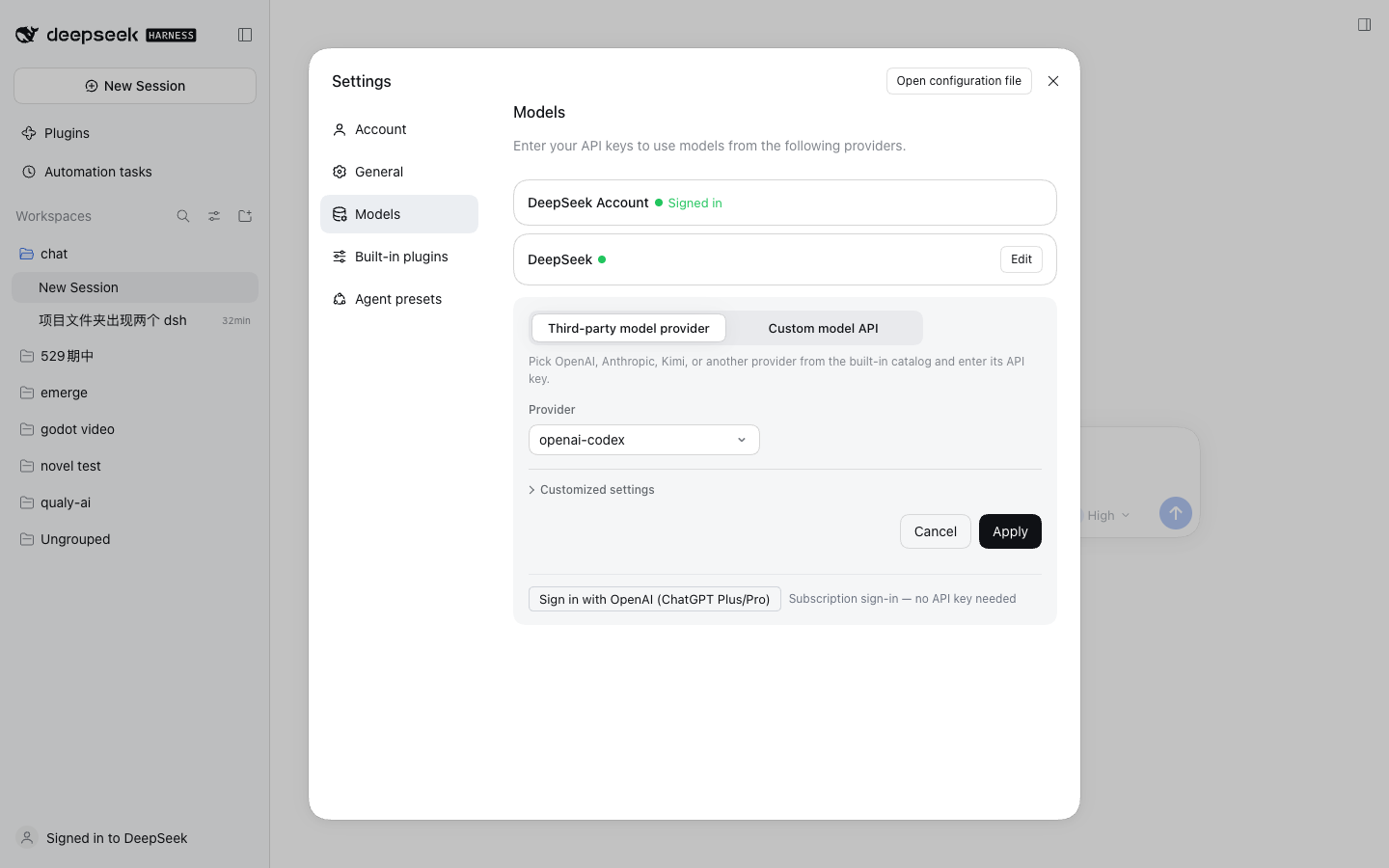
A provider card extension for the Models settings page: it lets a person sign in with a provider subscription (ChatGPT Plus/Pro, and any other flow the Host exposes for a provider) instead of pasting an API key.
codexAuth) that drives ctx.authorization for one
browser surface: start an attempt, read its notices and prompts, answer, cancel.settings.models.provider-card seat for the
llm-pi-ai family. Cards whose provider reports nativeAuth.oauth get a
"Sign in with …" button; every other card renders nothing.It does not ship an OAuth driver, a model adapter, or credential storage. Those belong to the provider plugin, and installing both would mean two owners for one credential.
0.2.1-rc.2 or newer.@deepseek-ai/dsh-llm-pi-ai.dsh plugin --profile <profile> add dsh-oauth-openaiFor a checkout:
dsh plugin --profile <profile> add /path/to/dsh-oauth-openaiRestart the profile, open Settings → Models, and add or edit a provider that offers a subscription login.
Settings → Models card (Client)
  └─ remote.codexAuth.start / state / answer / cancel
       └─ Host ProviderSignInController
            └─ ctx.authorization.begin({ key, method, signal, interaction })
                 └─ provider flow (dsh-llm-pi-ai)
The Host keeps one attempt per credential key, projects the seam's notices and prompts
into plain views, and retains a finished attempt for five minutes so a late poll still
sees its outcome. The Client polls state while an attempt runs; the stream is
deliberately not used, so the plugin needs no uplink support.
Secrets never cross the wire. The seam reports authorized only after the credential
is stored, and the views carry a message, a URL, a short code, and prompt text — never a
token or a credential record. Failures keep the seam's own sentence when the error is an
AuthorizationError, and collapse everything else to authorization failed.
pnpm install
pnpm run check   # build the client bundle, run the controller tests, verify the package
src/controller.js is Host logic and runs under node:test with a fake seam.
src/client.jsx is bundled by scripts/build.mjs into dist/client.js in the
window.__ModuleLoader__ wrapper the Web client expects.
llm-pi-ai/<provider>.MIT
CLASSIFICATION EVIDENCE
系统优先读取 GitHub Topics,再与站内分类词典和词根规则比对。当前命中: 无有效分类标签。
c1overzz
DSH 插件:每天替你刷一轮 B站,读字幕挑出值得的、写一份日报,值得的 @ 你

hellowind777
一个自主的高级智能伙伴,不仅分析问题,更持续工作直到完成实现和验证。

xing-shuyin
Just open your browser — get all your work done.