dsh-capability-optimizer




External-expert consultation for DeepSeek Harness: the agent headlessly invokes the Claude Code CLI with role personas — advisor, reviewer, designer, or your own — and weighs the subscription model's replies as reference answers.
English | 中文
Why this exists
A single harness has one perspective. When the DSH agent hits a decision point, finishes risky work, or starts significant new code, a second opinion from a different model — Claude, on your existing Claude Code subscription — is cheap insurance and a genuine quality lift. This plugin makes that a first-class tool call instead of a copy-paste detour: the agent consults, Claude answers in role, and the reply is framed as advice to weigh, not obey (the same contract Oh My Pi's advisors use).
Phase 1 speaks only to the Claude Code CLI. The settings schema (v2, one workspace per harness), the UI tab catalog, and the runner seam are already multi-backend: codex, zcode, kimi-code, pi, opencode, and omp each land later as a runner behind the same three tools.
Features
|
|
| 🎭 Role personas |
Built-in advisor / reviewer / designer, or your own (name, prompt, dedicated model, dedicated fallback, dedicated thinking effort). omp-style enabled toggle parks a role without deleting it |
| 🧠 Thinking effort |
Native --effort (low / medium / high / xhigh / max) at three levels: per-call argument > role > global default |
| 🔄 Model fallback |
One-hop retry on model-level errors (unrecognized_model, model-not-found, …) with usedFallback recorded in run metadata |
| 🤖 Agent tools |
consult_expert (one role, one question) · consult_panel (up to N roles in parallel, one wall-clock wait) · consult_roles (live roster) |
| 🎛 Auto consult |
Composer-seat toggle (permissions row) picks roles per session; a policy section rides the system prompt and lifecycle nudges fire at write/finish anchors, budgeted per role per session |
| 🖥 Settings workspace |
One tab per harness CLI; saves hot-apply — role edits reach the agent's next model step without a dsh restart |
| 🔬 Connectivity test |
One real consultation end-to-end (CLI + login + proxy) with turns, duration, cost, and fallback marker |
| 🛡 Safe by default |
No permission-bypassing flags, ever; read-only tools inside headless sessions, privileged actions auto-denied |
| 🌐 Fully bilingual |
Every UI string — including built-in role descriptions, reserved-backend notes, and validation messages — follows the UI language (zh/en); agent tooling keeps stable English identifiers |
Install
# from npm (recommended)
dsh plugin --profile web add dsh-capability-optimizer

# or straight from the GitHub repo
dsh plugin --profile web add github:hezhongtang/dsh-capability-optimizer
Restart dsh web (or your profile of choice). Works in any profile — web, tui, headless — because the tools are host-side agent tools.
Requirements: the claude CLI (npm i -g @anthropic-ai/claude-code) on PATH, logged in.
Usage
Ask your agent:
"consult the reviewer on this diff before we call it done"
The agent picks the role, packs the material into context, and calls consult_expert. Claude's reply returns as a reference answer with run metadata (session, turns, duration, cost) — advice the agent weighs, not an order it obeys.
| Tool |
Read/Write |
Purpose |
consult_expert |
read* |
One role, one question, optional material in context, optional model / effort overrides |
consult_panel |
read* |
Several roles, one question, parallel — all perspectives back together |
consult_roles |
read |
The live roster (including role-level model/effort) and global defaults |
* Read-only for your workspace; each call spends your Claude subscription quota — the tool descriptions themselves tell the model to batch material instead of machine-gunning calls.
Auto consult
The composer toolbar (the permissions control's row) carries an Expert Consult toggle: check roles for this session and the host proactively works them into the loop — no prompting, no re-explaining.
- Policy section: every model request carries a short policy block naming the checked roles and when each applies (advisor at decision points, reviewer before declaring work done, designer after the first file write of a turn, on the next step). Auto-consult mode is
off | remind | required (default remind).
- Lifecycle nudges: the first file write of a turn arms the designer anchor (the nudge rides the next step of that turn); a turn that changed files and is about to finish without a reviewer pass is steered one more step to consult first.
- Budget:
capPerRole (default 3) counts real consult_* calls per role per session — nudges and the model's own discretionary calls share it. At the cap the promise drops out of the policy text and the anchors go quiet.
- Soft by design: a nudge guarantees the instruction is delivered, never the tool call — dsh has no forced-call API. A model that declines must state the reason in one line.
- The popover shows live usage counts (
used/cap) per role; the last selection is remembered per browser. Settings → Expert Consult → Auto consult edits the default checked set and budget (row-config key autoConsult) — the same layer tui/headless profiles consume.
Settings UI
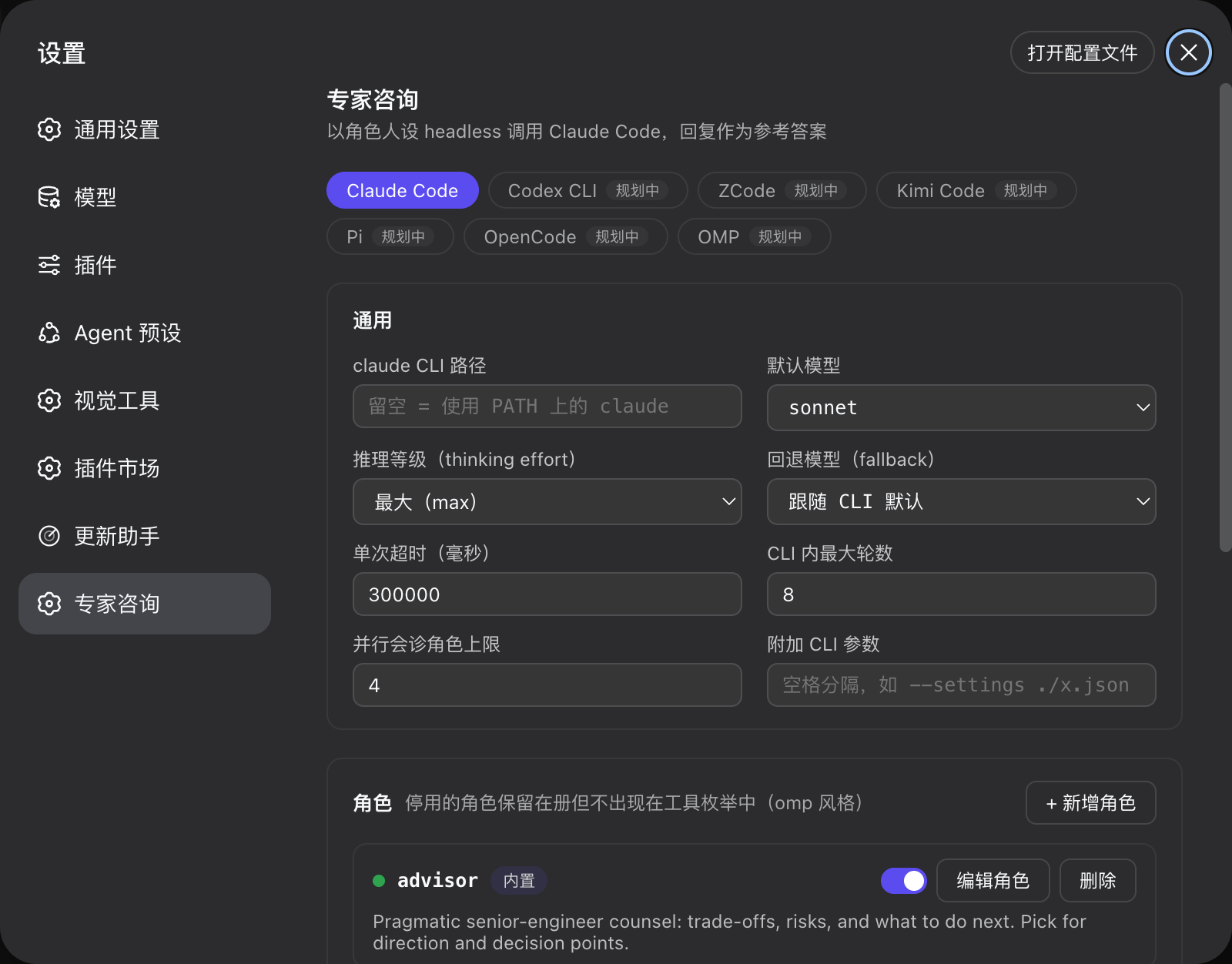
Settings → Expert Consult is organized as one workspace per harness CLI — a tab bar over the catalog (claude-code live; codex, zcode, kimi-code, pi, opencode, omp reserved with a planned-status page and no settings stored until their runners land). The Claude Code workspace manages everything at runtime:
- General — CLI path, default model (full catalog: follow-CLI-default, latest aliases, and versioned ids like
claude-opus-5 — extracted from the CLI itself), thinking effort (--effort: low/medium/high/xhigh/max), fallback model, per-call timeout, max turns, panel size, extra CLI args.
- Roles workspace — add / edit / delete roles, each with name, label, description, system prompt, a dedicated model, a dedicated fallback, and a dedicated thinking effort. A role's switch disables it omp-style: it stays in the roster but leaves the tools' enum until re-enabled.
- Auto consult — the default checked set plus the per-role per-session call budget; the composer toggle overrides it per session.
- Connectivity test — one real consultation end-to-end (CLI + auth + proxy), with turns, duration, cost, and a fallback-used marker.
- Save & apply persists to
~/.dsh/dsh-capability-optimizer/settings.json (atomic writes, 0600) and hot-applies: the agent tools re-register immediately. Reset removes the file and restores defaults.
Per-role model and effort beat the global defaults; a call-site effort argument beats both. fallbackModel (role-level or global) retries once when Claude fails with a model-level error (unrecognized_model, model-not-found, ...), recording usedFallback in the run metadata.
Configure (composition layer)
The row's config still works as the base layer (settings file wins once saved):
| Key |
Default |
Meaning |
cliPath |
claude |
Path to the CLI when it is not on PATH. |
model |
CLI default |
Model alias (opus, sonnet, ...) applied when a call does not specify one. |
timeoutMs |
300000 |
Wall-clock cap per consultation. |
maxTurns |
8 |
Agentic turn cap inside the CLI. |
maxPanelRoles |
4 |
Roles per consult_panel call. |
maxBudgetUsd |
0 |
Per-run dollar cap (--max-budget-usd) when the CLI supports it. 0 means no cap. |
extraArgs |
[] |
Extra CLI args, allowlisted. Flags that widen permissions, break the JSON protocol, or duplicate typed settings are dropped and reported. |
roles |
built-ins |
Custom roles: add new ones, or override a built-in by reusing its name. |
autoConsult |
{ enabled: [], capPerRole: 3, mode: 'remind' } |
Default checked set (role keys like claude-code:reviewer), per-role per-session budget, and trigger mode (off \| remind \| required). |
Example — a security-focused custom role:
- id: dsh-capability-optimizer
  name: 'dsh-capability-optimizer'
  config:
    model: sonnet
    roles:
      - name: security
        description: Threat-model focused reviewer for auth, crypto, and injection surfaces.
        systemPrompt: |-
          Role: security reviewer.
          Threat-model the material: authentication, authorization, injection,
          secrets handling, and unsafe parsing. Rate each finding by exploitability.
How a consultation runs
- One
claude -p process per consultation; the question (plus optional material) goes in via stdin, the role persona via --append-system-prompt, the reply comes back as one JSON document.
- The headless session is contained by five feature-detected flags:
--tools Read,Grep,Glob (built-in tools), --strict-mcp-config (MCP tools, which --tools does not govern), --setting-sources user (drops the consulted repo's own settings), a pinned --permission-mode (outranks permissions.defaultMode from any settings source) and --no-session-persistence. Permission-widening extraArgs never reach argv. Caller cancellation (AbortSignal) and the wall-clock timeout stay distinguishable.
- Wall-clock timeout (default 5 min) with SIGTERM → SIGKILL escalation;
--max-turns (default 8) caps agentic turns inside the CLI.
- Every reply carries a shared framing for Claude — this is a reference answer another agent will weigh — so even custom roles inherit the "advice, not orders" contract.
Security & data flow
What the plugin guarantees:
- The plugin never passes
--dangerously-skip-permissions or any permission-bypassing flag. extraArgs is an allowlist, not a passthrough. On a CLI that advertises the flags, a consultation gets exactly Read, Grep, Glob and no MCP server — verified against a real CLI, including against a project whose own .claude/settings.json asks for bypassPermissions (evidence, reproducible with DCO_LIVE_CLI=1 npm test). Each flag is feature-detected, so a CLI too old to advertise them degrades rather than failing; meta.tools / meta.strictMcp / meta.permissionMode report what was actually enforced.
- Prompts travel as argv/stdin to the local CLI only — the plugin itself adds no third-party service, no telemetry, no credential storage. Routes enforce same-origin; the settings file is 0600 and atomically written; subprocess output is size-capped and timeouts always reap the child.
- Claude's reply is returned to the DSH agent as tool-result data, framed as a reference answer to weigh ("advice, not orders"), never as an instruction channel.
What you should know (inherent to any agent-consults-agent setup):
- Your material leaves this machine to your own Claude account. The question plus any code/diff/plan passed as context is processed by the Claude Code CLI under the account you logged in with — the same data flow as running
claude -p yourself. Do not paste secrets you would not send to Claude directly.
- Prompt injection is possible, not eliminated. If consulted material (e.g. a malicious file Claude reads from the workspace) manipulates its reply, that reply reaches the DSH agent as text. The reference-answer framing and the "weigh, don't blindly obey" contract mitigate this, but treat expert replies with the same skepticism as web search results — the same residual risk class as every dual-model workflow.
Limitations
- Phase 1 is Claude Code only; the multi-backend settings schema (v2, one workspace per harness) and UI tabs for codex / zcode / kimi-code / pi / opencode / omp are already in place — each lands as a runner behind the same tools.
- Each consultation spends your Claude subscription quota; the tool descriptions tell the model to batch material instead of machine-gunning calls.
- No streaming — one JSON result per call.
Contributing
Issues and PRs welcome at hezhongtang/dsh-capability-optimizer. The codebase is intentionally small and dependency-free — plain ESM on the host, a hand-authored CJS bundle in the browser, no build step to set up. Adding a harness backend = one runner module (see lib/claude.js) + flipping available in lib/backends.js.
License
MIT © 2026 hezhongtang