
其他
完整应用

deepseek-harness
deepseek-ai
DeepSeek Harness: Everything is a Plugin.
PROJECT TOPICS
INSTALL REFERENCE
dsh plugin --profile web add github:elves-ai/dsh-web-search-firecrawl
该命令指向仓库当前默认分支;尚无绑定当前 commit 的完整验证结果。
PROJECT README
English | 中文
A Firecrawl-backed search provider for the DeepSeek Harness web capability seam (ctx.web): it makes the built-in web_search tool run on Firecrawl's search API instead of the shipped DeepSeek route.
The plugin is a Cordis function plugin that registers a WebSearchProvider (id: firecrawl) into the seam — it does not own ctx.web and does not register a model-facing tool (the tool schema stays with @deepseek-ai/dsh-tool-web). It calls Firecrawl's POST /v1/search endpoint and maps the flat data[] into the seam's normalized WebSearchResult.
The API key is configured from the Firecrawl page in DSH Settings; $FIRECRAWL_API_KEY remains available as a compatibility fallback.
0.1.0-rc.6 line of the official packages (the plugin peers on @deepseek-ai/dsh-web ^0.1.0-rc.6 and friends — the current release line). On an older line, pnpm nests a second copy of the seam into the profile and error classification degrades (cross-copy WebError); check from the profile directory with npm ls @deepseek-ai/dsh-web.Choose one of the following:
Option 1 — global dsh CLI
dsh plugin --profile web add @elves-ai/dsh-web-search-firecrawl@latestOption 2 — deepseek-harness source checkout (there dsh is a pnpm workspace script, not a global binary; run it from the workspace root):
pnpm dsh plugin --profile web add @elves-ai/dsh-web-search-firecrawl@latestdsh plugin forwards to pnpm inside the profile directory and appends the bundle to the profile's layer stack automatically. The bundle patch inserts the web-search-firecrawl plugin row and switches the web seam row to searchProvider: firecrawl (replacing the base bundle's deepseek-official).
After installing, restart dsh web, then hard-refresh the page (Cmd/Ctrl+Shift+R) so the browser half and its settings page load:
dsh webVerify: the Settings dialog should show the Firecrawl page, and asking the agent for a web search should route through Firecrawl. Without a key, a search fails with WEB_PROVIDER_CONFIGURED_UNAVAILABLE.
To keep DeepSeek search as the default and enable Firecrawl per instance instead, restate the web row in your profile's own cordis.patch.yml afterwards — the last write wins per row. The base bundle pins searchProvider: deepseek-official, so $DSH_WEB_SEARCH_PROVIDER selects the provider only when the web row sets no searchProvider: restate web with an empty config (- id: web + config: {}) for env selection, or with searchProvider: deepseek-official to pin DeepSeek.
Global dsh CLI:
dsh plugin --profile web update --latest @elves-ai/dsh-web-search-firecrawldeepseek-harness source checkout — run from the workspace root:
pnpm dsh plugin --profile web update --latest @elves-ai/dsh-web-search-firecrawldsh plugin update forwards to pnpm inside the profile directory; --latest upgrades to the latest published version regardless of the currently installed range. After updating, restart dsh web, then hard-refresh the page (Cmd/Ctrl+Shift+R). If the plugin is installed in another profile, replace web with that profile name.
Global dsh CLI:
dsh plugin --profile web remove @elves-ai/dsh-web-search-firecrawldeepseek-harness source checkout — run from the workspace root:
pnpm dsh plugin --profile web remove @elves-ai/dsh-web-search-firecrawldsh plugin remove forwards to pnpm inside the profile directory and also removes the package from dsh.profile.bundles. Once the bundle layer is gone, the web seam row reverts to the base bundle's deepseek-official provider. Restart dsh web for the removal to take effect in the running process.
The command removes the package and its mount, but not settings-page values. If you also want to delete the saved API key, clear it on the Firecrawl page before uninstalling. If the plugin was installed into another profile, replace web with that profile name.
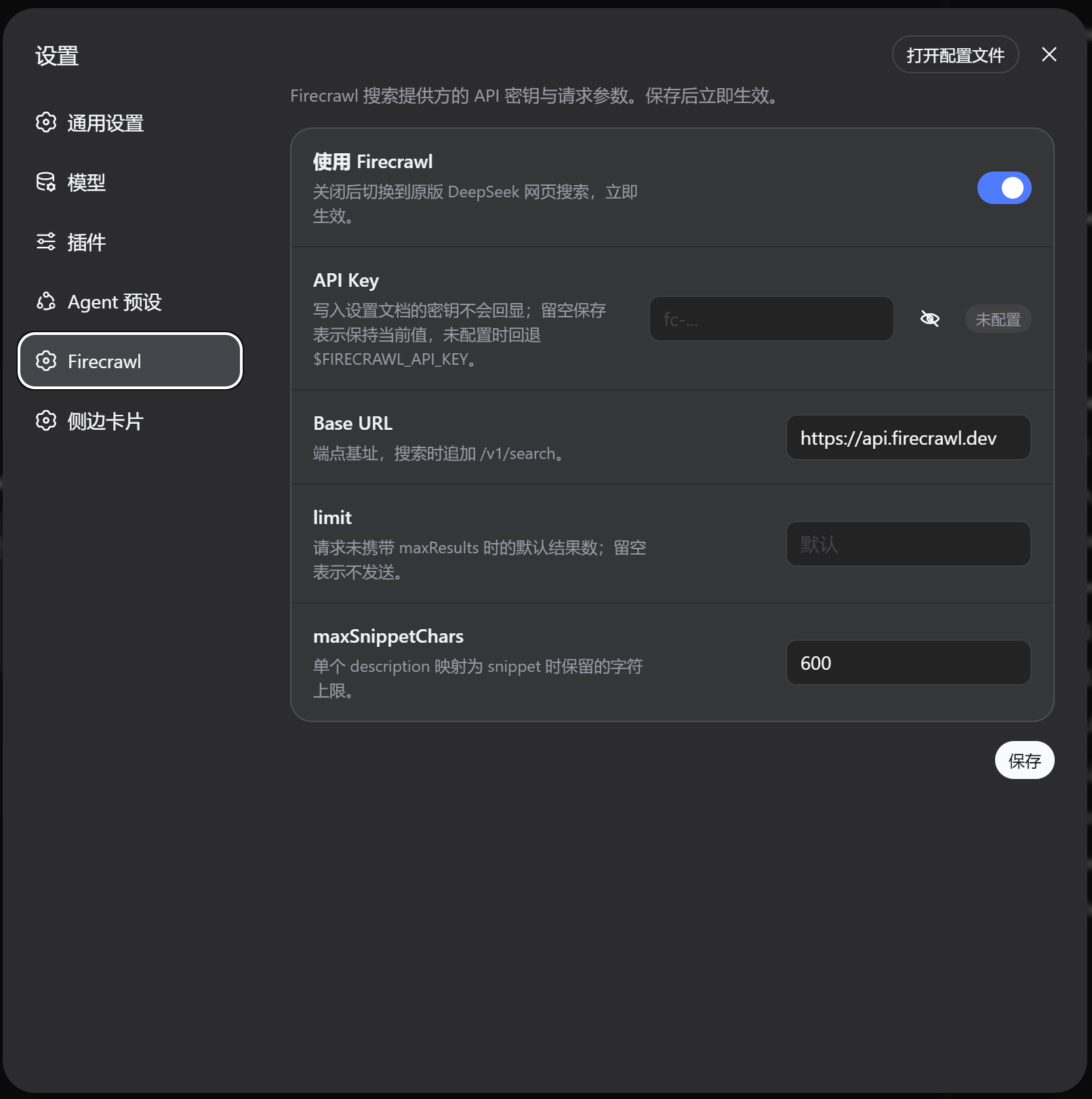
Installing the plugin switches the web seam's searchProvider to firecrawl, so Firecrawl replaces the original web search by default. In DSH Settings → Firecrawl, the Use Firecrawl switch at the top selects between the two providers live:
POST /v1/search is used.firecrawl provider delegates to the original DeepSeek search implementation, so the model keeps using the shipped DeepSeek search route; DeepSeek's endpoint/model still resolve from the original web-search-deepseek settings section.The switch applies immediately without a restart. Firecrawl credentials and request settings are preserved while off.
Open DSH Settings → Firecrawl:
fc-... into the API Key field and save. The eye button beside the field toggles plain-text visibility for the current draft.role('secret'): the saved literal never rides a response; the page only shows whether a key is configured.If the settings-page key is blank, the provider still falls back to $FIRECRAWL_API_KEY:
export FIRECRAWL_API_KEY=fc-...
dsh --profile web| Key | Default | Meaning |
|---|---|---|
useFirecrawl |
true |
Whether to use Firecrawl; false switches back to the original DeepSeek web search. |
apiKey |
(blank) → $FIRECRAWL_API_KEY |
Firecrawl API key. Written as a secret by the settings page and never echoed back. Blank falls back to the env var; with neither present the provider is unavailable. |
baseURL |
https://api.firecrawl.dev |
Endpoint base; /v1/search is appended. An unparseable value makes the provider unavailable. |
limit |
(unset) | Default result count when a request carries no maxResults. Unset sends no default. Must be a positive integer. |
maxSnippetChars |
600 |
Upper bound on characters kept from one description when mapping snippet. Must be a positive integer. |
Every field is editable from the settings page. Bundle config remains the composition base layer under that user section, so a profile can pin only the fields it needs:
# profile cordis.patch.yml (optional; usually not needed)
- id: web-search-firecrawl
  name: '@elves-ai/dsh-web-search-firecrawl'
  config:
limit: 10Firecrawl returns a flat data[] and no generated answer, so content is omitted. Each entry maps to a WebSearchSource: url ← url, title ← title, snippet ← description trimmed and bounded to maxSnippetChars (an entry without a non-blank description keeps its citeable URL-only source). A request's maxResults wins over the configured limit default and is sent as Firecrawl's limit for a cost/latency optimization; the final bound is enforced by the seam. Provider failures (HTTP errors, network failure, unparseable or wrong-shape bodies, a success: false envelope) surface as WebError WEB_PROVIDER_ERROR; an aborted request surfaces as WEB_ABORTED. HTTP redirects are rejected before the Location target is contacted.
Indirect, through @deepseek-ai/dsh-tool-web: the model sees the maxResults-bounded URLs, titles, and bounded descriptions, plus the consumer's error wrapper around Firecrawl search aborted, Firecrawl search request failed: <error>, and Firecrawl returned an unprocessable response body: <error>. Generated answers and provider-private fields stay out of context.
description excerpt, not a search-engine summary — it can be long page markdown, so the provider bounds it to maxSnippetChars; entries without a description carry no snippet at all (URL-only).limit/maxSnippetChars are exposed — Firecrawl's other controls (language, country, recency, location, targeting, scrape options) wait on provider-neutral Service Definition fields in @deepseek-ai/dsh-web.DOMException named AbortError maps to WEB_ABORTED; an abort carrying a custom reason surfaces as WEB_PROVIDER_ERROR.pnpm install
pnpm run typecheck
pnpm test # unit suite (no network)
FIRECRAWL_API_KEY=... pnpm run test:e2e # live-API smoke, self-skips without the key
pnpm run build # emits lib/ (ESM host) + lib/client.js (browser) + lib/types/ (d.ts)MIT
CLASSIFICATION EVIDENCE
系统优先读取 GitHub Topics,再与站内分类词典和词根规则比对。当前命中: 无有效分类标签。
deepseek-ai
DeepSeek Harness: Everything is a Plugin.

anywhere-labs
为 DeepSeek Harness (DSH) 插件生态打造的现代化桌面端解决方案。万物皆「插件」,桌面本身也是「插件」。

walkinglabs
Harness engineering beginner tutorial, from 0 to 1