

模型与 MCP
待识别

rea
morluto
Reverse engineer anything with agents, from app behavior down to native binaries.
PROJECT TOPICS
INSTALL REFERENCE
dsh plugin --profile web add github:elliotmasheal/dsh-provider-enhance
该命令指向仓库当前默认分支;尚无绑定当前 commit 的完整验证结果。
PROJECT README


English | Chinese
One third-party provider, many named configurations. DeepSeek Harness (DSH) binds one credential per provider route; ProviderEnhance turns a provider profile into a container of equally editable configurations — each with its own name, API key, endpoint, wire protocol and model list. Chat's model picker groups models by those configuration names.
Built and tested against DSH Desktop 0.2.1-rc.3 on Windows. The adapter half is a patched build of the bundled
@deepseek-ai/dsh-llm-pi-ai; read Compatibility and risks before upgrading DSH.
Maintained by Youpeng (@elliotmasheal).
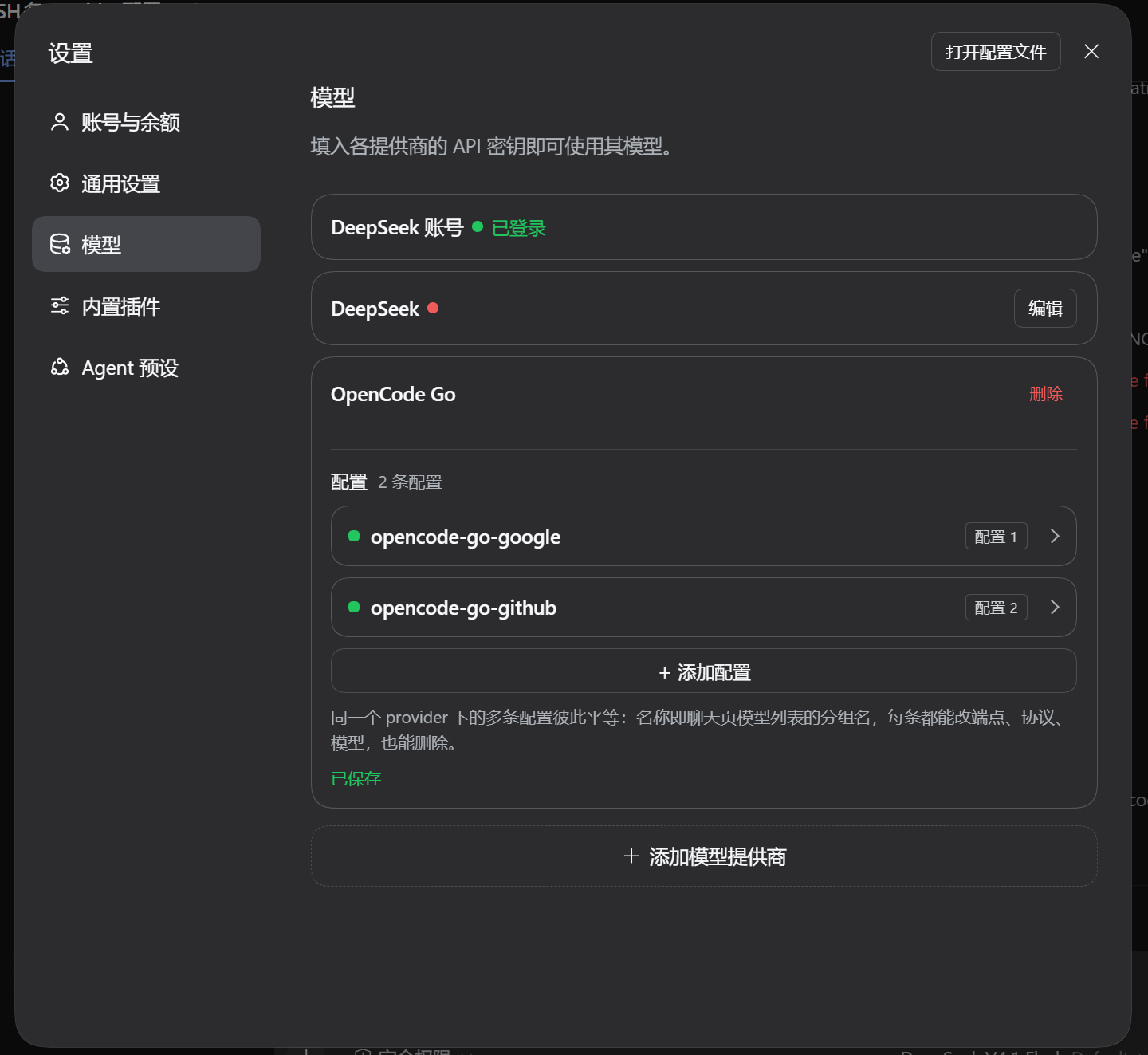
The Models page: one provider card holding several peer configurations, each with its own key, endpoint, protocol and model list.
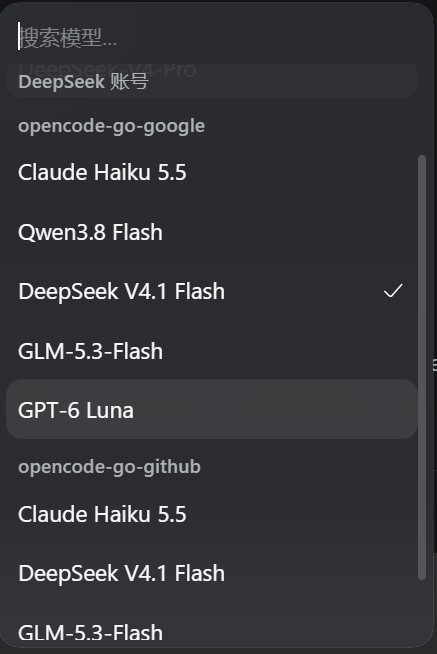
The chat model picker: models are grouped under configuration names
(opencode-go-google, opencode-go-github, …).
A model route in DSH is one provider id with one display name, one credential
reference and one model list; registering the same route twice fails with
DUPLICATE_ADAPTER. That makes "two subscriptions of the same provider"
impossible with the stock UI. ProviderEnhance keeps one provider id in
configuration and expands its accounts into internal routes at load time, so
each configuration gets its own credential and its own chat group while the
Models page still shows a single provider row.
Requirements: DSH Desktop 0.2.x with the desktop profile, and the Node/pnpm that DSH ships (the script finds them). Node 22+ is only needed when you run the script with your own Node.
git clone https://github.com/elliotmasheal/dsh-provider-enhance.git
cd dsh-provider-enhance
node scripts/install.mjs --profile desktop
The installer:
packages/adapter as @deepseek-ai/dsh-llm-pi-ai in the profile, so the
loader resolves the patched adapter for the existing llm-pi-ai row;packages/ui and appends it to dsh.profile.bundles;pnpm install (backups of package.json /
pnpm-lock.yaml are written first).Restart DSH Desktop afterwards. The profile links to this clone, so keep the directory where it is (re-run the installer if you move it).
Options:
--dry-run prints the manifest changes without writing them.--no-install skips pnpm; run pnpm install in the profile yourself.--home <DSH_HOME> for a non-default harness home.--profile <name> for a profile other than desktop.The installer edits the profile manifest, so review it with --dry-run first if
you keep the profile under version control.
The UI bundle is also published on npm as
dsh-provider-enhance.
It is only the Web half: the stock adapter rejects accounts, so installing the
npm package alone shows the configuration editor but breaks provider loading.
The installer above adds both halves; if you install from npm, link
packages/adapter into the profile as well.
opencode-go) and paste the first subscription's API key.GET {baseURL}/models
for custom endpoints);providers:
opencode-go: # the only route id in configuration
models: [...] # provider defaults, inherited by configurations
accounts: # configuration 1 … N, in order
- name: opencode-go-google
apiKeyEnv: OPENCODE_GO_API_KEY
- name: opencode-go-github
apiKeyEnv: OPENCODE_GO_2_API_KEY
- name: opencode-go-work
apiKeyEnv: OPENCODE_GO_3_API_KEY
baseURL: https://opencode.ai/zen/go
api: openai-completionsaccounts[0] is served on the base route id (opencode-go), so
agent-default-model and existing session logs keep working; entries 2…N
expand to internal routes opencode-go#2, #3 that inherit the profile and
catalog.api /
baseURL win over those defaults when set, and models replaces the served
list. Configurations therefore behave identically instead of configuration 1
forcing its own protocol.models / compat / headers / retryPolicy override the
profile defaults; blank values inherit. headers merge field by field with
the provider's headers.configName, so the provider's
product name never doubles as a chat group name.Every provider request carries the harness identity, the configuration's headers, and the protocol headers pi-ai adds:
user-agent is always deepseek-harness/<version> (+url). A configured value
is dropped so attribution cannot be suppressed.opencode-go, opencode) pi-ai sends
x-opencode-session with the current DSH session id. That name is reserved:
a configured value is dropped, so every conversation keeps its own id. The
id is stable for the life of a session (including resume, compaction and the
session-title request) and differs for a new session or a subagent.x-client-request-id with the same
session id from pi-ai.headers untouched, including a
custom session header, because no OpenCode provider wrapper is involved.packages/adapter/lib/index.js is a built
artifact extracted from that build and patched. After a DSH upgrade, re-run
the upstream extraction and re-apply the patches in
docs/upgrading.md; otherwise the plugin fails to load or
loses the accounts feature.*_rowActions). If a future
build renames that class, the button reappears; nothing else depends on it.+ Add configuration); this is a page-internal filter that slots cannot
extend.This project is not affiliated with, endorsed by, or sponsored by DeepSeek.
Run the diagnostic first:
node scripts/doctor.mjs --profile desktopIt checks the profile manifest, the linked adapter and UI bundle, the adapter
patch markers, the accounts blocks, and the installed DSH version.
Common issues:
| Symptom | Likely cause |
|---|---|
| The Models page shows no configuration UI | The UI bundle is not in dsh.profile.bundles; re-run the installer and restart. |
Startup fails with "unexpected field accounts" |
The patched adapter is no longer linked (for example after a DSH upgrade); re-run the installer. |
| DSH does not start after uninstalling | accounts blocks remain in the profile's cordis.patch.yml; run node scripts/uninstall.mjs again or remove them by hand. |
| Two configurations share a name | Names must be unique per provider; rename one. |
Fetch models returns nothing |
The endpoint answered no models; check the base URL and key, or add models manually. |
node scripts/uninstall.mjs --profile desktopThe script removes the adapter and UI dependencies, deselects the bundle, and —
because the stock adapter rejects unknown fields — removes the accounts:
blocks from the profile's cordis.patch.yml after writing a backup. Pass
--keep-accounts to leave them in place. Restart DSH afterwards.
| Path | What |
|---|---|
packages/adapter |
Patched @deepseek-ai/dsh-llm-pi-ai (drop-in override; not published) |
packages/ui |
dsh-provider-enhance Web client bundle and locale dictionaries |
patches/0001-accounts-and-headers.patch |
the adapter diff against the published upstream release |
scripts/install.mjs, scripts/uninstall.mjs, scripts/doctor.mjs |
profile installer, remover and diagnostics |
scripts/sync-adapter.mjs |
rebuilds packages/adapter/lib/index.js from npm + patches |
scripts/check.mjs |
offline syntax/manifest/hygiene checks (also runs in CI) |
tests/headers.test.mjs |
fake-fetch regression tests for the header contract |
docs/upgrading.md |
how to re-patch the adapter after a DSH update |
docs/architecture.md |
how the loader override, slots and route expansion fit together |
node scripts/check.mjs
npm test                       # header tests; need a DSH install (or peers below)
node scripts/install-test-peers.mjs   # fetch the published DSH peer packages
DSH_APP_NODE_MODULES=.test-dsh/node_modules npm test
node scripts/sync-adapter.mjs --check # adapter == npm upstream + patches
node scripts/pack-check.mjs           # published tarball contents
check.mjs verifies JavaScript syntax, manifests, patch markers and scans the
tree for personal absolute paths or secret-like strings. CI runs the same
checks on Linux and Windows, and runs the header tests against the published
DSH 0.2.1-rc.3 packages.
Contributions are welcome; see CONTRIBUTING.md. Please report security issues privately as described in SECURITY.md.
MIT. packages/adapter/lib/index.js is a modified copy of
@deepseek-ai/dsh-llm-pi-ai (MIT, Copyright (c) 2026 DeepSeek). See
LICENSE and NOTICE.md.
CLASSIFICATION EVIDENCE
系统优先读取 GitHub Topics,再与站内分类词典和词根规则比对。当前命中: deepseek-harness。
morluto
Reverse engineer anything with agents, from app behavior down to native binaries.

deepseek-ai
DeepSeek Harness: Everything is a Plugin.

nexu-io
The 1st Collaborative AI Design Agent Workspace. Local-first and open source. Create motion, prototypes, websites, apps, dashboards, presentations, images, and videos with your team and AI agents. Share work, exchange feedback, and iterate together in one workspace.