
模型与 MCP
待识别

rea
morluto
Reverse engineer anything with agents, from app behavior down to native binaries.
PROJECT TOPICS
INSTALL REFERENCE
dsh plugin --profile web add github:dujar/dsh-community-plugins
该命令指向仓库当前默认分支;尚无绑定当前 commit 的完整验证结果。
PROJECT README
English | 简体中文
A DeepSeek Harness (DSH) web-GUI plugin that adds a Community plugins tab to Settings → Plugins. It discovers the plugins published under GitHub's dsh-plugin topic, keeps a local SQLite catalog of their metadata, refreshes it in the background, and lets you search, browse, aggregate by tag, and install/uninstall with one click.
The tab sits alongside the built-in Plugin configuration and Plugin list tabs. The built-in Plugin list only shows what is already installed; this tab makes the rest of the community discoverable.
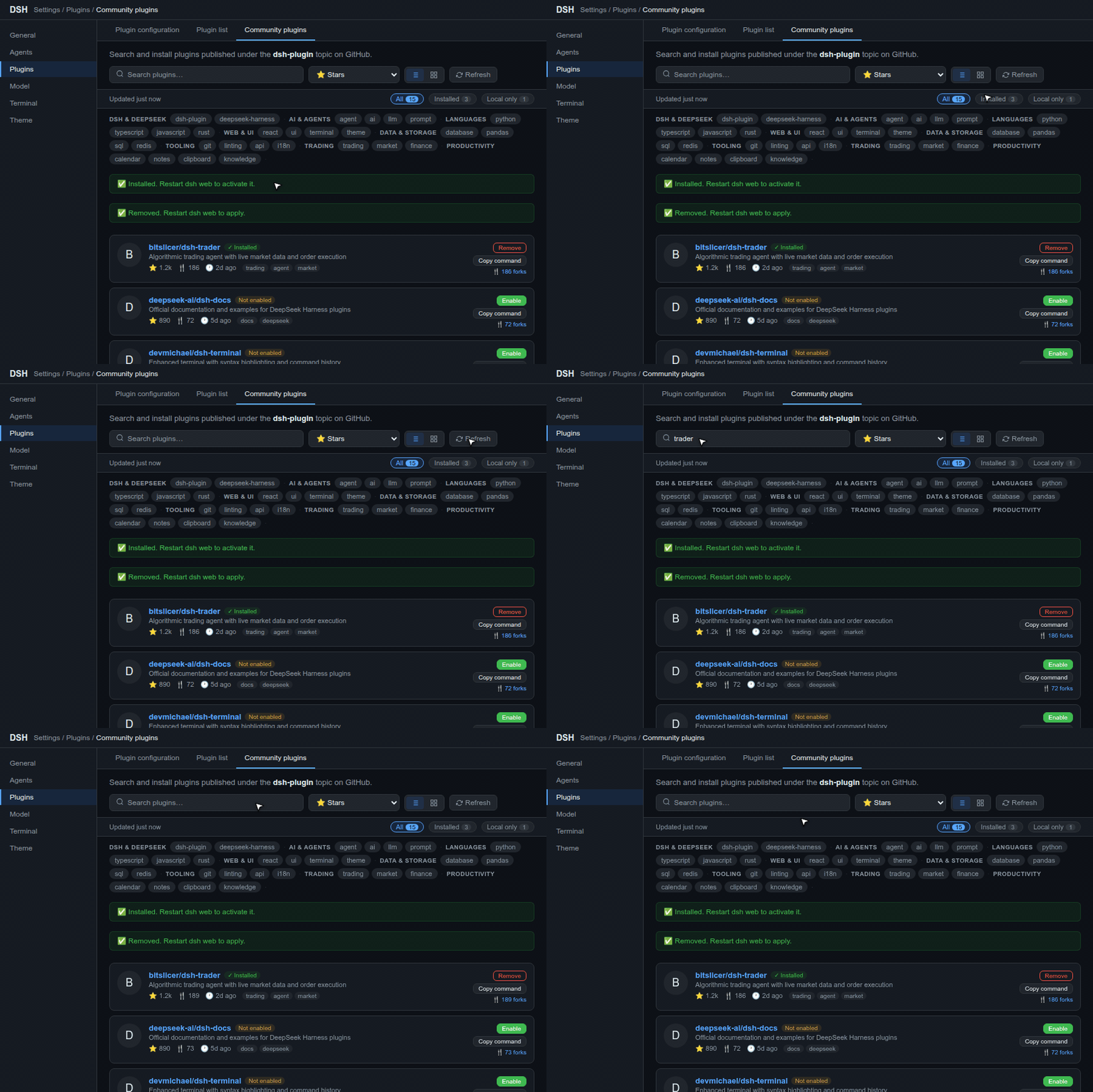
dsh-plugin and deepseek-harness tags are omitted.$DSH_HOME/dsh-community-plugins/catalog.db (node:sqlite). Browsing, searching, sorting and tag aggregation all read this local file, so they are instant and offline.Refresh, and the filters plus the last result set survive switching settings tabs and reloading the page. Clear filters in the status row resets search, sort, tags and the status filter in one click.file:/link: specs resolve relative to the profile directory, anything else through the profile's node_modules), its install spec, an Uninstall button that removes by package name, and — when the package ships one — its README rendered inline (a safe minimal markdown subset: headings, bullets, fenced code, bold/italic, http(s) links; everything else is escaped, truncated at 12k chars). Multiple README variants (README.md, README.zh-CN.md, …) become language tabs on the card, so each reader can pick their preferred language. A local plugin whose repo exists on GitHub additionally renders with the same rich card as catalog rows (avatar, stars, forks + fork browser, topics, remove/open actions) — metadata is fetched once per repo and cached in SQLite.dsh web startup (top repos by stars and by recent update) and refreshes again in the background when you change the search term, so the cache grows with what you look for. A Refresh button forces an immediate update; the status row shows Updating… while a fetch is in flight, and the list picks up the new rows once that fetch lands.updated_at (any repo change), not the push time the cards display.github.com/<upstream>/compare/<branch>...<forkOwner>:<branch>) so you can see what it carries that upstream has not merged, and an Install button that installs that fork instead of the original. When a fork would displace an already-installed plugin of the same name, the row says replaces <owner/name>. Listings are cached per repo (10 min, DSH_COMMUNITY_FORKS_TTL_MS); Refresh in the dialog forces a fresh fetch.dsh plugin --profile <profile> add github:owner/name on the host (pnpm under the hood) and reconciles dsh.profile.bundles. A pre-flight check fetches the repo's package.json and rejects repos that do not declare a dsh.bundle manifest, so repos that merely carry the dsh-plugin topic (the harness itself, apps, demos) fail fast with a clear reason instead of a confusing pnpm error or a hang./home/user/my-plugin), then click Validate. The host reads that directory's package.json and checks for a dsh.bundle.patch declaration — if the manifest is missing, invalid JSON, or lacks the DSH bundle key, the UI shows a clear error and the install button stays disabled. Once validated, click Dry run to confirm the metadata (name, version, author, description) before committing; the dry run returns the same info without touching pnpm. Only after a successful dry run does Install local plugin become active, and clicking it runs the real dsh plugin add <path> on the host./community-plugins/browse. A browser folder chooser cannot return an absolute path without routing the selection through a file-upload prompt, which is the wrong shape when only a path is wanted, so the disk is read server-side instead — nothing is uploaded. Folders that already hold a dsh.bundle manifest are badged plugin and can be taken with Select without opening them; Select this folder takes whatever directory is currently listed. Hidden directories are off by default and the toggle persists while the tab is open.package.json, so anything you installed earlier (here or with dsh plugin add) shows a green Installed badge and a Remove button instead of Install. A plugin that is installed but missing from dsh.profile.bundles — installed, not loaded — additionally shows a Not enabled badge. Matching is by resolved GitHub repo, falling back to package name, so a plugin installed from the npm registry under a name that differs from its repo is not detected.dsh.profile.bundles in the profile manifest. The badge and button flip immediately; the harness itself loads or unloads the plugin after you restart dsh web. Only names that are actually installed can be toggled, so the manifest can't be polluted with unknown entries. Every notice that needs one carries a Restart dsh web button: it respawns the server with the exact command line it was launched with, and the page reloads itself once the new instance answers.dsh plugin --profile <profile> remove <package>, resolving the actual package name from the profile manifest.--dsw-alias-*), so it follows the light/dark theme automatically.Requires Node.js 22.19+ and pnpm (
dsh plugininstalls through pnpm under the hood).
# local checkout (development)
dsh plugin --profile web add /path/to/dsh-community-plugins

# from GitHub
dsh plugin --profile web add github:dujar/dsh-community-plugins
Then restart dsh web and refresh the browser page. The install adds dsh-community-plugins to the profile's dsh.profile.bundles automatically; if it is not added, append "dsh-community-plugins" to that array in $DSH_HOME/profiles/web/package.json and restart.
dsh web and refresh the page (the note under the result explains this). Newly installed plugins appear in the built-in Plugin list tab after the restart.dsh-community-plugins/
package.json # manifest + dsh.bundle.patch / dsh.client declarations
cordis.patch.yml # host-half mount line (applied by the profile bundle mechanism)
lib/
index.js # host half: SQLite catalog + background refresh + install/uninstall routes
client.js # browser half: list/grid/table views + tag aggregation (React, zero-build, i18n)
test/
helpers.test.mjs # repo/spec parsing helpers
catalog.test.mjs # SQLite upsert / query / tag aggregation
host-smoke.test.mjs# route registration
client-smoke.test.mjs # slot wiring
install-route.test.mjs # install pre-flight + responses
folder-picker.test.mjs # browse route + local validate/install flow
forks.test.mjs # fork listing cache, forced refetch, rate-limit fallback
installed-state.test.mjs # profile manifest -> installed / enabled reporting
toggle-route.test.mjs # enable/disable edits dsh.profile.bundles, guarded
restart-route.test.mjs # restart responds, schedules restarter, exits; untrusted rejected
mini-react.mjs # React stub + fake clock shared by the client tests
persistence.test.mjs # cached results / filter-driven refetch / clear filters
forks-ui.test.mjs # fork count -> fork browser -> install from a fork
LICENSE
README.md # English (this file)
README.zh-CN.md # Simplified Chinese| Route | Method | Description |
|---|---|---|
/community-plugins/catalog |
GET | Local catalog query. Params q, tag, sort (stars/forks/created/updated/name), filter (all/installed/local), limit, offset. filter=local returns the profile's installed plugins with no catalog row (flagged local: true). Returns { items, total, allCount, tags, counts, filter, refreshing, refreshedAt }. |
/community-plugins/refresh |
POST | Body { q }; schedules a background GitHub fetch. |
/community-plugins/forks |
GET | Params repo (owner/name), force (1 to bypass the cache). Returns { ok, items, fetchedAt, cached, stale?, rateLimited? } — one page of forks (up to 50, by stars), cached in SQLite. |
/community-plugins/state |
GET | Returns { profile, plugins: [{ name, spec, repo, enabled }] } — the profile name and installed out-of-tree plugins. enabled is true when the package is listed in dsh.profile.bundles (i.e. actually mounted). |
/community-plugins/install |
POST | Body { repo: "owner/name" } for GitHub installs, or { path: "/local/path", dryRun?: bool } for local filesystem installs. A dryRun: true returns metadata without running pnpm. Runs dsh plugin --profile <p> add <spec> on the host. |
/community-plugins/uninstall |
POST | Body { repo: "owner/name" }, or { name } for a local plugin with no GitHub repo (the name must be actually installed). Runs dsh plugin --profile <p> remove <name>. |
/community-plugins/browse |
GET | ?path= (empty means the user's home) and ?hidden=1; returns { ok, path, parent, entries: [{ name, path, plugin }], self, home, truncated, reason }. Subdirectories only, symlinked directories followed, capped at 400 entries. |
/community-plugins/validate |
POST | Body { path: "/local/path" }; reads the local package.json, checks for dsh.bundle.patch, returns { ok, installable, name, version, description, author, reason }. |
/community-plugins/plugin |
POST | Body { name, enabled }; adds or removes the name from dsh.profile.bundles in the profile manifest. Guarded to installed plugin names. |
/community-plugins/restart |
POST | Respawns this dsh web process (detached restarter re-execs the original command line after a 1.5s port-release wait), responds { ok, restarting }, then exits. DSH_COMMUNITY_RESTART_CMD overrides the re-exec command for supervised setups. |
All routes are guarded by the same fail-closed same-origin/localhost trust check as dsh-trader: a cross-origin or malformed Origin/Referer rejects, a CORS-simple content type rejects, and only then does a localhost host count as trusted.
Environment variables (all optional):
| Variable | Default | Purpose |
|---|---|---|
DSH_COMMUNITY_PROFILE |
auto-detected | The profile to install into. Falls back to DSH_PROFILE, then auto-detection, then web. |
DSH_PROFILE |
— | Fallback profile name when DSH_COMMUNITY_PROFILE is unset. |
DSH_BIN |
dsh on PATH |
Full path to the dsh executable used for install/uninstall. |
DSH_COMMUNITY_INCLUDE_FORKS |
unset | Any non-empty value includes GitHub forks in the catalog (forks are excluded by default). |
DSH_COMMUNITY_MIN_FETCH_INTERVAL_MS |
6000 |
Minimum gap between GitHub fetches, to stay under the search rate limit. |
DSH_COMMUNITY_FORKS_TTL_MS |
600000 |
How long cached fork listings and GitHub repo metadata are served before GitHub is asked again. The REST endpoints use GitHub's core limit (60/hr unauthenticated), separate from search. |
DSH_COMMUNITY_GITHUB_TOKEN |
— | Optional bearer token (falls back to GITHUB_TOKEN) sent with GitHub API requests — lets the fork browser and local-plugin metadata reach private repos you have access to. |
DSH_COMMUNITY_RESTART_CMD |
— | Overrides the restart command (e.g. systemctl restart dsh-web). Default: re-exec this process's own command line. |
Profile auto-detection finds the profile whose dsh.profile.bundles includes this plugin, so a custom profile hosting the web GUI works without any configuration.
node --check lib/index.js
node --check lib/client.js
npm test
npm pack --dry-run   # package validation before publishing
docs/record.mjs regenerates the docs/demo.gif at the top of this README (it drives a running DSH page with Playwright; playwright is a dev dependency only).
CLASSIFICATION EVIDENCE
系统优先读取 GitHub Topics,再与站内分类词典和词根规则比对。当前命中: deepseek、deepseek-harness。
morluto
Reverse engineer anything with agents, from app behavior down to native binaries.

deepseek-ai
DeepSeek Harness: Everything is a Plugin.

nexu-io
The 1st Collaborative AI Design Agent Workspace. Local-first and open source. Create motion, prototypes, websites, apps, dashboards, presentations, images, and videos with your team and AI agents. Share work, exchange feedback, and iterate together in one workspace.