

模型与 MCP
待识别

rea
morluto
Reverse engineer anything with agents, from app behavior down to native binaries.
PROJECT TOPICS
PROJECT README
A real Monaco editor inside the DeepSeek Harness right sidebar: open a text or code file and edit it in place, save it under a version guard, and extend it from your own plugins with language and theme registrations.
English | 简体中文

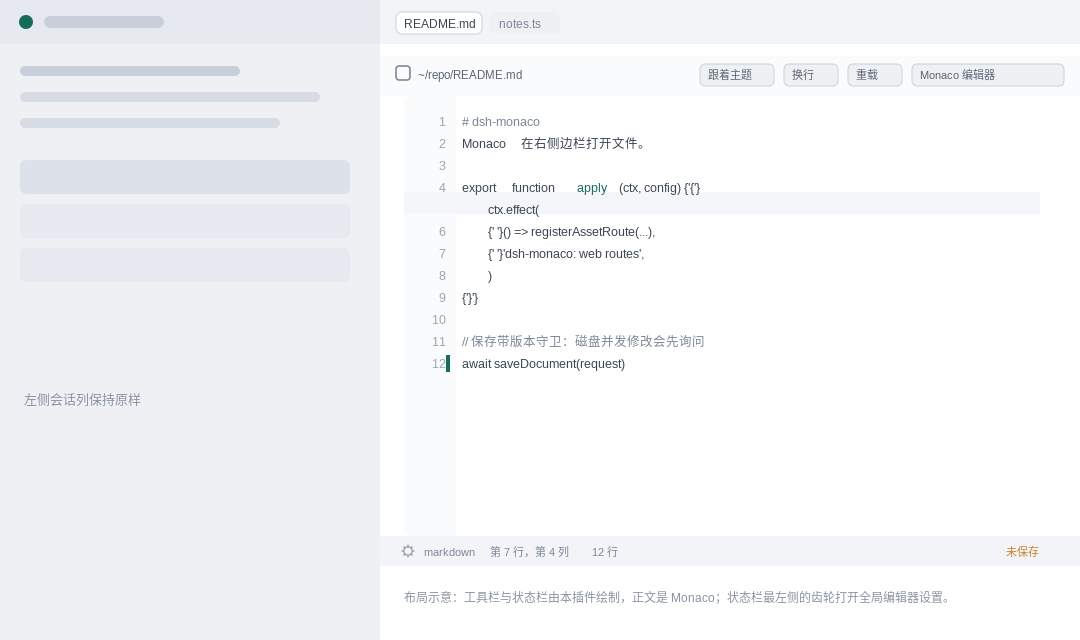
dsh-monaco replaces the right sidebar's read-only file preview for text and code files with an editable Monaco instance. It reads through the platform's own remote.workspaceFiles channel, writes through a host route it registers itself (the platform file service is read-only), and exports ctx.monacoEditor so other plugins can register languages, Monarch tokenizer rules, themes, commands, and actions.
| Capability | Detail |
|---|---|
| Takes over the file preview | Registers a document-preview implementation at extension priority, covering the built-in code preview and the plain-text fallback. Images, PDF, Office, and Excel still render through the platform's own implementations. |
| In-place edit and save | Ctrl/Cmd+S writes back to disk, and closing a tab offers the same. A successful save refreshes the local baseline; undo/redo, cursor, and scroll position survive switching to another tab. |
| Unsaved marker | A tab with changes draws its chip × as a dot (hover restores the ×), matching VS Code. |
| Close confirmation | Closing a tab with unsaved changes asks Save / Don't Save / Cancel: Esc cancels, Enter saves. A failed save keeps the dialog open and shows the reason inside it. |
| Version guard | A save carries the file version observed at read time. If the file changed on disk since, the host answers 409 and the UI offers Reload or Overwrite anyway — never a silent overwrite. |
| Follows the UI theme | Monaco colors are derived from --dsw-alias-* variables (selection uses the theme's own document-selection veil, cursor and focus use the brand accent, scrollbars use border colors) and follow light/dark switches. A registered theme can be pinned in config instead. |
| Follows font settings | Code font family and size come from the code font in Settings → Appearance and apply immediately, without reopening the file. |
| Editor settings | The gear at the left of the status bar opens a global settings panel (shared by every editor in the browser, persisted in localStorage). It currently offers Word wrap. |
| Popup colors | The context menu and command palette follow the UI theme, including the corner radius, border, and shadow they depend on. |
| Localization | Strings register into the platform locale system; Monaco's own message bundles load per UI language (zh-cn, zh-tw, ja, ko, de, and others). |
| Extension API | ctx.monacoEditor: register languages with Monarch rules, themes, commands, actions, extra claimed extensions, and subscribe to document open/save/change/close. |
Editor assets. The host mounts the whole monaco-editor/min/vs directory under /dsh-monaco/vs/ as a kind: 'prefix' route. The browser injects loader.js and loads the AMD module vs/editor/editor.main. Language packs, fonts, and the four language workers all come from Monaco's own directory layout, so the plugin's own bundle stays small.
Asset hardening. A request path is decoded first, then validated segment by segment: ./.., an embedded / or \ inside a single segment, and NUL are rejected, and only a whitelisted set of extensions passes. The resolved absolute path is checked for containment once more before the file is read.
Reading. Reads go through the platform's remote.workspaceFiles.readBytes (per-session authorization, with a byte ceiling) and are decoded strictly as UTF-8. Decode failures, missing files, and oversize reads surface a readable message rather than a silent fallback.
Writing. The platform file remote is read-only, so the plugin registers POST /dsh-monaco/api/write on the host: validate protocol version and JSON shape → resolve the session cwd → lstat and reject non-regular files → resolve the sandbox policy for the session → fs.writeText with a replaceIfVersion guard. FS_STALE_VERSION maps to 409 stale-version; a sandbox refusal maps to 403.
Document takeover. The implementation registered with ctx.documentPreviews works in renderer mode and reads the whole file itself. Switching away from a tab unmounts the view, but the Monaco model and unsaved text stay in plugin state; they are released only when the tab record disappears (tab.signal aborts).
Theme and font. On theme/change the colors are re-derived and defineTheme runs again. These variables' declared values are usually another var() (or even color-mix()), while Monaco only accepts resolved colors and a real font-family list — so instead of chaining variables by hand, var(--x, sentinel) is applied to a temporary element's standard property and the browser-resolved value is read back with getComputedStyle. The sentinel distinguishes "variable not defined".
The value read back must then be normalized to hexadecimal: Monaco 0.57 theme colors accept only #rrggbb / #rrggbbaa, and passing rgb(), rgba(), or color(srgb …) throws Illegal value for token color inside editor.create, leaving the editor half-initialized (default white background, no syntax coloring). A value of undefined throws as well, so unparseable keys are simply omitted and left to the base theme, and a variable that cannot be normalized produces one warning.
Semantics matter too: --dsw-alias-brand-primary is the text-primary tier (near-white in dark mode, near-black in light), not the brand accent. Selection therefore uses --dsw-alias-bg-document-selection, cursor and focus use --dsw-alias-brand-primary-new-colorprimary-new-color, scrollbars use --dsw-alias-border-l2/-l4, and popup surfaces use --dsw-alias-bg-layer-3. When stacking alpha, the existing alpha is multiplied (border-l1 is already 6% white; overwriting it would blow it up to 50%).
Fonts come from the composed --ds-font-family-code and --dsh-code-font-size on body; interface text such as the status bar uses the text stack --dsw-font-family.
Close confirmation. The platform's close chain is synchronous: sidebarRight.close(tabId) → close hook → remove the tab. The hook either returns normally (close proceeds) or throws (the tab is preserved — the platform documents Failure preserves the tab, and its own click path catches and logs the exception). So "show a confirmation dialog" is implemented as: registerCloseHandler('text', …) throws TabCloseVeto to abort the close when the tab has unsaved changes, and the dialog lives in shell.overlay. Once the user chooses, the guard issues a permitted close. The permit lasts only for that one synchronous call, so it never leaks into the next close.
The chip × is rendered by the platform's docking component and has no replacement hook, so the dot leaves the title alone: it sets a data-dsh-monaco-tab-dirty marker on the close button and the stylesheet turns the icon into a dot (visibility, not display, so the button keeps its size and the strip does not jitter). The marker is re-applied both when the dirty state changes and when the strip re-renders, since React remounts nodes and drops foreign attributes.
Two platform behaviors are known and left as they are: Ctrl/Cmd+W goes through the platform's shortcut dispatcher, which has no try/catch, so a keyboard close logs one thrown TabCloseVeto to the console — the dialog still appears and nothing else is affected; and when the platform "replaces a tab with new content" it runs the same close hook, so the dialog's Save closes the old tab first and that navigation has to be reissued. Both are properties of the platform close chain, not something the plugin works around.
Popup variables. The context menu and command palette are not rendered inside the editor — Monaco puts them in the Shadow DOM of a div.shadow-root-host, whose :host { all: initial } cuts off every inherited value, while --vscode-* variables are declared only on .monaco-editor / .monaco-component. Inside the popup, background-color: var(--vscode-menu-background) therefore fails outright (transparent background) and color falls back to the initial value (black) — black text on a dark background is effectively invisible.
The fix mirrors those variables onto document.documentElement: a Shadow DOM host inherits from document, so custom properties propagate into the shadow tree. The values are read from Monaco's own injected style.monaco-colors, so re-mirroring after a theme switch keeps up and no second copy of the palette has to be maintained here. Once that color sheet is found, observation narrows to the sheet itself (Monaco switches themes by rewriting the text of an existing <style>), so unrelated head changes do not trigger a re-read.
Monaco also only references, never defines, --vscode-cornerRadius-*, --vscode-strokeThickness, and --vscode-shadow-lg (in VS Code these come from the workbench stylesheet); without them the menu has no rounded corners and no border. The plugin supplies defaults: radius and stroke are fixed, and the shadow is composed from the theme's mask color. If Monaco ever declares them itself, its values win.
The theme also writes the menu.* color family (background, foreground, border, separator, selection) explicitly; otherwise the menu falls back to Monaco's own grey and no longer matches the DSH layers.
Editor settings. Settings live in localStorage (key dsh-monaco/editor-settings) and are shared by the current page and other same-origin windows — cross-window sync uses the storage event, which the writing window does not receive, so it cannot feed back on itself. Changes are pushed to every open editor immediately.
Word wrap currently has two sources: the global setting is the default, and the preview toolbar's button is a per-tab override. The platform's own state defaults to "on" and cannot distinguish "the user just turned it off" from "the initial value", so the toolbar value is recorded as an override only when it changes — the initial value at mount does not count, otherwise the global setting would never take effect. The override lives with the tab and does not follow you to another file. Changing the global setting clears the current tab's override; without that, a user who once pressed the toolbar button could never get back to "follow the global setting".
From a Git source (the source is fetched and built in place; pnpm blocks dependency build scripts by default, so approve it once when prompted):
dsh plugin --profile web add "github:dsh-plugins/dsh-monaco"Or, inside a DSH session, point plugin_manager's install_bundle at this directory; or install a local directory from the command line:
dsh plugin --profile web add C:\path\to\dsh-monacoBuilding from source:
git clone https://github.com/dsh-plugins/dsh-monaco.git
cd dsh-monaco
npm install --ignore-scripts
npm run build
npm test
npm test runs tests/*.test.ts directly with node --test, relying on type stripping in Node ≥ 22.18 (engines.node declares that floor).
This package is not on npm yet. Once published,
dsh plugin --profile web add "@dsh-plugin/dsh-monaco"will install it without a build step.
cordis.patch.yml inserts one host entry (@ is a reserved YAML indicator, so the scoped package name must be quoted):
- insert:
    - id: dsh-monaco
      name: '@dsh-plugin/dsh-monaco'
After installing from a linked directory, re-running npm run build does not switch a running instance to the new host-side artifact: the module URL is unchanged, so Node's ESM cache never re-reads it. Rebuild host code and restart the dsh instance; for client-only changes, rebuild and refresh the page.
- id: dsh-monaco
  name: '@dsh-plugin/dsh-monaco'
  config:
    editor:
      fontSize: 13
      tabSize: 2
      insertSpaces: true
      minimap: false
      theme: dsh
    extensions: [log, lock]
    maxWriteBytes: 8388608
assetCacheSeconds: 86400| Field | Default | Meaning |
|---|---|---|
editor.fontSize |
12 |
Editor font size (8–32); a code font size set in DSH takes precedence |
editor.tabSize |
2 |
Indent width (1–8) |
editor.insertSpaces |
true |
Indent with spaces |
editor.minimap |
false |
Show the minimap |
editor.theme |
'dsh' |
dsh follows the UI theme; any registered theme id may be pinned instead |
extensions |
[] |
Extra extensions to claim beyond the built-in set (a leading dot is allowed) |
maxWriteBytes |
8388608 |
Largest text accepted in one save; anything above is refused, never truncated |
assetCacheSeconds |
86400 |
Browser cache lifetime for Monaco's static assets |
Config is injected through webserver/index-inject as window.__DSH_MONACO_CONFIG__, so the host and the browser read the same values.
Declare 'monacoEditor' in your plugin's export const inject to use the client-side Cordis service ctx.monacoEditor.
export const inject = ['monacoEditor']

export function apply(ctx: Context): void {
  // Language + Monarch rules + language configuration
  ctx.effect(() => ctx.monacoEditor.registerLanguage({
    id: 'glsl',
    label: 'GLSL',
    extensions: ['.glsl', '.vert', '.frag'],
    tokens: {
      keywords: ['void', 'float', 'vec2', 'vec3', 'vec4', 'uniform', 'in', 'out'],
      tokenizer: {
        root: [
          [/\/\/.*$/, 'comment'],
          [/[a-zA-Z_]\w*/, { cases: { '@keywords': 'keyword', '@default': 'identifier' } }],
          [/\d+\.?\d*/, 'number'],
        ],
      },
    },
    configuration: { comments: { lineComment: '//' }, brackets: [['{', '}'], ['[', ']'], ['(', ')']] },
  }))

  // Theme: layered over one of Monaco's base themes
  ctx.effect(() => ctx.monacoEditor.registerTheme({
    id: 'dsh-monaco-solarized',
    label: 'Solarized',
    base: 'vs-dark',
    inherit: true,
    rules: [{ token: 'comment', foreground: '586e75' }],
    colors: { 'editor.background': '#002b36' },
  }))

  // Commands and actions: keybindings need Monaco's constants, so register after ready
  void ctx.monacoEditor.ready.then(() => {
    const monaco = ctx.monacoEditor.monaco
    if (monaco === undefined) return
    ctx.effect(() => ctx.monacoEditor.registerCommand({
      id: 'dsh-monaco.insertTimestamp',
      label: 'Insert timestamp',
      keybindings: [monaco.KeyMod.CtrlCmd | monaco.KeyCode.KeyK],
      run: ({ editor, monaco }) => {
        const line = editor.getPosition()?.lineNumber ?? 1
        editor.executeEdits('timestamp', [{
          range: new monaco.Range(line, 1, line, 1),
          text: `${new Date().toISOString()} `,
        }])
      },
    }))
  })

  // Extra claimed extensions
  ctx.effect(() => ctx.monacoEditor.registerFileExtensions(['log', 'properties.local']))

  // Document events
  ctx.effect(() => ctx.monacoEditor.events.onDidSaveDocument(({ sessionId, path, version }) => {
    ctx.logger.info('saved %s (%s) in %s', path, version, sessionId)
  }))
}
registerLanguage follows Monaco's languages.register field semantics: extensions, filenames, and filenamePatterns decide file matching, tokens is the Monarch rule set, and configuration is the language configuration. Plugin-registered languages rank ahead of Monaco's built-ins, so a plugin declaration wins for the same extension. The loader field loads another contribution bundle before the rules are applied (for example globalThis.require(['vs/basic-languages/…'])).
Full monacoEditor surface:
| Member | Meaning |
|---|---|
version |
Extension API version, currently 1 |
ready |
Promise resolved once Monaco is ready; the editor API is safe to call inside it |
monaco |
The loaded Monaco namespace, undefined before it is ready |
registerLanguage(contribution) |
Register a language, its rules, and its configuration; returns a disposer |
registerTheme(contribution) |
Register a color theme layered over a built-in base theme |
registerCommand(contribution) |
Register a command (command palette, optional keybindings) |
registerAction(contribution) |
Register an action (optional Monaco context-key precondition) |
registerFileExtensions(extensions) |
Claim additional file extensions for the editor |
getActiveEditor() |
The focused editor as { editor, monaco, document }, or undefined when none is open |
openFile({ sessionId, path, line? }) |
Open a file in the sidebar, optionally revealing a line |
events.onDidOpenDocument / onDidSaveDocument / onDidChangeDocument / onDidCloseDocument |
Document lifecycle |
npm run typecheck   # both tsconfigs: host and client
npm test            # node --test, type stripping over tests/*.test.ts
npm run build       # build:host (tsc) + build:client (tsdown + declarations)
The source has three layers:
src/shared/ — pure logic shared by host and browser (address construction, asset path validation, extension normalization, language matching, the save protocol, locale mapping). Tests concentrate on these runtime-independent rules.src/ (top level) — the host half: asset route, write route, Monaco directory resolution, config.src/client/ — the browser half: Monaco loader, theme derivation and popup variables, extension registry, editor state, save channel, close guard, editor settings and view, and the exported service.tsdown.client.config.mjs wraps the client output as window.__ModuleLoader__.load({ id: "@dsh-plugin/dsh-monaco", factory }) — the registration id must equal the package name, because the platform looks the factory up by entry id and otherwise reports loaded without registering. react, react-dom, and @deepseek-ai/cordis stay external; everything else is inlined. At runtime the plugin never value-imports @deepseek-ai/*: each half declares only the service faces it actually uses (src/host-types.ts, src/client/types.ts).
plugin tree failed to load, and the client entry appears in window.__DSH_BOOT__.entries__DSH_MONACO_CONFIG__ matches the host config/dsh-monaco/vs/loader.js, editor.main.js, editor.main.css, the locale packs, and the workers all answer 200 with the right Content-Type/dsh-monaco/vs/../../package.json, ..%2f..%2fpackage.json, and ..%5c..%5cpackage.json all answer 404__ModuleLoader__.load, and factory returns { name, inject, apply, VIEWER_ID }Ctrl+S still writes to disk× into a dot (data-dsh-monaco-tab-dirty, icon visibility: hidden, button size unchanged)rgb(53, 54, 56), text rgb(249, 250, 251), 8px radius, 1px borderwordWrap, persists to localStorage, and survives a page reloadLGPL-3.0-only. Monaco Editor is published by Microsoft under the MIT license; it is installed as a dependency and is not redistributed by this repository.
CLASSIFICATION EVIDENCE
系统优先读取 GitHub Topics,再与站内分类词典和词根规则比对。当前命中: deepseek-harness。
morluto
Reverse engineer anything with agents, from app behavior down to native binaries.

deepseek-ai
DeepSeek Harness: Everything is a Plugin.

nexu-io
The 1st Collaborative AI Design Agent Workspace. Local-first and open source. Create motion, prototypes, websites, apps, dashboards, presentations, images, and videos with your team and AI agents. Share work, exchange feedback, and iterate together in one workspace.