
模型与 MCP
待识别

rea
morluto
Reverse engineer anything with agents, from app behavior down to native binaries.
PROJECT TOPICS
INSTALL REFERENCE
dsh plugin --profile web add github:ds-hu/dsh-collaborative-clarity
该命令指向仓库当前默认分支;尚无绑定当前 commit 的完整验证结果。
PROJECT README




Work with the agent inside a right-sidebar tab: instead of a hundred lines of plan, you get the demo and the reasoning in front of you.
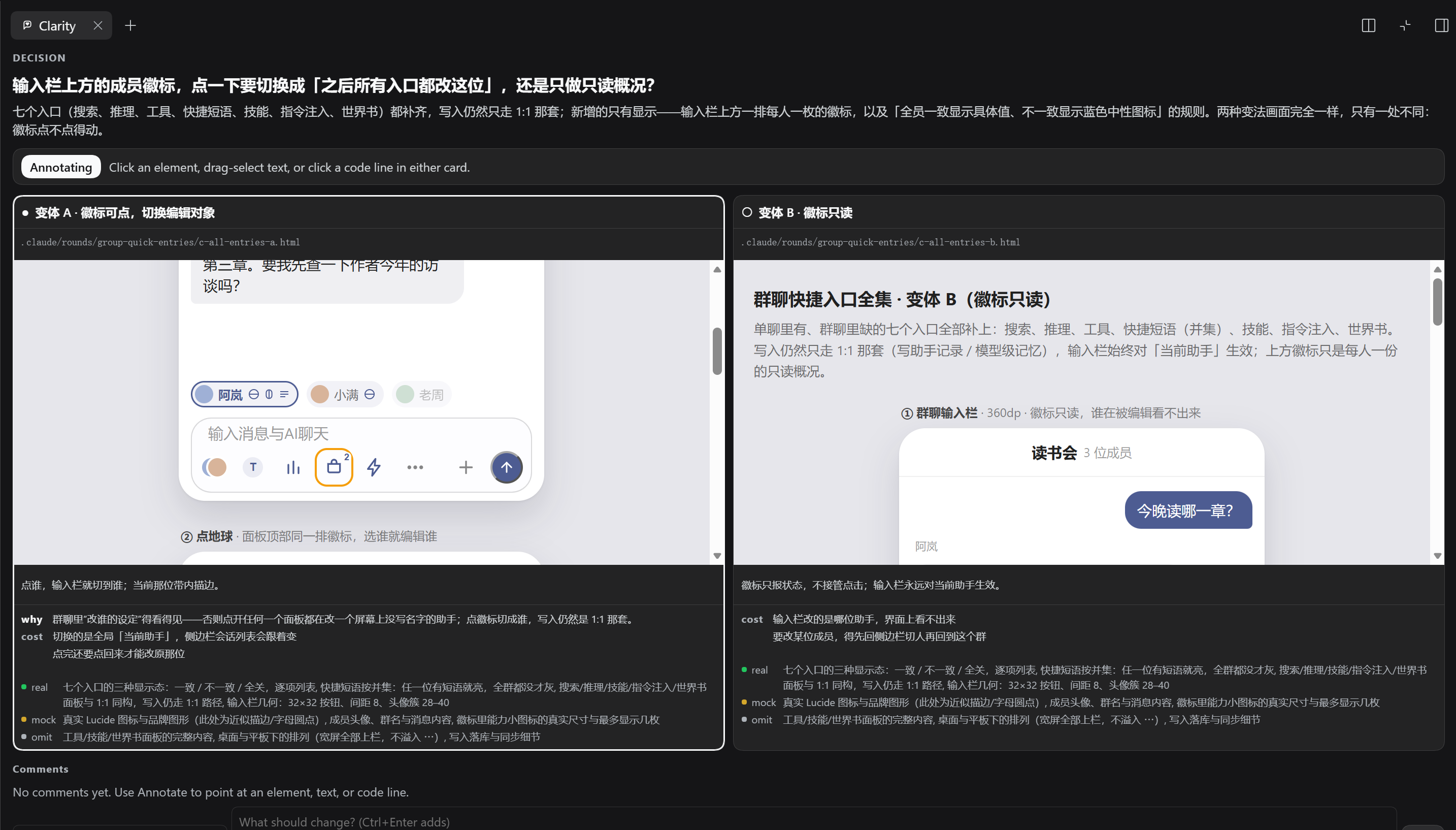
Handing the build to an agent is fast, and three things go wrong every time.
clarity_round puts the UI in
front of you before it is built, so you can point at what to change.clarity_round puts the reasoning, the cost, and the few lines of pseudocode that matter in
front of you, so the project stays yours.clarity_test makes sure a change went through your own test before it ships, and takes your
screenshots and notes when it did not.HTML goes anywhere. It is the cheapest thing to render and the widest: a terminal, a diff, a table, a screen. Parts that do not matter can be left out of the replica; what matters is having a picture of your own product before it is built.
The two halves are good at opposite things. Every extra turn makes an agent re-read a longer
context and drift a little; what it does very well is produce a 20 KB HTML file in one pass. A
person is the reverse: nobody writes a finished page from nothing in one sitting, and nobody wants
to rewrite one that already exists. clarity_round spends the agent's pass on what it is good at,
and your attention on the judgement it cannot supply.
A person has to sign off. Whatever ships ends up in front of a user, so somebody has to have used it first — on the real build, with their own eyes, before the user does.
clarity_round: a decision you can seeclarity_test: a real test before it shipsclarity_test asks you to build the change and try it, tells you what passing looks like, and
records what you found. When it does not pass, you answer with words and screenshots. Nothing ships
without having been run by the person who asked for it.
dsh plugin --profile web add @ds-hu/dsh-collaborative-clarity      # web UI
dsh plugin --profile desktop add @ds-hu/dsh-collaborative-clarity  # desktop
Pick the profile that matches your host. From GitHub, use
github:ds-hu/dsh-collaborative-clarity instead. There is no build step and one runtime dependency
(markdown-it). Non-blocking rounds also need @deepseek-ai/dsh-tool-jobs in the profile.
Apache License 2.0. See LICENSE.
CLASSIFICATION EVIDENCE
系统优先读取 GitHub Topics,再与站内分类词典和词根规则比对。当前命中: deepseek-harness。
morluto
Reverse engineer anything with agents, from app behavior down to native binaries.

deepseek-ai
DeepSeek Harness: Everything is a Plugin.

nexu-io
The 1st Collaborative AI Design Agent Workspace. Local-first and open source. Create motion, prototypes, websites, apps, dashboards, presentations, images, and videos with your team and AI agents. Share work, exchange feedback, and iterate together in one workspace.