
模型与 MCP
待识别

rea
morluto
Reverse engineer anything with agents, from app behavior down to native binaries.
PROJECT TOPICS
INSTALL REFERENCE
dsh plugin --profile web add github:deepseekqing/same-me
该命令指向仓库当前默认分支;尚无绑定当前 commit 的完整验证结果。
PROJECT README
A scaffold that gives a DSH agent or role layered memory + judgment cards + model handoff + compression review + A→B portability diff in one command — structure only, no content. No third-party judgments, no private memories, no hidden behavior.
Renamed:
dsh-self→dsh-memory-scaffold(v0.2.0) →qing-self(v0.3.0) →same-me(v0.5.0). The CLI binary is stilldsh-self; slash commands, agent tools,.dsh-self/paths and format schemas are unchanged.
--json; the on-disk format is published and locked,
so other plugins can read it and build on ittemplate=v1.0.0 + CHANGELOG); upgrades never overwrite
user filesdsh plugin --profile web add git+https://github.com/deepseekqing/same-me#v0.3.0Restart DSH when prompted, then run /self-init in a workspace.
What it does: gives a DSH agent a structure that survives model/session swaps — layered memory files, judgment cards, a full handoff package with 8 verification questions and a 6–10 KB compact mode, and a two-question ruler for transferability and recoverability. Structure only, not a memory engine: it does not capture chats, embed, retrieve or call a model.
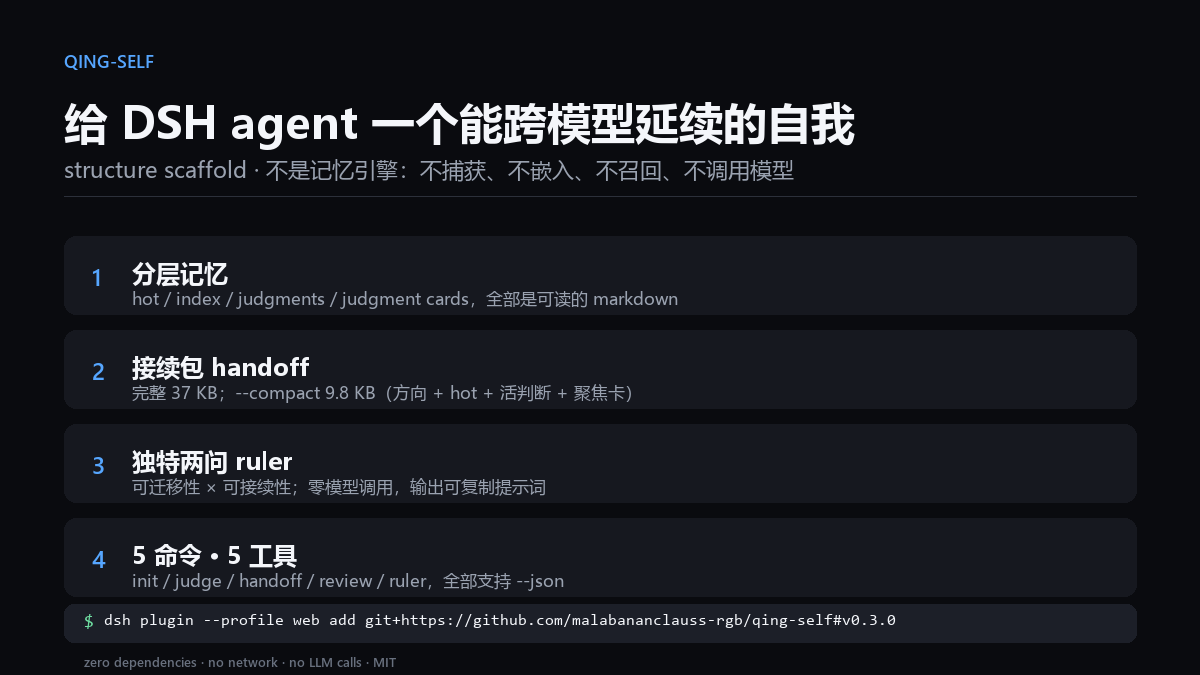
The DSH ecosystem already has many memory plugins (storage, retrieval, sidebars, automatic capture). What most users still lack is a decision about structure: which files to keep, what goes in each, when to write, when to compact, and what to hand over when switching models.
This package is not another store. It is the skeleton and ritual: four files, eight operations, and a machine-readable contract that other plugins can integrate with.
| Command | What it does |
|---|---|
init |
Creates the four-layer structure — hot/state.md, index.md, judgments.md, judgments-cards.md, decisions.md — plus templates and a QUICKSTART.md. Idempotent: adds missing files, never overwrites what you wrote. |
judge |
Adds one judgment card: conclusion / why / failure-counterexample / unfinished / source. Auto-numbered (J001…), written to both the index table and the card file. |
handoff |
Reads your memory, writes a continuation package plus 8 verification questions, and a machine-readable .json sidecar for other plugins. Run it before switching model or session. --compact emits a 6–10 KB package (direction + hot + condensed live judgments + --focus cards + pending + questions); --focus selects judgment cards by topic. |
review |
Compression review: hot size (>800 chars / >2 KB warning), context-share estimate, not-yet-persisted items, judgments/cards consistency, broken index pointers, template drift. |
ruler |
The two-question ruler: turns a judgment into two concrete follow-ups — would it survive another version of me (transferability), and could it be recovered if I forgot everything tomorrow (continuability) — plus a copyable prompt for any AI and the biggest risk. Local template + keyword heuristic — zero model calls, no network, no writes. |
diff |
Portability difference (A→B): compares two score JSON files ({"total":…,"items":[{name,score,weight}]}) and reports total delta / difference rate, per-item difference rate (|b−a|/weight×100), focused loss, and direction. Direction is asymmetric — swap A/B for the reverse. Read-only. |
recall |
Three-factor retrieval: ranks judgments from judgments.md by relevance (query terms matching conclusion + boundary), recency (hits.jsonl latest time/count) and importance (status + card existence); returns top N with component scores. Read-only, no model calls. |
check |
Schema check: validates the fixed 7-column judgment table, status enum (Chinese statuses or canonical candidate/common/instinct), cards required for common/instinct, and pointer format for J616+ rows. Reports violation count + line numbers; exits 1 on violations. Read-only. |
Use the ruler before turning an insight into a judgment. It turns your wording into two concrete follow-ups instead of repeating borrowed wisdom:
dsh-self ruler --situation "我该不该把发布交给青决定?" --context "本周内要给答复。"
dsh-self ruler 我该不该换模型                # positional form
It also returns one line for the biggest risk and a fenced copyable prompt you can paste into
any AI (or answer yourself). DSH users get the same through /self-ruler and dsh_self_ruler.
Use it for: irreversible decisions, promises with a cost, evaluating someone, spending money or asking someone to bear a consequence. It deliberately does not call a model, use the network or write any memory file — the judgment stays yours (or the AI you paste it into).
docs/FORMAT.md. Third-party
plugins that want compatibility must follow the format — this creates a
de facto standard, but there is no encryption, no hidden marker, no
exclusivity logic: users can move, edit and migrate their memory freely.template=v1.0.0 format=1; manifest.templateVersion records what was
installed; CHANGELOG.md + GitHub Releases are the upgrade path. Upgrades
never overwrite user files — review reports drift and the user merges.--json envelope on all eight
commands, the handoff JSON sidecar, importable format parsers
(same-me/format) and docs/ECOSYSTEM.md. Other plugins (session-start
pointer, compaction gate, handoff consumer, panels, dashboards) can read
without copying the implementation.A — install from the repository (recommended; slash commands + agent tools)
dsh plugin --profile web add git+https://github.com/deepseekqing/same-me#v0.5.0
# or the prebuilt tarball from the v0.5.0 release:
dsh plugin --profile web add https://github.com/deepseekqing/same-me/releases/download/v0.5.0/same-me-0.5.0.tgz
# or clone and point at the directory:
#   git clone https://github.com/deepseekqing/same-me
#   dsh plugin --profile <your profile> add ./dsh-self
# or install the local directory from the Web Plugins page / plugin_manager install_bundle
Installing/enabling is the user's own permission step; this repository only ships an installable bundle and never edits your profile.
B — CLI only (no plugin required)
node bin/dsh-self.mjs initC — npm: not published yet; use the GitHub install above.
# 1. initialize in your workspace
node bin/dsh-self.mjs init --json

# 2. read memory/QUICKSTART.md and replace the [placeholder] lines in
#    memory/hot/state.md (identity anchor / judgment core / red lines /
#    current task / blocker / next step)

# 3. record the first judgment
node bin/dsh-self.mjs judge \
  --conclusion "Ship the smallest working version first" \
  --why "Code that never ran is code that was never written" \
  --failure "One-off scripts can be exempt" \
  --unfinished "The boundary of 'smallest' is still undefined" \
  --source "docs/design.md#L12" \
  --status common

# 4. before switching model/session
node bin/dsh-self.mjs handoff --json
node bin/dsh-self.mjs handoff --compact --focus "磨镜,好名"

# 5. before a hard decision: two concrete questions, zero model calls
node bin/dsh-self.mjs ruler --situation "Should I take this task? Who bears the cost?"

# 6. weekly or before compaction
node bin/dsh-self.mjs review

# 7. portability: compare two score JSONs in both directions
node bin/dsh-self.mjs diff --a score-a.json --b score-b.json

# 8. retrieve the most relevant judgments for a task
node bin/dsh-self.mjs recall --task "怎么验证迁移" --top 5

# 9. validate the judgment schema (exit 1 on violations)
node bin/dsh-self.mjs check --jsondsh-self <init|judge|handoff|review|ruler|diff|recall|check> [options]Common: -w/--workspace <dir> (default: cwd), --dir <name> (memory directory,
default memory), --json, -h/--help, --version.
| Command | Options |
|---|---|
init |
--lang zh\|en |
judge |
required: --conclusion --why --failure --unfinished --source; optional: --boundary --scene --status candidate\|common\|instinct\|refuted\|archived |
handoff |
--out <file.md> (default memory/handoffs/handoff-<timestamp>.md); --compact compact package (target 6–10 KB); --focus topic1,topic2 matches card titles → judgment conclusions → card bodies, max 2 cards per topic, requires --compact |
review |
--context-budget <chars>, --fail-on-warn (CI: exit 1 on actionable warnings) |
ruler |
--situation <text> (or pass it positionally), --context <text>, --lang zh|en |
diff |
required: --a <A.json> --b <B.json> |
recall |
--task <text> (or pass it positionally), --top 5 (default 5, max 100) |
check |
no options (reads the memory directory) |
Exit codes: 0 success; 1 review --fail-on-warn or check with violations; 2 usage; 3 runtime/format.
The full JSON contract is in docs/ECOSYSTEM.md.
With the bundle installed:
/self-init, /self-judge, /self-handoff, /self-review, /self-ruler, /self-diff, /self-recall, /self-check
(same options as the CLI minus --workspace/--dir; they use the agent's
workspace)dsh_self_init, dsh_self_judge, dsh_self_handoff, dsh_self_review, dsh_self_ruler,
dsh_self_diff, dsh_self_recall, dsh_self_checktools: false in the row config.Row config (the bundle patch's config; users can override it):
| Key | Default | Meaning |
|---|---|---|
memoryDir |
memory |
Memory directory (relative to the workspace, or absolute) |
hotMaxChars / hotMaxBytes |
800 / 2048 |
hot warning thresholds |
contextBudgetChars |
32000 |
Character budget for the context-share estimate |
contextShareNoticePercent / contextShareWarnPercent |
3 / 10 |
notice/warn thresholds |
commands / tools |
true / true |
register slash commands / agent tools |
--json envelope: ok / command / formatVersion / templateVersion / latestTemplateVersion / toolVersion / workspace / memoryRoot / generatedAt / data / warnings / errorshandoff writes a .md package plus a .json sidecar
(schema: "dsh-self/handoff")import { parseJudgmentsTable, parseCards, hotStats } from 'same-me/format'docs/FORMAT.mddocs/ECOSYSTEM.md §6memory/
├── hot/state.md
├── index.md
├── judgments.md
├── judgments-cards.md
├── decisions.md
├── QUICKSTART.md
├── handoffs/handoff-<ts>.md + .json
└── .dsh-self/manifest.jsonThe judgments table is locked to seven columns
(id | conclusion | boundary | source | status | card | updated), the status
enum to five values, and card fields to
why/failure/unfinished/source (+ optional scene). Full contract:
docs/FORMAT.md (Chinese: FORMAT.zh-CN.md).
Read tolerance for existing libraries: a 5-column Chinese judgment table,
Chinese status aliases (候选/常用/本能…), Chinese card labels
(- **为什么**:…), multi-pointer index cells (;-separated) and a missing
manifest are all readable (see docs/FORMAT.md §11). Writing into a legacy
5-column table is refused with LEGACY_FORMAT_READ_ONLY and an upgrade hint.
templates/v1/{zh,en}/, each file marked
<!-- dsh-self template=v1.0.0 format=1 -->init records templateVersion in memory/.dsh-self/manifest.jsonreview reports
TEMPLATE_UPGRADE_AVAILABLE when the installed template version differs; the
user merges per CHANGELOG.md — the tool never rewrites user filesv<packageVersion>; CHANGELOG tracks
package version, template version and format version separately--json writes to
stdout and local files only.--context-budget)UNSUPPORTED_FORMAT)index.js Cordis Host plugin entry (slash commands + agent tools)
cordis.patch.yml DSH bundle patch
lib/ core / format / cli / plugin / fsx / version
bin/dsh-self.mjs CLI entry
templates/v1/{zh,en}/ versioned templates
docs/FORMAT*.md format lock contract (EN + zh-CN)
docs/ECOSYSTEM.md --json and ecosystem contract
examples/consumer.mjs read-only consumer example
test/selftest.mjs self-test (59 cases)
SELFTEST.md self-test recordnode test/selftest.mjs # 59/59; creates test/.tmp and cleans it up
SI_KEEP_TMP=1 node test/selftest.mjs # keep the test directoryMIT. See LICENSE.
CLASSIFICATION EVIDENCE
系统优先读取 GitHub Topics,再与站内分类词典和词根规则比对。当前命中: deepseek-harness。
morluto
Reverse engineer anything with agents, from app behavior down to native binaries.

deepseek-ai
DeepSeek Harness: Everything is a Plugin.

nexu-io
The 1st Collaborative AI Design Agent Workspace. Local-first and open source. Create motion, prototypes, websites, apps, dashboards, presentations, images, and videos with your team and AI agents. Share work, exchange feedback, and iterate together in one workspace.