
模型与 MCP
待识别

rea
morluto
Reverse engineer anything with agents, from app behavior down to native binaries.
PROJECT TOPICS
INSTALL REFERENCE
dsh plugin --profile web add github:cofy-x/axern
该命令指向仓库当前默认分支;尚无绑定当前 commit 的完整验证结果。
PROJECT README


Documentation · Quickstart · SDKs · 简体中文
Axern is open-source, self-hosted infrastructure for single-host agent execution and persistent workspaces. It provides isolated execution through gVisor (runsc) and experimental single-writer Workspace resources. The CLI and Go, Python, and TypeScript SDKs expose the same public APIs for Environments, Runs, sandbox processes and files, Tunnels, lifecycle state, and Allocation-scoped access. gVisor/runsc is the sole long-term execution backend.
The primary use case is a personal agent system on one Linux host: independent workers, inspectable execution, retained working data, and a small operational surface. Agent sessions, configuration, planning, collaboration, and workflows belong to caller applications. See the product direction and single-host serving decision.
Project status: Axern is pre-1.0 and under active development. An experimental native Linux installation provides a source-built runtime archive and managed systemd lifecycle. It is not yet a published release channel or a supported upgrade path. Docker Compose remains the local development path. Optional Workspace data requires XFS project quotas; other writable storage is Allocation-local. Supported backup/restore and upgrades remain unqualified, and sealed outputs expire 15 minutes after cleanup begins. Review the current deployment and storage boundaries before use.
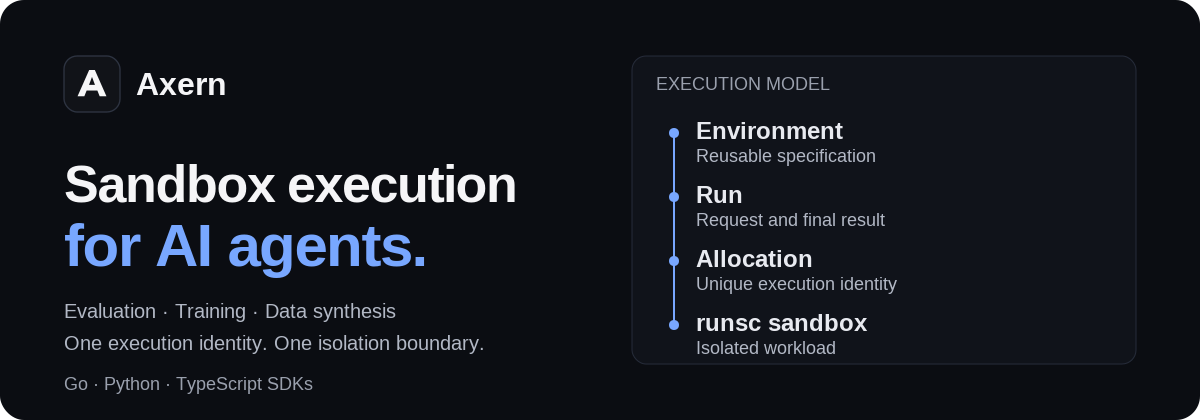
The durable chain is Environment → Run → Allocation → runsc sandbox. The following concepts describe how an agent system uses that chain; they do not introduce another execution lifecycle or an Axern Agent resource.
| Concept | Responsibility and status |
|---|---|
| Image | Immutable runtime, tools, and reference inputs. Environments resolve execution inputs and policy; read-only ImageMounts provide additional image content. |
| Workspace | Experimental: retained working data on one bound Node, with its own identity, authorization, block/inode capacity and explicit deletion. One fenced writer per Workspace. |
| Sandbox | The running execution view and SDK facade over one Run/Allocation, including its processes and filesystem access. It does not own a persistent Agent session. |
| AgentSession | Caller-owned conversation, configuration, planning, and coordination state; Axern executes the worker without interpreting that session. |
The default collaboration pattern is independent writable working directories, common read-only references, and explicitly published results that the caller merges or hands off. Use separate Workspaces or Allocation-local directories, read-only image mounts, and explicit result handoff. Simultaneous shared writable mounts remain outside the single-writer contract.
Agent workload images share a base and development toolchain, then add official Claude Code or Codex programs in separate layers. Build them locally with make agent-images; model credentials, provider selection, tasks and session policy remain runtime inputs owned by the caller.
For Linux single-host serving, build and stage a coherent native archive using the installation guide. Operate the installed server with axern server start, status, logs and stop. API contexts select remote execution services; they do not change the host managed by server.
Use the CLI, services and SDKs from one coordinated release or source revision. For repository development on Linux or a macOS Linux VM, use Go 1.26.10, Make and Docker Compose v2:
make quickstart-source
make axern-cli-build
./bin/axern context list
quickstart-source builds current service images and verifies the source Compose stack. The packaged Compose lifecycle is axern dev up|status|logs|down; it is separate from the installed server and retains the machine-local context/data identity. A published CLI's development bundle requires its matching published service images. See the CLI contract for deployment commands and contexts.
Workspace usage covers retained files through fresh Runs. Without a Workspace, existing ephemeral execution stays available. Agent programs, tasks and session recovery remain caller-owned.
For repository development, make verify-changed is the normal fast feedback entrypoint. Linux correctness, full regression, and release qualification are separate tiers. Every main commit starts a commit-bound full regression; a green PR check does not imply that this later run has passed. Check Post-Merge Full before release or promotion; see the verification tiers.
flowchart LR
    Client["CLI and SDK clients"] --> Gateway["gatewayd\npublic control and data edge"]
    Gateway --> Control["controld\ndurable intent and placement"]
    Gateway --> Tunnel["tunneld\nreverse TCP relay"]
    Gateway --> Node["axnoded\nsandbox execution"]
    Control --> Node
    Node --> Egress["egressd\ntrusted egress policy enforcement"]
    Node --> Image["imagemgr\nOCI image mounts"]
    Node --> Runtime["runsc sandboxes"]
gatewayd is the unified external gateway for public control and Allocation-scoped data-plane traffic; controld and PostgreSQL remain authoritative for product state, while node services own host-local execution, images, networking, and Allocation-local writable storage. A Run can declare a bounded set of files or tar archives for node-local sealing before runtime cleanup; callers download and durably publish those bytes before the reported output expiry, which is 15 minutes after cleanup begins. A successful finite Run may separately publish its complete writable rootfs as a content-addressed OCI image and ordinary reusable Environment. Neither path creates a persistent workspace or generic object store. See the storage architecture, runtime architecture, and resource model.
Public clients are available in Go, Python, and TypeScript under sdk/. Shared wire contracts are defined in sdk/proto.
Follow the Kubernetes installation guide to provision signing material, supply qualified node memory reserves, bind explicit Node identities, install the control plane, and admit nodes before waiting for runtime readiness. SSH is optional and uses Principal Credentials. Do not skip the identity and admission steps by running a bare Helm install.
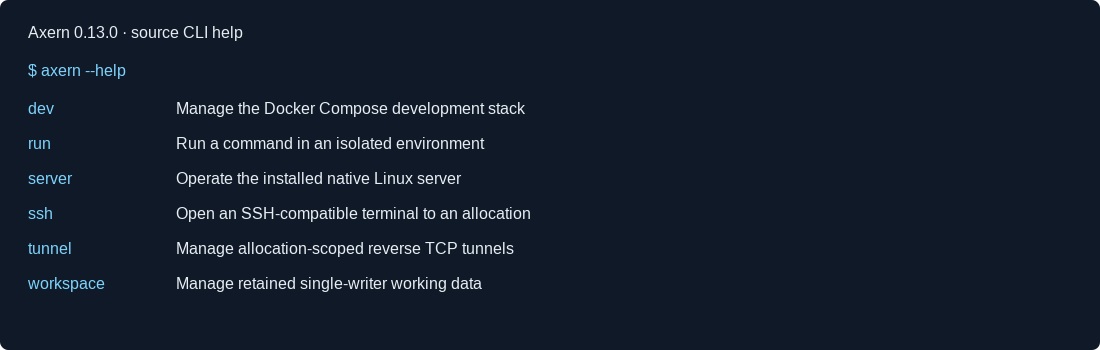
Treat each Axern release as one coordinated CLI, SDK, chart, and runtime version. Review its release notes before upgrading and use artifacts only after publication completes; a source version is not proof of artifact availability. The command overview is generated from source CLI help; it is not a deployed workload or performance measurement.
Axern does not claim that a default local or example deployment is safe for an untrusted multi-tenant environment. Review authentication, TLS, network policy, runtime isolation, image trust, secret storage, resource limits, and persistent storage before production use. Report vulnerabilities according to SECURITY.md.
Contributions are welcome. Read CONTRIBUTING.md, follow the Code of Conduct, and sign every commit under the Developer Certificate of Origin. Project decisions follow the governance model.
Copyright 2026 cofy-x.
Licensed under the Apache License, Version 2.0.
CLASSIFICATION EVIDENCE
系统优先读取 GitHub Topics,再与站内分类词典和词根规则比对。当前命中: deepseek、deepseek-harness。
morluto
Reverse engineer anything with agents, from app behavior down to native binaries.

deepseek-ai
DeepSeek Harness: Everything is a Plugin.

nexu-io
The 1st Collaborative AI Design Agent Workspace. Local-first and open source. Create motion, prototypes, websites, apps, dashboards, presentations, images, and videos with your team and AI agents. Share work, exchange feedback, and iterate together in one workspace.