dsh-sidebar-cdp-browser
中文 · npm · GitHub
A dsh-better-sidebar sidebar tab for DeepSeek Harness (DSH) that live-projects an external Chromium into the DSH Web GUI as a JPEG pixel stream, and sends back keyboard/mouse actions through a strictly allow-listed command protocol. The target page is never embedded as an iframe — the host process owns the only CDP connection, so the browser side never learns the CDP address and can issue no arbitrary CDP passthrough.


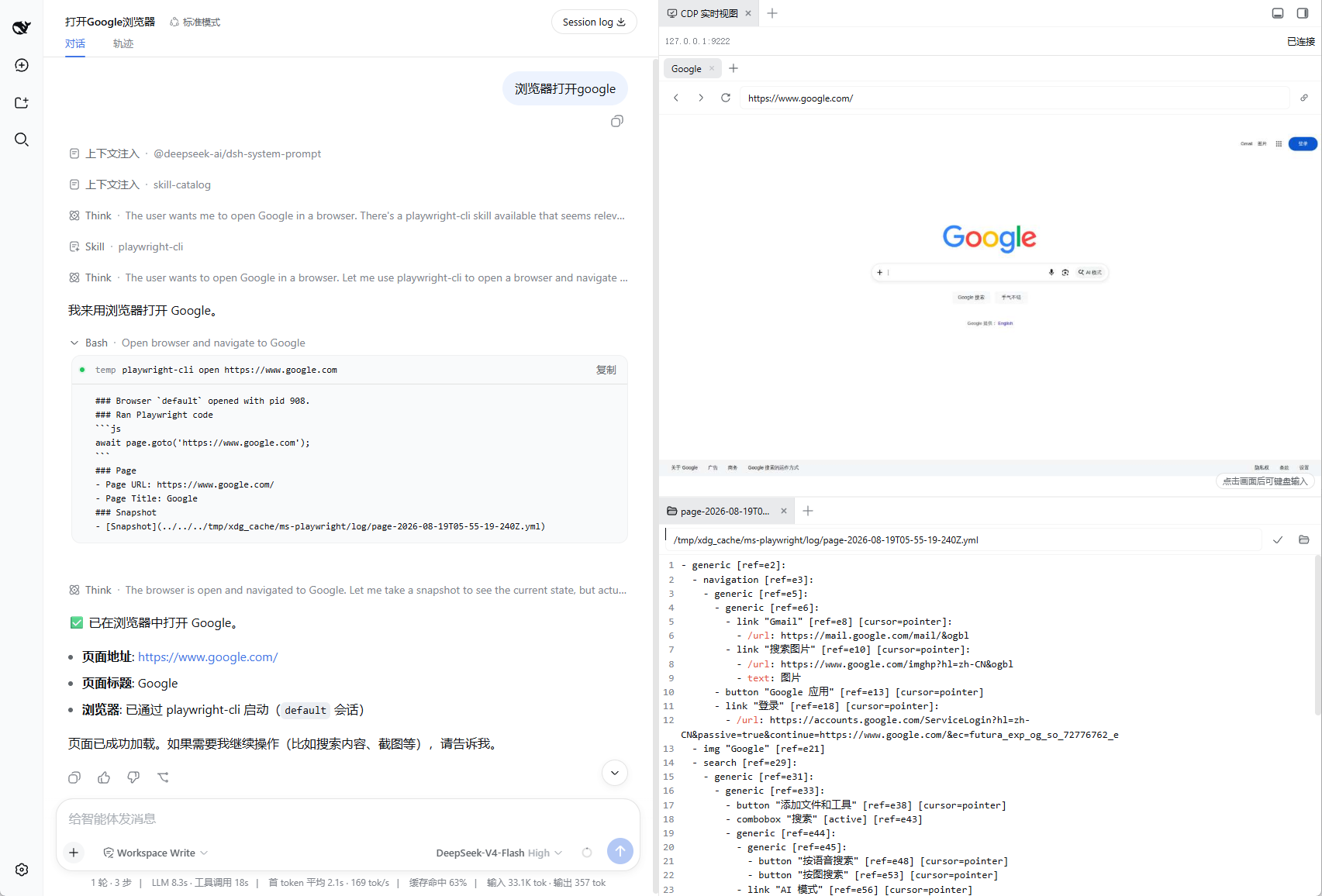
Screenshot
DSH Web (browser)                    DSH host process                   external Chromium
┌──────────────────┐   POST /dsh-cdp-live/api/open   ┌──────────────┐
│ sidebar tab      │  ────────────────────────────►  │ one-time     │
│ (React + Canvas) │   ◄──── ticket (TTL 30s) ──────  │ 256-bit ticket│
│                  │                                 │              │   the only CDP
│ renders JPEG ◄───┼── WS /sidebar/ws/cdp-live ──────┼─ puppeteer ──┼──► :9222
 │                 │   frame meta JSON + JPEG bytes  │  -core       │   (screencast
 └─│──────────────┘                                 └──────────────┘    + Input)
   └ allow-listed commands (zod strict discriminated union; no CDP passthrough)
Features
The live view
- Registers the「CDP 实时视图」(CDP live view) tab (id
dsh-sidebar-cdp-browser:live) in the better-sidebar sidebar, rendering the remote page as a live pixel stream on a canvas (Page.startScreencast JPEG frames; contain-fit scaling, devicePixelRatio-aware drawing);
- A top tab strip lists every page target: switch, create, close (titles come from the
Target.getTargets snapshot, polled at 1s);
- The toolbar offers address-bar navigation (type an HTTP(S) URL and press Enter / back / forward / reload) and a manual reconnect; after a drop the client reconnects with automatic backoff;
- Hiding the tab or collapsing the panel stops the frame stream automatically (better-sidebar's
visible gating) and resumes on return;
- Copy is bilingual (zh/en) and follows the DSH host language preference (dictionaries register with the locale service; the browser language is only the pre-service fallback); known host-side close reasons display localized too, and the loader config fields carry zh/en descriptions.
Controlled interaction
- Mouse: click, drag, wheel — coordinates map back onto the page through the frame geometry; keyboard: click the canvas to claim focus, then type; IME (Chinese et al.) commits once through composition, paste is forwarded as text insertion through the local clipboard (copy / Ctrl+C is not supported yet);
- Everything the client can send is one zod
strict() discriminated union (src/cdp/protocol.ts) — target lifecycle, screencast start/stop, Input.dispatch*, Page.navigate / history, ping — with no {method, params}-shaped CDP passthrough of any kind;
- Interaction sits behind a two-level gate (see Usage): the "interactive input" master setting plus the header's "keyboard & mouse control" checkbox; only with both open does a view run in interactive mode, and the host enforces the ticket's mode — an unauthorized (even forged) client cannot emit a single control command.
The settings panel
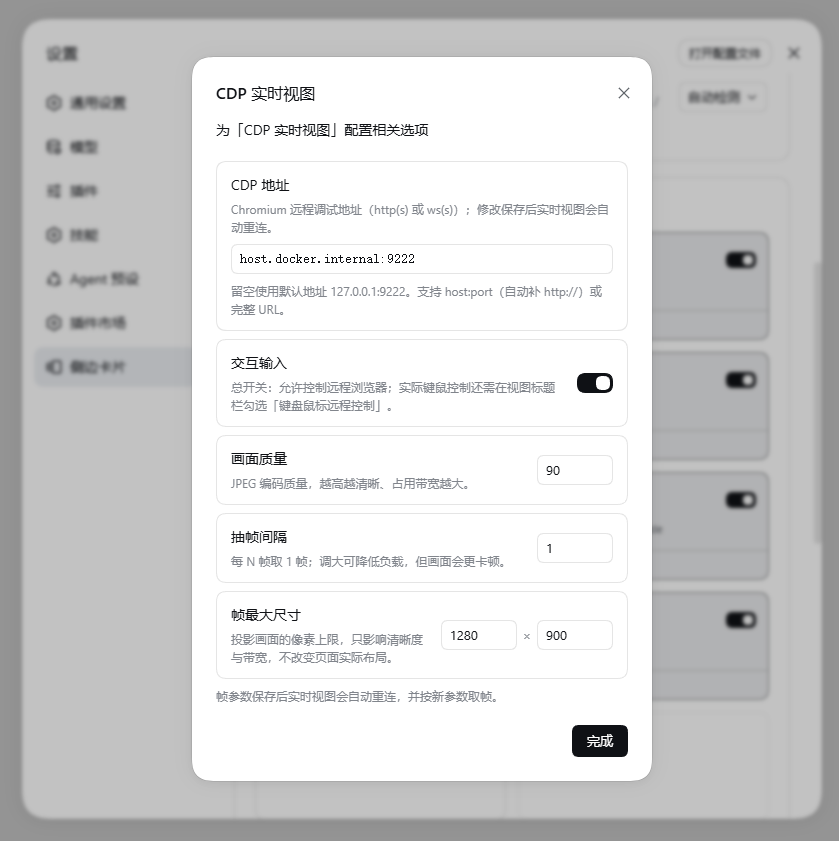
- "Settings → side card → sidebar content → CDP实时视图" gear popup: the CDP address, the interactive-input master switch, and four frame-capture knobs (quality / interval / max width × height);
- The CDP address is configured in the web UI and persisted (in better-sidebar's prefs document) — no loader-config edits; on save the host drops the old connection and the live view reconnects to the new address by itself;
- Frame knobs support per-field UI overrides (winning over the loader config); out-of-range or junk stored values are silently dropped by the host, falling back to safe values.
Use cases
- Remote / headless Chromium visualization: the browser runs on a server or in a container; you watch and click from the DSH UI;
- Watching browser automation inside a DSH session: keep an eye on an agent-driven browser in real time and take over at any moment;
- A lightweight VNC substitute: browser-only "remote desktop" with zero client installs;
- Controlled demos / debugging: project a test browser to colleagues — navigation and clicks stay inside the permission model;
- The pixel-stream + gated-input model is a natural fit for "projecting" one browser session to many observers, or supervising the operator of an AI session.
Installation
Prerequisites
-
A DSH host (Web GUI, web profile) on Node.js ≥ 20;
-
dsh-better-sidebar ≥ 0.17.1 — a required peer: this plugin's tab is registered through it and will not appear without it (install both with the one-liner below);
-
A started Chromium CDP endpoint reachable from the DSH host process, e.g.:
chromium \
  --remote-debugging-address=127.0.0.1 \
  --remote-debugging-port=9222
The plugin itself
The package ships a dsh.bundle.patch (cordis.patch.yml: one insert row mounting the host-half entry). From the npm registry (prebuilt — no build permission needed) — one command installs the framework and this plugin together:
dsh plugin --profile web add dsh-better-sidebar dsh-sidebar-cdp-browser
From the GitHub repository (source — pnpm runs the prepare build):
dsh plugin --profile web add dsh-better-sidebar github:chendefine/dsh-sidebar-cdp-browser
Or through the DSH plugin marketplace (设置 → DSH插件市场) — tag the repo with the dsh-plugin topic and it is indexed automatically.
pnpm may block native-dependency builds of better-sidebar (e.g. node-pty); add the named package to allowBuilds in the profile's pnpm-workspace.yaml as prompted and re-run.
After the plugin joins the profile layer stack, restart dsh web for it to load; uninstall with dsh plugin --profile web remove dsh-sidebar-cdp-browser and restart again.
Usage
Configuring the CDP address
The address is configured in the DSH web settings page, not in the profile array:
- Open settings → side card → sidebar content → CDP实时视图 and click the card's gear;
- Fill the「CDP 地址」field; blur or press Enter to save;
- Empty = the default
127.0.0.1:9222;
- Accepted formats:
host:port (auto-prefixed with http://) or http://host:port: the host discovers the webSocketDebuggerUrl via /json/version;https:// / wss://: same, TLS is the deployment's concern;ws://.../devtools/browser/...: connect to the browser WebSocket directly;
- On save the host drops the old connection and open live views reconnect to the new address.
The address persists in better-sidebar's prefs document (pluginSettings['dsh-sidebar-cdp-browser:live'].endpoint), read and subscribed through the DSH settings service. There is no loopback restriction — remote addresses work as-is; make sure of reachability and access control yourself.
The two-level control gate
The panel's "interactive input" master switch combines with the view header's "keyboard & mouse control" checkbox into a two-level gate:
- Interactive input OFF (default): observe mode — view only; the header checkbox is greyed out and unchecked;
- Interactive input ON: control is allowed, but the checkbox still starts unchecked (still view-only); check「键盘鼠标远程控制」left of the「已连接」label in the view header to make that view truly interactive (clicks, typing, navigation, tab create/close); unchecking returns it to observe instantly.
The checkbox does not persist: a page refresh or panel reopen resets it unchecked (safe by default). Any switch change reconnects the view in the new mode, and the host enforces the ticket's mode — an unauthorized, even forged, client cannot emit control commands.
Daily operation
- Keyboard & mouse control: the header checkbox left of「已连接」(see above);
- Targets — switch / create / close: the top tab strip, interactive mode required;
- Mouse: click, drag, wheel, coordinates mapped through the frame geometry;
- Keyboard: click the canvas to claim focus, then type. IME commits once via composition; paste is forwarded as text through the local clipboard; copy (Ctrl+C) is not supported yet;
- Navigation: type an HTTP(S) URL in the toolbar and press Enter, or use back / forward / reload;
- Connection: manual reconnect in the toolbar; automatic backoff reconnect after drops.
Loader runtime tuning (optional)
Optional fields in the profile config (all omittable; parentheses hold defaults and ranges). The four frame* fields double as the deployment defaults of the web-UI settings — a field changed in the UI wins:
- insert:
    - id: sidebar-cdp-browser
      name: dsh-sidebar-cdp-browser
      config:
        frameQuality: 60        # JPEG quality (20–90)
        frameMaxWidth: 1280     # max frame width (320–3840)
        frameMaxHeight: 900     # max frame height (240–2160)
| Field |
Default |
Range |
ticketTtlMs |
30000 |
5000–120000, one-time ticket TTL |
connectTimeoutMs |
15000 |
1000–120000, CDP connect timeout |
frameQuality |
60 |
20–90, JPEG quality |
frameMaxWidth |
1280 |
320–3840 |
frameMaxHeight |
900 |
240–2160 |
frameEveryNth |
1 |
1–30, keep 1 of every N frames |
bufferedAmountSoftLimit |
524288 |
64KB–16MB, frame dropping starts |
bufferedAmountHardLimit |
4194304 |
256KB–64MB, connection cut |
Frame knobs in the web UI
The four frame-capture parameters (frameQuality / frameEveryNth / frameMaxWidth / frameMaxHeight) can also be adjusted directly in the web-UI gear popup, besides the loader config:
- The popup matches the other "sidebar content" feature settings (row cards + switches + numeric inputs); width × height share one row;
- Untouched fields display the effective value (loader config; the code default when unavailable); a saved edit writes the prefs document as that field's explicit override;
- UI overrides beat the loader config (per field): only edited fields are written, the rest keep the loader values; out-of-range or junk stored values are silently dropped by the host, falling back to the loader values;
- On save the host disconnects live views with
1012 and they reconnect automatically; the new parameters apply at the next Page.startScreencast after the reconnect;
- The panel reads effective values through the read-only route
GET /dsh-cdp-live/api/config (equally trust-fenced).
Note: frameMaxWidth / frameMaxHeight are only projection caps (post-capture downscale bounds); they never affect the page's real layout size — pages always render at the remote Chromium window's true viewport (the plugin connects with an explicit defaultViewport: null and never overrides the viewport).
Troubleshooting
Refused WebSocket upgrades return explicit HTTP statuses; the browser console shows Unexpected response code: <status>:
| Status |
Meaning |
Fix |
| 401 |
ticket invalid or expired |
The client re-runs /open for a fresh ticket automatically; if persistent, check the session is still alive |
| 403 |
trust fence refusal (Host header not trusted, or cross-site marker) |
Behind a reverse proxy, verify the proxy forwards the correct Host header |
| 404 |
wrong path / session not found |
Check the route path and session id |
| 1006 (no status) |
the request died at the reverse-proxy tier |
The proxy must forward WebSocket upgrade headers (below) |
| 1011 (app close) |
CDP connection / attach failure |
Check the DSH host log (below) |
| 1012 (app close) |
settings change (address / frame params) — expected |
The client reconnects automatically |
| 1013 (app close) |
slow client exceeded the hard backpressure limit |
Auto-reconnects once the network recovers; raise bufferedAmount*Limit or lower quality if frequent |
nginx WebSocket forwarding reference:
map $http_upgrade $connection_upgrade {
    default upgrade;
    ''      close;
}
location / {
    proxy_pass http://127.0.0.1:3080;
    proxy_http_version 1.1;
    proxy_set_header Upgrade $http_upgrade;
    proxy_set_header Connection $connection_upgrade;
}
CDP connection failures log [dsh-sidebar-cdp-browser] CDP session attach failed: ... in the DSH host log — the browser only sees the disconnect, so start debugging there.
Architecture
The two halves
A DSH plugin has a host (node) half and a browser half; this plugin's split:
┌──────────────── DSH host process ─────────────┐      ┌── Chromium ──┐
│  host half (src/index.ts)                     │      │              │
│  ├─ POST /dsh-cdp-live/api/open  ── issue ticket│     │  CDP :9222   │
│  ├─ GET  /dsh-cdp-live/api/config── frame params│     │  (screencast │
│  ├─ WS   /sidebar/ws/cdp-live    ── the protocol│    │   + Input)   │
│  └─ EndpointManager → puppeteer-core ────────────────┤              │
└───────────────────────────────────────────────┘      └──────────────┘
         ▲ ticket + binary frames (JSON meta + JPEG)   ┌── browser ───┐
         │                                            │ client half  │
         └────────────────────────────────────────────┤ canvas render │
              mouse/keyboard/navigation — allow-listed (zod) commands ┘
- The host half (
src/, injects webServer / sessions / webRuntime): registers the HTTP and WebSocket routes, keeps the single CDP connection alive through puppeteer-core, subscribes to the DSH settings service for the UI's address and frame overrides, and hot-swaps the connection on settings commits;
- The client half (
src/client/, the tab registered via dsh-better-sidebar): React components, canvas rendering, input events translated into the restricted commands.
The connection handshake
POST /dsh-cdp-live/api/open        → trust fence + DSH session check
                                   → one-time 256-bit ticket (TTL 30s by default)
GET  /dsh-cdp-live/api/config      → trust fence; effective frame params (loader ∪ UI overrides)
WS   /sidebar/ws/cdp-live?ticket=… → trust fence + one-time ticket consumption
                                   → 101, then the versioned protocol (v: 1)
- The client never learns the CDP address or any credentials — the connection and target ids are ephemeral state inside the host process;
- The ticket binds the session and the mode (observe / interactive) and dies after one use;
- The upgrade request does not require Origin: common DSH reverse-proxy setups rewrite Host to loopback and drop Origin, so admission rides the trust fence (Host + cross-site markers) plus the one-time ticket.
The frame pipeline & backpressure
Page.startScreencast (JPEG; quality/size/sampling = loader config ∪ web-UI overrides, UI per-field wins)
  → the host ACKs each Page.screencastFrame immediately (decoupled from downstream)
  → LatestFrameQueue        single-slot latest-frame queue: producers never block, new frames evict old
  → ws.send(frameMeta JSON) metadata (sequence / mimeType / byteLength …)
  → ws.send(JPEG bytes)     the binary frame right behind
  → client canvas draw
Two backpressure tiers keyed off ws.bufferedAmount:
- past the soft limit (512KB default): frames are dropped, not sent — the picture stales slightly, the connection stays healthy;
- past the hard limit (4MB default): disconnect with
1013 so a slow client can't pile up memory without bound.
The command protocol
Versioned (v: 1, a zod strict() discriminated union, src/cdp/protocol.ts); the client's commands:
targets.list / targets.create / target.select / target.detach / target.closevisibility (frame-stream toggle for tab hide/restore)screencast.start / screencast.stop (options: format / quality / maxWidth / maxHeight / everyNthFrame)input.mouse / input.key / input.textnavigate (http(s) URLs only) / history (back / forward / reload)ping
The server's ready / response / targets.changed / target.closed / frame / error messages are equally strict schemas; unknown fields are always rejected.
Connection & lease management
- EndpointManager: one implicit CDP connection identified by a generation; an address change in settings → the host listens on
settings/document-updated → drops the old connection, bounces clients with 1012 → the clients' backoff loop lands on the new address; http(s) addresses discover the webSocketDebuggerUrl via /json/version, ws(s) addresses connect directly; timeout and retries are tunable;
- LeaseManager: a target's screencast frame queue has exactly one consumer at a time; switching targets releases the old lease first;
- TargetRegistry: target discovery, switching and destruction notices (titles from the
Target.getTargets snapshot polled at 1s; the real document title after navigation is fetched through the same command).
Remote tab closes (another CDP operator closing the streamed tab) are a first-class lifecycle path (since v0.1.2, covered by tests/remote-close.spec.ts): the registry marks the target closed and every attached client receives target.closed; the teardown chain (TargetController.detach → ScreencastController.stop → frame-queue close → pump end) is best-effort and never rejects — puppeteer's "Session already detached" on an already-dead session is swallowed by design, because an unhandled rejection there would take the host process down. The same guarantee covers a close racing an in-flight target.select, and the endpoint-change order (connection generation disposed before the bounced sockets finish closing).
Security boundary
The CDP capabilities open by default: target lifecycle, screencast start/stop/ack, Input.dispatch*, Page.navigate / Page.reload / navigation history.
Interactive commands (keyboard/mouse, navigation, tab management) sit behind the two-level gate: the "interactive input" setting (master) + the header's "keyboard & mouse control" checkbox (per view at runtime, unchecked by default). Only with both open is a session established in interactive mode; the host enforces the ticket's mode and blocks every control command otherwise.
Deliberately not open:
Runtime.evaluate;- cookies / storage / network;
- downloads, uploads, permission grants;
- arbitrary CDP method passthrough;
- the DevTools frontend.
Two notes:
- The CDP address is configured from the web UI and the host applies no loopback restriction — any session that can open that settings page can make the DSH host dial arbitrary addresses; expose the settings page only in trusted environments;
- The trust fence defends against cross-site requests and DNS rebinding; it is not user authentication — a keyless DSH should be used as a single-user local tool only.
Repository layout
src/
├── index.ts              # host-half entry: route registration, settings subscription, hot swap (inject: webServer, sessions, webRuntime)
├── config.ts             # config schema (schemastery + zod twins) & endpoint normalization (covered via endpoint-config, 4 tests)
├── frame-settings.ts     # the single frame-spec table: ranges/defaults/override reads/merge (pure, shared host+client) (6 tests)
├── trust-fence.ts        # host/cross-site trust decision (5 tests via cdp-security)
├── routes/
│   ├── http.ts           # /open + /config routes + the one-time ticket registry
│   └── websocket.ts      # the WS upgrade route (trust fence + ticket admission + 401/403/404 refusals)
├── cdp/
│   ├── live-session.ts   # session orchestration: attach, command dispatch, frame pump, 1012/1013 lifecycle
│   ├── endpoint-manager.ts / browser-connection-manager.ts / puppeteer-adapter.ts   # the single CDP connection (9 tests via cdp-manager)
│   ├── screencast-controller.ts / frame-queue.ts    # capture & the single-slot latest-frame queue (3 tests)
│   ├── input-controller.ts / target-controller.ts / target-registry.ts
│   ├── lease-manager.ts  # exclusive per-target lease
│   └── protocol.ts       # the versioned zod protocol (4 tests)
└── client/               # the better-sidebar tab (React + canvas + input bridges)
    ├── index.tsx         # browser-half entry: register tab + settings panel (ctx.effect)
    ├── SidebarCdpBrowser.tsx  # view assembly: settings / socket / target store
    ├── use-cdp-socket.ts      # WS client: ticket fetch, backoff reconnect, binary frames
    ├── use-target-store.ts    # target state
    ├── LiveCanvas.tsx         # canvas + IME sink + keyboard ownership
    ├── input-bridge.ts        # mouse bridge + capture-phase keyboard bridge (7+5+3 tests)
    ├── frame-renderer.ts      # ImageBitmap rendering (contain fit + DPR)
    ├── geometry.ts            # contain-fit coordinate mapping (3 tests)
    ├── TargetTabStrip.tsx / BrowserToolbar.tsx / ConnectionToolbar.tsx / StatusOverlay.tsx   # the chrome components (13 tests)
    ├── settings.tsx           # the gear settings panel: address / interactive switch / frame rows (10 tests)
    ├── i18n.ts                # locale wiring: register zh/en dicts + t() (follows the DSH preference) + close-reason localization
    └── locales.ts             # zh/en dictionaries (key sets enforced equal, 5 tests)
tests/                    # vitest: 94 cases / 18 files (live-probe is the opt-in real-Chromium probe; live-wiring spins real loopback HTTP/WS servers; remote-close replays the remotely-closed-tab lifecycle over real WS sockets; client-bundle verifies the built artifact's identity & purity)
cordis.patch.yml          # the bundle channel's host-half insert row (mount declaration)
tsdown.config.ts          # dual-bundle build (host ESM + client ModuleLoader format + purity gate + CSS inlining)
pnpm-workspace.yaml       # pnpm ≥ 11-only settings (allowBuilds / minimumReleaseAgeExclude)
lib/                      # build outputs (lib/index.js host ESM; lib/client.js client bundle; lib/types declarations)
Build outputs: the host half is a plain ESM bundle (puppeteer-core / ws / zod ship with the package); the browser half is a window.__ModuleLoader__.load({ id, factory }) registration bundle (the official external client-plugin delivery format) with React / cordis external and a purity gate that rejects Node builtins and @deepseek-ai/* value imports — tests/client-bundle.spec.ts verifies the built artifact's identity and browser purity after every build.
Development notes
Build & test
git clone https://github.com/chendefine/dsh-sidebar-cdp-browser && cd dsh-sidebar-cdp-browser
pnpm install       # install (prepare builds once)
pnpm typecheck     # tsc --noEmit
pnpm test          # build + vitest run (82 cases)
pnpm build         # rm -rf lib && tsc declarations + tsdown dual bundle → lib/
The real-Chromium probe: CDP_PROBE=1 pnpm vitest run tests/live-probe.spec.ts (override the address with CDP_PROBE_ENDPOINT).
Environment & conventions
- pnpm ≥ 11: pnpm-specific settings are read only from
pnpm-workspace.yaml (same-named .npmrc keys are silently ignored). This repo pins allowBuilds.node-pty: false there (better-sidebar's optional native dep is types-only; its build never runs) and minimumReleaseAgeExclude: dsh-better-sidebar@0.17.1 (a release-age policy exemption);
- better-sidebar baseline 0.17.1: the peer range is
>=0.17.1. Since 0.17 the package no longer augments the standalone cordis module's Context — the client half imports Context from the package root (import type { Context } from 'dsh-better-sidebar'; the type already carries the betterSidebar service face); TabComponentProps / SidebarSettingsRenderProps still come from dsh-better-sidebar/client/service;
- *`@deepseek-ai/
are all optional peers** (dsh-host-webserver/cordis/react/react-dom`), resolved by the DSH host at runtime and never bundled;
- Shared-pure-module discipline:
src/frame-settings.ts carries zero imports and is reused verbatim by both bundles as the single spec table — loader schema, UI panel inputs and override reads can never drift apart on ranges/defaults; the client bundle's purity gate (build-time rejection of Node builtins and @deepseek-ai/* value imports) is enforced in tsdown.config.ts;
- Protocol evolution: the
PROTOCOL_VERSION constant lives on both ends (src/cdp/protocol.ts / src/client/cdp-api.ts) and message shapes are locked with zod strict() — adding a command means adding a union member, never loosening an existing field;
- Host-half changes take effect after a
dsh web restart; client-half changes need a rebuild plus a browser hard refresh.
Publishing
The npm package is dsh-sidebar-cdp-browser (repo: chendefine/dsh-sidebar-cdp-browser):
# 1. bump package.json's version, syncing every doc/comment that cites it
# 2. build + test, then publish (prepublishOnly re-runs the build)
pnpm test && pnpm publish --access public
# 3. tag & push the release
git tag v<version> && git push origin main --tags
Known limits
- One consuming screencast frame queue per target at a time;
- Chromium's launch and process lifecycle are outside the plugin's scope;
- Target titles follow the 1s-polled command snapshot — a short lag after navigation;
- Keyboard: copy (Ctrl+C) is not supported yet (needs reading the remote selection; a later release); touch, file upload/download and the full DevTools are unimplemented;
- No
Page.captureScreenshot compatibility fallback;
- Remote, multi-user, multi-host deployments need external authentication, a shared ticket store and stricter network policies.
License
MIT (see LICENSE).


