

模型与 MCP
待识别

rea
morluto
Reverse engineer anything with agents, from app behavior down to native binaries.
PROJECT TOPICS
INSTALL REFERENCE
dsh plugin --profile web add github:btspoony/dsh-keys-manager
该命令指向仓库当前默认分支;尚无绑定当前 commit 的完整验证结果。
PROJECT README



English | 简体中文
A DeepSeek Harness plugin that turns one provider API key into a managed pool. It extends the Models page rather than replacing it: providers, models, and the model picker stay where they are; only the API-key source moves behind the manager.
Pool and routing
Accounts and sign-in
Interface
llm-pi-ai routes — 35 of
them, listed under Provider coverage.In the Desktop or Web app, open Plugins → Add plugin, enter dsh-keys-manager,
click Install, then Enable now. This installs the same published package
as the CLI path, already carrying its built bundle.
dsh plugin --profile web add dsh-keys-managerOne install yields both bundles, dsh-keys-manager and llm-omp-transports;
enable both — the manager owns credentials and routing, the transport the seven
routes' wire protocols. Refresh the Web page afterwards for the browser half.
git clone https://github.com/btspoony/dsh-keys-manager
cd dsh-keys-manager
pnpm i
dsh plugin --profile web link .
add installs the published tarball with its built lib/ and client bundle;
link . builds them via prepare during pnpm i, as does prepack when packing.
Plugins → 密钥管理 → 查看 in the Chinese locale); the manager renders on the plugin's
detail page. Existing DSH providers appear first; the plugin also ships the
curated extra catalog described under Provider coverage.Providers that ship a native OAuth sign-in offer two ways to join the pool:
Add key stores a static API key, while Add account runs the provider's
OAuth sign-in flow and stores the result as an account row in the same pool.
Nine routes join as an account: seven through pi-ai's own flows, kilo and
zai through the plugin's bundled clients (device code, pasted zcode://
redirect), which mint a static credential renewed only by Sign in again.
| Route group | How it joins | Refresh / renew |
|---|---|---|
| 9 OAuth accounts | Add account — seven pi-ai flows, two plugin clients | provider-managed for the seven; Sign in again for the two static credentials |
| 7 transport routes | Transport accounts — one grant per route | see Transport routes |
API keys form the selection ring — sticky sessions, round-robin, retry failover and cooldowns operate across the provider's keys — while one projected OAuth grant serves its provider, and an account row's counters reflect only that account's own successes and failures. Per-account ranking is future work. When the projected grant fails, the account cools down and the pool falls back to its keys, or stops serving on an OAuth-only route until a manual re-login.
muse-code needs no transport or account row of its own: the vendored pi-ai
meta route (openai-responses on https://api.meta.ai/v1) serves it, the
agreement check was static, and the first live call is a manual smoke check per
Known limits.
Providers the vendored pi-ai cannot speak are served by the companion
dsh-llm-omp-transports component:
llm-omp-transports/<route> — no key pool and no
per-account rotation. Sign-in happens in the Transport accounts section of
the Keys Manager page.@oh-my-pi/pi-catalog@18.18.8 table when
the transport is built, and the clients are unofficial: read the
transports package docs and its
known limits before relying on them.| Route | Sign-in | Refresh | Model rows |
|---|---|---|---|
cursor |
browser page + poll | on the credential seam | 123 |
devin |
paste the landed callback URL | none — sign in again | 2 |
google-gemini-cli |
loopback 8085 + paste fallback |
on the credential seam | 7 |
google-antigravity |
loopback 51121 + paste fallback |
on the credential seam | 22 |
factory-droid |
WorkOS device code (URL + user code) | one refresh in a 60 s window, keeps orgId/region |
77 |
gitlab-duo |
PKCE loopback localhost:8080/callback, no port fallback, paste fallback |
one refresh in a 60 s window | 16 |
gitlab-duo-agent |
paste the vscode:// URL |
one refresh, echoes the vscode redirect |
1 |
exp minus five minutes, else one year), and without a readable expiry
the row shows active with a blank countdown column.lib/omp/google.mjs artifact yet
keep separate grants, account rows and catalogs. The grant is
{access, refresh, expires, projectId, email?}; sign-in resolves the Cloud
project the route bills, and a legacy-tier or paid account whose project
cannot be discovered is asked for it in the sign-in panel — GOOGLE_CLOUD_PROJECT
(or GOOGLE_CLOUD_PROJECT_ID) in the host environment answers the same
question without the prompt, and declining both fails AUTH_FAILED. The
question belongs to google-gemini-cli; Antigravity onboards its free tier
instead. The two routes are not interchangeable accounts: google-gemini-cli
is the Google Cloud (Gemini Code Assist) route and needs a Cloud project — a
Google One subscription does not supply one — while google-antigravity runs
on a Google account's Antigravity entitlement, where Antigravity's own plans
(including the Google One AI plans) decide access. Neither route needs
Antigravity's agy CLI, and neither speaks ACP: omp ships that as a separate
antigravity-cli provider, which this plugin does not bundle.orgId/region) survives refresh.gitlab-duo's direct-access token cache is keyed on the
GitLab token, so a rotated token misses it; gitlab-duo-agent re-seeds a
workflow per request and replays the transcript rather than resuming a socket.| Mechanism | Behaviour |
|---|---|
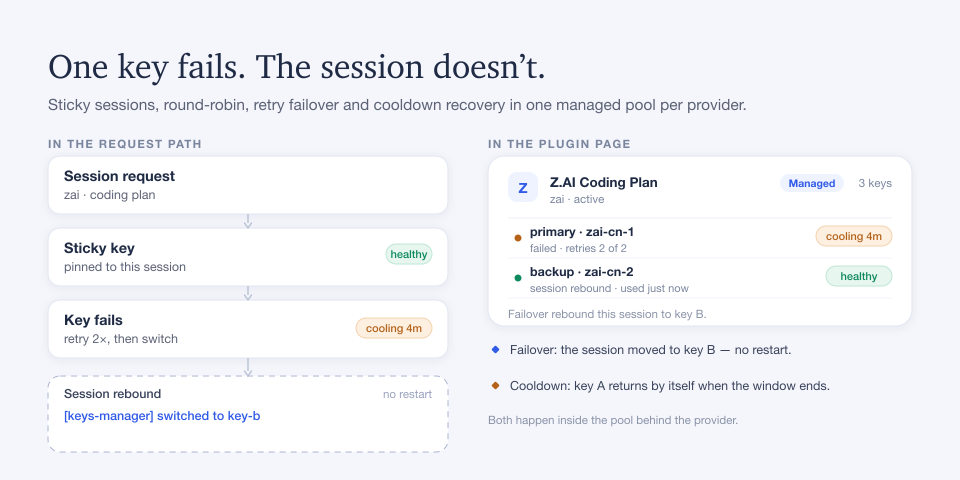
| Sticky session | The first request of a session selects a key and binds it for that session/provider pair. Later requests reuse it. |
| Round robin | A new session advances the provider cursor and takes the next healthy key. |
| Retry | A failing request is retried on the same key retryCount times. Request-shaped failures such as CONTEXT_WINDOW_EXCEEDED and cancellation never cool a key. |
| Switch | After the retry budget is spent, the failing key is marked cooling, and the session is rebound to another healthy key. When no alternate key exists, the manager delegates to the composition's normal retry/fallback policy. |
| Cooldown | The first failure cools a key for baseCooldownMs. A failure while cooling, or within recoveryGraceMs after recovery, doubles the next cooldown; a long healthy gap resets the escalation. The hard cap is seven days. |
| Recovery | The key is automatically selectable again when its cooldown expires; no manual reset is required. |
Manager metadata lives at:
$DSH_HOME/keys-manager/state.jsonwith owner-only permissions. It contains aliases, credential references,
health counters, session bindings, and provider adoption facts. API key
literals live only in the Harness credential store; an account row follows the
same rule behind its grantRef, with only non-sensitive metadata (email,
account id, expiry) in the state. The file is written atomically through a
temporary file and a rename.
Each managed provider profile points its apiKeyEnv at a broker reference
such as KEYSMGR_ZAI_CODING_CN_3FA2C1. The Host credential layer answers that
reference per request with the session's selected key. The Models page sees
the profile as configured; writing directly to the broker reference is
refused with a pointer to the manager.
The state shape already distinguishes kind: "api-key" from kind: "oauth"
and keeps a nullable oauth object beside the credential reference. A future
account flow can add records under keys-manager/<provider>/<key> without
rewriting existing rows. Providers whose only authentication is OAuth are
reported as unsupported in this version rather than being treated as API-key
providers.
Four groups, one pool:
llm-pi-ai routes.kilo and zai are signed in by the plugin's
bundled clients.dsh-llm-omp-transports.Plugin extra built-in — 35 — from oh-my-pi's provider catalog (MIT):
| Provider | Route id | API key env |
|---|---|---|
| DeepInfra | deepinfra |
DEEPINFRA_API_KEY |
| Novita | novita |
NOVITA_API_KEY |
| StepFun | stepfun |
STEPFUN_API_KEY |
| SambaNova | sambanova |
SAMBANOVA_API_KEY |
| Qianfan | qianfan |
QIANFAN_API_KEY |
| GMI Cloud | gmi-cloud |
GMI_API_KEY |
| Synthetic | synthetic |
SYNTHETIC_API_KEY |
| ZenMux | zenmux |
ZENMUX_API_KEY |
| Kilo Gateway | kilo |
KILO_API_KEY |
| NanoGPT | nanogpt |
NANO_GPT_API_KEY |
| Venice AI | venice |
VENICE_API_KEY |
| AIML API | aimlapi |
AIMLAPI_API_KEY |
| AI& | aiand |
AIAND_API_KEY |
| Helmcode | helmcode |
HELMCODE_API_KEY |
| Alibaba Coding Plan | alibaba-coding-plan |
ALIBABA_CODING_PLAN_API_KEY |
| MiniMax Coding (Global) | minimax-code |
MINIMAX_CODE_API_KEY |
| MiniMax Coding (CN) | minimax-code-cn |
MINIMAX_CODE_CN_API_KEY |
| Umans AI Coding Plan | umans |
UMANS_AI_CODING_PLAN_API_KEY |
| Sakana AI | sakana |
SAKANA_API_KEY |
| CoralBricks | coralbricks |
CORAL_API_KEY |
| Wafer Serverless | wafer-serverless |
WAFER_SERVERLESS_API_KEY |
| Alibaba Token Plan | alibaba-token-plan |
ALIBABA_TOKEN_PLAN_API_KEY |
| Alibaba Token Plan (CN) | alibaba-token-plan-cn |
BAILIAN_TOKEN_PLAN_API_KEY |
| Charm Hyper | charm-hyper |
CHARM_HYPER_API_KEY, HYPER_API_KEY |
| LiteLLM Proxy | litellm |
LITELLM_API_KEY |
| SiliconFlow | siliconflow |
SILICONFLOW_API_KEY |
| SiliconFlow (CN) | siliconflow-cn |
SILICONFLOW_CN_API_KEY |
| Zhipu Coding Plan | zhipu-coding-plan |
ZHIPU_API_KEY |
| Abliteration | abliteration |
ABLITERATION_API_KEY, ABLIT_KEY |
| ClinePass | cline-pass |
CLINE_API_KEY |
| Command Code | commandcode |
COMMAND_CODE_API_KEY, COMMANDCODE_API_KEY |
| CoreWeave Serverless Inference | coreweave |
COREWEAVE_API_KEY |
| Fire Pass | firepass |
FIREPASS_API_KEY |
| Ollama Cloud | ollama-cloud |
OLLAMA_CLOUD_API_KEY |
| Yolo Auto | yolo-auto |
YOLO_AUTO_API_KEY |
Where two variables are listed, either is accepted; the first is the primary.
CoreWeave Serverless Inference also needs COREWEAVE_PROJECT=<team>/<project> in
the DSH process environment before it is added.
OAuth accounts — 9
| Provider | Route | Sign-in client |
|---|---|---|
| Anthropic | anthropic |
pi-ai |
| GitHub Copilot | github-copilot |
pi-ai |
| Kimi Coding | kimi-coding |
pi-ai |
| OpenAI Codex | openai-codex |
pi-ai |
| OpenRouter | openrouter |
pi-ai |
| Radius | radius |
pi-ai |
| xAI | xai |
pi-ai |
| Kilo | kilo |
plugin bundled client — device code + poll |
| Z.AI Coding Plan | zai |
plugin bundled client — pasted zcode:// redirect |
The two plugin-signed credentials are static, tagged signin:kilo /
signin:zai-coding-plan, and nothing is written to llm-pi-ai/<provider>; the
seven pi-ai rows are the provider's own grants. kilo is listed twice on
purpose: the same route takes an API key as an extra built-in and an account
through its bundled client.
Transport routes — 7 — cursor, devin, google-gemini-cli,
google-antigravity, factory-droid, gitlab-duo, gitlab-duo-agent; sign-in,
refresh and model detail live in Transport routes.
| Provider | Why |
|---|---|
amazon-bedrock |
AWS credential chain (profile, IAM keys, ECS/IRSA/EC2), not one API key |
cloudflare-ai-gateway |
API key plus a Cloudflare account ID and gateway ID |
cloudflare-workers-ai |
API key plus a Cloudflare account ID |
openai-codex |
ChatGPT OAuth sign-in only; no API-key credential — usable as an OAuth account instead of a key |
Every other DSH catalog route exposes an API-key credential; a route you declare
yourself in the profile (自定义 / Custom) is pooled like any built-in.
| Doc | Content |
|---|---|
| Development | build and dev workflow, repository layout |
| Release | CI checks and the npm release flow |
| Known limits | current design boundaries, including the seven transport routes |
| Transports package | Transport routes: support status, risks, build/test, release |
Chinese: README.zh-CN.md · 开发 · 发布 · 已知限制.
Released under the MIT License.
CLASSIFICATION EVIDENCE
系统优先读取 GitHub Topics,再与站内分类词典和词根规则比对。当前命中: deepseek-harness、deepseek-harness-plugin。
morluto
Reverse engineer anything with agents, from app behavior down to native binaries.

deepseek-ai
DeepSeek Harness: Everything is a Plugin.

nexu-io
The 1st Collaborative AI Design Agent Workspace. Local-first and open source. Create motion, prototypes, websites, apps, dashboards, presentations, images, and videos with your team and AI agents. Share work, exchange feedback, and iterate together in one workspace.