A session-header 3-dots menu for dsh: download the session log, switch each chat between Normal and Verbose, and define what Verbose expands (thinking blocks, tool calls, terminal output) — plus a per-turn metrics footer.
A DeepSeek Harness plugin that gives the transcript a per-chat reading mode, in the shape dsh itself lacks: the session-header 3-dots menu downloads the session log, switches each chat between Normal and Verbose, and defines what Verbose expands — thinking blocks, tool calls, terminal output.
Everything stays in the browser. Two localStorage keys — a per-chat switch and a global category set — no service, no telemetry.
It does four things:
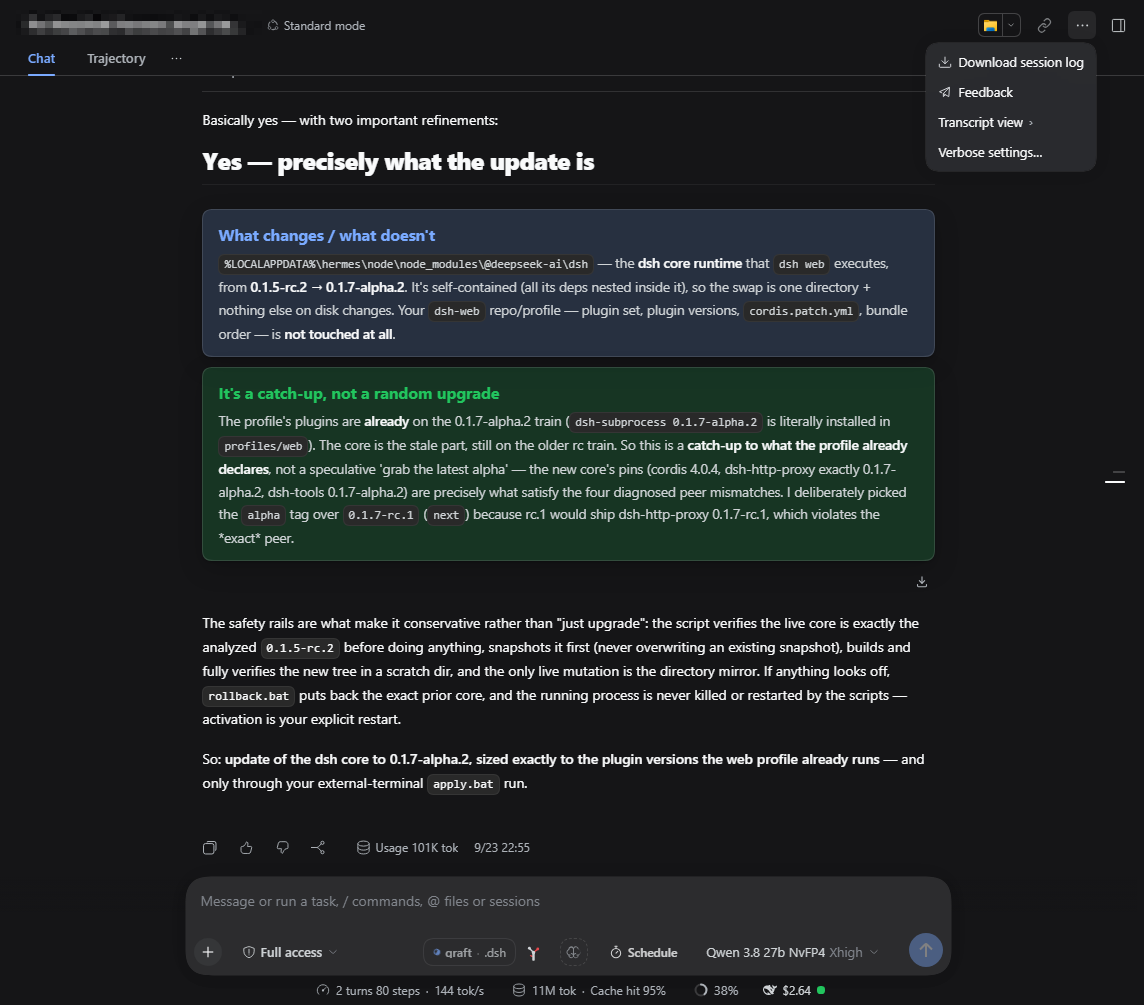
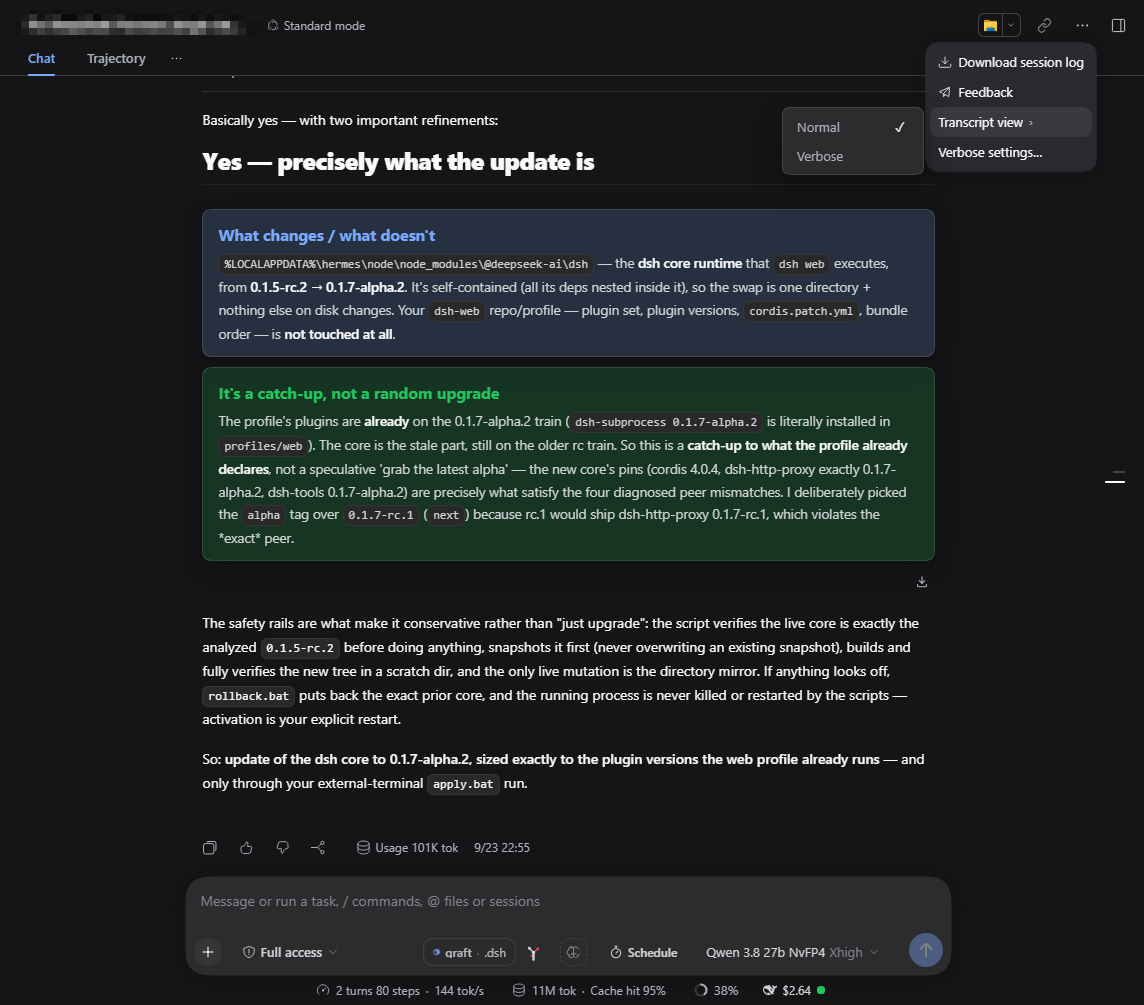
A per-chat Normal/Verbose switch — in the 3-dots menu, which replaces the built-in Session-log button in place (same seat, same id, lower priority), so the header still has exactly one such control. Applies to the open chat immediately; remembered per session in localStorage.
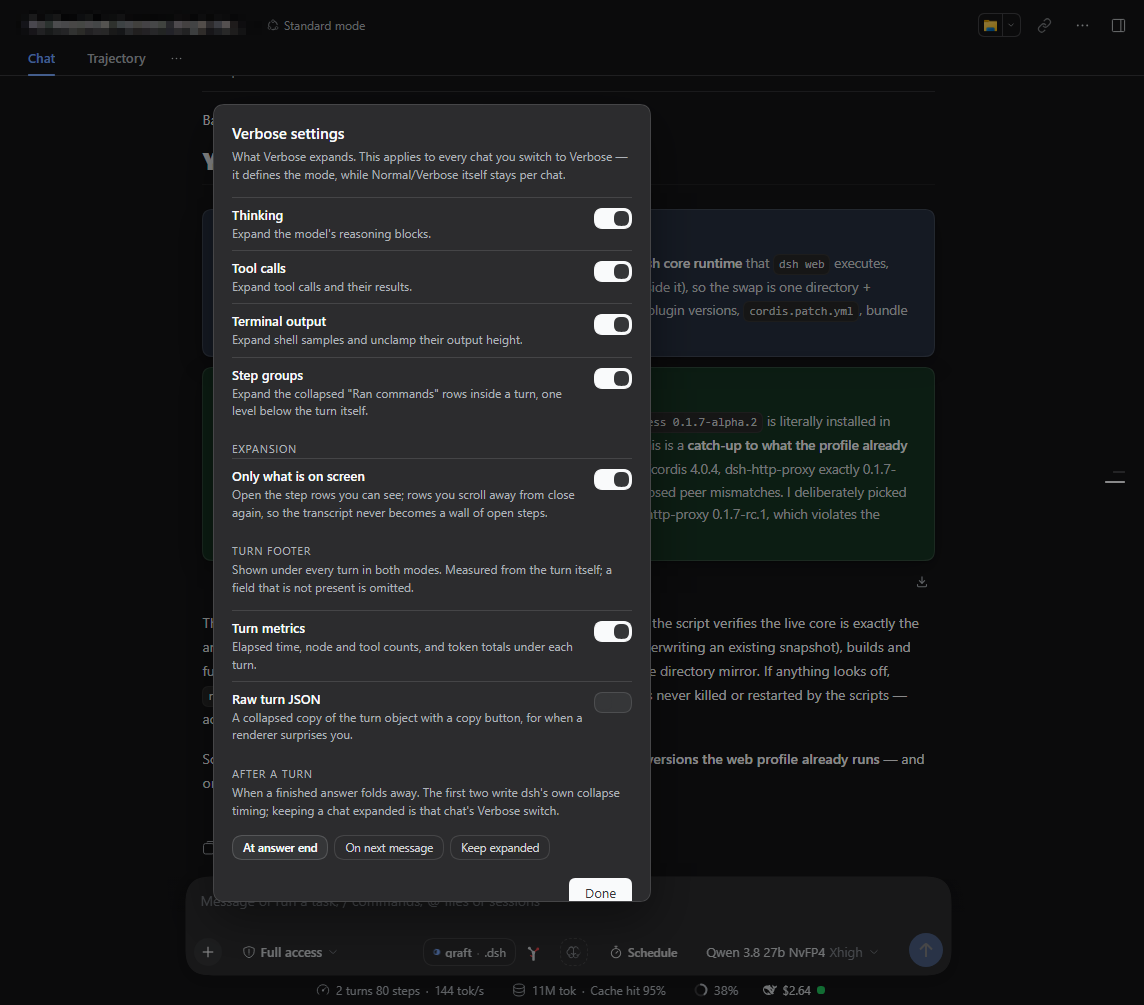
A "what Verbose expands" dialog — global switches for Thinking, Tool calls and Terminal output, a Turn footer group and an After a turn fold choice. Changing a category re-applies the open chat at once.
An expansion scope — by default Verbose opens step rows only as they enter the viewport and folds them again when they scroll out, so a long transcript never builds a wall of open steps; off gives the original "open everything at once" behaviour.
A turn footer — ⏱ 12.3s · 47 nodes · 9 tools · 84.2k tokens under every turn, in Normal and Verbose, plus a collapsed raw turn JSON with a Copy button.
Install
Requires a working dsh (0.2.1-rc.3 tested) with a web profile.
dsh plugin --profile web add dsh-verbose
dsh --profile web
Or install from GitHub or a local folder instead:
dsh plugin --profile web add github:adithyanraj03/dsh-verbose
dsh plugin --profile web add /path/to/dsh-verbose
Restart the host afterwards — the bundle row and the governor bridge are host-side; the browser half alone is reload-only. The 3-dots menu in the session header gains the Transcript view and Verbose settings… rows.
Confirm the row:
dsh --profile web --dump-config | Select-String "id: verbose"
One line is correct; none means the bundle row was not written.
Why this exists
dsh's transcript has one global presentation knob (transcriptView: compact / standard /
detailed / verbose) and no per-chat reading choice at all. That is the wrong shape for the
job: how much of a conversation's process you want to see is a property of that
conversation, while what "verbose" means is a property of you.
This plugin splits the two:
Scope
Setting
Where it lives
Per chat
Normal or Verbose
localStorage, keyed by session id
Global
Which categories Verbose expands: Thinking, Tool calls, Terminal output
localStorage, one set for every chat
Two scopes on purpose. A per-chat copy of the categories would only drift; a global
Normal/Verbose would flip every conversation at once.
What you see
The menu replaces the built-in Session-log button — same seat, same id, lower priority —
so the header still has exactly one 3-dots control:
Session log — downloads the session's log (falls back to the export URL when the
host's controller is not mounted).
Transcript view → Normal / Verbose — applies to the open chat, immediately.
Verbose settings… — the dialog: the three category switches, Turn metrics / Raw turn
JSON under a Turn footer heading, and the fold choice under After a turn. Changing a category re-applies the
current chat at once; the footer switches are global and take effect on the next render.
Compact settings… — only when context-governor is mounted (see Compatibility).
Normal leaves the transcript as dsh renders it. Verbose works the only way available from
outside React: it finds every disclosure row dsh already renders
([data-expandable][aria-expanded]), classifies it, and clicks the ones whose category is
enabled — then keeps doing so for rows that arrive while an answer streams, because dsh
rebuilds them as it grows. The hooks are semantic attributes, never class hashes:
Category
Row it governs
Selector
Thinking
reasoning blocks
closest('[data-variant="think"]')
Terminal
shell samples
closest('[data-sample="bash"]')
Tool calls
everything else
default
Step groups
the nested "Ran commands" rows inside a turn
[data-process-activity]
Thinking is tested first, so a tool row nested inside a reasoning block counts as thinking
— the enclosing kind is the one you switched off.
Expansion scope (new in this port)
A switch, Only what is on screen, decides how much work Verbose does:
on (default) — a step row opens when it enters the viewport and folds again when it
scrolls out. The reading position is what matters, so a long transcript never builds a wall
of open steps, and scrolling back re-opens what you return to.
off — everything enabled opens at once, which is what the original plugin did.
Three rules keep the mode stable, and each one exists because of a real failure:
Two bands, not one threshold. A row must be clearly on screen (120 px inside) before it
opens, and clearly gone (260 px outside) before it closes. The gap between them is a dead
zone where the engine does nothing — with a single boundary, expanding a row pushed the next
one past it, that row folded, the layout snapped back, and the row qualified again.
Folding waits for the reader to stop (600 ms after the last scroll). Nothing collapses out
from under a scroll in progress.
A pass that clicked anything suppresses itself for 320 ms. The mutations our own clicks
cause would otherwise schedule the next decision immediately, which is what made the
oscillation self-sustaining rather than a one-off.
Two touches make the remaining motion read as motion rather than as damage: the pass records the
row anchoring the reading position and corrects scrollTop by the height it just added or removed
(without that, expanding a row above you shoves the page), and each row it toggles gets a 170 ms
fade-in. The first pass after switching chats waits one frame, because dsh restores that session's
scroll position in the same commit.
Keyboard focus
dsh's own disclosure rows call focus() inside their click handler, which moves the scrollport
to the focused element. Two things follow from that: a synthetic click used to park focus on a
row (the next Enter re-toggled it instead of sending), and — during a live generation, where
every arriving tool call triggers a pass — clicking a row above the reader yanked the transcript
up to it.
The fix attacks the cause and then the symptom: for the duration of each programmatic click the
row's focus is shadowed with a no-op, so focus never moves and nothing scrolls; afterwards any
focus that still changed is restored with preventScroll.
The turn footer (new in this port)
Two switches that dsh's renderer has no toggle for, so they are this plugin's own node in
conversation.chat.turnTail:
Turn metrics — ⏱ 12.3s · 47 nodes · 9 tools · 84.2k tokens under every turn, in
Normal and Verbose. Everything is measured from the Turn object the slot hands over;
a field that is not present is omitted rather than printed as a zero.
Raw turn JSON — a collapsed copy of that same object with a Copy button, capped so a
giant turn cannot freeze the page.
They are deliberately not engine categories: the engine classifies disclosure rows, and
a "metrics" row does not exist — listing them as categories would make it look for rows
that can never be found. They live in the same dsh-verbose.categories document, and a
dsh-verbose:prefs event keeps every mounted footer in step with the dialog.
After a turn (new in this port)
The third group decides what happens to a finished answer:
Choice
Effect
At answer end
writes dsh's own collapseTiming: completion
On next message
writes dsh's own collapseTiming: next-input
Keep expanded
flips this chat to Verbose — "never fold" is the per-chat toggle, not a global value dsh has
The first two go through ctx.configForms.get("ui-chat"), the same seam dsh's own Settings row
uses, so the shipped renderer reacts exactly as if you had used it. The third deliberately
reuses the per-chat switch instead of storing a separate flag: two sources of truth for "is
this chat expanded" would eventually disagree, and the disagreement would look like a bug in
one of them.
Screenshots
Taken from a live dsh session, not mocked:
The shipped menu, extended. Download session log and Feedback are untouched; our two rows are appended below them.
Per-chat Normal/Verbose. The tick shows this chat's current view.
The dialog. What Verbose expands, the expansion scope, the turn footer, and the fold choice.
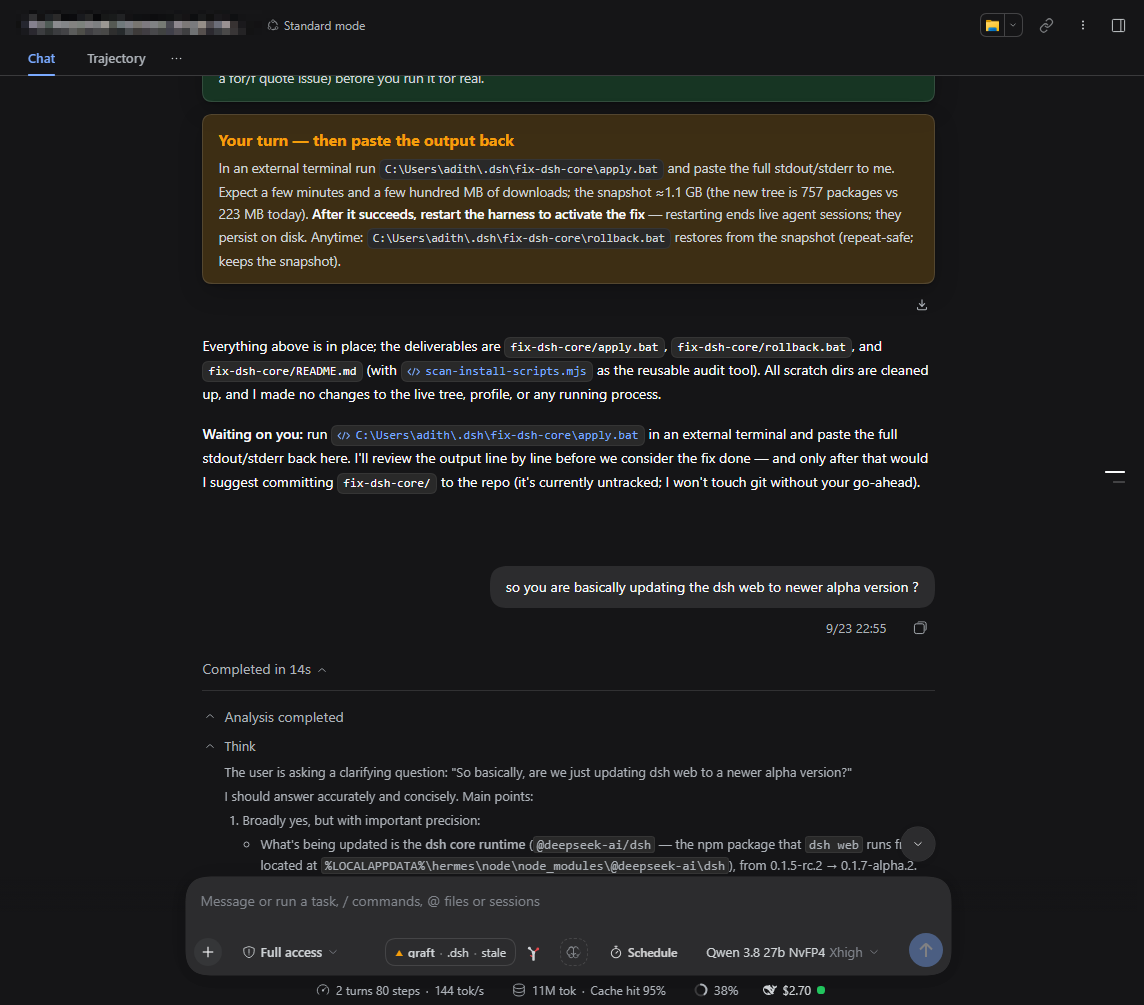
A Verbose chat. Step groups and reasoning open as the reader scrolls.
Compatibility
dsh 0.2 requires create() on every strict codec. The original plugin predates that
rule, so its CG_CODEC gains create: () => CG_CODEC.schema. Without it the loader
refuses the whole client plugin — not just the remote.
The slot shadow is intentional. Registration uses the built-in's own entry id
(session-log-download) with priority: -1; a list slot projects one entry per id,
lowest priority first. That is what removes the duplicate button rather than adding a
second one.
context-governor is optional. The host half republishes its service over a Typert
Remote for the Compact panel. In a profile without that plugin the bridge fails inside a
try, every method answers available: false, and the menu simply omits the item.
dsh 0.2 groups its process rows. 0.1.5 marked every transcript row
[data-expandable][aria-expanded]; 0.2 collapses a turn's rows into one
button[data-turn-process] and only the bash toolview still marks itself expandable
(as data-variant="bash"). The engine therefore matches
[data-turn-process][aria-expanded], [data-expandable][aria-expanded] — the ported
0.1.5 selector matched nothing here, which looked exactly like "Verbose does nothing".
Consequence worth knowing: inside a collapsed group there is one button, so switching
Thinking off individually cannot hide reasoning while the group is closed — the group is
expanded or it is not.
Storage keys are namespaced to this plugin (dsh-verbose.verbose,
dsh-verbose.categories), so installing the original alongside it cannot share state.
Troubleshooting
Symptom
Cause
Fix
Entry fails to load (dsh-verbose: failed)
an undeclared service in apply
it declares slots + remote; re-check against the error text
Two 3-dots buttons
another plugin also shadows session-log-download
keep one; both use the same id
Verbose does nothing
the chat has no disclosure rows yet
send a message; rows appear as the turn streams
Compact settings missing
context-governor not mounted
expected — it is optional
Choices reset on reload
private mode / blocked storage
the plugin needs localStorage
Development
npm test
tests/client.test.mjs — evaluates the real bundle against a shim and asserts the two
things that decide whether it mounts: the declared services, and the slot shadow
(name, built-in id, priority, registrant). It also renders the menu one level and checks
the trigger exists and the modal is closed.
tests/classify.test.mjs — the engine's classification spec: a fake transcript with a
reasoning wrapper, a generic tool row, a bash row that carries both attributes on one
element, and an already-open thinking block.
Requirements
dsh 0.2 (0.2.1-rc.3 tested), with a web profile
Node 22+
localStorage — in private mode, or with storage blocked, the choices reset on reload
Credits
The implementation is adapted from session-view-menu 1.1.0 (MIT, same author), retargeted at dsh 0.2 with the codec rule and namespacing above.