

其他
完整应用

deepseek-harness
deepseek-ai
DeepSeek Harness: Everything is a Plugin.
PROJECT TOPICS
PROJECT README

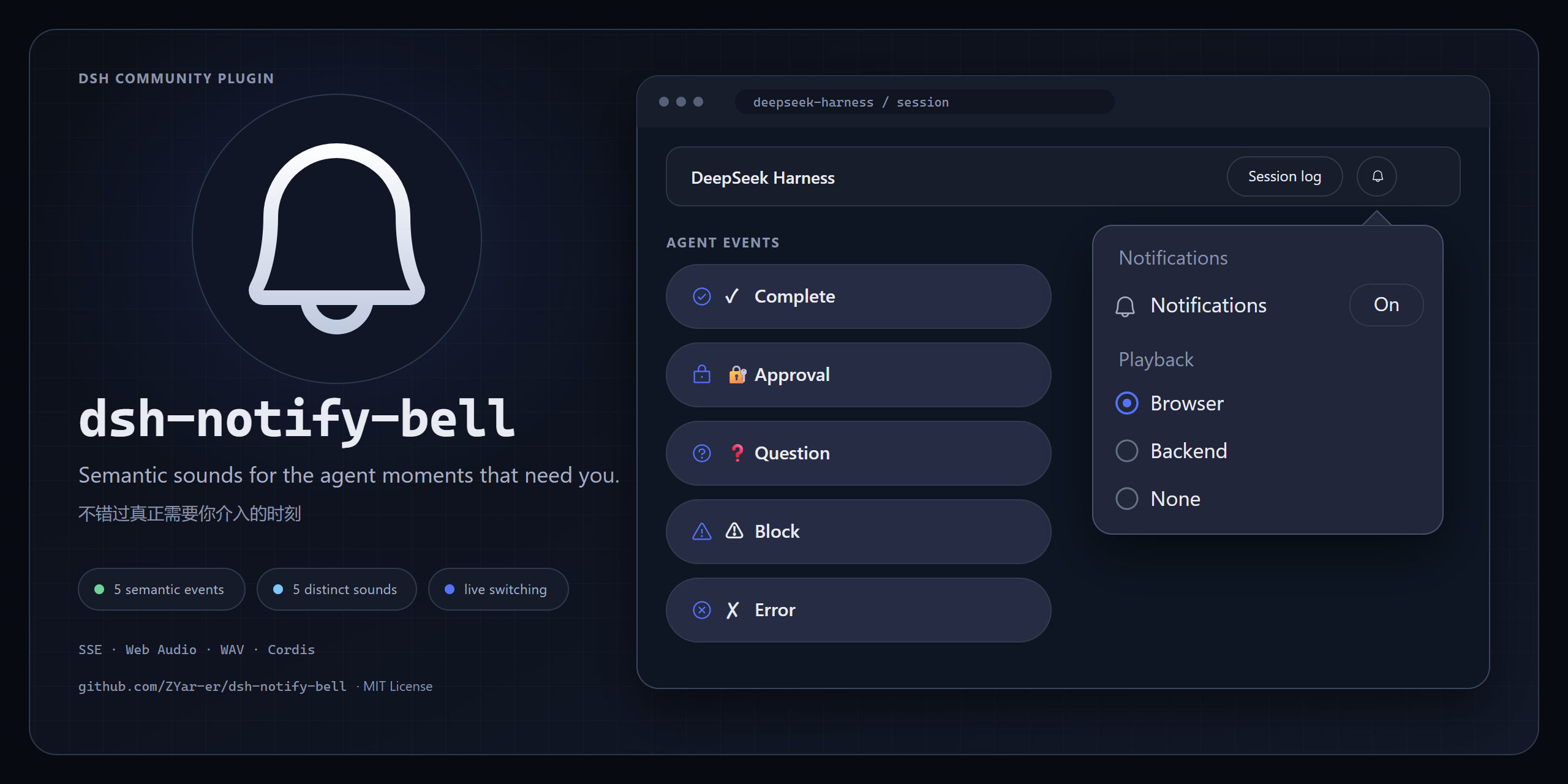
A community plugin for DeepSeek Harness (DSH) that provides semantic notification sounds for important agent events.
Developer Preview · v0.12.0
🎧 Listen to the notification sounds →
dsh-notify-bell lets you step away from the DSH Web UI without missing important agent events.
Instead of notifying on every internal event, it focuses on moments when the agent actually needs your attention:
Each event has its own semantic sound rather than relying on repeated beeps to communicate meaning.
bell / bell-slash notification button@deepseek-ai/schemasteryInstall from npm:
dsh plugin --profile web add dsh-notify-bellAfter installation, restart dsh web if required by your current DSH setup.
From a checkout of this repository:
dsh plugin --profile web add ./dsh-notify-bellFor development versions or source testing, install straight from GitHub:
dsh plugin --profile web add github:zyar-er/dsh-notify-bell#<commit-sha>Pinning a commit is recommended when installing directly from GitHub.
After starting DSH Web, a notification bell appears next to Session log:
Session log 🔔Click the bell to open notification settings.
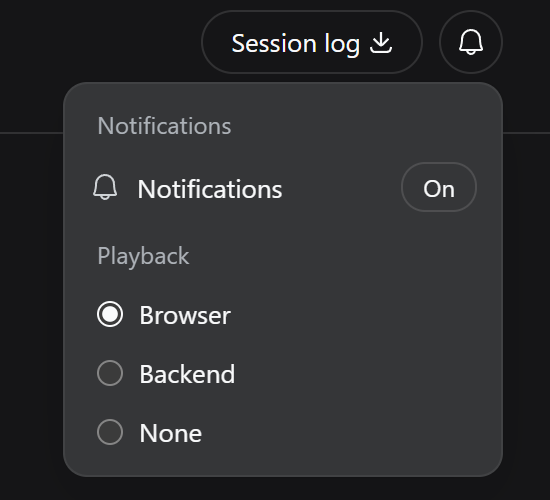
You can control:
Notifications — enable or disable all notification sounds
Playback — choose where sounds are played:
Changes apply immediately and are persisted automatically.
Recommended for DSH Web.
The backend classifies notification events and sends semantic sound events to the browser over SSE. The browser plays the bundled WAV files using Web Audio.
DSH backend
   ↓
SSE
   ↓
DSH Web
   ↓
Web Audio
   ↓
WAV
Browser playback requires normal user interaction with the page before the first sound because of browser autoplay policies.
Once unlocked, the DSH tab can remain in the background while you work in another tab.
Browser playback does not use the browser Notification API and does not require notification permissions.
Playback happens on the host instead of inside the browser.
On Windows and WSL:
PowerShell
  → System.Media.SoundPlayer
  → Windows Audio
On Linux, the plugin probes available players in this order:
paplay
pw-play
aplay
ffplay
If WAV playback is unavailable, backend playback can fall back to the terminal BEL when a TTY is available.
Notifications are logged but no sound is played.
The playback mode can be changed from the notification settings popover without restarting DSH.
Configuration:
{
  "playback": "browser"
}
Allowed values:
browser
backend
none
There is currently no automatic Browser → Backend fallback and no both mode. The selected mode is intentional: one notification is handled by one playback backend.
| Event | Sound | Source | Duration |
|---|---|---|---|
| ✓ Complete | ui/success_bling |
react-sounds | 0.76s |
| 🔐 Approval | notification/notification |
react-sounds | 0.86s |
| ❓ Question | notification/info |
react-sounds | 0.86s |
| ⚠ Blocked | ui/blocked |
react-sounds | 0.89s |
| ✗ Error | notification/error |
react-sounds | 0.55s |
Each notification uses a distinct sound identity rather than counting repeated beeps.
The plugin follows the official DSH Cordis configuration model and exports
a Schemastery Config schema: the config block of the plugin row in your
profile's cordis.patch.yml is validated and default-filled at load time,
and invalid values fail loudly.
Example (profile patch):
- id: notify-bell
  config:
    minDuration: 10
    playback: backend
The legacy runtime-state file is:
~/.config/dsh/notify-bell.jsonIts path can be overridden with:
DSH_NOTIFY_BELL_CONFIGThe Web UI persists enabled and playback there. Example file:
{
  "enabled": true,
  "minDuration": 10,
  "objective": {
    "maxLength": 120
  },
  "events": {
    "complete": {
      "enabled": true,
      "sound": "done"
    },
    "block": {
      "enabled": true,
      "sound": "block"
    },
    "approval": {
      "enabled": true,
      "sound": "permission"
    },
    "question": {
      "enabled": true,
      "sound": "question"
    },
    "error": {
      "enabled": true,
      "sound": "error"
    }
  },
  "soundPack": "wav",
  "playback": "browser",
  "wav": {
    "directory": "~/.config/dsh/notify-bell/sounds",
    "fallback": "bell"
  },
  "bell": {
    "gapMs": 150,
    "permissionGapMs": 300
  }
}Tasks shorter than minDuration do not play the completion sound.
Approval and question notifications are immediate because they indicate that the agent is waiting for the user.
enabled controls all notification playback.
When disabled:
The plugin follows the official DSH Cordis configuration model.
Explicit plugin configuration takes precedence over the legacy runtime-state file:
cordis config > notify-bell.json > schema defaultsFor normal users, the Web UI is the easiest way to change notification state and playback mode.
A completion notification means that the agent has finished its final answer for the current turn.
The notification is based on:
session/event
type = turn/end
data.reason.kind = completed
The turn must contain a real final assistant text response. Empty no-op turns and tool-call-only concludesTurn endings do not trigger the completion sound.
Subagent turns are ignored.
Completion duration is measured from:
turn/start.time → turn/end.timeRequests shorter than minDuration are logged but do not play the completion sound.
Triggered by:
approval/askedThis means a tool operation is waiting for user approval.
approval/decided does not produce another notification.
Triggered when the agent invokes:
ask_user_questionThe notification indicates that the agent is waiting for a user response.
The response itself does not create another notification.
Triggered by:
goal/changed
operation = blockTriggered by:
agent/errorThis represents an agent-level error. A normal shell command returning a non-zero exit code does not necessarily produce this event.
Browser playback is recommended when using DSH Web.
Backend playback uses:
PowerShell
  → System.Media.SoundPlayer
→ Windows AudioBackend playback automatically probes:
paplay
pw-play
aplay
ffplay
No additional player is installed automatically.
The following sections are primarily for contributors and plugin developers.
dsh-notify-bell follows the official DSH plugin format.
The package:
Config schemadsh.bundledsh.clientcordis.patch.yml without requiring manual profile patch editingThe official DSH plugin documentation is available at:
https://deepseek-harness.github.io/deepseek-harness/develop/basic/
DSH session events
        ↓
event classification
        ↓
semantic sound
        ↓
playback
   ┌────┼───────┐
   ↓    ↓       ↓
browser backend none
   ↓      ↓
 SSE    audio
   ↓      ├─ WAV
 Web      └─ BEL fallback
 Audio
The event layer is independent from the physical audio backend.
Semantic sounds are:
done
permission
question
block
error
Browser mode uses:
session event
    ↓
server-side classification
    ↓
SSE: /notify-bell/events
    ↓
client.js
    ↓
Web Audio
    ↓
bundled WAV
The browser does not duplicate the event classification logic.
Backend mode uses the existing platform audio abstraction:
Windows / WSL
→ PowerShell + SoundPlayer

Linux
→ paplay
→ pw-play
→ aplay
→ ffplay

failure
→ BEL fallbackThe Web client is loaded using the DSH client module system and registers the notification controls next to Session log.
The notification settings popover controls:
enabledplaybackRuntime state is persisted atomically to the legacy configuration file.
The project includes unit and session-layer integration tests.
Current test status:
All tests passing — 11 node:test cases (6 unit + 5 session-layer integration), with 179 assertion checks in the unit script.
Real-world verification has covered:
The error notification path is covered by automated tests; deliberately breaking credentials is not required for normal validation.
DSH is still in Developer Preview, so upstream plugin and event APIs may change.
dsh-notify-bell is a community plugin and is not an official DeepSeek plugin.
Community testing is especially welcome for:
When reporting an issue, please include:
Sound assets are from react-sounds.
Icons use Phosphor Icons.
Built for DeepSeek Harness.
The dsh-notify-bell source code is licensed under the MIT License.
This repository also distributes third-party sound and icon assets. See NOTICE.md for their respective licenses and attribution.
CLASSIFICATION EVIDENCE
系统优先读取 GitHub Topics,再与站内分类词典和词根规则比对。当前命中: 无有效分类标签。
deepseek-ai
DeepSeek Harness: Everything is a Plugin.

walkinglabs
Harness engineering beginner tutorial, from 0 to 1

anywhere-labs
为 DeepSeek Harness (DSH) 插件生态打造的现代化桌面端解决方案。万物皆「插件」,桌面本身也是「插件」。