
模型与 MCP
待识别

rea
morluto
Reverse engineer anything with agents, from app behavior down to native binaries.
PROJECT TOPICS
INSTALL REFERENCE
dsh plugin --profile web add github:YunFengyi/dsh-landmarks-3d
该命令指向仓库当前默认分支;尚无绑定当前 commit 的完整验证结果。
PROJECT README
English · 简体中文
A DeepSeek Harness plugin. It adds one entry to the left sidebar; the entry opens a full page with four world landmarks rendered as interactive 3D models.
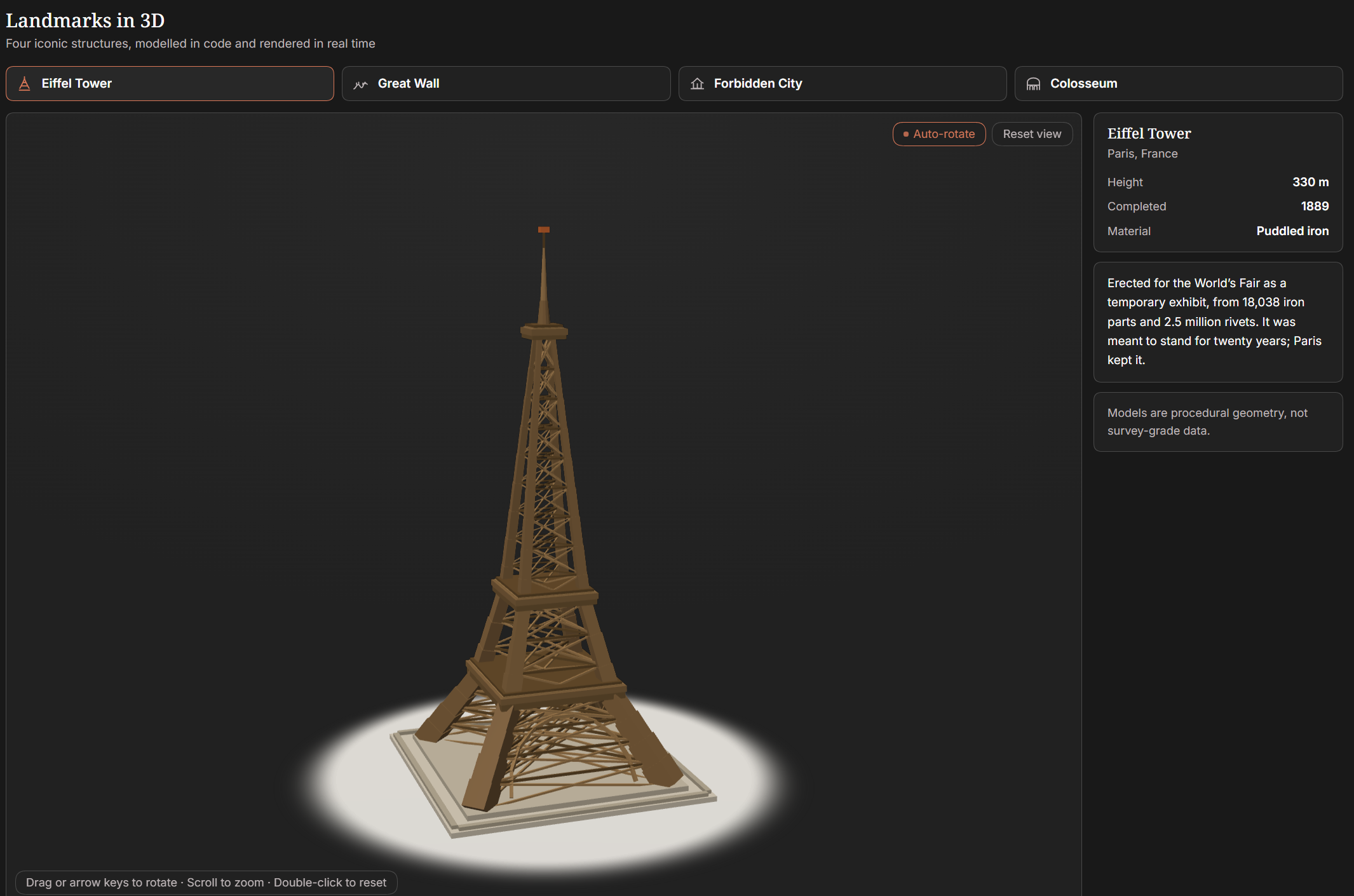
Rendered live in the panel — the dark theme shown here; the light theme is equally supported.
| Landmark | Location |
|---|---|
| Eiffel Tower | Paris, France |
| Great Wall | Northern China |
| Forbidden City | Beijing, China |
| Colosseum | Rome, Italy |
sidebar.panellist with id: landmarks-3d,
and the matching main panel key renders the page. The icon is a hand-drawn SVG
Eiffel Tower, so no image asset is downloaded.client.js.
No three.js, no CDN script, no build step.+/-/arrow keys
on the focused canvas, double-click to reset the camera, and a toggle that stops or
starts the slow auto-rotation. A new landmark starts rotating only after the gesture
pauses, and motion follows prefers-reduced-motion.--dsw-alias-* tokens, so light and dark themes
both work; only the artwork carries its own stone/bronze palette.Each model is generated from a parametric description rather than loaded from a file:
Requirements: DeepSeek Harness with the web client (the plugin targets the
sidebar.panellist and main slots) and a WebGL-capable renderer. Nothing else — the
bundle has no dependencies and no build step, so it installs offline.
The plugin is a directory bundle, so DSH installs it from a folder, not from npm:
git clone https://github.com/YunFengyi/dsh-landmarks-3d.gitDownloading Code → Download ZIP from the repository page and unpacking it works the same way.
Two ways, same result: it installs into the current profile, applies to every session, and survives a restart.
dsh-landmarks-3d folder. This entry installs a local directory.D:\code\dsh-landmarks-3d". It runs plugin_manager action: install_bundle with
that directory as target.The rendering half is a client module, so the Harness page has to load again. The left sidebar gains an icon — a small Eiffel Tower, ordered after the built-in panels — and clicking it opens the page.
If the icon does not appear, open Plugins, make sure the dsh-landmarks-3d row is
enabled, and reload once more.
cd dsh-landmarks-3d && git pull # then reload the pageTo remove it: in Plugins, delete the dsh-landmarks-3d row; or have the agent call
plugin_manager action: remove_bundle with target: dsh-landmarks-3d.
| Action | Input |
|---|---|
| Orbit | drag with the pointer |
| Zoom | wheel, two-finger pinch, or + / - with the canvas focused |
| Rotate with keys | arrow keys with the canvas focused |
| Reset camera | double-click, or the "Reset view" pill |
| Stop auto-rotation | the "Auto-rotate" pill |
| Recover from a WebGL failure | the message inside the stage says so; the tabs stay inert |
package.json        manifest: bundle patch + client section
cordis.patch.yml    inserts the host plugin row
index.js            host half (no server work; the client owns rendering)
client.js           client module: models, WebGL renderer, sidebar icon, page
icon.svg            sidebar icon
locale/en.json      plugin manager metadata (English)
locale/zh.json      plugin manager metadata (Chinese)
docs/DETAIL.md      plugin detail page (English)
docs/DETAIL.zh.md   plugin detail page (Chinese)
docs/screenshot.png README hero: a real render of the panel
docs/preview.svg    preview illustration used by the detail page
test/verify-panel.mjs     static check: slots, locale keys, a11y, CSS coverage
test/verify-geometry.mjs  model geometry, real-world proportions, camera fit
CONTRIBUTING.md commit format, branch names, how to run the checksNo browser and no dependencies — both checks read client.js as text, or rebuild the models
in Node and project them through the same matrices the renderer uses:
npm testverify-panel.mjs loads the module through a fake __ModuleLoader__, calls apply() with a
recording ctx, and asserts the two slot registrations share one id, that the <style> is
mounted, every t() key resolves in both languages, and every rendered className has a rule.
verify-geometry.mjs builds the four models, then checks triangle data, proportions against
the real buildings, and that the fitted camera keeps the whole model inside the frustum.
client.js uses only the built-in React and ctx handed to
a client module. It imports no Harness client package and touches no network.CLASSIFICATION EVIDENCE
系统优先读取 GitHub Topics,再与站内分类词典和词根规则比对。当前命中: deepseek-harness。
morluto
Reverse engineer anything with agents, from app behavior down to native binaries.

deepseek-ai
DeepSeek Harness: Everything is a Plugin.

nexu-io
The 1st Collaborative AI Design Agent Workspace. Local-first and open source. Create motion, prototypes, websites, apps, dashboards, presentations, images, and videos with your team and AI agents. Share work, exchange feedback, and iterate together in one workspace.