
Agent 与会话
插件

nuwa-skill
alchaincyf
你想蒸馏的下一个员工,何必是同事。蒸馏任何人的思维方式——心智模型、决策启发式、表达DNA。Distill how anyone thinks.
PROJECT TOPICS
INSTALL REFERENCE
dsh plugin --profile web add github:Winnie-0721/dsh-dialogue-cleanup
该命令指向仓库当前默认分支;尚无绑定当前 commit 的完整验证结果。
PROJECT README
English · 简体中文






Delete DeepSeek Harness sessions from the running Web GUI — without restarting, without leaving the window.
One row in the session ... menu for a single delete, plus a bulk management page inside Settings.
Install · Gallery · How it works · Releasing · Releases
One-line positioning: deleting a session should actually delete it. DeepSeek Harness keeps a session in four places at once — the live store, the workspace records, the registry leftovers (pin / archive), and the files on disk. Removing one of them leaves a ghost row, a stale workspace, or a directory that silently keeps occupying disk. Everything below is that positioning made concrete:
deleteSession lives in the Host
(lib/service.js) and is reached through two thin adapters — the HTTP contract and the slot UI —
so the single-delete path and the bulk path cannot drift apart.deletable and the UI simply
does not offer what the Host would reject. The panel never decides by itself whether something is
safe to delete.hide archived / all /
archived only — and archived are shown by default.)user/message and no session/title, so it never had a title to show. They usually far outnumber
real sessions (199 of 254 on one host), and listing them one-per-row is what used to fill the
panel with (no title). The official sidebar's sessionVisible() does
if (session.blank && session.id !== current) return false;. Here it is a tri-state filter —
hide blank / all / blank only — default hide; the two explicit settings exist because
cleaning disk is this plugin's job, so blank sessions stay reachable for bulk deletion. The list
reports blank: { filter, total, hiddenInView } — total is the whole-corpus count (like
archived.total), hiddenInView is how many this view actually hid after the other filters
ran. The count is rendered inside the filter's own selected label
(Hide blank sessions (7)), so the number always describes the list you are looking at, and the
state is stated in exactly one place — there is no separate notice bar repeating what the dropdown
already says. One click switches the filter, so nothing ever looks silently lost.origin: 'subagent' rows entirely, so
whenever those rows do appear (kind = subagent / all) each one is explicitly badged — a subagent
session must never look like an ordinary conversation.detached: false rather than claiming success.200),
this one uses real status codes: 400 / 403 / 404 / 405 / 409 / 429 / 500.The confirmation overlay: irreversible, and it says so. Two closing paths only — an explicit
Cancel button, or Esc. Clicking the scrim deliberately does not dismiss it, because a
mis-click on an irreversible delete should not cost you your chance to confirm:
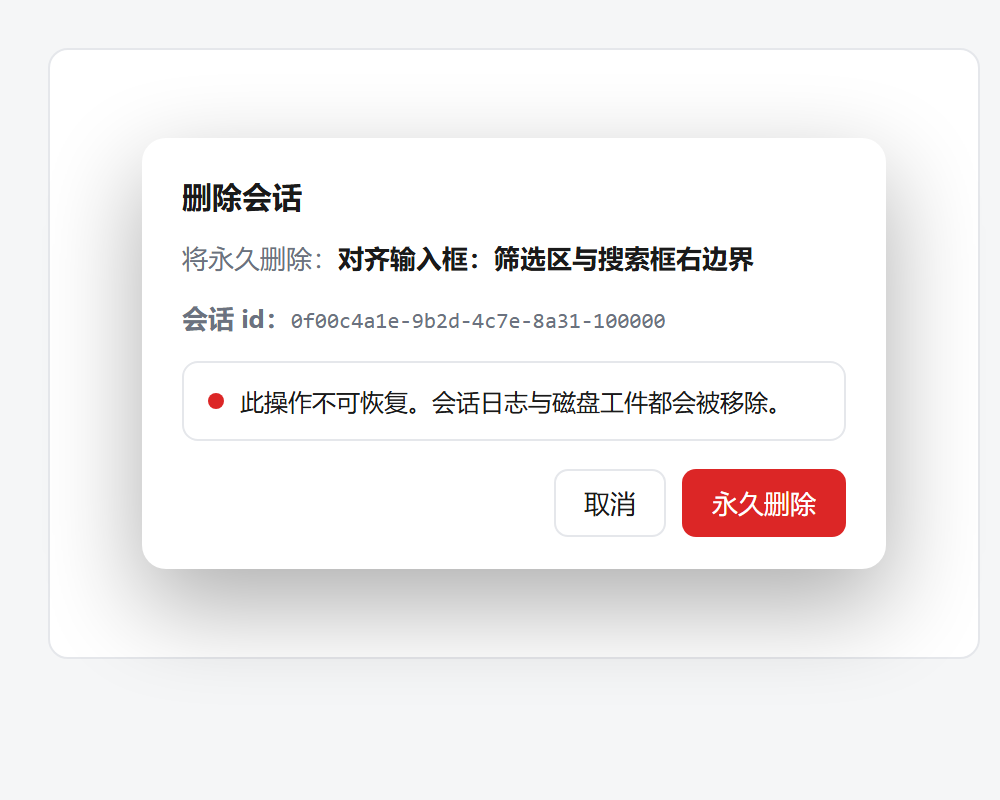
The overlay is a native <dialog> driven by showModal(), so it enters the browser's top
layer and therefore stacks above the Settings panel it was opened from (a plain positioned element
could not). That also brings a real focus trap and correct Esc semantics for free — and it needs no
portal outside the component tree.
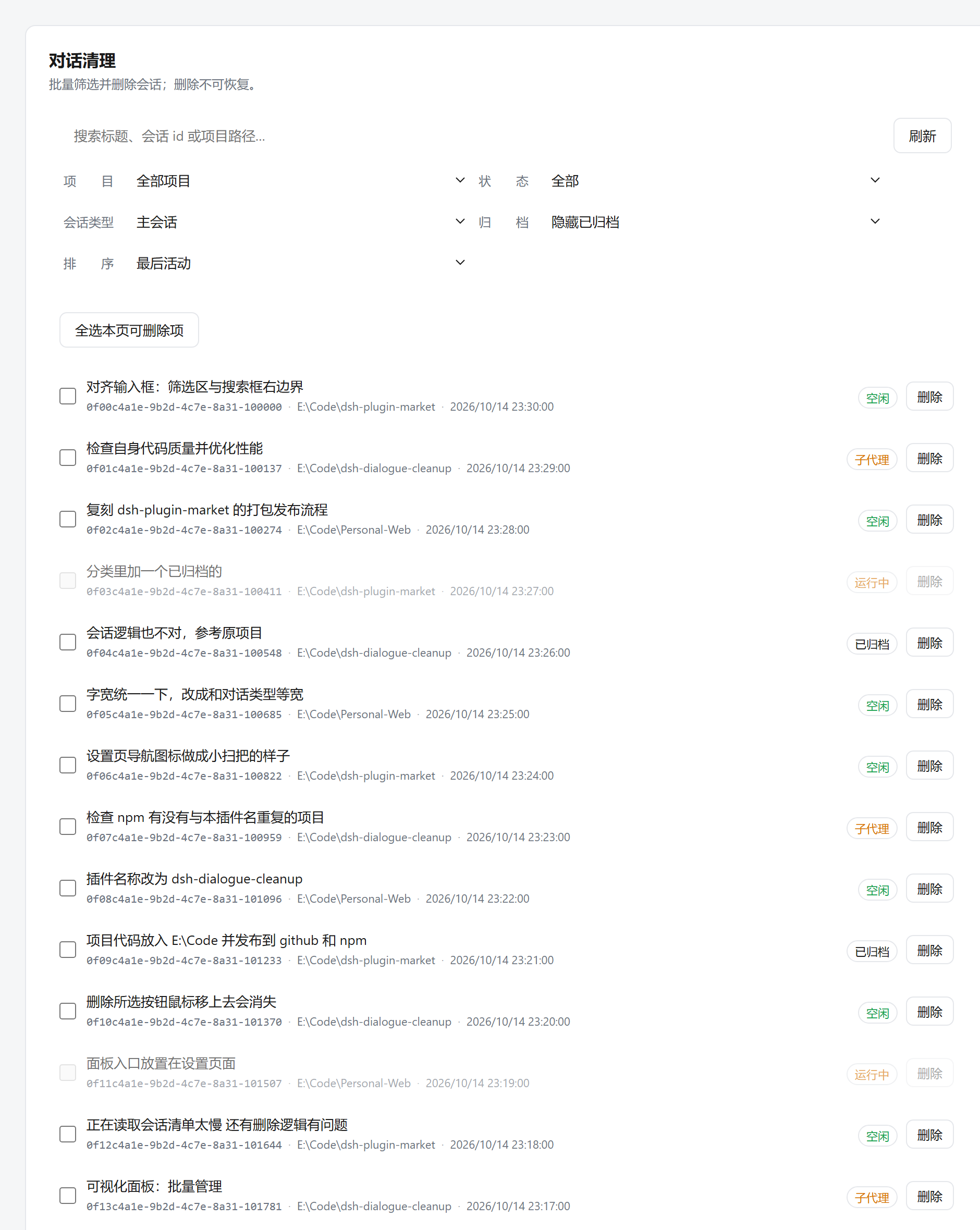
The bulk panel (inside Settings) — search, project / state / session-kind / archive filters,
sort, paging, and per-row status badges. The badges in the screenshot above come from real render
output: 空闲 (idle) / 运行中 (running, not selectable) / 子代理 (subagent) / 已归档 (archived).
The two screenshots are generated from the actual component tree and the actual CSS by
scripts/render-shot.mjs(the same React stand-in the render tests use), rasterised with headless Edge. They are not hand-drawn mockups; they are also not a photograph of a live GUI — see Honest limitations.
dsh plugin --profile web add dsh-dialogue-cleanup... menu and pick
Delete session (registered at order: 500, right after the shipped Archive entry at 400).
A themed confirmation appears; confirming removes the live entry, the workspace records, the
registry leftovers and the on-disk artifacts.Compatible with DSH 0.2.0-rc.2. The npm package and the GitHub Release are published together; versioning rules and the release chain live in docs/RELEASING.md.
One npm package carries both halves, installed into the host per the official plugin spec:
lib/index.js is a Cordis function plugin exporting only
name / inject / apply. It registers a single ctx.webServer prefix route and keeps the
entire deletion implementation in lib/service.js. Filesystem removal and path containment live in
lib/artifacts.js; the audit trail in lib/audit.js.client.js, a single-file bundle registered through
window.__ModuleLoader__.load({ id, factory }), with zero dependencies beyond require("react").sidebar.workspaces.session.menu.item at order: 500 → the single-delete row.settings.section (id: dialogue-cleanup, order: 25, after the shipped
account(-10) / general(0) / models(10) / plugins(15) / agent-presets(20)) → entry and panel.
One registration is one Settings page, whose content renders in the panel's content column.layout service and does not compete for space
in main or the sidebar — one fewer optional dependency and one fewer degradation branch.<style> beside
itself (finding H1 of the project's own audit: the row was rendering unstyled because the
stylesheet was only injected on the settings path).refused.<DSH_HOME>/sessions/<project>/<sessionId>, plus the derived
projection cache.<DSH_HOME>/logs/dialogue-cleanup.jsonl.| Method | Path | Purpose |
|---|---|---|
POST |
/api-ext/dialogue-cleanup/delete |
{ "sessionId": "..." } → delete one; { "sessionIds": [...] } → delete many (the Host runs the same deleteSession per id and returns a per-id result) |
POST/GET |
/api-ext/dialogue-cleanup/list |
session rows with deletable / blockedReason / classification / titleState |
GET |
/api-ext/dialogue-cleanup/status |
capabilities, config, runtime paths |
Envelope: { ok: true, value } / { ok: false, error: { code, message, hint? } }.
Each /list row carries titleState, which distinguishes the four reasons title can be
empty. Collapsing them into one "untitled" label is what made a whole screen look broken:
titleState |
Meaning | Retry helps? |
|---|---|---|
ready |
the title is present | — |
blank |
blank: true — the session never received a user message (init events only) |
no, it should never have had one |
empty |
the session has content, but the host answered that there is genuinely no title (e.g. a subagent session that only ran turn/start → turn/end) |
no |
unread |
the session has content, but the title was not read this time (outside titleLimit, or the read failed) |
yes |
empty is backed by a titleConfirmed set that only accepts ids the host answered for
successfully, so a budget miss or a failed batch can never masquerade as "there is no title".
The client renders three distinct placeholders from this, and prints the session id for both
empty and unread rows (both are real sessions, and deletion is irreversible) while staying
silent for blank rows (199 of 254 on a measured profile — a wall of UUIDs would bury the real ones).
All tunables live in the plugin Config (lib/config.js), so a user's patch layer survives
upgrades. A matching override replaces the whole config — write every field you care about.
| Key | Default | Meaning |
|---|---|---|
maxBodyBytes |
65536 |
request-body ceiling (upstream: 1 MiB) |
readTimeoutMs |
10000 |
body-read timeout (upstream: none) |
audit / auditPath |
true / null |
audit log; null → <DSH_HOME>/logs/... |
auditMaxBytes |
4194304 |
audit rotation threshold (4 MiB); 0 disables rotation |
auditRotateKeep |
3 |
rotated files kept (excluding the current one) |
rateLimitPerMinute |
60 |
per-minute delete request budget (a batch counts once); 0 disables |
requireIdleSession |
true |
safety valve for the running-session refusal |
stopIdleAgent |
false |
see the honest-degradation note below |
matchAlternateIdSpelling |
true |
probe the other session- spelling, guarded |
removeProjectionCache |
true |
also drop the derived projection cache |
clearRegistryRecords |
true |
unpin / unarchive leftovers |
confirmInUi |
true |
UI confirmation (the Host does not trust it) |
announceRemoval |
true |
emit session.removed after deletion so other views drop the row |
titleCacheTtlMs |
300000 |
title-fold cache TTL; 0 disables |
titleFetchConcurrency |
8 |
shard concurrency when folding titles |
titleLimit |
100 |
max rows per page to fold titles for; 0 skips title reading |
titleSearchLimit |
40 |
separate title budget for keyword search (independent of titleLimit); rows beyond it are reported in titles.truncated |
runningProbeTtlMs |
1000 |
how long a running-state snapshot is reused. Turns batch delete from O(N) full-corpus list calls into O(1); 0 re-probes every item |
These are measured against the live runtime and differ from what the upstream package assumes. They are reported truthfully rather than papered over:
Agent type is
{ readonly id: SessionId } — no status, no ctx. Upstream's agent.status === "running" and
agent.ctx.fiber._unload() therefore cannot be relied on (_unload is a Cordis private method
and is deliberately never called). "Is it running?" comes from the public
sessionController.list() → SessionSummary.running. A session that still has an attached agent
and cannot be stopped safely is refused, and the UI shows why.sessions service exposes
create/prepare/enter/announce/flush/get/list/fork — no public detach. The plugin tries the
public method first, then the internal store entry, and reports detached: false when neither is
available instead of claiming success.<DSH_HOME>:
...\<uuid>\session.v4.jsonl.zstd and ...\session-<uuid>\session.v4.jsonl.zstd. An exact-id join
can never delete the prefixed half. This plugin probes the alternate spelling only when it can
confirm the candidate is not a different live session; with no such evidence it deletes nothing
rather than risk a neighbour.# Full gate: node --check + migration/contract/render/release regression suites
node scripts/run-tests.mjs
# Release gate only (no version change, no packing, no publishing)
pwsh -File scripts/release.ps1 -LocalOnly
# Regenerate the two documentation screenshots from the real component tree
node scripts/render-shot.mjsDo not use
node --test "test/**/*.test.mjs": glob expansion needs Node 22+, whileengines.nodedeclares>=20. On Node 20 that command fails outright withCould not find '.../test/**/*.test.mjs'.scripts/run-tests.mjsenumeratestest/*.test.mjsitself and hands the list tonode --test, so all three Node versions and both platforms behave identically (covered by CI).
The suites are currently 302 tests across 18 files (3 of them are platform-specific, so each platform actually runs 299):
| Suite | Covers |
|---|---|
contract.test.mjs |
the host ↔ client contract and slot declarations (largest suite) |
service.test.mjs |
deleteSession end-to-end behaviour and refusals |
fault-injection.test.mjs |
per-step fault injection: disk / memory / workspace / audit / announce each failing must not be reported as complete success; includes the §4.1 pre-delete re-check race, §4.2 observable identity-query failure, §4.3 observable link skipping, the alternate-spelling red line, and junction escape (static + race) |
isolated-integration.test.mjs |
destructive integration in isolation: full side-effect cleanup, running sessions untouched, a real child process SIGKILLed mid-run then re-run, batch partial success then retry |
batch-semantics.test.mjs |
batch semantics: de-duplication, distinguishable deleted/noop/refused/blocked, exact retry list, allComplete |
audit.test.mjs |
audit log: field minimisation, truncation, rotation (without truncating the log being written), concurrency, unwritable/out-of-root paths, disabled, config bounds |
perf-regression.test.mjs |
query-performance semantic guards: cold vs warm results identical field by field, no duplicate title reads within one request, N concurrent requests read once, failures recoverable, metrics never leak titles or cwd |
client.test.mjs |
registration surface, ids, no-cross-package requires |
render.test.mjs |
components actually rendered through a React stand-in; the four titleState placeholders must be pairwise distinguishable, empty must not reuse unread's wording, every defaulted filter value (archived / kind / blank) must actually reach the request URL — a dropdown that only changes local state looks perfectly fine and filters nothing — and the blank-session count must live inside the dropdown's own label (one place, hiddenInView, no duplicate notice bar) |
artifacts.test.mjs |
path containment, symlink refusal, alternate-spelling guards, isRealPathInside positive and negative |
session-id.test.mjs |
id validation (no separators or dots) |
eol.test.mjs |
line endings, and that every tracked file is git-declared eol=lf |
release-workflow.test.mjs |
the OIDC publishing structure (reverse assertion: pack-release.yml must not contain its own publish steps) |
ps-script.test.mjs |
PowerShell 5.1 BOM / encoding pitfalls |
project-identity.test.mjs |
a row's project identity is one field: display, filtering and the dropdown are all derived from it (cwd when present, else the workspace path); case/separator variants collapse into one option |
transaction-boundary.test.mjs |
delete × concurrency boundaries: a title read in flight, a batch with one refused and one malformed id, audit in flight / failing, and the three projection-cache states (normal / symlink fail-closed / root path anomaly) |
title-async-prototype.test.mjs |
a prototype, not a production path: the reference merge state machine from docs/TITLE-ASYNC-DESIGN.md, checked against a gate-controlled fake host (first paint unblocked, no stuck pending, late token rejected, deleted row not resurrected, empty ≠ unreadable) |
classification.test.mjs |
session classification is three-state: a row seen only in the summary path must come back as unknown, never as main; evidence only accumulates (a missing field is not a counter-proof); plus a handler-level case pinning GET /list?kind=unknown through the HTTP whitelist |
Two of these exist because the corresponding bug actually shipped and was caught afterwards:
eol.test.mjs — the first release produced different bytes from CI (pnpm pack) and from
local (npm pack): icon.svg and LICENSE were CRLF in CI, because .gitattributes declared
only * text=auto and the GitHub Windows runner defaults to core.autocrlf=true. The first
version of this test missed it (it scanned a hardcoded extension list, so *.svg and the
extension-less LICENSE were invisible); it now sweeps every git-tracked file and reads the
effective attribute via git check-attr. Fixing it also caught .gitignore.release-workflow.test.mjs — the OIDC trust is bound to a workflow filename, and writing
the publish steps a second time is exactly the bug that broke that other repository's releases
twice. See docs/RELEASING.md.| Path | Contents |
|---|---|
lib/index.js |
apply(ctx, config) — assembles and registers the host routes |
lib/service.js |
deleteSession — the single deletion implementation |
lib/artifacts.js |
disk removal + path containment |
lib/http.js |
same-origin checks, body limits, status codes |
lib/config.js |
Config schema + defaults |
lib/audit.js |
JSONL audit trail |
client.js |
the web client half: slot registrations (menu row + confirm overlay + settings section) |
cordis.patch.yml |
inserts the host half, inject: [webServer] |
.github/workflows/ |
pack-release.yml (tag → gate → pack → GitHub Release) and publish-npm.yml (the only npm-publish implementation, triggered by the same tag push in parallel — never invoked via workflow_call) |
docs/RELEASING.md |
version rules and the release chain |
scripts/release.ps1 |
version bump + gate (+ CI pack/release) |
scripts/render-shot.mjs |
regenerates the documentation screenshots |
test/ |
the 302-test regression suite |
MIT
CLASSIFICATION EVIDENCE
系统优先读取 GitHub Topics,再与站内分类词典和词根规则比对。当前命中: agent。
alchaincyf
你想蒸馏的下一个员工,何必是同事。蒸馏任何人的思维方式——心智模型、决策启发式、表达DNA。Distill how anyone thinks.

freestylefly
Prompt as Code | GPT Image 2 / 2.5 提示词与案例库,530+ 个案例、20+ 套工业级模板与可复用 Skills,新增 2.5 同提示词对比专区,附完整提示词与生成记录,持续更新。

titanwings
Distilly — Distill how they think into reusable Skills for any Agent or Bot. Formerly Colleague Skill(原同事 Skill).