
Agent 与会话
插件

nuwa-skill
alchaincyf
你想蒸馏的下一个员工,何必是同事。蒸馏任何人的思维方式——心智模型、决策启发式、表达DNA。Distill how anyone thinks.
PROJECT TOPICS
INSTALL REFERENCE
dsh plugin --profile web add github:Tkingxiao/dsh-memu-memory
该命令指向仓库当前默认分支;尚无绑定当前 commit 的完整验证结果。
PROJECT README

A local-first memory plugin for DeepSeek Harness — shared by folder, bound to a chat, written by the agent, curated in the background, and honest about what it does not know.




English | 中文
dsh-memu-memory is built for long-form RP and companion chats. It gives a DSH conversation a memory that behaves like memory instead of a log: three retention layers that fade, a first-turn anchor plus at most one per-turn recall, provenance that cannot be quietly upgraded from "I inferred it" to "they said it", contradictions that either wait for a decision or — when explicitly versioned — stay side by side with a conflict card instead of being silently merged, near-identical facts collapse to one entry and one recall seat, and an optional relationship graph with evidence. Speakers, characters, worlds and story branches form hard boundaries, and what a character is allowed to know stays separate from what actually happened.
It is local-first by default. The default agent backend stores full text in JSON indexes and recalls lexically — no Python, no embedding service, no API key. The api backend switches recall to the optional, pinned MemU engine (vector search). MemU is a plugin for people who want it, not a requirement for the plugin to start.
[!WARNING] Early-stage software. This plugin is still early and may contain unforeseen errors, bugs or breaking changes. Back up your data, and please report an issue or send a pull request — feedback helps the project improve.
Status: 1.3.6. The first public release was 1.0.0. The manual now lives in
docs/, withAGENTS.mdas a short index. Back up~/.dsh/dsh-memu-memorybefore upgrades, and read Compatibility & limits before storing data you cannot re-create.
All screenshots are the real WebUI on isolated example data, not anyone's memories.
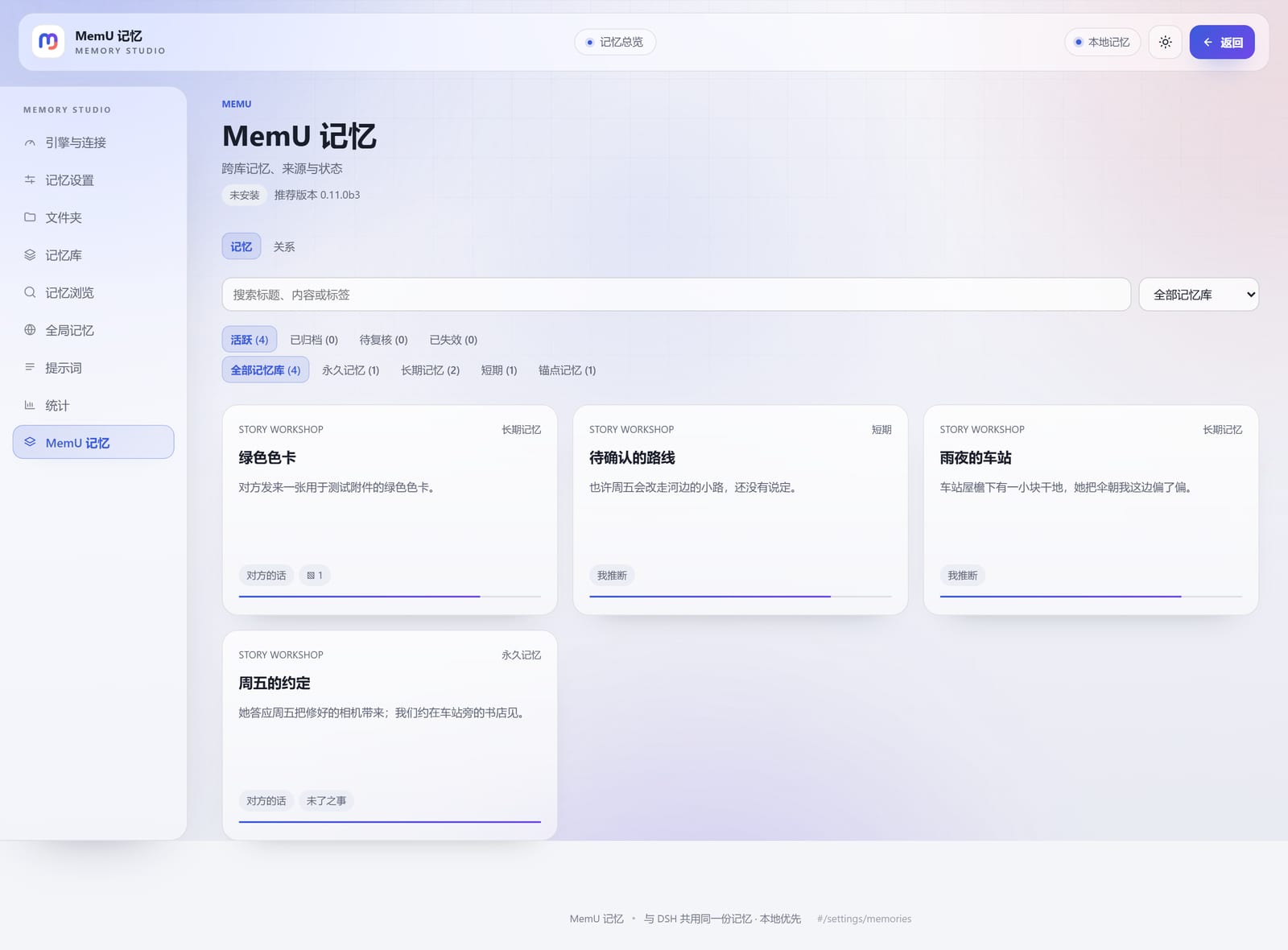 MemU WebUI · cross-library memory wall |
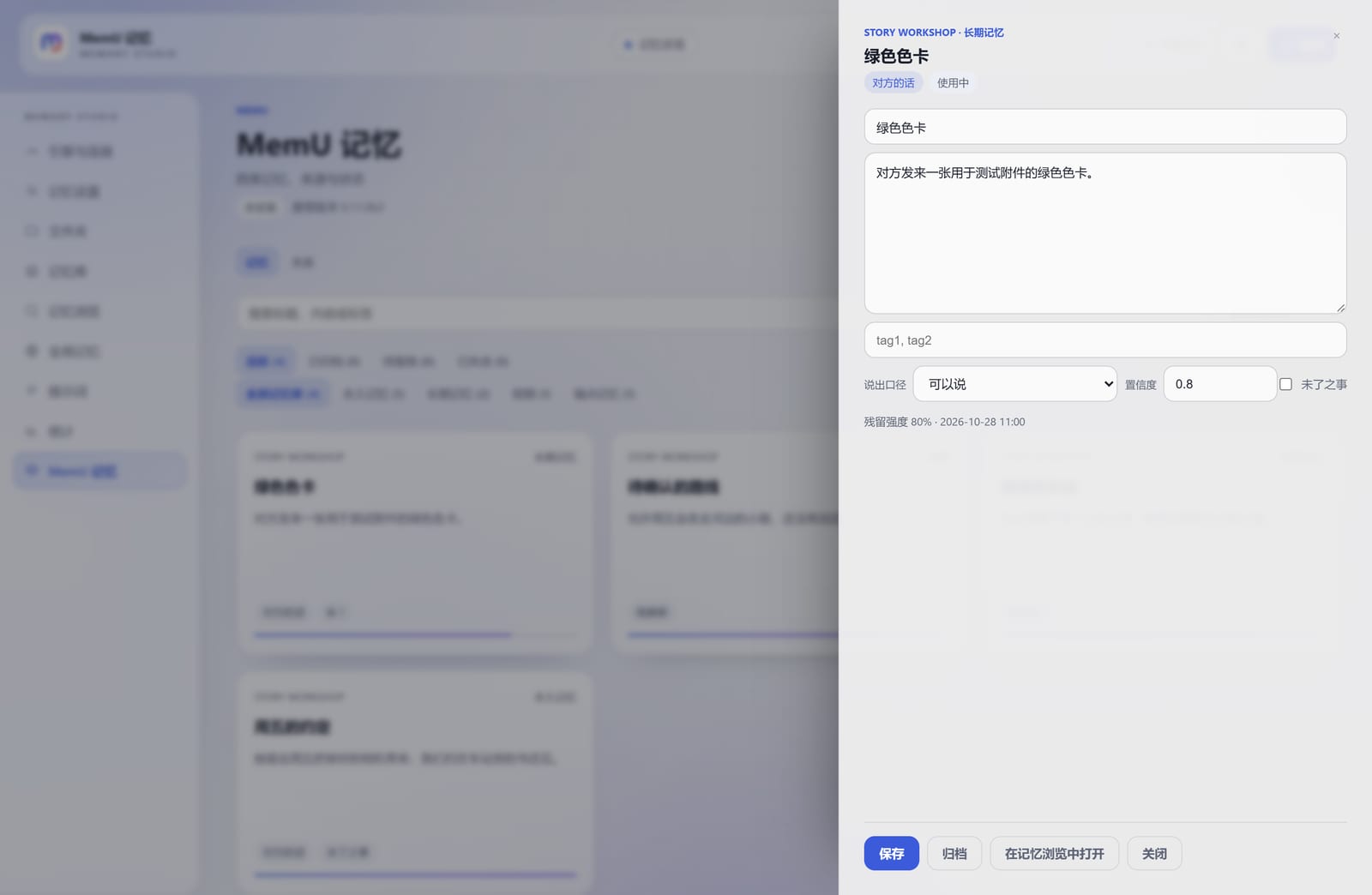 Edit, archive or restore without leaving the wall |
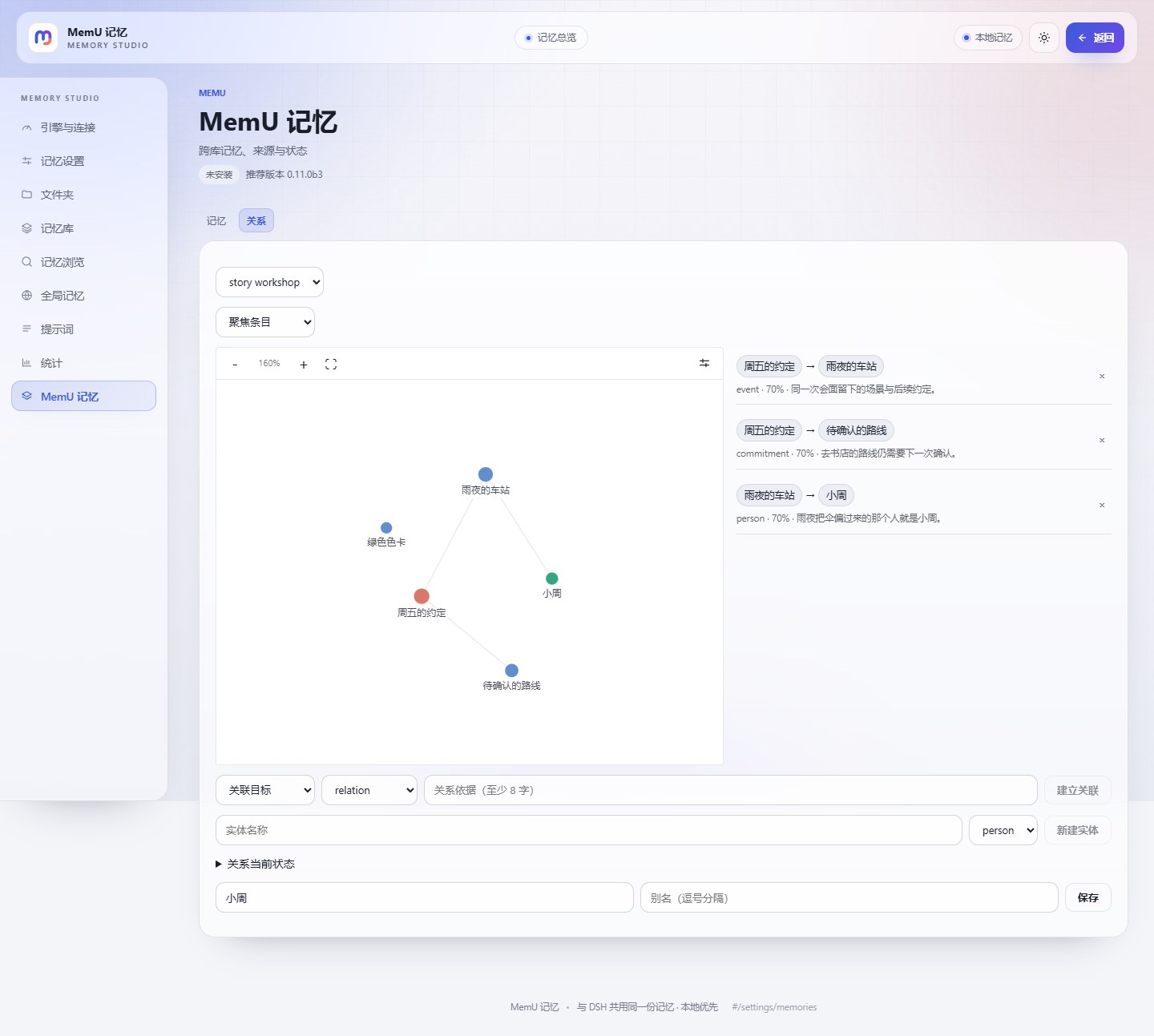 Full-screen relationship graph · canvas and inspector |
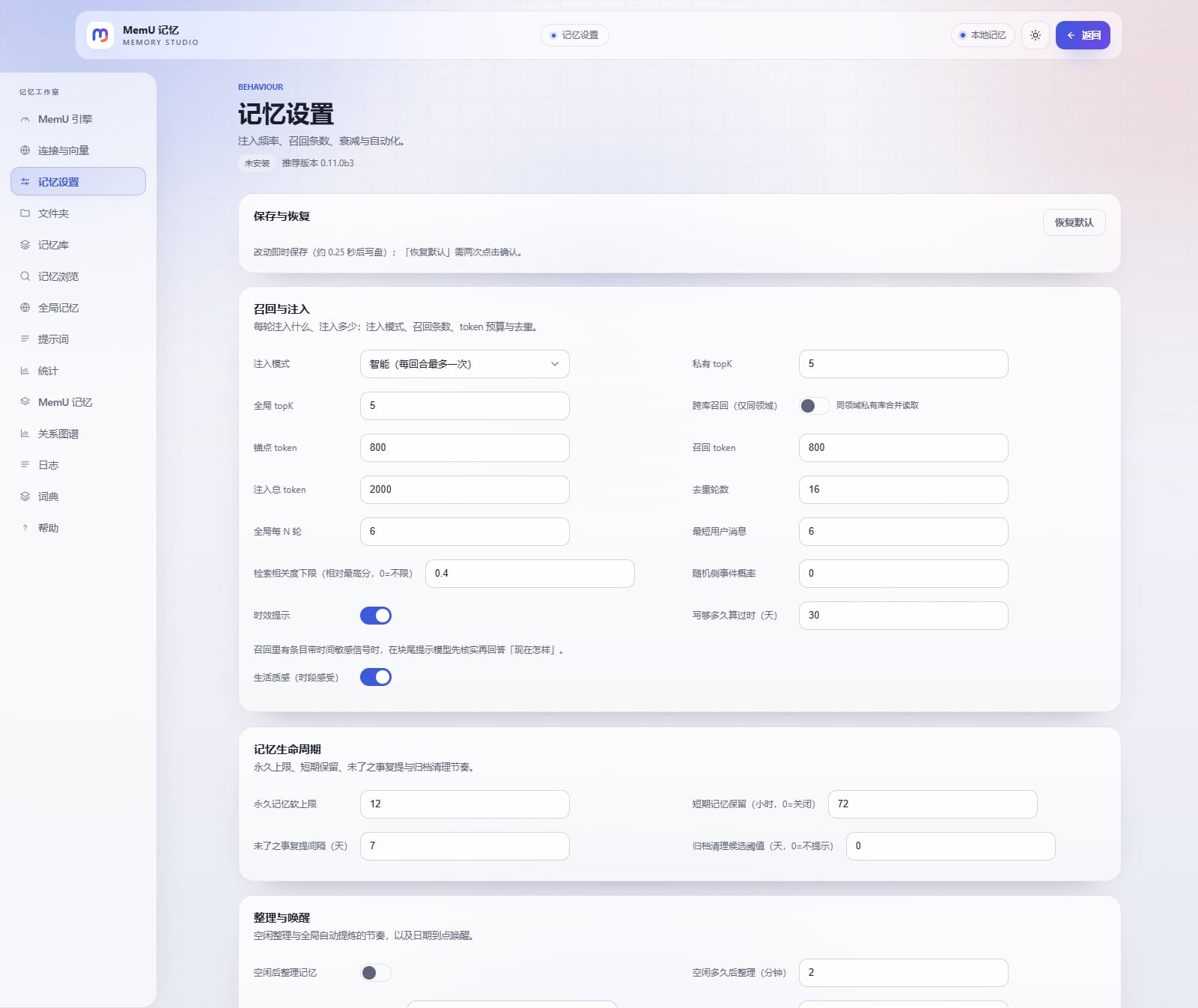 Injection, budgets, retention and automation |
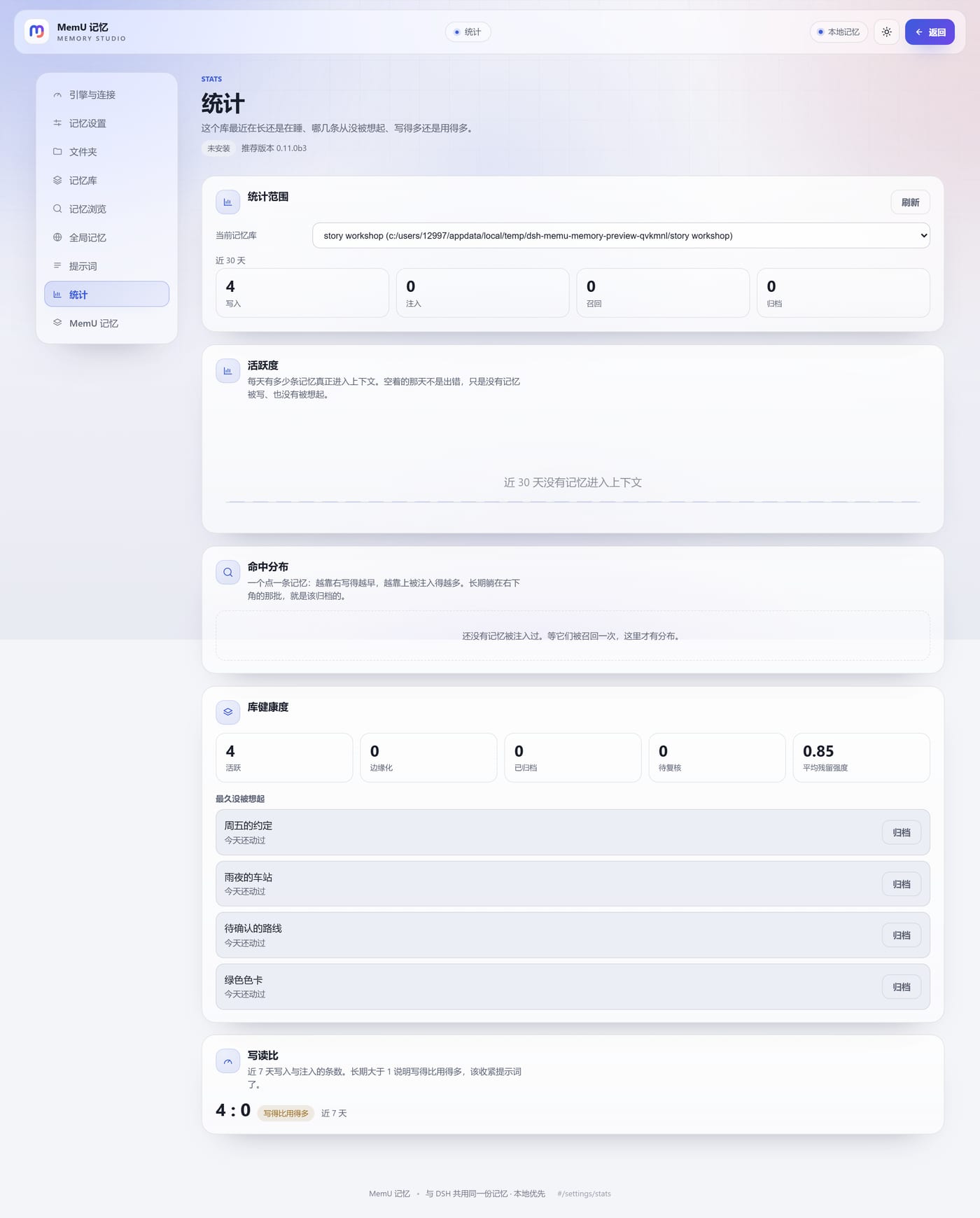 Daily activity, hit distribution and archive candidates |
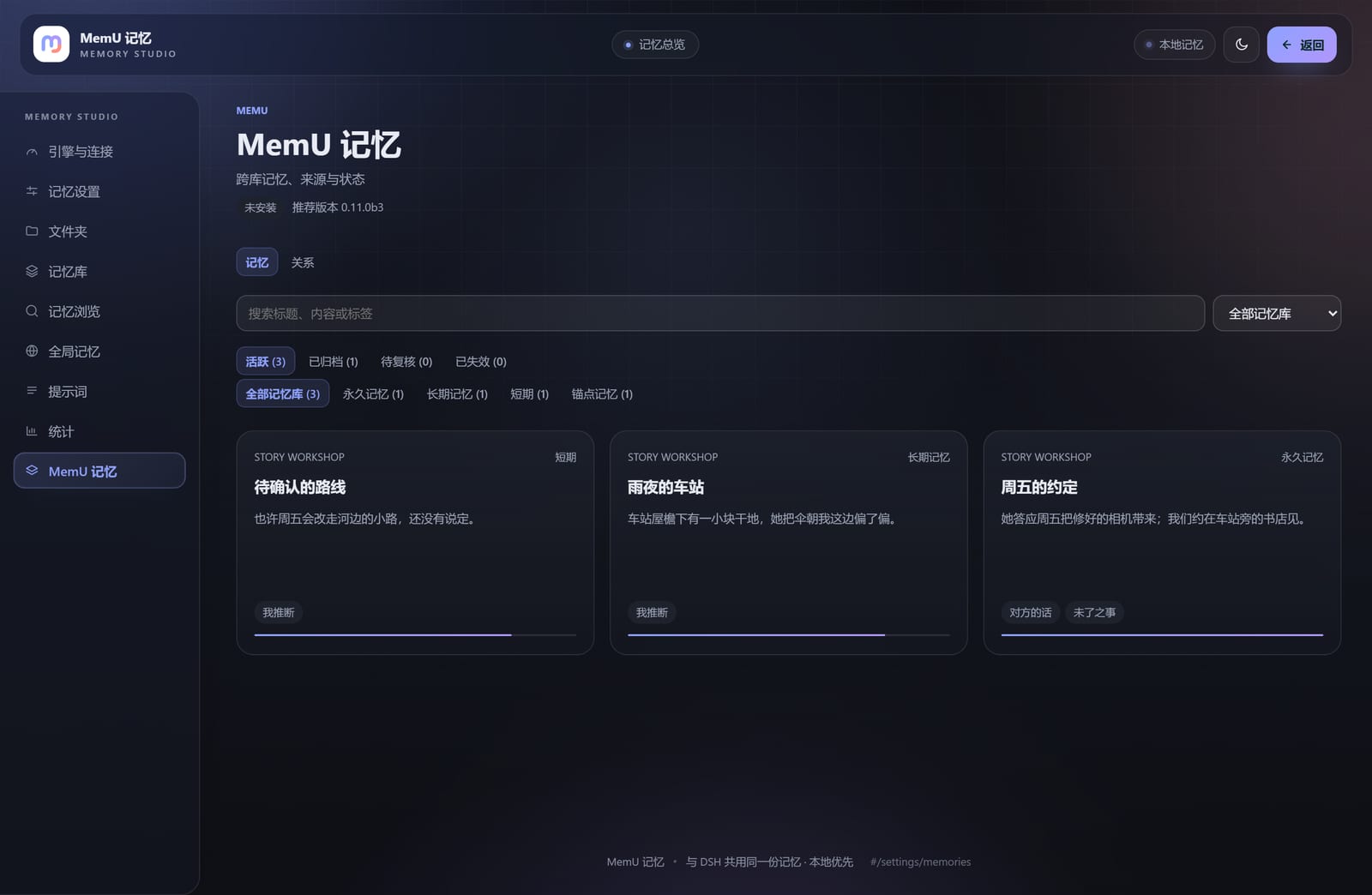 Dark theme · the same surfaces and motion |
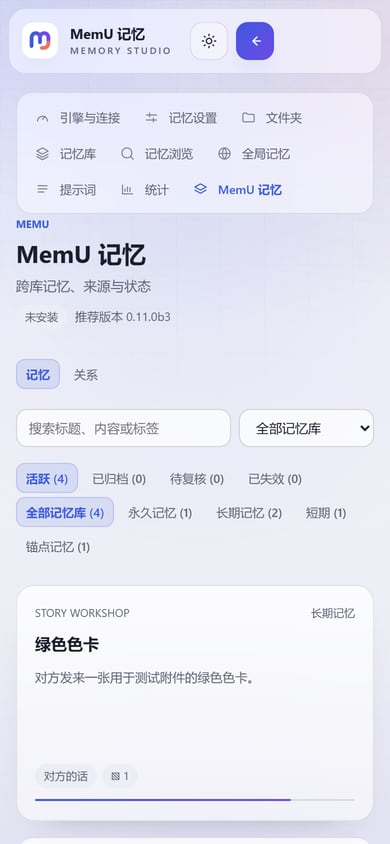 Narrow layout · the rail folds into a horizontal strip |
|
short_term drafts expire after 72 hours by default; long_term is the body of ordinary memory; must_remember needs a reason and a source, decays over 365 days with a 0.35 strength floor, and can be marginalized but never auto-deleted to make room.memu_private_recall / memu_global_recall, so the same budget exposes far more memories without pasting text the model never asked for.memu_lexicon_search merge those libraries too — the page still browses one book at a time.autoLinkMode defaults to candidates only: a local zero-token pass ranks names into a review queue and writes nothing. Once you confirm an entity, its names and aliases are matched against memory text (entity-mention); conflicts_with / supersedes / the same fact_key add field-evidence edges. Lexical similarity, shared tokens and vectors never create an edge. Confirming, renaming, merging or deleting an entity maintains its edges immediately, and a removed auto edge is suppressed so it cannot come back. Links are metadata, shown with an “Auto” badge in the graph; they never rewrite a body, write a vector or delete anything. Existing libraries migrate with node scripts/rebuild-auto-links.mjs (dry-run first, --apply takes a backup).MM-DD recurs every year (a birthday); YYYY-MM-DD fires the day before and the day itself, then is spent. Relative wording (今天 / 明天 / 下周X / 月底) is resolved against the turn's scene time and stored as an absolute date; a memory that says "tomorrow" is stored as the dated form, so an appointment does not come back every year.source / source_kind (user_said / assistant_said / told / imagined / inferred / tool), speaker_id, confidence, accuracy, and disclosure rules. A vague recollection cannot impersonate a quote, and the assistant's own promises or plans cannot be filed as something the user said.pending_review: it is not injected, not recalled, and appears in a review queue until someone accepts or rejects it. When the writer explicitly marks two statements as versions of one fact (conflicts_with), both stay active, are recalled together and surface as a conflict card; an explicit supersedes retires the old row without deleting its text.secret visibility, group-chat channels, characters, worlds, branches and knownBy all constrain reads and edits. Automatic recall never injects a secret memory, and a secret is still readable by an explicit recall from the same folder — it hides a memory from the prompt, it is not a lock. What actually separates two conversations in one folder is the context scope (channelId / characterId / worldId / branchId); a blank scope on both sides means one shared scope, which is the point of a folder. The old visibility: 'session' level is gone — reading turns it into shared with its context untouched, and node scripts/migrate-visibility.mjs rewrites libraries that still store it (--apply, backs up first).speakerId / channelId, not display names. RP uses characterId / worldId / branchId. Relationships are edges with a note and confidence, entities can be renamed without rewriting memory bodies, and the current relationship state (familiarity, trust, warmth, boundaries, promises) is a snapshot that keeps its history and evidence.Idle consolidation is not "every quiet session gets a fork". Before a fork the plugin scores the evidence since the last cursor: human turns (H), content volume (C: human text, assistant text and deduped successful tool results, 2,000 characters per result) and effective tool work units (U), with score = 0.35*min(H/3,2) + 0.45*min(C/4000,2) + 0.20*min(U/20,2) (default threshold 0.8). A session idle for 15 minutes wakes below that score only when it is small; transcripts of 2,000+ events must earn their fork, because the host seeds the full prefix. A recent consolidation or a recent recall suppresses the idle fork.
More is not better: thin turns on a large transcript are skipped by the guard (about 37% fewer prompt tokens on the same scenarios, at the cost of roughly 1 in 22 labels arriving a little later), but once the unconsolidated range passes 600 events the check runs unconditionally, so decisions made early in a long session do not stay out of memory forever.
Four real long sessions from this machine were replayed read-only (no new chat) and their turns were counted:
| Session | Events | Turns | Score-qualified | Below threshold | Fresh human turns after cursor |
|---|---|---|---|---|---|
62056bff… |
5,913 | 12 | 6 | 6 | 0 |
adedb9ac… |
5,766 | 23 | 16 | 7 | 0 |
e38a0de0… |
85 | 2 | 0 | 2 | 0 |
edf7dc5c… |
78 | 4 | 0 | 4 | 0 |
Below-threshold turns on the two small sessions can still wake through starvation; on the 2,000+ event sessions they do not. None of the four had new human input after its real cursor, so none would fork again immediately.
The sidebar has exactly one entry: MemU WebUI. The memory wall and all settings live in the same navigation, with deep links such as #/settings/memories, #/settings/folders and #/settings/stats. The interface follows the browser locale (Chinese or English).
Private / global groups with multi-select. The "Memories" page splits into Private and Global blocks (private first, default). The private block supports multi-select: bulk archive, restore and permanent delete (two-step confirm) — one failed row never eats the rest. Every row on the Global memory page has a "View" action that jumps straight to that entry on the wall.
In-place work. Clicking a memory card opens a right-side drawer with the full text and the fields that decide how it behaves — title, content, tags, disclosure, confidence, open loop — plus save, archive, restore and "open in the browser" for heavier work. Archived memories can be deleted in the same drawer; the first click only arms it and the second confirms. Global memories are read-only in the drawer and link to their own page. Filters and scroll position stay where they were. Cards that carry images use the first usable attachment as a cover, and the drawer opens the full gallery; secret and never_say entries never receive a pixel URL, so they show a label instead.
One page for the graph. Relations is its own full-screen page in the WebUI (#/settings/graph): the canvas on the left, the inspector on the right, and a Manage tab for the list view with the same filters. Source (all / automatic only / manual only), rule, library and search all narrow one shared dataset instead of switching modes, and Settings → Relations is a single button that opens that page. The scope selector still carries a Global memory entry: nodes are global entries and edges are related/refines/supports; the global view is read-only, and edges are removed from the global memory list.
The graph runs on a self-written continuous force engine — no third-party runtime is bundled. It stays alive while you work, preserves node positions and the camera across background data refreshes, and stops requesting frames the moment it cools down, so an open graph costs no idle GPU. Dragging pins a node exactly where you drop it (release never yanks it back), and only the cluster you touched keeps simulating: frozen clusters act as obstacles the moving one cannot slide through. Repulsion, link distance and centering are adjustable in the panel, labels avoid collisions, and the minimap repaints only after the canvas does. Zoomed all the way out the nodes necessarily merge on screen — separation lives in world coordinates, so spread clusters with repulsion/link distance instead of the zoom. Settings → Relations is a single button that opens the full-screen graph page in the WebUI, where you can also add, edit and delete nodes, and filter edges by the rule that produced them. The layout only visualizes recorded links: it never infers or writes relationships. The graph page also lists entity merge candidates (same kind, contained or near-identical spellings) — suggestions only, confirmed by two clicks, and merging redirects links and folds aliases into the main node without deleting any memory.
| Page | What it is for |
|---|---|
| Memories | Private/global grouped wall, source/status/library/preview, in-place drawer, multi-select bulk ops, node graph tab |
| Engine & connection | Optional MemU engine install/switch, embedding endpoint, backups and restore; local runtime download shows MB/s, offers npmjs / npmmirror, and supports pause, stop and resume |
| Memory settings | Injection mode, token budgets, topK, same-domain cross-library recall, relevance threshold, retention, open-loop cadence, freshness hint, date wake-up, automation |
| Folders | Folder-level private/global ceiling, expandable conversations and their own switches |
| Libraries | Create, rename, archive, restore, explicitly delete libraries |
| Memory browser | Full-text editing, attachments, review queue, graph and bounded canvas, JSON/ZIP import/export |
| Global memory | Domain-scoped global memories, evidence, review queue and the separate curator; every row can jump to the wall |
| Prompts | General / RP / Coding / Mixed variants, overrides and per-key reset; new conversations start on RP and can pick a domain in the first-run prompt |
| Stats | Daily activity, hit distribution, health, never-recalled shortlist, 7-day write/read ratio |
Settings save as you change them (250 ms debounce), with about 2.5 s cross-window sync and a heartbeat for writes made by tools or another window. The WebUI opens in a new tab; when a popup is blocked it falls back to an in-app overlay without unloading the host SPA. Light, dark, reduced-motion and narrow layouts are supported.
anchorTokens and turnTokens bound anchor and recall content independently (default 800 each). injectionTotalTokens caps the whole plugin message (default 2000); it does not replace the recall budget. Title cards spend far fewer tokens per entry than full text, so the same budget exposes more memories; the budget itself was deliberately not increased in 1.2.2.
freshnessDays), one conditional line is appended after the recall block telling the model to verify with a search tool if the conversation has one. It never claims a tool exists, and it is dropped rather than pushing recall over budget.open_loop memory whose YYYY-MM-DD has passed is re-raised every openLoopRemindDays (default 7) with its date and how late it is — undated promises keep the old "quiet after one mention" behaviour. Closing a loop is always the user's action.salientWake (default off) schedules a one-shot host task per bound conversation so a salient date is spoken about on the day, even if the conversation went cold. The delivered turn carries its own text — recall and anniversary blocks do not run there — and the tasks are visible in the host's schedule UI. Requires the host process to be running; experimental until verified on a real install.Resident guidance, writing policies and consolidation prompts follow the current session domain. Local tools and remote JSON consolidation share the domain body, with separate supported output contracts. New conversations default to RP; Coding, Mixed and custom pages stay enabled and can be selected per conversation. The new-conversation memory prompt also offers the four memory domains, so a coding session can be started in an RP workspace without remembering to change the sidebar afterwards.
| Domain | Memory focus |
|---|---|
| Coding | Requirements, acceptance criteria, interfaces, call chains, invariants, root causes, tradeoffs, verification and handoff points. Neutral engineering notes, not character psychology. Preserve necessary minimal code and exact semantics without copying whole files or truncating critical conditions. |
| RP | Evidenced moments, character reactions, names and habits, commitments, boundaries and repair. Let memory shape present choices without repetitive callbacks, invented facts or automatic intimacy. |
| Mixed | The prompt separates technical, character and OOC material per item; it does not automatically change the session domain. Tags aid retrieval, not access control or character knowledge. |
| General | Neutral facts, preferences, decisions with reasons, promises and constraints; no default roleplay. |
Updated defaults never overwrite custom text. The default-update notice remains until that prompt is saved or reset. Compare, merge or restore individual prompts in Prompts; there is no need to clear memories. Regression tests cover routing and output contracts, not a guarantee of naturalness or long-term memory quality, which still requires real-conversation evaluation.
| DSH | >=0.2.0-rc.1 (web profile; verified on 0.2.2-rc.1, 2026-11-05) |
| Node.js | >=20.9 |
| OS | Windows, macOS or Linux, wherever DSH's web host runs |
| Optional engine | Python 3.11+ only if you choose the vector backend. The default backend needs no Python, no embedding service and no API key. |
dsh plugin --profile web add dsh-memu-memory
dsh web
Restart the host after installing or updating. The plugin appears as Settings → MemU, and the right sidebar gets the MemU WebUI button.
Replace
webwith your profile name if you use another one. Older DSH CLIs accept the shorter formdsh plugin add dsh-memu-memorywithout the profile flag.
npx @deepseek-ai/dsh plugin --profile web add dsh-memu-memory
npx @deepseek-ai/dsh webThe repository has no build step: lib/ is the runtime. Clone it, link the checkout into your DSH profile, and add the bundle.
git clone <this repository> dsh-memu-memory
cd dsh-memu-memory
npm ci --legacy-peer-deps
In the profile's package.json:
{
  "dependencies": {
    "dsh-memu-memory": "link:/absolute/path/to/dsh-memu-memory"
  },
  "dsh": {
    "profile": {
      "bundles": ["dsh-memu-memory"]
    }
  }
}
Then restart DSH. A symlinked checkout is picked up on restart; there is no bundle cache.
The default agent backend is fully usable without this step. Install the engine from Settings → MemU → Engine & connection, or from a terminal:
npx --package dsh-memu-memory dsh-memu-memory-setupWhat it does:
memu-cli==0.11.0b3 into ~/.dsh/dsh-memu-memory/engine/<version>/venv;pip inside the venv;PATH untouched;The default memoryBackend="agent" uses lexical recall and does not call an embedding service. To enable the vector library, choose memoryBackend="api", then select vectorSource="local" for managed local embeddings or vectorSource="api" for a configured compatible embedding endpoint (which may itself run on localhost). Both sources feed MemU storage and retrieval; installing the MemU engine alone does not enable vectors.
memoryMode (local / cloud) is a MemU storage-compatibility setting, not the embedding switch or source selector; its cloud option is not a claim that managed local inference is offline cloud storage. Summary generation is configured independently of the vector route: ordinary private consolidation uses an Agent fork; an explicit remote-summary action uses its chat endpoint and commits through the same memory write path. Recall uses neither LLM reranking nor an LLM fallback. Exact memory ids still use the direct path; the plugin does not maintain a parallel vector database.
Managed model download, progress reporting and profile-switch/migration flows are implemented, but real model/runtime downloads and end-to-end native inference/switching have not been verified in this work. A candidate or pending artifact is not available for use; it must not be advertised as downloadable or ready until its artifact and validation gates pass.
Folder policy is a ceiling, not an initial value: turning a folder switch off immediately clamps every conversation in it, and turning it back on restores each conversation's own choice. A folder with both switches off does not prompt, does not create a library and does not inject anything.
| Tool | Purpose |
|---|---|
memu_private_remember |
Write a private memory, with source, layer, disclosure, visibility, tags, open loop and attachment references |
memu_private_recall |
Natural-language or exact-id recall; results may carry up to two relationship pointers |
memu_private_list |
List the memories usable in the current scope |
memu_private_update |
Edit, without bypassing pin admission, review or visibility rules |
memu_private_archive |
Archive; never delete |
memu_private_unpin |
Marginalize a permanent memory with a first-person reason, quota and cooldown |
memu_private_link |
Link memories/entities with evidence, or update a relationship snapshot; also adjudicates uncertain memu_private_link_suggest candidates; cannot delete edges |
memu_private_link_suggest |
Refresh deterministic edges (confirmed-entity mentions and field evidence) for ids written this consolidation and return only uncertain candidate pairs |
memu_lexicon_search |
Search active lexicon terms this conversation can see: bound library + global lexicon (+ same-domain libraries when cross-library recall is on); archived and tombstoned terms stay hidden |
memu_lexicon_propose |
Add or update a lexicon term in the bound library (never the global lexicon); ordinary entries become active immediately, sensitive triggers remain user-only |
memu_global_recall / memu_global_list |
Read the global layer by domain |
memu_status |
Storage health, sync heartbeat, recall state and image-turn status |
The main agent has no global write tool. Global memories are produced only by the separate curator.
What is stored. Everything lives under ~/.dsh/dsh-memu-memory/ (or $DSH_MEMU_MEMORY_HOME; the legacy $DSH_MEMU_HOME and ~/.dsh/dsh-memu are still honoured when no new state.json exists):
~/.dsh/dsh-memu-memory/
├─ state.json                 settings, folder policies, session bindings
├─ index/<libraryId>.json     private memory bodies (source of truth)
├─ index/global.json          global memories
├─ index/*.stats.json         per-day counters (90-day roll)
├─ index/*.media.json         attachment metadata and reference counts
├─ index/*.entities.json      entities and relationship snapshots
├─ attachments/<libId>/<sha256>.<ext>
├─ libraries/*.sqlite3        optional vector layer (acceleration, not truth)
├─ engine/<version>/venv      optional MemU engine
├─ prompts/                   user prompt overrides
├─ backups/                   explicit backups and pre-switch snapshots
└─ logs/ install log onlysecret entries never serve their attachments over the HTTP route; never_say captions are not echoed. The vision description service is enabled by default, but it only sends an image after you configure an endpoint, and it may cost money. It never uses host credentials automatically.PATH. All memory writes are confined to the data directory; config writes use temp-file + rename.A host turn may remain open while a third-party tool waits for messages. New human input can trigger one bounded recall at the next model step without ending that turn or making another model call. Native user messages work directly. Unmarked tool logs, sleep completions, failed calls and empty polls do not trigger it. The plugin does not depend on a particular waiting implementation.
Transport plugins can put this exact object in their own ToolResult.meta.memoryInbound:
const batch = {
  type: 'dsh-memu-memory/inbound-batch',
  version: 1,
  producer: 'my-message-transport',
  batchId: 'delivery-42',
  messages: [{
    id: 'remote-message-18',
    role: 'user',
    context: { channelId: 'room-1', speakerId: 'person-7' },
    content: [{ type: 'text', text: 'Where is the deployment script we discussed?' }],
  }],
}
// A normal ToolResult: keep the original model-facing content and other metadata.
return { content: originalContent, meta: { ...originalMeta, memoryInbound: batch } }
The channel/character/world/branch must match the conversation's configured memory
scope; omit unavailable identities rather than guessing them. Images must use
{ type: 'image', attachment: hostAdmittedRef }, never filesystem paths, URLs or bytes.
If metadata is unavailable, return the complete protocol as JSON text and list
the exact tool name under External message tool allowlist. JSON embedded in logs
or code fences is not accepted, nor is JSON from an unapproved tool.
An in-process integration may instead import
ingestInboundBatch from dsh-memu-memory/integration and call
ingestInboundBatch({ sessionId, batch, ctx, session }). It registers work only:
the producer still delivers the actual incoming content to the model. It does not
wake the agent, append a fake user turn or write fact memories.
Deduplication uses producer + channel + speaker + message id; changing a delivery id
does not replay an already processed message. Memory cadence advances by human-message
batches even when the host turn number stays fixed. Pending input is capped at 32
messages / eight images / 96 KB, with at most 4000 characters per external text block;
overflow is explicitly refused, never silently discarded. Split oversized batches.
Recall failure preserves the queue with a 30-second retry delay; cancellation does not consume it.
Only the admitted batch is confirmed, so messages arriving during recall remain pending.
Running agents (including waiting tools) and pending batches are not sleep-consolidated;
the idle window starts from real message activity or the agent's return to idle.
memu_status reports inbound queue/clock/result and inbound_error when degraded.
>=0.2.0-rc.1, using public extension points only (tools, injection, session query, subagents, slots, a prefixed HTTP route). No host source modifications. The core surfaces (13 memu_* tools, guide injection, settings page, right-sidebar tab, prefixed RPC) were verified on 0.2.2-rc.1 on 2026-11-05; the check table lives in docs/host-adaptation.md. The optional dated-wake feature uses the host-wide ctx.schedule task API introduced in 0.2.2; on 0.2.0–0.2.1 (session-scoped reminders) it detects the older shape and skips with one warning instead of retrying every sweep.format v4 message requires a producer-owned source kind rows can be diagnosed but not rewritten; the plugin never edits private session files.i-am-yuike, yuike-standard, …) carries its own cordis.yml composes its model-facing plugins from that list alone, and its scope never delivers agent/pre-step to this plugin. At runtime lib/preset-scope.js attaches an injection listener to that agent's own context, so anchor and recall delivery works. All conversations now receive the memory rules as one <memory-guide rules="…"> plugin message on the first step of a turn; the plugin no longer registers a system-prompt section, and the message is replaced after a domain/prompt change or a compaction (rulesKey / guideLost). The final tool list is a third, separate question: it follows the preset's own plugin list and the host scope, and it cannot be inferred from whether this plugin is listed — observations in this repo record both "no memu_* tools" and memu_private_* present in some presets' tool chains. Per-preset tool availability still needs a real-host check (W3); until then do not read this as "presets have no tools", nor as "listing the plugin is enough". The plugin never edits anyone's preset files.sessionQuery.observeSession() lease (falling back to readSession() when the host offers no lease), cuts at the last complete turn/end, and drops unpaired tool calls and half steps — a live transcript whose last turn is still open is deferred, never consolidated. A job is settled only by a structured completion receipt that is cross-checked against the library index (an id the library does not contain is not a success, and a rewrite of an existing id counts as an update, not a new memory). Checked / pending / in-flight ranges and a lease are persisted separately in consolidation.json, so a crash, a timeout or a failed turn leaves the range pending instead of looking consolidated. Limits: the worker still runs inside the parent preset's own system prompt — it receives an explicit "you are a background consolidation worker, not this character" brief, which reduces but does not remove persona carry-over, because the host has no public API to replace that prompt; and when the conversation's tool surface carries no memu_private_remember / memu_private_update (or exposes memory only through PTC), consolidation reports unavailable (worker-tools-missing / worker-tools-ptc-only) rather than forking a worker that could not write. The parent's library, scope, domain and memory context are re-checked before dispatch, on every worker tool call, and again before any result is credited.MM-DD is not rewritten — the fix applies to new writes.npm ci --legacy-peer-deps
npm test # full suite; the isolated real-engine case skips unless configured
npm run check # syntax + i18n key alignment + package.json
npm run build:graph # rebuild shipped offline assets after graph source changes
node scripts/acceptance-local.mjs # 50 automated acceptance checks
node scripts/migrate-visibility.mjs # report (add --apply to rewrite) libraries that still store the removed session level
node --import ./tests/loader-register.mjs scripts/preview.mjs --port 7789
node scripts/make-readme-shots.mjs # re-record the screenshots above against that previewThe preview serves the real WebUI against isolated example data at http://127.0.0.1:7789/dsh-memu-memory/ui#/settings/memories.
With the preview running, use npm run test:graph-browser -- http://127.0.0.1:7789/dsh-memu-memory/ui#/settings/memories in another terminal to check 200 nodes, desktop/narrow layouts, dragging, refresh stability, themes and load retries. Run npx playwright install chromium once, or set GRAPH_BROWSER_CHANNEL=msedge on Windows to use installed Edge. Stress data is intercepted only in the test browser and never written to memory. No CDN is needed at runtime; the bundle carries no third-party runtime code, which lib/webui/graph-LICENSE.txt records.
The suite includes two optional real-engine integration cases: curator writing requires DSH_MEMU_TEST_ENGINE_PYTHON, and the backup venv/WAL case requires DSH_MEMU_BACKUP_REAL_ENGINE=1; both are skipped by default. The 50 automated acceptance checks pass. The optional engine was installed and smoke-tested in an isolated directory with the pinned wheel; embedding tests use a local deterministic server, which proves the protocol, not semantic quality.
CHANGELOG.mdAGENTS.md is the index for anyone changing this repo — which file answers
which question. The detail lives in docs/: failure modes, the change process,
the host facts, and the UI, memory and environment rules.
MIT © dsh-memu-memory contributors.
You may use, modify, distribute and sell this software, provided the copyright notice and permission notice are included. The software is provided as is, without warranty of any kind.
If this plugin is useful to you, open an issue with the host version and a minimal reproduction — memory bugs are easiest to fix when the transcript and the storage state are both available.
CLASSIFICATION EVIDENCE
系统优先读取 GitHub Topics,再与站内分类词典和词根规则比对。当前命中: memory。
alchaincyf
你想蒸馏的下一个员工,何必是同事。蒸馏任何人的思维方式——心智模型、决策启发式、表达DNA。Distill how anyone thinks.

freestylefly
Prompt as Code | GPT Image 2 / 2.5 提示词与案例库,530+ 个案例、20+ 套工业级模板与可复用 Skills,新增 2.5 同提示词对比专区,附完整提示词与生成记录,持续更新。

titanwings
Distilly — Distill how they think into reusable Skills for any Agent or Bot. Formerly Colleague Skill(原同事 Skill).