
Agent 与会话
插件

nuwa-skill
alchaincyf
你想蒸馏的下一个员工,何必是同事。蒸馏任何人的思维方式——心智模型、决策启发式、表达DNA。Distill how anyone thinks.
PROJECT TOPICS
INSTALL REFERENCE
dsh plugin --profile web add github:TheLiudawei/dsh-codeflow-canvas
该命令指向仓库当前默认分支;尚无绑定当前 commit 的完整验证结果。
PROJECT README

Turn an agent's coding work into a graph you can audit and roll back.
Every node is a real task, every link a dataflow dependency, every green node evidence.





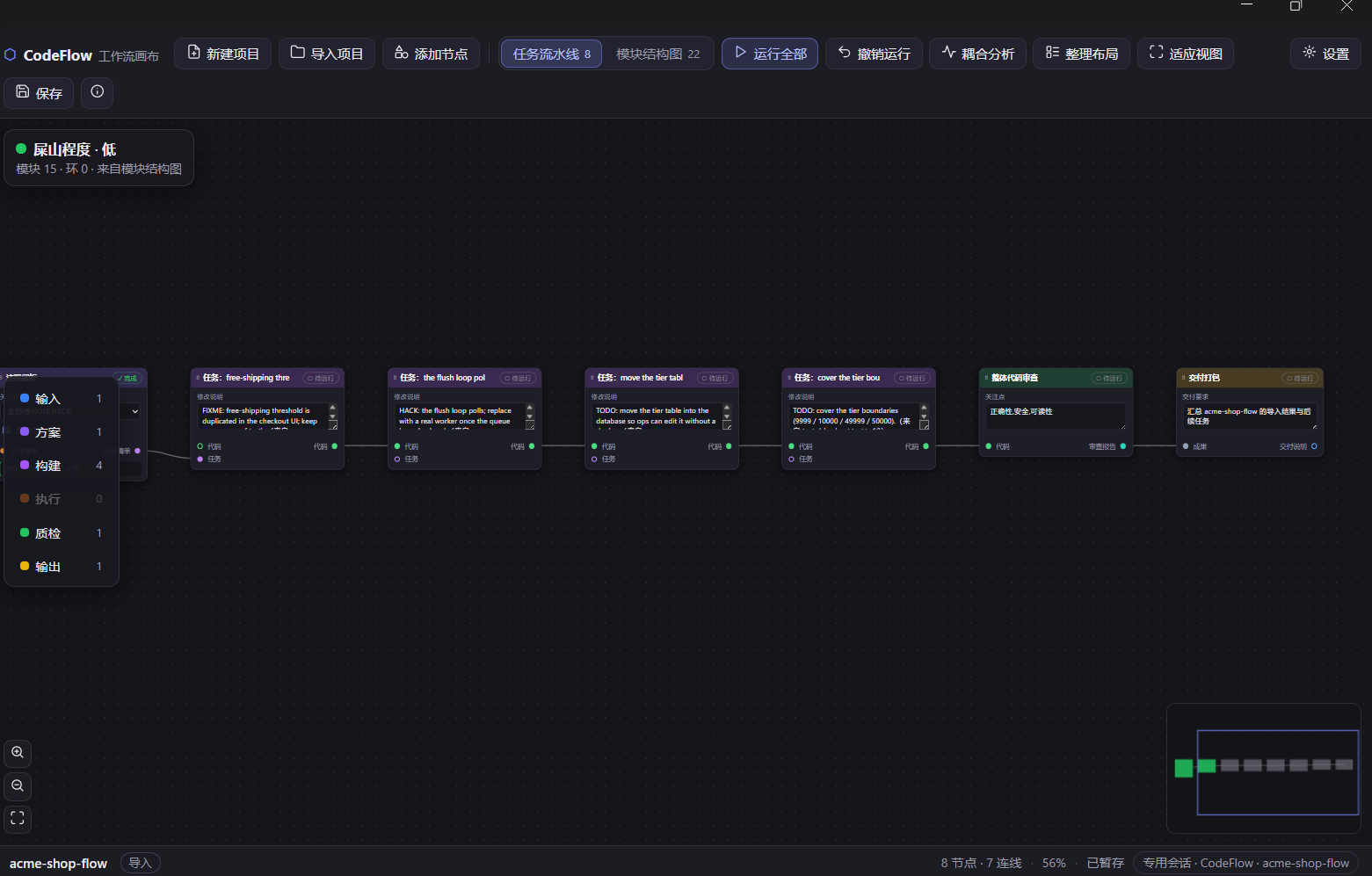
One deterministic scan of a repository produced this 8-task pipeline and its 22-module graph — zero LLM tokens.
English | 简体中文
CodeFlow is a coding workflow canvas for DSH (DeepSeek Harness). Import a repository and it becomes a node graph — the canvas is ComfyUI-style by design. Each node is a task the agent executes in your workspace; each link is a dependency. What makes it different is not the graph itself, but what the graph is allowed to claim.
It is a DSH plugin, ported from the ZCode plugin codeflow-canvas v0.2.2. The canvas editor carries over; every piece of host wiring — sessions, tool protocol, persistence, delivery, undo — was rewritten for DSH.
UI screenshots are in Chinese because the canvas follows your DSH locale and theme. It ships with dark and light palettes and switches live with the host.
You ask an agent to add validation to eight files. It answers "done".
Then the questions start. Which eight? Did all of them pass? What did it touch that you never asked for? If it broke something, how far back do you have to unwind? The transcript holds the answers as prose, and prose is not a diff.
| Planning in the transcript | CodeFlow canvas | |
|---|---|---|
| Where the plan comes from | Regenerated by the model on every attempt | Computed from the tree: scanning, symbol extraction, comment markers. No prompt, no tokens, no network |
| What failed, and why | You reconstruct it from the conversation | It lands on the node card, with the reason, and the node stops spinning |
| "It says it finished" | Taken on trust | A turn that ends without progress is reconciled to failed |
| Undoing a bad run | Manual git surgery, easy to over-reach | Snapshot before every run; one command reverts files and node state together |
| Deliverables | Scattered through the chat | Native present cards plus docs/DELIVERY.md |
1 · Import without a model. /flow-import and the import dialog scan the tree locally — language detection, symbols, TODO/FIXME markers — and produce both a task pipeline and a module graph in seconds. Two scans of the same commit agree on every task, file and score, because nothing is invented. → lib/importer.js, lib/analyst.js, lib/duo.js
2 · Undo a run, not a file. Every RUN_NODE / RUN_ALL snapshots the project tree first (excluding node_modules, dist, .git …). "Undo run" restores files and node state together, strictly LIFO, and survives a DSH restart. The current state is backed up before anything is restored, so a restore never destroys what it overwrites. → lib/undo.js
3 · A green node means something. A node flips to running when the prompt is queued and only reaches done when the agent reports back. If the turn ends with no progress, the host marks it failed — "agent did not execute this node" — and offers one-click retry. Nothing is inferred from what the agent said. → lib/gestures.js (optimistic running), lib/index.js (end-of-turn reconciliation), lib/activity.js
npm run bench runs a fixed synthetic fixture (60 modules, 13.9 KB) through the real import command and the real undo manager, then prints this table. The fixture is generated by a pure function — same files, same content on any machine — and the run fails if determinism or undo stops holding, so these numbers cannot rot silently.
| measured | value |
|---|---|
| import (cold / warm) | ≈90 ms / ≈70 ms (65–120 ms across runs) |
| agent wakeups during import | 0 |
| prompt tokens spent on import | 0 |
| tasks / module nodes produced | 9 / 39 |
| tasks derived from TODO / FIXME / HACK | 5 |
| two independent imports agree on analysis fields | 48 / 48 |
| undo checks (byte-exact restore, added file removed, report accurate) | 4 / 4 |
Absolute timings come from the author's machine and will differ; the zeros and the agreement counts will not.
For comparison, a plan written in the transcript cannot start without the model reading the source: 13.9 KB here, ≈3.5k tokens by the chars/4 heuristic. That line is an estimate and is labelled as one — everything else in the table is measured. Reproduce with npm run bench (add --json for machine-readable output).
"Write the requirement first; the host recognizes the type after the run" — the "pick a type when adding a node" step moves off the user's shoulders.
task (meta.cf.task:true structural marker, ports fixed at any → any). The old type list UI is not deleted — it became a generic type picker, reused by the node context menu's "设置类型…".lib/typing/classify.js is the single rule table (only evidence-backed codegen / edit / testgen / docgen / testrun / shell), and attribution is (the node's own write-tool paths ∪ artifacts) ∩ this run's diff — unclaimed files are never guessed, and no file changes means the node stays task. Recognition calls no model, produces no extra agent turn and adds no tool. The result lands in meta.cf.typeAuto (source, rule id, time, counts and up to 3 sample paths, ≤400 bytes); color and label follow, but ports and links never change — typeOf is the single display/structure merge point on the canvas.task), or re-identify from the latest run's evidence (no evidence → "下次运行后自动识别"). The details dialog shows the source and the evidence summary, and lets you edit the requirement in place.type and the recognition state per node; restoring brings files, execution state and auto-typing back together, while unrelated meta.cf keys (like stale-card markers) are never clobbered.tests/typing suite (CI now runs 19 suites): the verdict matrix, two-node attribution without cross-talk, locking and idempotency, the reidentify gate, and undo rollback (real store + real undo + temp directories).tests/bench.mjs (run with npm run bench) drives a fixed 60-module fixture through the real /flow-import command and the real undo manager, then reports import time, agent wakeups, prompt tokens, tasks/modules produced, cross-import agreement and undo fidelity. It exits non-zero if determinism or undo stops holding, so the table cannot go stale silently.Documentation only — no code changed.
lib/importer.js, lib/undo.js, lib/gestures.js + lib/index.js).A visible change to the product's face — which is exactly why it gets its own version.
⬡, a text glyph that rendered differently on every platform. They now share one vector mark — a hex canvas cut by the flow channel — drawn inline by tools/port-canvas.mjs (toolbar 17px, empty state 46px) and in currentColor for the sidebar so the shell still decides hover and selected tints.assets/branding/ is the source of truth: logo.svg (colour), logo-on-light.svg, logo-mono.svg (currentColor) and PNGs at 32/64/128/256/512 for stores, docs and social cards.docs/images/social-preview.png (1280×640) is ready for the repository's social card.tests/release.mjs fails when package.json does not run ahead of the latest tag while there are unreleased commits — the exact situation that left a feat commit sitting past v1.3.2. It runs in CI (which now checks out with fetch-depth: 0) and in npm test.Card identity got stricter, and two defects the CI matrix caught are fixed.
v1.2.3, 3.5, https://example.com/x.md and e.g. all produced anchors — two unrelated cards could pair, or the same card could stop pairing after a re-import. A token now qualifies when it contains a separator or ends in a known source extension (SOURCE_EXTENSIONS, ~90 entries); scheme URLs, version/number patterns, abbreviations and timestamps are rejected. Five counterexamples and seven positive cases live in tests/cards.mjs.pending. When the source changed since the import, the old "done" is no longer evidence of the current state: the card returns to pending (the same rule as "not executed means failed"), keeps a note 源码已变,需重跑, and shows an amber badge that disappears as soon as it runs again. No drift, no change.npm test is now tests/run-all.mjs. Sequential spawn, exit codes collected, one summary table with per-suite timing — aligned with CI's if: always(), so a failing suite never hides the rest.files.modified was decided from size plus a 1 ms mtime tolerance; a same-size edit written within the same millisecond was reported as unchanged on Linux. dryRun and restore now fall back to comparing contents in that ambiguous case.rm(recursive) occasionally threw ENOTEMPTY on macOS while the plugin's debounced persistence wrote a file back; recursive removals in validate go through a short-backoff retry instead of failing the run.No feature changes — this release makes the suite trustworthy on machines that are not the author's.
ubuntu-latest / windows-latest / macos-latest × Node 22, all blocking. Every step carries if: always(), so one failing suite still lets the rest report — a single run shows the whole picture.fit-popover computed its minimum height as Math.min(minListHeight, Math.max(minListHeight, innerH)) — identically minListHeight — so a short stage still demanded 96px and pushed the list past the bottom edge. It is now Math.min(minListHeight, innerH), with maxHeight clamped to the available height; the test for that boundary actually exercises it (stage 100px, inner height 84px).\n-anchored assertions broke on CRLF checkouts (.gitattributes now pins LF, and the shared read() normalises); one assertion only held on Windows and was removed in favour of the explicit win32/POSIX pair; four /flow-import checks were passing only because a stale directory happened to exist in %TEMP%; Windows-path assertions in the workspace and browse suites now pass an explicit platform. Closes the failures reported in #2.tools/canvas-sources.mjs is the single input list) and the button audit recomputes it, instead of comparing mtimes — which cannot work in a fresh clone.npm test runs all 19 suites.logo · 项目/运行/视图/帮助 menus · view tabs · 新建/导入/运行全部 · undo/save/settings icons — flex-wrap: nowrap, no second row at any width. Menus collapse into a ☰ panel below 720px rendered from the same model (lib/ui/menu.js → lib/ui/menu-html.js, build-time static markup; tools/patches/menu-ui.js only delegates clicks to the existing handlers via one action-key table). Full keyboard support (arrows/Home/End/Esc) with aria-haspopup/aria-expanded/role="menu".lib/ui/fit-popover.js, inlined at build time): the list scrolls to the last row at 480px height with 200 nodes, the search box stays visible, wheel scrolling no longer chains into the canvas, and the left category bar itself scrolls.cards.asked in CodeFlow/config.json). Enabled, re-importing the same project merges by stable card identity (lib/cards/identity.js): run state, result, position, renamed titles and edited params are preserved onto the freshly scanned graph; deleted tasks stay as「失效卡片」(excluded from run-all, cleanable from the 项目 menu); merge runs as a pure function (lib/cards/merge.js) and never blocks import. Disabled behaviour is byte-identical to 1.2.2 plus a .bak- backup.codeflow.log: level filters, case-insensitive search, follow-tail (2s polling, stops on close), copy visible rows as raw JSONL, and 打开所在目录 with graceful 501 fallback to copying the path. Backed by GET /api/log (tail/rotated/level/q, path bound at wiring — request parameters cannot point it elsewhere) over lib/logging/reader.js.lib/ui/actions.js, 73 controls) is the single source of truth; tests/buttons.mjs statically proves each control is registered and has a binding path, the injected window.__CF_ACTION_MANIFEST__ powers an in-canvas click self-test (tests/buttons/canvas-selftest.js), and tests/buttons/MANUAL-CHECKLIST.md covers the rest. Fixed real defects the audit exposed: the 耦合分析 toolbar button never had a click listener (it was disabled and reachable only via context menus), the session chip was a focusable no-op button (now opens the session dialog), and the ✕ close button of the three drop dialogs (confirm / progress / conflict) was dead — dialog close/cancel is now handled by one delegated listener on #cf-dialog. A follow-up runtime defect surfaced the moment the button worked: the analysis success path called a misspelled helper (fetchCouplingStale), so the canvas toasted 耦合分析失败 after the host had already written the result — fixed, and tests/buttons.mjs now carries an undefined-symbol check that fails on any called-but-never-defined identifier.lib/import/root-detect.js): strip the outer wrapper of an archive, then unwrap further only on unambiguous signals (project marker / shell-name / same-name). proj/src stays proj; markerless single-chain shells answer 400 SHELL_AMBIGUOUS instead of inventing a wrong project; empty shells are rejected; multi-project parents keep the parent with a multiProject warning. 51 fixture×channel combinations are covered in tests/import-shells.mjs.codeflow.log next to the plugin source (5 MiB rotation, one .1 backup, serial writes, fail-safe). It records the plugin lifecycle, imports (import.start/root/done/…), coupling runs, HTTP errors and canvas UI actions/errors — never prompts, source code, graph JSON or cookies/tokens (key-based redaction + truncation). The canvas batches its own events through POST /codeflow/api/log (whitelist ui.action/ui.error/ui.selftest, 64 KiB body cap, 50 events/s, 20 per batch). CODEFLOW_LOG=off disables it; CODEFLOW_LOG_FILE overrides the path. An architecture test (tests/architecture.mjs) pins the layering: logging/root-detect stay dependency-free, the import pipeline never touches req/res, and the static import graph has no cycles.GET /codeflow/api/workspaces listing, plus a read-only preview of the final absolute path (将创建到 …) computed by the host. Requests without a workspace — or with one that is not a registered DSH workspace — answer 400 / 409 and create nothing on disk.registry.list()[0] fallback — the "workspace wandering" culprit — is gone.workspaceId and attached to the workspace group, so it no longer shows up under「未分组」.GET /codeflow/api/browse (directories only, no symlink following, 500-entry cap, 5 s timeout). Keyboard-first: ↑/↓ select, Enter enters, Backspace goes up, Esc closes the picker first. The dialog shows both 将扫描 (source dir) and 项目文件保存在 (the workspace the graph lands in).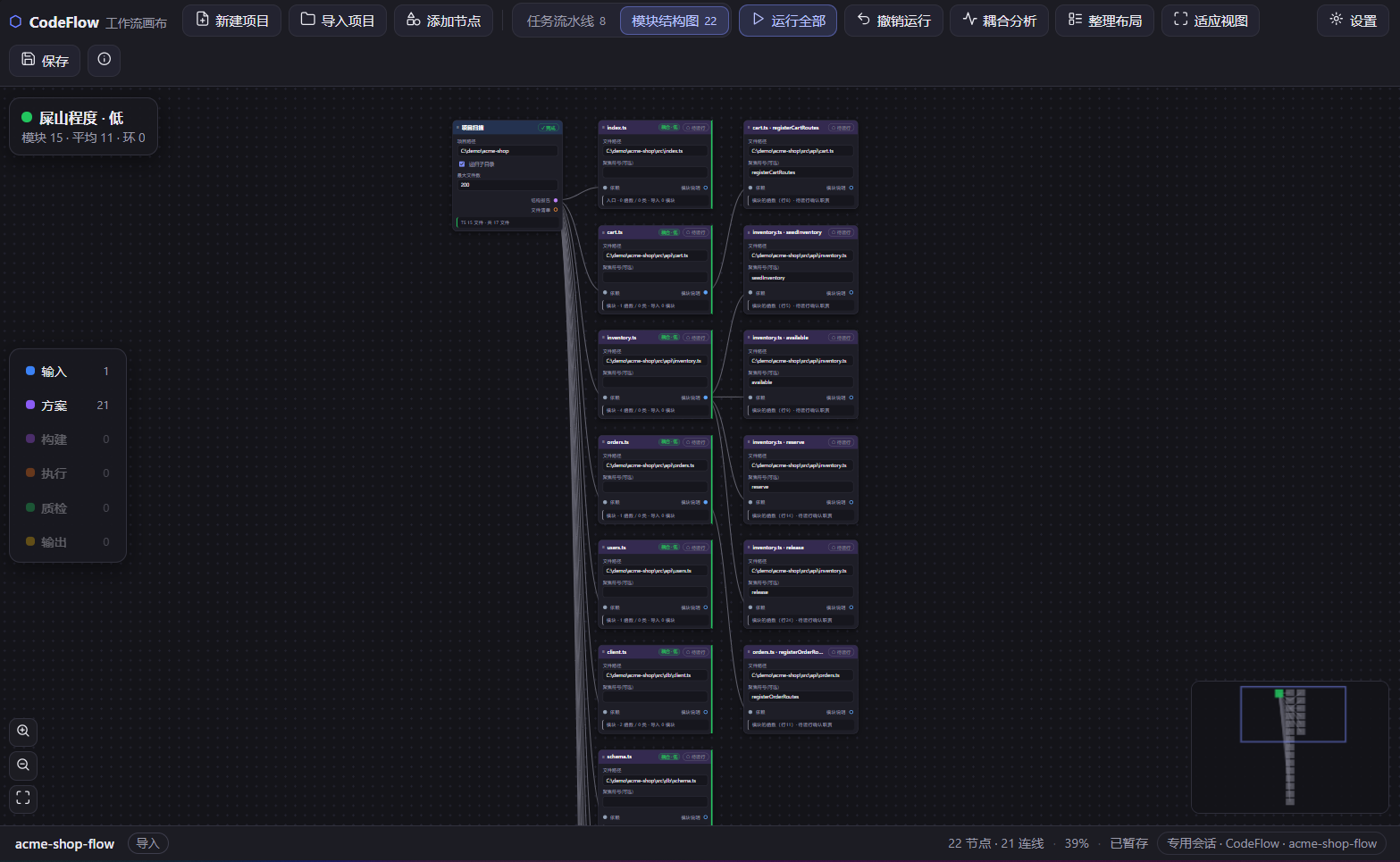 Module graph. Every file becomes a node; each carries a 低/中/高 coupling badge (low / medium / high). |
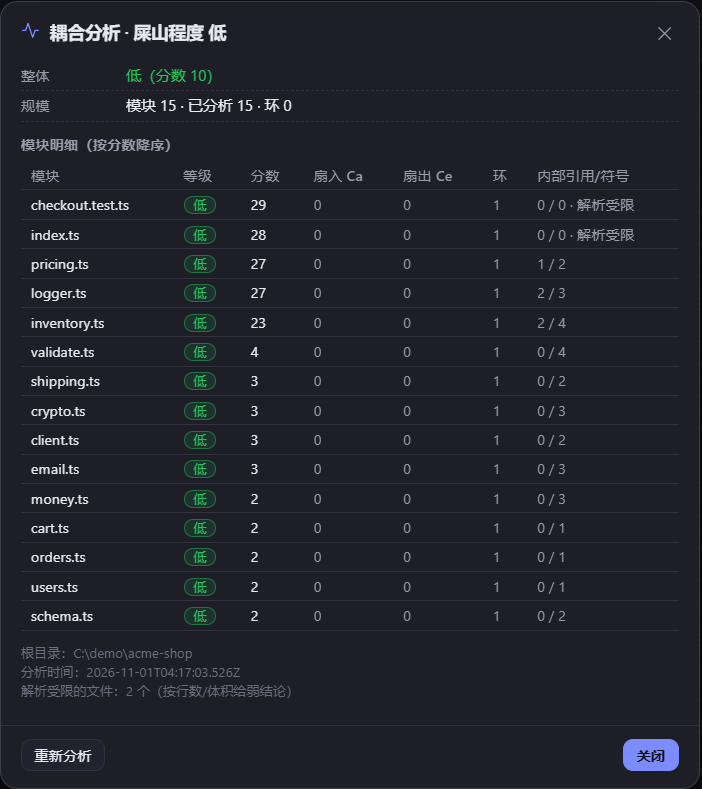 Coupling detail. Per-module score, fan-in Ca, fan-out Ce, cycles and symbol counts — deterministic and reproducible. |
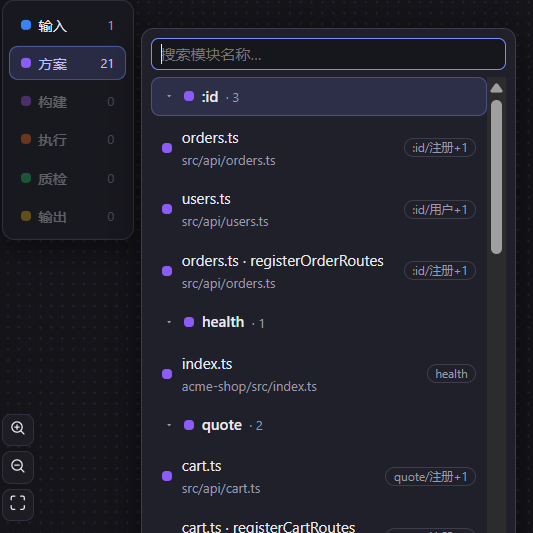 Navigation. Click a module category to open a searchable two-level list; ↑/↓/Enter to jump and zoom to a node. |
|
workflow.json) and a module graph (workflow.modules.json). Switch with the toolbar segmented control — no rescan, no re-analysis, no agent wake-up. Nodes, coordinates, run states and rev are fully independent per view.score = round(0.6 × intra + 0.4 × inter), graded at fixed thresholds of 30 and 60. The canvas shows a per-node badge and an overall 「屎山程度」(codebase messiness) card with a full per-module table. All constants are exported and unit-tested; the same source scores byte-identically twice.feature → file → node map in features.json next to the graph: design-doc parsing, entry signals, top-level symbols, directory/file dictionaries. Zero model calls; a manual section always wins and survives rebuilds.zip / tar / tar.gz are parsed in pure Node, 7z / rar fall back to system tools.failed and offers one-click retry.deliver node collects upstream artifacts, writes docs/DELIVERY.md and calls DSH's native present, so deliverables show up as real cards in the session — not as a list inside the canvas.CodeFlow · <project>); canvas runs go only there, and DSH's active session is never hijacked.edit/write/apply_patch tool arguments — never guessed from prose), the matching module pulses and the card gets a badge.text / json / code / report / file / any); editing parameters resets downstream nodes.package.json has no runtime dependencies. Host half is plain ESM; the browser half is a hand-written __ModuleLoader__ bundle.# Install from a local directory — no build step
dsh plugin --profile desktop add link:<absolute path to this checkout>Or install the local directory from Settings → Plugins, then restart DSH (the host half does not hot-reload) and refresh the page.
Verify it is live:
curl -i http://127.0.0.1:<port>/codeflow/canvas # expect 200 + HTMLA 404 with no codeflow entry under profiles/<profile> means the plugin was not installed into that profile — re-run the install command above and restart.
Requirements: DSH desktop with a sessionController (for runs). Without it the canvas still edits, imports and saves, but running a node reports a clear error instead of binding a random session.
| Entry | What it does |
|---|---|
/flow |
Open the canvas (loads the most recent project); with an argument, create a project from that requirement |
/flow-new [requirement] |
Create a project directly |
/flow-import <path> |
Import a project: the host scans it and produces both graphs in seconds, bypassing the agent. Accepts @-picked paths, ~, quotes and file:// |
codeflow_canvas tool |
The agent's write-back channel: load (re-read a view's graph from disk — preferred), render (fallback), read, save, progress (dedicated session only). view: "tasks" \| "modules" selects the view |
Skill codeflow-canvas |
The agent's orchestration contract (create / run / write back / deliver); /flow* attaches it automatically |
node lib/importer.js <path> |
Standalone CLI import — both graphs, no DSH running |
Right-click a node → Run, or Run all in the toolbar. The host snapshots the project, hands a self-contained [CodeFlow:RUN_NODE] message to the project's dedicated session, and flips the node to running immediately. The agent executes and reports progress; the card updates as it goes.
Browser (panel iframe)
  ├── GET  /codeflow/canvas          host assembles the fragment + __CF_BOOT__
  ├── GET  /codeflow/api/state       poll; a newer rev replaces the graph of that view
  ├── POST /codeflow/api/state       autosave (expectedRev conflict detection → 409)
  ├── POST /codeflow/api/view        switch active view (no rev bump, no scan)
  ├── POST /codeflow/api/save        persist both views (507 + ok:false on failure)
  ├── POST /codeflow/api/import      deterministic scan → task pipeline + module graph
  ├── POST /codeflow/api/action      run / create → snapshot, then deliver [CodeFlow:*]
  ├── POST /codeflow/api/session     create or rebind the project's dedicated session
  ├── GET  /codeflow/api/workspaces  registered workspace list (read-only; feeds the new-project dropdown)
  ├── GET  /codeflow/api/browse      read-only directory listing for the import picker (dirs only, no links)
  ├── GET  /codeflow/api/activity    reasoning stream, steps, progress, file edits (memory only)
  ├── GET/POST /codeflow/api/undo    run history / restore (LIFO, shared across views)
  └── GET/POST /codeflow/api/config  project root: global root + per-project override
                                        ↓
          agent executes per the skill → codeflow_canvas (progress / load / render)
                                        ↓
  store.js (per-view rev) + paths.js (the only place project paths are assembled)
  sessions.js (bindings) + activity.js (in-memory traces) + undo.js (.undo/ snapshots)
Design constraints worth knowing:
keydown (Delete, Space) and pointer events on window; inside the host document it would steal keystrokes from the input box.rev, per view. Writing one view never bumps the other, so editing a task graph is not interrupted by a background module update.load; oversized nested JSON in tool calls trips tool input is invalid JSON and kills the turn.node_modules, dist, .git and friends can never be reverted by accident.sessions.js is the only component that creates or rebinds project sessions.Projects live under <workspace>/CodeFlow/flow-projects/<project>/ (workflow.json, workflow.modules.json, view.json, features.json, session.json). The workspace itself is never created by the plugin: new projects pick one of DSH's registered workspaces and the canvas session is attached to it (when the host exposes workspace entities). The root is configurable — toolbar ⚙ Settings sets a global root and optional per-project overrides, stored in <workspace>/CodeFlow/config.json so it stays discoverable per workspace. Legacy <workspace>/flow-projects/ data migrates on first resolve; conflicts are never overwritten and failures keep the old directory. Workspace resolution follows one explicit chain — binding → project directory → session cwd, all matched against the registry (longest prefix) — and a project whose workspace cannot be resolved reports an actionable error with the candidate list instead of silently landing somewhere else.
lib/core/                 fsio / path / text primitives (atomic write, tolerant JSON, bounded reads)
lib/scan/                 walk / comments / symbols — the shared scanning layer
lib/features/             six slices behind features.js (detect, dictionary, index-file, apply, map, ops)
lib/http/                 respond / context / canvas / state / import / features / project / workspace / browse routes
lib/paths.js              the single place that assembles project paths
lib/workspace-binding.js  workspace resolution (B1 chain) + registry adapter (the only registry reader)
lib/browse.js             read-only directory listing (pure functions + fs adapter)
lib/store.js              dual-view graph state, per-view rev, sanitizing
lib/coupling.js           coupling algorithm (constants exported for tests)
lib/importer.js           deterministic import (task pipeline) + CLI
lib/analyst.js            structure analysis (module graph)
lib/routes.js             thin router assembly
lib/index.js              plugin entry — pure assembly
assets/canvas/            canvas.html (generated by tools/port-canvas.mjs — do not hand-edit)
assets/skill/             skill docs + four references
tests/ validate / regression / e2e / undo / coupling / features / drop-import / workspace / browse / contrast# All 19 suites, in one go (plain Node; DSH does not need to be running)
npm test
# Or one at a time — the same command works with the DSH binary as the runtime
node tests/validate.mjs
ELECTRON_RUN_AS_NODE=1 "<DeepSeek Harness.exe>" tests/validate.mjs
# Regenerate the canvas after editing the port script (never hand-edit the output)
ELECTRON_RUN_AS_NODE=1 "<DeepSeek Harness.exe>" tools/port-canvas.mjs
# Loading-contract check for the client bundle
ELECTRON_RUN_AS_NODE=1 "<DeepSeek Harness.exe>" tools/verify-client-bundle.mjs .Changing lib/*.js requires a DSH restart; changing lib/client.js requires a page refresh.
.github/workflows/ci.yml runs 19 suites on Ubuntu, Windows and macOS (Node 22), blocking on all three. Between them:
| Area | Suite |
|---|---|
| Structure, routes, tools, canvas asset, XSS | validate (184 checks) |
| Per-fix regressions (B2–B9, concurrency, atomic writes) | regression |
| Re-import merge, stale cards, opt-out path | cards |
| Menu model, ARIA, build-time render, popover geometry | menu |
| Layering and acyclic static imports | architecture |
| Log schema, redaction, rotation, degrade path | logging |
| Run snapshots, LIFO, cross-view restore | undo |
| Task-node auto-typing after a run (zero-LLM rule table, attribution, locking, undo rollback) | typing |
| Coupling score determinism and persistence | coupling |
| Feature index build and rebuild stability | features |
| Workspace resolution chain | workspace |
| Read-only directory listing caps and timeouts | browse |
| Conservative import-root detection (51 combos) | import-shells |
| Log viewer filter/search/follow/path binding | log-viewer |
| Folder/archive staging, extraction, collisions | drop-import |
| Real HTTP server + fetch scenarios | e2e |
| Control manifest, bindings, action audit | buttons |
Version discipline: package.json runs ahead of the latest tag |
release |
| Measured benchmark: import cost, determinism, undo fidelity | bench |
What is not automated — and is not claimed to be:
present delivery, theme following the OS. The suites use fake hosts; the contract is tested, the integration is not.tests/mac/ is a manual diagnostic kit for exactly this (see its README) — it needs an installed DSH and a human.7z and rar are only exercised where the tool exists; zip/tar/tar.gz are parsed in pure Node and are covered.tests/contrast.mjs is a module imported by other suites (WCAG audit of the light palette), not a standalone suite.tools/canvas-sources.mjs is the single list) and buttons recomputes it, so a stale artifact is caught in a fresh checkout too.| ZCode v0.2.2 | This plugin |
|---|---|
::visualize{} Gen UI embedded in the conversation |
Native sidebar panel (iframe) |
| Agent generates the canvas HTML | Host assembles the document; the agent only submits the graph |
window.zcode.sendFollowUpMessage |
POST /codeflow/api/action → dedicated session |
setWidgetState (16 KiB cap) |
Host state + disk, no cap |
widgetState.rev comparison |
Host owns rev, per view |
| Markdown command files | Real commands via ctx.commands.register |
.zcode-plugin/plugin.json |
package.json + cordis.patch.yml |
| Dark only | Dark + light palettes following DSH |
| — | Dedicated sessions, live traces, native delivery, run undo, coupling, feature index, drag-and-drop import |
shell redirection or indirect scripts are out of scope and not guessed at.workflow.json or logs..undo/ holds source copies (≤10 runs / 1 GB, local only, never exposed by any route). Delete the project directory to clear it.shell nodes can run arbitrary commands; the skill asks the agent to confirm first, nothing more.MIT © TheLiudawei
CLASSIFICATION EVIDENCE
系统优先读取 GitHub Topics,再与站内分类词典和词根规则比对。当前命中: ai-agent。
alchaincyf
你想蒸馏的下一个员工,何必是同事。蒸馏任何人的思维方式——心智模型、决策启发式、表达DNA。Distill how anyone thinks.

freestylefly
Prompt as Code | GPT Image 2 / 2.5 提示词与案例库,530+ 个案例、20+ 套工业级模板与可复用 Skills,新增 2.5 同提示词对比专区,附完整提示词与生成记录,持续更新。

titanwings
Distilly — Distill how they think into reusable Skills for any Agent or Bot. Formerly Colleague Skill(原同事 Skill).