
Agent 与会话
插件

nuwa-skill
alchaincyf
你想蒸馏的下一个员工,何必是同事。蒸馏任何人的思维方式——心智模型、决策启发式、表达DNA。Distill how anyone thinks.
PROJECT TOPICS
INSTALL REFERENCE
dsh plugin --profile web add github:Starlit-Sky-code/dsh-prompt-starlight
该命令指向仓库当前默认分支;尚无绑定当前 commit 的完整验证结果。
PROJECT README

DSH plugin · by Starlit Sky · Changelog




A circular four-pointed-star button on the left of the DSH composer, wearing a hairline ring and soft glow so it lifts off the toolbar. One click turns your draft into a clearer, more complete, more executable prompt.
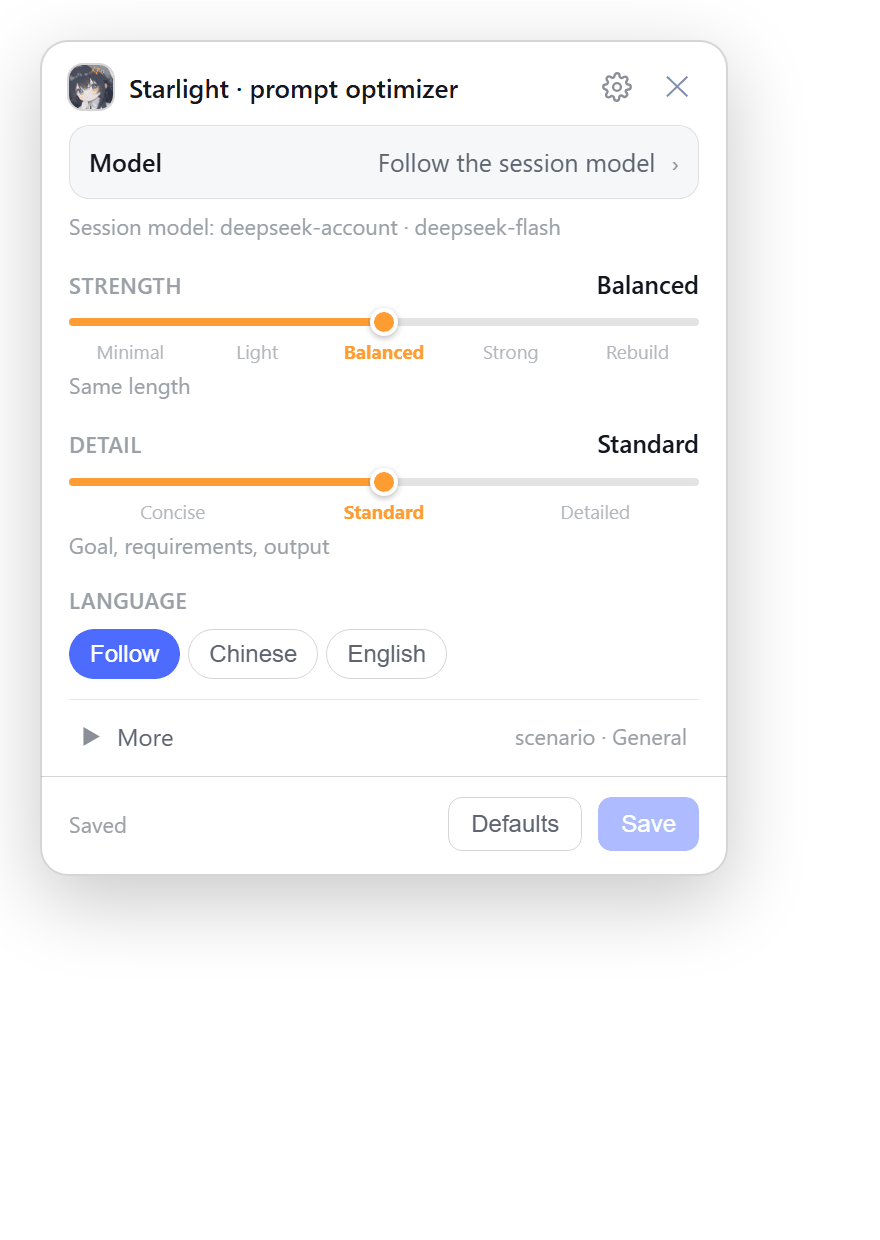
Model, strength, detail, language and rules are all editable, each in its own place: the model comes first, strength and detail are two sliders, and the 11 built-in rules toggle individually — custom rules on top. All of it lives on a dedicated settings page (Settings → Starlight), while the popover keeps only the four controls you reach for.
A standalone plugin. No DSH source edits, no
index.htmlinjection, two official slot seats.
┌───────────────────────────────────────────────┐
│  Draft text…                                  │
│                                               │
│  (✦) [+] [permissions]       [model] [send]  │
│   └ star button (left, ringed)                │
└───────────────────────────────────────────────┘| ✦ One click | Read the draft → rewrite with the rule set → atomic write-back, caret returned to the editor |
| ✦ Editable rules | 11 built-in rules grouped as structure / expression quality / fidelity guards, each toggleable, with per-group counters and all-on / all-off |
| ✦ Custom rules | One per line; they outrank the built-in rules |
| 🎚 Slider-first | Strength (5 stops: minimal → light → balanced → strong → rebuild) and Detail (3 stops) are sliders with real stops, not three values padded into five |
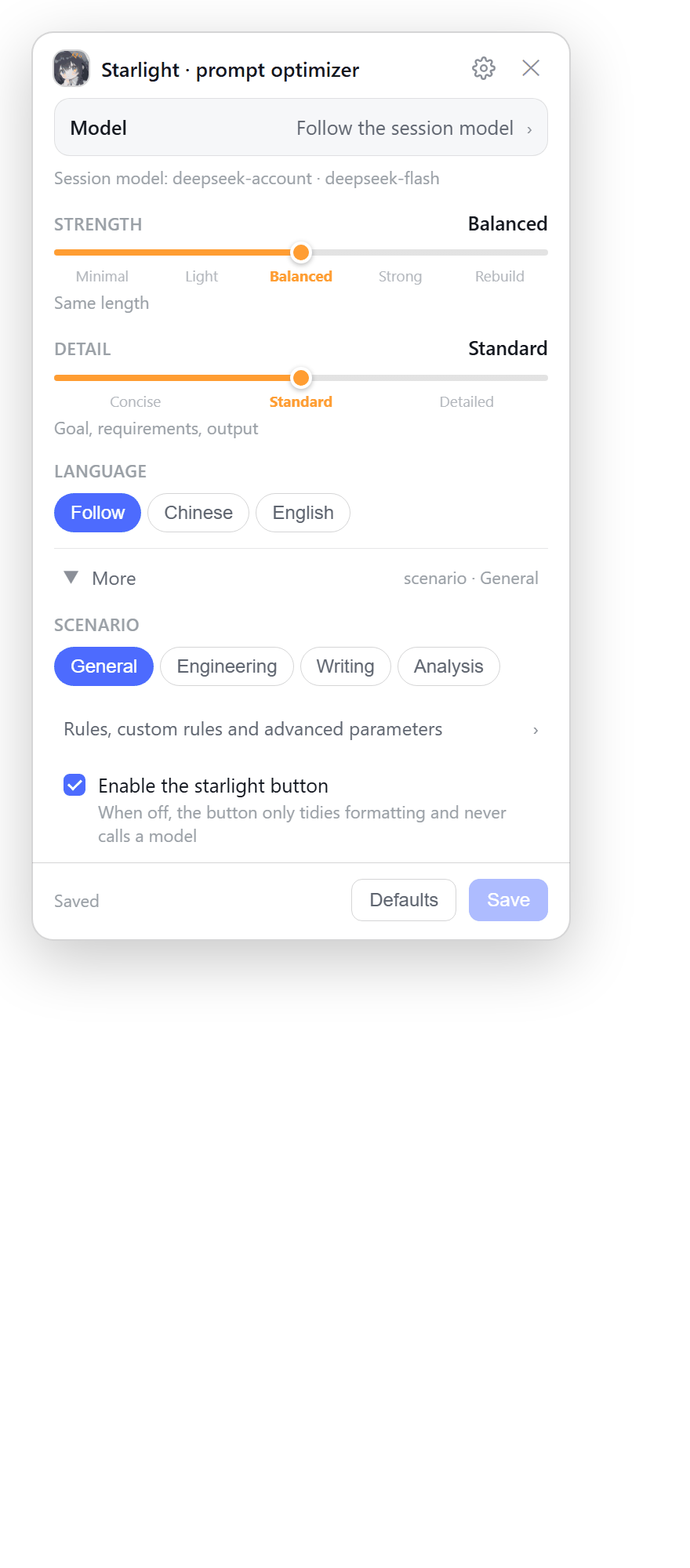
| ✦ Scenario | General / engineering / writing / analysis, folded under “More” |
| ✦ Output language | Follow the draft / force Chinese / force English |
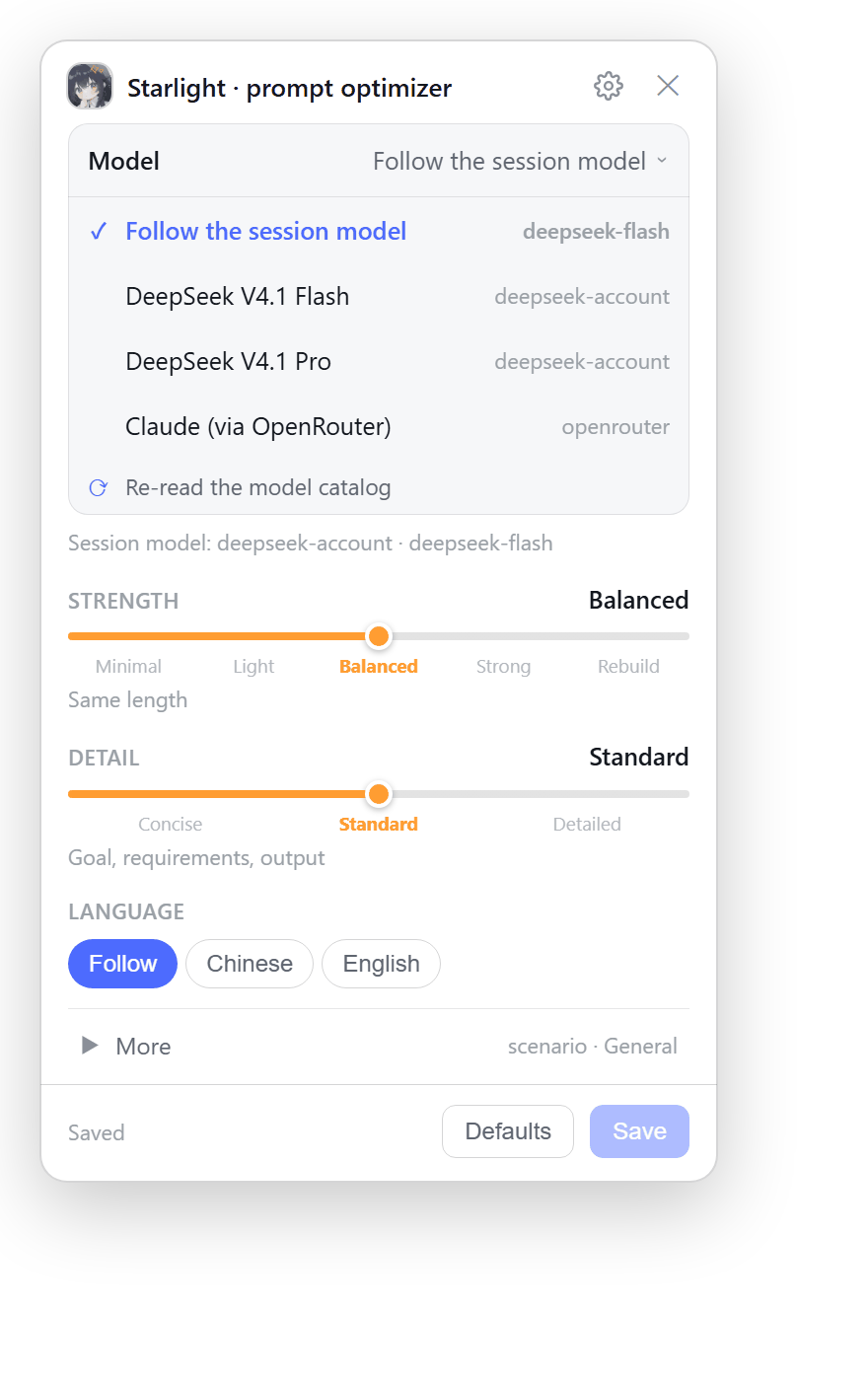
| 🎛 Model switching | Pick any model the host advertises (provider · friendly name), or keep the default "follow the session model". Affects only Starlight's side call, never your session model |
| ⚙ Settings page | Settings → Starlight: switch, shape, all 11 rules, custom rules, model, temperature / token cap / timeout — in one place |
| ↩ Undo | A toast after each run restores the previous draft in one click |
| ⌨ Shortcut | Ctrl/⌘ + Shift + O inside the composer |
| 🛟 Local fallback | No model, timeout or offline → mechanical tidy-up plus a stated reason, never a silent failure |
| 🖱 Right-click / long-press | Opens the compact rules popover (520 ms for touch); the settings page has everything else |
It never sends messages, creates turns, writes to the session log, or touches other plugins' settings.
Popover (right-click / long-press) — four controls by default, everything else folded into “More”:
Model list expanded (the same row + chevron as DSH's native picker, no OS dropdown):
"More" expanded — only the scenario switch and the master toggle; rules, custom rules and advanced live in the settings window:
The gear in the popover opens a standalone settings window — the same config as Settings → Starlight, 760px wide, rules in two columns:
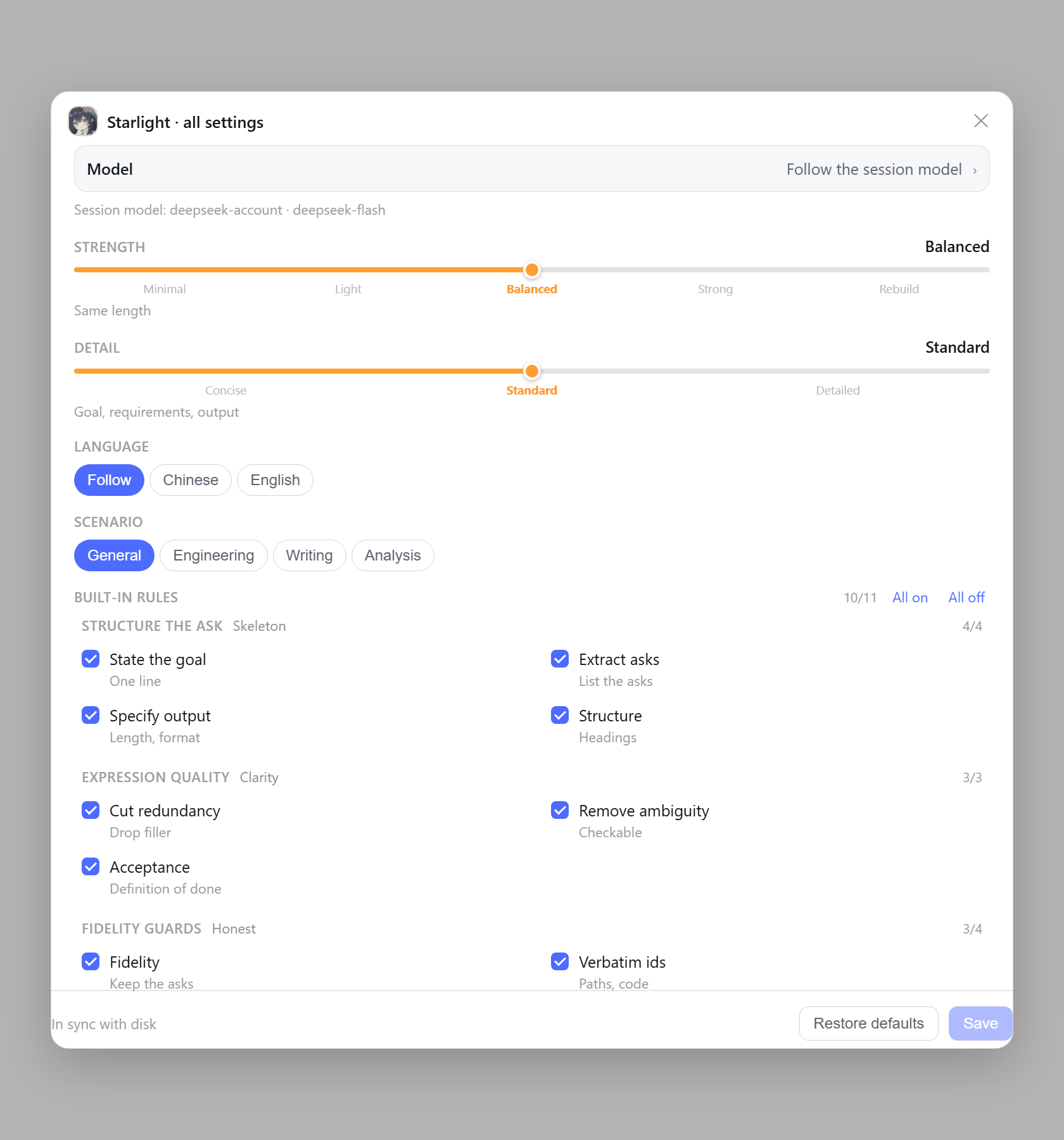
Settings page (Settings → Starlight) — the same content as the settings window: model first, then sliders, language, scenario, rules, custom rules and advanced:
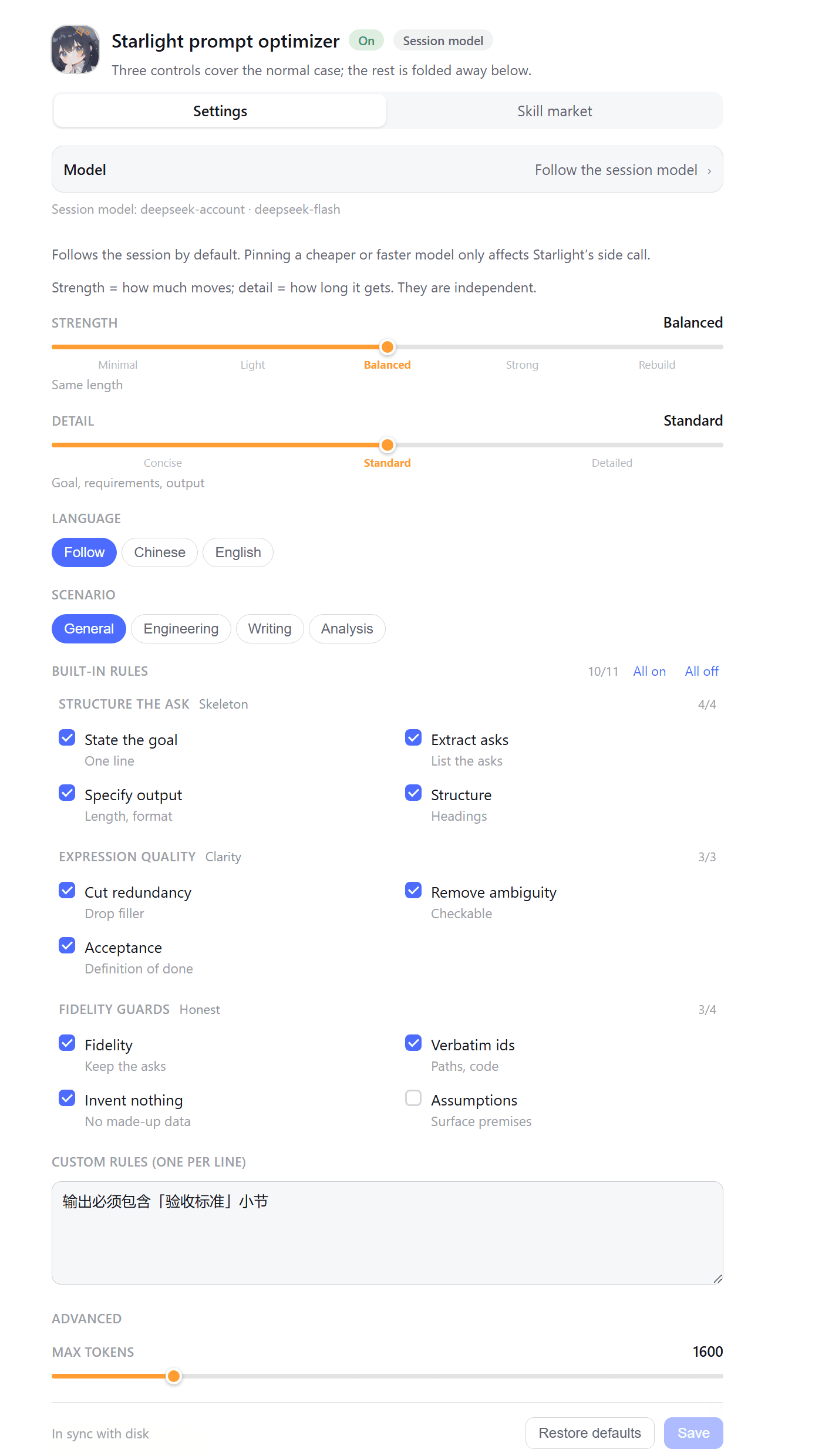
Both are rendered from the real components by
node tools/make-shots.mjs(jsdom + React + headless Edge), not hand-drawn mockups — they cannot drift from the shipped UI.
On/Off, current model) and a footer that always says Unsaved changes / Saved / In sync with disk; Save is disabled while clean.prefers-reduced-motion is respected: no spin, no pulse, no slide-in.One npm package = one host half + one browser half.
DSH ships no official market — a "market" is a format: 1 JSON index hosted at any https URL. This repository carries one, so you can treat it as a market listing just this plugin:
Sidebar Plugins → More next to Experimental plugins → enable Custom plugin markets
Open Discover and add the index URL (prefer the fastly host):
https://fastly.jsdelivr.net/gh/Starlit-Sky-code/dsh-prompt-starlight@main/market/index.jsonjsDelivr's edge hosts differ a lot in reachability, especially on mainland China networks. Measured here:
| Index URL | Measured |
|---|---|
https://fastly.jsdelivr.net/gh/Starlit-Sky-code/dsh-prompt-starlight@main/market/index.json |
本次实测可达(1.4s) |
https://gcore.jsdelivr.net/gh/Starlit-Sky-code/dsh-prompt-starlight@main/market/index.json |
本次实测可达(0.9s) |
https://testingcf.jsdelivr.net/gh/Starlit-Sky-code/dsh-prompt-starlight@main/market/index.json |
本次实测可达(1.1s) |
https://cdn.jsdelivr.net/gh/Starlit-Sky-code/dsh-prompt-starlight@main/market/index.json |
官方 CDN 域名,本网络下 SSL 失败 |
https://raw.githubusercontent.com/Starlit-Sky-code/dsh-prompt-starlight/main/market/index.json |
unreachable on this network |
Switching hosts is just a domain swap — the path is identical. Avoid
github.com/.../raw/...: the host refuses redirects and that URL 302s to raw.githubusercontent.
Install from the list. DSH installs it into the current profile pinned to the exact 40-character commit in the index, so the result is reproducible.
The index is validated with the official
@deepseek-ai/dsh-plugin-market-index(npm run market:validate). The host caches a successful read for ten minutes, so a release is not visible instantly.
dsh plugin add "git+https://github.com/Starlit-Sky-code/dsh-prompt-starlight.git#<40-char-commit>"Every version ships a packed tgz, so installing needs neither a local pnpm build nor a build-authorisation prompt:
dsh plugin add "https://github.com/Starlit-Sky-code/dsh-prompt-starlight/releases/download/v0.4.1/dsh-prompt-starlight-0.4.1.tgz"The asset name carries the version, so the URL pins the
v0.4.0tag; bump both when you upgrade. Caveat: the download 302s to GitHub's release CDN (objects.githubusercontent.comand friends), which is frequently unreachable on mainland China networks — use option A (the jsDelivr index) or D in that case.
$profile = "$env:DSH_HOME\profiles\desktop"
$pkg = Get-Content "$profile\package.json" -Raw | ConvertFrom-Json
$pkg.dependencies | Add-Member -NotePropertyName 'dsh-prompt-starlight' -NotePropertyValue 'link:D:\plugins\dsh-prompt-starlight' -Force
$pkg.dsh.profile.bundles += 'dsh-prompt-starlight'
$pkg | ConvertTo-Json -Depth 20 | Set-Content "$profile\package.json" -Encoding utf8

& "$env:DSH_HOME\resources\runtime\pnpm\bin\pnpm.cmd" install --dir $profile
Then restart DSH — the host half has to reload before the HTTP routes exist.
The desktop profile is named
desktop, and the CLI'sdsh plugin --profilerefuses it. Use the GUI or the manual link above; don't copy--profile webinstructions from web-edition tutorials.
http://127.0.0.1:19387/dsh-starlight/health
http://127.0.0.1:19387/plugins/dsh-prompt-starlight/client.js
JSON with providers = host half alive. JavaScript = the browser half made it into the boot graph. Both fine but no star? Hard-refresh (Ctrl+Shift+R).
| Channel | Mechanism | Status |
|---|---|---|
| Index in this repository | market/index.json (format 1, official validator passes) |
✅ live, URL above |
| awesome-dsh-plugin | one PR adding data/plugins/<owner>__<repo>.yml |
📝 entry ready in market/awesome-entry.yml, pending the "repo at least 1 day old" gate |
| dshbase.com | per their docs, adding the dsh-plugin GitHub topic is what makes a repo discoverable |
⏳ topic still to add |
| npm | npm publish, then dsh plugin add dsh-prompt-starlight |
⚠️ package is ready, but the starlit_sky npm account is temporarily suspended (recent security-sensitive action); publishing is refused with 403 until it lifts |
| Personal indexes (e.g. Silentforfar's market) | each author's private index | — not something to push an entry into |
npm login            # once; the publish target is already pinned to the official registry
npm publish
Then the shortest install form works:
dsh plugin add dsh-prompt-starlight
package.jsonpinspublishConfig.registry = https://registry.npmjs.org/on purpose. If any global.npmrcpoints the registry atnpm.pkg.github.com, publishing fails withENEEDAUTHeven when you are logged in, and the error only says "you need to log in" — a genuinely hard bug to trace. Pinning the target rules that failure mode out.
# 1) bump the version (package.json + the two version strings in lib/index.js
#    + the watermark and About line in lib/client.js)
# 2) commit, then tag
git tag v0.4.2
git push origin main --tags
.github/workflows/release.yml then:
package.json (mismatch fails, so a wrong version can never reach the market index)npm pack, then creates or updates the Release and uploads the tgzNPM_TOKEN is configuredEvery push and PR also runs
.github/workflows/ci.yml— the same checks plus a 2 MB unpacked-size guard.
Locally, the equivalent is two commands:
npm run market           # pin index.json to HEAD + the package.json version
npm run market:validate # run the official validatornpm's recommended path is OIDC trusted publishing, not a long-lived "Bypass 2FA" token — that token is a key that skips the one-time code entirely, so leaking it is far worse than a leaked OTP.
Bootstrap order matters: trusted publishing is configured on an existing package's settings page, and there is no such entry until the package exists. So the first version has to go out with a token, and the token gets revoked right after:
| Step | Action |
|---|---|
| 1 | Create a Granular Access Token: 7-day expiry, this package only, "Bypass 2FA" checked |
| 2 | Publish the first version with it: npm publish --//registry.npmjs.org/:_authToken=npm_xxx |
| 3 | The package now exists → its Trusted publishing settings appear; configure the fields below |
| 4 | Revoke the token (Access Tokens → Delete) |
| 5 | Package settings → Publishing access → Require two-factor authentication and disallow tokens |
Every later version then goes through OIDC, with no long-lived credential anywhere.
One-time setup:
npmjs.com → Packages → dsh-prompt-starlight → Settings → Trusted publishing → Add trusted publisher
| Field | Value |
|---|---|
| Provider | GitHub Actions |
| Organization / user | Starlit-Sky-code |
| Repository | dsh-prompt-starlight |
| Workflow filename | release.yml |
| Environment | leave empty |
| Allowed actions | npm publish |
A new configuration expires in 2 days: the first successful publish must happen inside that window, otherwise it dies and has to be recreated.
Repo Settings → Secrets and variables → Actions → Variables → new NPM_PUBLISH = true
From then on every tag push exchanges the workflow's OIDC token for a short-lived publish token, and public repositories get provenance for free. The workflow only needs:
permissions:
  contents: write
  id-token: write     # ← that is all
After the first successful publish, harden it: package settings → Settings → Publishing access → Require two-factor authentication and disallow tokens. No long-lived token can publish the package again; OIDC is the only way in.
Skipping all of this is fine too: the publish step skips itself and the rest of the release (Release asset + index re-pin) still runs.
| Action | Effect |
|---|---|
| Left click | Optimize the current draft (greyed out when empty) |
| Right click / long-press | Open the compact rules popover |
| Settings → Starlight | Open the dedicated settings page (everything, plus advanced fields) |
Ctrl/⌘ + Shift + O |
Optimize while the editor is focused |
Popover and settings-page edits both apply on Save and share one config document. Restore defaults resets every rule, slider and model override.
Navigation id: starlight.
| Section | Contents |
|---|---|
| Switch | Master switch; off ⇒ the button only tidies formatting and never calls a model |
| Rewrite force | Strength (5-stop slider) + Detail (3-stop slider) + language (3 segments); the current stop's explanation sits under each slider |
| Rules | Folded by default: scenario chips, 11 grouped checkboxes with per-group counters, all-on / all-off, master switch |
| Custom rules | Folded: multi-line textarea, one rule per line |
| Model (first) | Dropdown to switch models (Follow the session model or any advertised model), with ⟳ to re-read the catalog |
| Advanced | Folded: maxTokens / temperature / timeoutMs as sliders, plus the config-file path |
| Config file | Absolute path of the config document; a clear reason plus Retry when the host is unreachable |
The footer shows Unsaved changes (amber) / Saved / In sync with disk, with Restore defaults and Save (disabled while clean).
Follow the session model (recommended) writes no provider/model: every click uses whatever model your session is on.NO_ADAPTER, missing credential, auth) falls through to the next.GET /dsh-starlight/models (60 s cache, ?refresh=1 forces, 4 s timeout per provider, and a failing provider only becomes one entry in errors).Config file: $DSH_HOME/starlight-prompt.json (created on first save; safe to hand-edit, picked up immediately)
{
  "version": 1,
  "enabled": true,
  "verbosity": "standard",
  "lens": "auto",
  "locale": "auto",
  "depth": "balanced",
  "disabledRules": ["assumptions"],
  "customRules": ["Always include an Acceptance section", "No 'please make sure' filler"],
  "maxTokens": 1600,
  "temperature": 0.3,
  "timeoutMs": 60000,
  "provider": "",
  "model": ""
}
Built-in rule ids:
goal requirements output structure concise precise
preserve verbatim noinvent assumptions acceptance
To replace the whole rule set, put all 11 ids in disabledRules and write your own rules into customRules.
browser (lib/client.js)                      host (lib/index.js)
─────────────────────────                  ─────────────────────────
conversation.input.left slot                GET  /dsh-starlight/manifest
  └─ circular star button (ringed)          GET  /dsh-starlight/models
      ├─ read:  input.state snapshot         POST /dsh-starlight/optimize
      ├─ write: input.setDraft(text)         POST /dsh-starlight/config
      └─ undo:  previous draft               POST /dsh-starlight/reset
settings.section slot                        GET  /dsh-starlight/health
  └─ settings page (same form state)               │
                                            ctx.llm.stream({ provider, model,
                                              system: built from the rules,
                                              messages: JSON-framed draft })
Deliberate choices:
__ModuleLoader__, so it cannot import local modules; the catalog always comes from /manifest. No two drifting copies.useRulesConfig(). Loading, dirty-checking, saving and restoring have one implementation; the two surfaces are just different layouts over the same state machine, so they can never disagree.listModels may hit the network; folding it into /manifest would let a slow provider stall the rules panel. Separate route, 60 s cache, 4 s timeout per provider — a slow provider only shows up as one line of text.```, <system> or --- inside it cannot forge a structural boundary.box-shadow layers (1 px outline + near shadow + far bloom), not border, so the button stays exactly 28×28 and never nudges the toolbar height; hover swaps the outline to the accent colour and blooms a 4 px halo.webServer.register() disposer, styles tagged data-plugin for DSH to reclaim, listeners added in ctx.effect() and removed in its return value.All six routes require a loopback Host (localhost / 127.0.0.0/8 / ::1), reject Sec-Fetch-Site: cross-site, and require Origin to match Host when present. Write routes (/config, /reset) additionally require the request to come from this machine. If the host exposes connection.requestRejection, it is consulted too and the stricter result wins.
Behind a reverse proxy or on a LAN, whitelist explicitly:
STARLIGHT_TRUSTED_HOSTS=192.168.1.9:19387,my-box.local(The whitelist only relaxes read routes; writes always require the local machine, so possessing a web session never grants permission to rewrite your prompt rules.)
node tools/test-package.mjs   # package shape, card metadata, changelog
node tools/test-host.mjs      # host (routes, fence, persistence, catalog, icon, fallback, prompt, sanitize)
node tools/test-client.mjs    # browser (both slots, sliders, folding, model switch, click, undo)
One command runs every check — CI runs exactly this:
npm run verifytest-client.mjs needs real React and jsdom, installed only under tools/fixture:
cd tools\fixture
npm installnpm run preview # = node tools/make-preview.mjs && node tools/check-preview.mjsWrites tools/preview.html — just open it. It is not a hand-drawn mock: the script mounts the real components (button, right-click popover, settings page) in jsdom with real React, then lifts the injected stylesheet and the rendered outerHTML into one page. So the preview cannot drift from what ships. It covers the toolbar position, five button states, a 3× zoom of the ring, the popover and the settings page, in light and dark themes.
tools/check-preview.mjs asserts the preview really contains those pieces, so it can't silently degrade into an empty shell.
node tools/make-shots.mjs # writes docs/screenshots/{popover,settings}{,.zh}.pngAlso renders the real components, then screenshots them with the local Edge/Chrome in headless mode — one set per locale.
tools/asar-list.mjs lists or unpacks DSH's app.asar for debugging.
Verified against DSH 0.2.0-rc.2 (@deepseek-ai/dsh-client-ui-conversation and -settings-general inside app.asar):
| Interface used | Source |
|---|---|
conversation.input.left slot (kind: list, scope: session) |
registerComposerBar() |
settings.section slot (kind: list, scope: root; entries carry id / order / label()) |
SettingsRoot in dsh-client-ui-settings-general |
ctx.slots.inject() / slots.register() / inject(sessionId) |
dsh-client-ui-slots |
conversation.input.for(actx), .shell(sessionId), .setDraft(), .state snapshot |
SessionInputShell / InputHub |
session.projections.faceOf('modelSelection') |
SessionInputShell.submissionState() |
ctx.llm.listProviders() / .listModels(provider) |
@deepseek-ai/dsh-llm |
ctx.llm.stream({ provider, model, messages, system, maxTokens, signal }) |
@deepseek-ai/dsh-llm |
ctx.webServer.register({ kind, path, handler }) |
@deepseek-ai/dsh-host-webserver |
agentDefaultModel.currentSelection() |
@deepseek-ai/dsh-agent-default-model |
Every possibly-absent service (llm, agentDefaultModel, connection, sessions, conversation) is read lazily through ctx.get() inside try/catch: a missing one only degrades a feature — it never parks the plugin in PENDING and never makes the composer disappear. A missing settings.section slot (older host) simply means no settings page; the button keeps working.
© 2026 Starlit Sky · AGPL-3.0 — see NOTICE and LICENSE.
node tools/stamp-signature.mjs and verified mechanically with --check —
stripping it fails the test suite.lib/client.js ships to the browser verbatim, so the header and a runtime
watermark appear directly in devtools.STARLIGHT_QUIET=1 silences it).AGPL-3.0 is a strong copyleft licence with a network clause: running a modified version as a network service obliges you to offer users the corresponding source. Forks and redistributions stay under AGPL-3.0 and must keep the signature headers and LICENSE.
Relicensing under a permissive licence (vendoring into a closed product or hosted service) requires a commercial licence from the copyright holder — open an issue to discuss. Relicensing is the copyright holder's decision; don't route around it.
CLASSIFICATION EVIDENCE
系统优先读取 GitHub Topics,再与站内分类词典和词根规则比对。当前命中: prompt、prompt-engineering。
alchaincyf
你想蒸馏的下一个员工,何必是同事。蒸馏任何人的思维方式——心智模型、决策启发式、表达DNA。Distill how anyone thinks.

freestylefly
Prompt as Code | GPT Image 2 / 2.5 提示词与案例库,530+ 个案例、20+ 套工业级模板与可复用 Skills,新增 2.5 同提示词对比专区,附完整提示词与生成记录,持续更新。

titanwings
Distilly — Distill how they think into reusable Skills for any Agent or Bot. Formerly Colleague Skill(原同事 Skill).