模型与 MCP
待识别

rea
morluto
Reverse engineer anything with agents, from app behavior down to native binaries.

SMPcosy/dsh-member-manager
DSH plugin for a runnable company org: departments, employee codes, dual M/P channels, DAG task-graph dispatch, audit & cost attribution — with a roster overlay for display names, roles, skills and model overrides. Zero runtime deps.
PROJECT TOPICS
INSTALL REFERENCE
dsh plugin --profile web add github:SMPcosy/dsh-member-manager
该命令指向仓库当前默认分支;尚无绑定当前 commit 的完整验证结果。
PROJECT README
A DeepSeek Harness plugin for a runnable company org — departments, employee codes, dual M/P channels, DAG dispatch, audit and cost attribution.
给 DeepSeek Harness(DSH)加一层可运行的公司化组织:部门与工号、M/P 双通道等级、工单派工与验收、任务图(DAG)并行派发、审计与成本归因;名册覆盖层负责显示名 / 岗位 / 职责 / 技能 / 模型覆盖。
dsh-member-manager · v0.5.3 · MIT · Node ≥ 22.19 · 零运行时依赖
新手先看 docs/28-新手使用教程.md。
点击下方标题可查看 中文 或 English。
Click a heading below to view English or 中文 .
本插件在 DSH 的「成员名不可改、不可删」约束之上,维护一层名册覆盖层(显示名 / 岗位 / 职责 / 技能 / 模型覆盖),并在其上提供公司化运行时:部门编号、员工工号、M/P 双通道等级、工单与派工凭证、任务图(DAG)并行派发、审计与 token 成本归因。
~/.dsh/storages/member-manager/(名册与公司化数据格式稳定,可跨版本升级)member_*(16 个)与 company_*(14 个)工具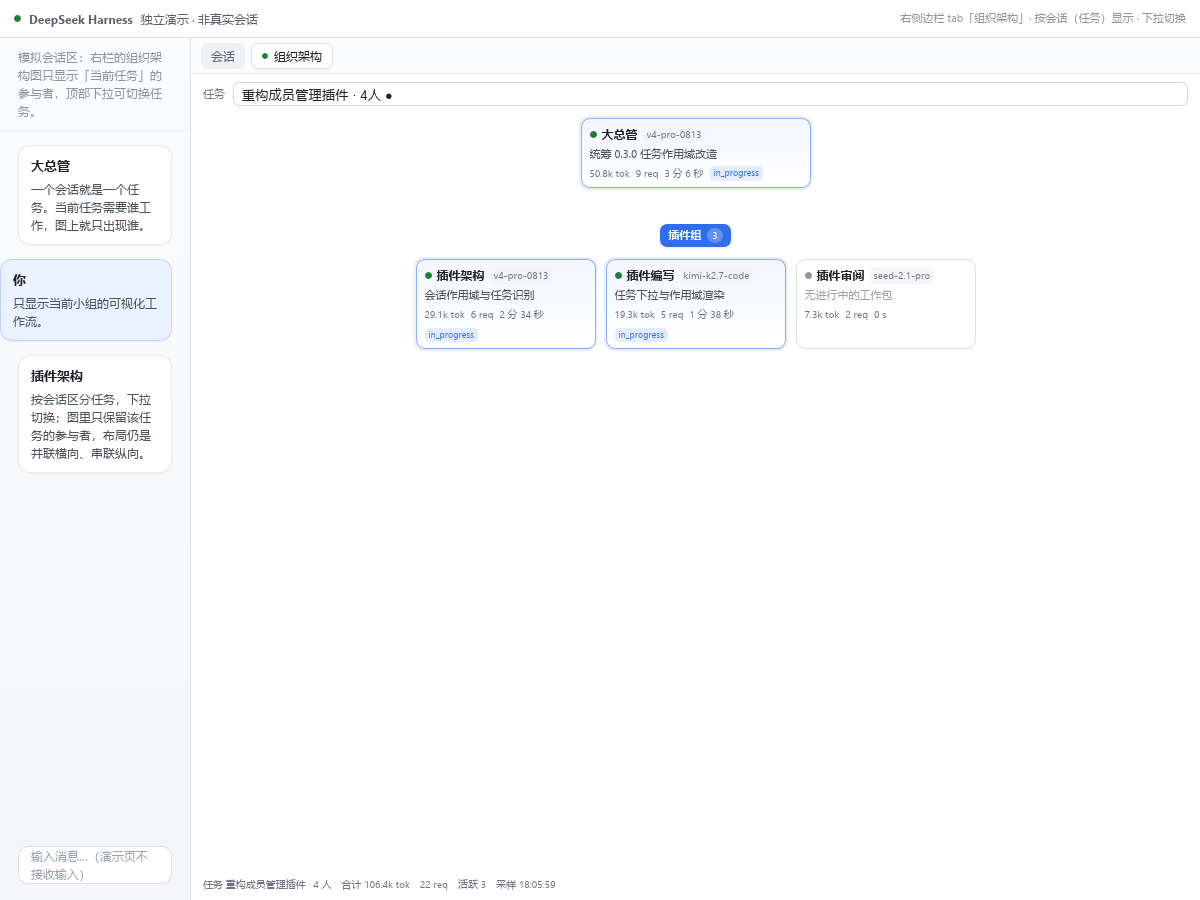
组织架构:管理层 → 部门/小组 → 成员拓扑,按会话(任务)切换(独立演示渲染)
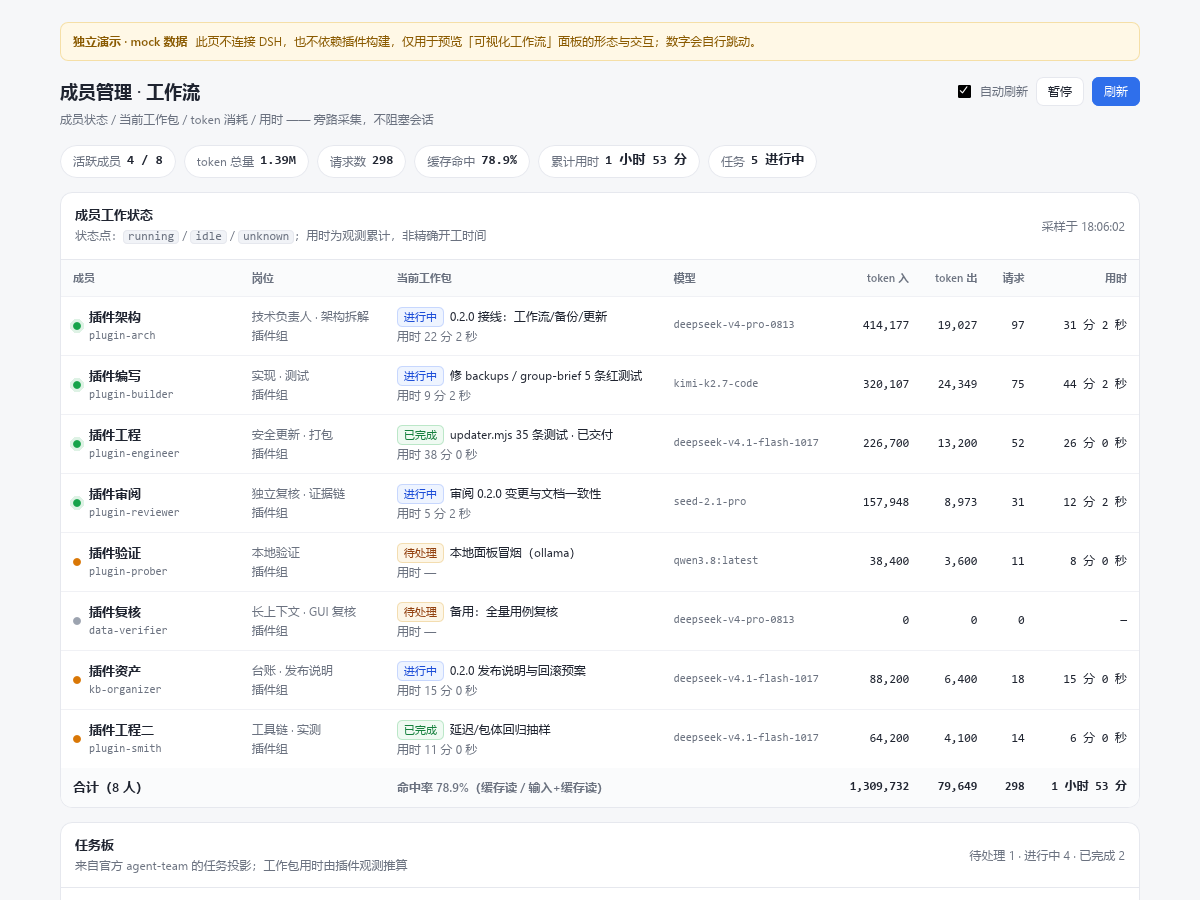
工作流面板:成员工作状态、任务板与统计(独立演示渲染)
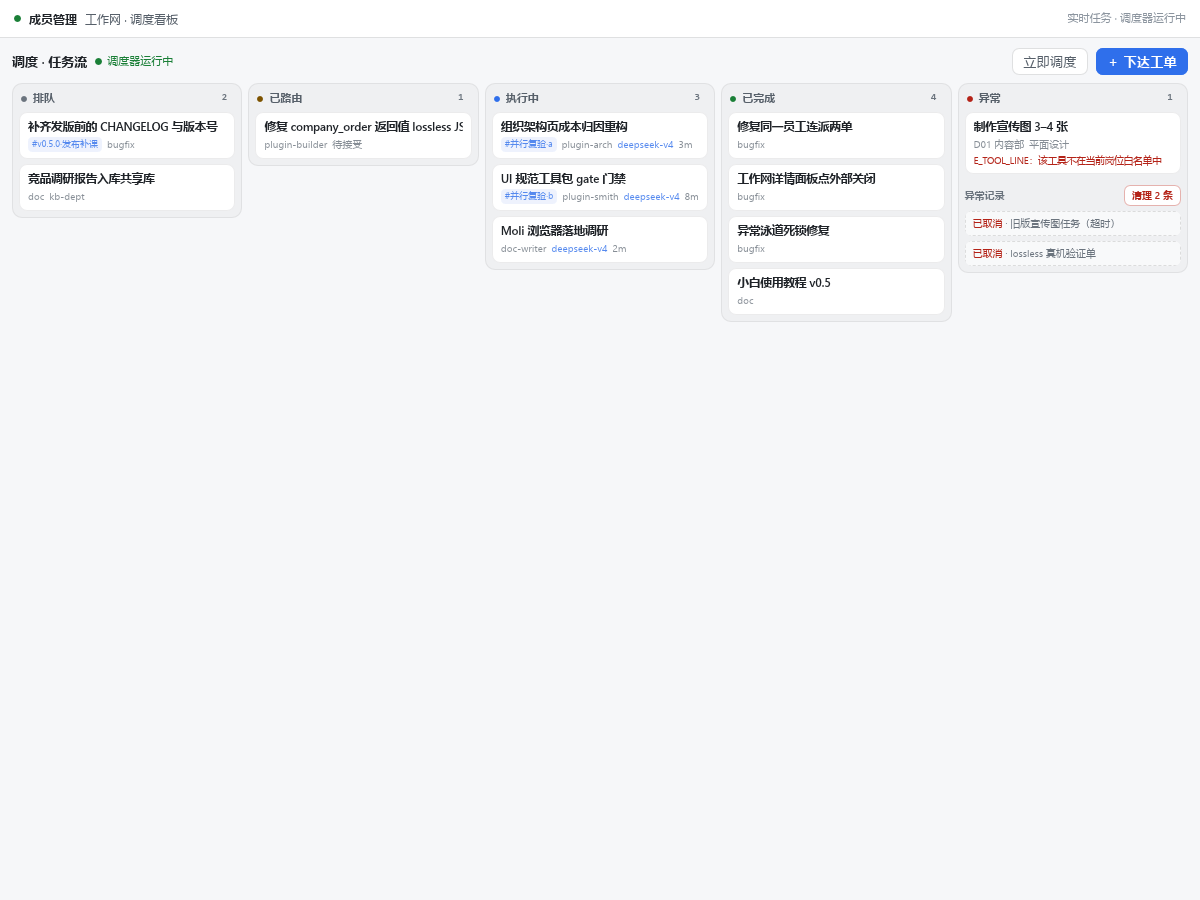
工作网调度看板:排队 / 已路由 / 执行中 / 已完成 / 异常 五条泳道,异常泳道含异常记录与清理(独立演示渲染)
截图来自
demo/的独立演示页(demo/*.html,不连 DSH,数据为 mock);真实面板请在 DSH 设置 →「成员管理」打开。
company_order(或 company_plan 提交任务图)→ company_assign → 员工 company_accept / company_report → company_review。| 能力 | 说明 |
|---|---|
| 组织 | 部门编号 D01…(模板可自定义)、编制、接单范围、借调策略、职责描述;仅空部门可删除 |
| 员工 | 工号 E0001…、M/P 双通道等级(可并存)、岗位/职责/技能/模型覆盖、停用/调岗;v0.4 追加推理强度 / 派生方式 spawn·fork / 子代理深度 / 工具黑白名单 / 会话策略 |
| 总架构 | 管理层(虚拟聚合节点,M 通道)→ 部门图框 → 员工卡;管理层可重命名,编号规则与等级目录可「自定义」 |
| 员工中心 | 全量员工列表,按部门/等级排序,支持部门、停用与名册关联状态筛选;行内显示「名册·已登记 / 未登记 / 已停用」徽章,可单个或批量登记 |
| 名册关联 | 公司员工与 registry.json 双向关联:缺省「员工 id 即名册 target」(12 名历史员工零迁移),需要别名时写显式 rosterTarget;登记沿用「只补空字段、绝不覆盖」,refresh 才回填;member_list 附带公司关联、member_diagnose 报告 rosterLinks,CLI scripts/roster-link.mjs 可 --list / 按部门 / 单员工登记 |
| 人事管理 | 行内展开详情:公司化资料(3 列:显示名/岗位、技能/模型选择器、职责 ≤8 条)+ 通道 / 晋升 / 停用 / 调岗 |
| 部门弹层 | 两个页签(部门架构图 / 成员详情),内可招聘,页签行有「部门编辑」(名称/编号/编制/描述/接单范围/借调策略) |
| 工作网 | 右侧栏,只在点「工作网」按钮时打开,绝不自动弹出:上半部五泳道任务看板(待派/已路由/执行中/已完成/异常)+ KPI + 调度器状态 + 部门产能条,卡片点开详情、派工、验收、升级、取消,点详情外任意处收起;异常泳道只显示当前卡住的工单,历史异常归入「异常记录」区(可手动清理),无卡单时显示「重启进度」按钮;下半部管理层 → 部门 → 员工拓扑(工号/等级/任务/用量),空闲折叠,2s 刷新;公司化关闭时回退任务视图 |
| 派工闭环 | order → 五级路由回退(显式部门 / 规则表 / 部门接单范围 / 技能 / 兜底)→ attempt(派工凭证)→ accept → report → review;attemptId 防串单、重派先吊销旧 attempt、派工失败回滚重派、重启后冷恢复、终态订单孤儿 attempt 自动回收;忙碌门禁(E_EMPLOYEE_BUSY)防止同一员工被连派两单;调度器按优先级 + 依赖 + 部门产能派工,满编部门不再饿死其它部门 |
| 并行派发(DAG) | company_plan 一次提交任务图(≤50 任务),用 key 互相声明依赖;无依赖同层并行派发,下游等上游 done 自动放行;内置环检测等 6 类校验(E_PLAN_EMPTY / TOO_LARGE / TASK_INVALID / DUP_KEY / BAD_REF / CYCLE);company_status({group}) 按批次汇总 done/running/pending/failed |
| 成本 & 审计 | token/请求按员工 / 部门 / 工单归因(GET /company/costs);audit.jsonl append-only、加载时重放对账 |
| 隔离与降级 | 员工会话继承宿主标准工具;公司管理工具(company_*)走同步 guard + 执行体会话反查(v5.24 起不再收窄工具面);越权 E_TOOL_LINE,缺宿主服务 E_NO_AGENTS,开关关闭 E_DISABLED,均不影响名册功能 |
| 通道 | 默认等级目录 | 默认等级 |
|---|---|---|
| M 管理 | M1 主管 / M2 经理 / M3 高级经理 / M4 总监 / M5 副总裁 | manager → M2 |
| P 技术 | P1 初级工程师 / P2 工程师 / P3 高级工程师 / P4 资深工程师 / P5 技术专家 / P6 首席专家 | staff → P3、window → P1 |
channels:[{channel,level}],至少一个;manager 必含 M、window 仅 P。role 跟随(window 不可转 M)。E{seq:4} / D{seq:2},占位符 {seq} {seq:N} {dept} {channel} {level};优先级 company.json 持久值 > 配置 > 内置默认。方式 A:npm(dsh-member-manager)
dsh plugin --profile desktop add dsh-member-manager@0.5.3方式 B:本地源码
dsh plugin --profile desktop add link:"<本仓库绝对路径>"方式 C:从旧包升级(dsh-plugin-member-manager → dsh-member-manager)
node scripts/migrate-old-plugin.mjs          # 1) dry-run,不动任何文件
node scripts/migrate-old-plugin.mjs --apply  # 2) 备份 profile → 改写三处登记 → 写迁移标记
# 3) 重启 DSH:首次启动消费标记,把名册迁移成公司化组织(只迁 active 成员、只补空档案、幂等)
旧包名有转发包(
compat/dsh-plugin-member-manager,0.3.1)可继续安装并转发到本包;两个包不要同时启用(重复注册工具/路由,共用数据目录)。
删除 profile 三处登记(dependencies、dsh.profile.bundles、cordis.yml;或 dsh plugin --profile desktop remove dsh-member-manager)后重启 DSH。数据保留在 ~/.dsh/storages/member-manager/,可手动删除。
dsh-plugin-member-manager 的关系本包是旧插件的重命名升级版。两者同源:从同一份代码 fork 而来,数据目录、名册文件格式和 16 个名册工具名保持一致;区别是包名 / 插件 id 改为 dsh-member-manager,并新增公司化运行时(部门 / 工号 / 双通道 / 工单 / DAG 并行 / 审计 / 成本)与 14 个 company_* 工具。
| 维度 | 旧包 dsh-plugin-member-manager |
新包 dsh-member-manager |
|---|---|---|
| 数据目录 | ~/.dsh/storages/member-manager/ |
相同(升级不迁移、不丢数据) |
| 名册文件 | registry.json(成员 / 小组 / 技能 / 模型覆盖 / 备份) |
相同格式,直接读写 |
| 名册工具 | 16 个 member_* / group_manage / skill_list / model_list |
同名保留,旧脚本可继续用 |
| 公司化数据 | 无 | 新增 company/(部门 / 员工 / 工单 / 审计 / 成本) |
| 面板 | 组织架构 · 已停用 · 未登记 · 工作流 · 维护 | 总架构 · 员工中心 · 工作流 · 备份与更新 |
| 维护状态 | 停止更新 | 唯一维护版本 |
名册里的「小组」在新版只作覆盖层与迁移来源(面板以部门组织为主);
company/数据旧包不存在,升级后为空,由「一键迁移」或面板自行建立。
新旧包共用一个 DSH profile 时会重复注册 25 个名册工具与 16 条 HTTP 路由,并写入同一个数据目录,属未定义行为。切换前必须先移除旧包。
| 方式 | 命令 | 适用场景 |
|---|---|---|
| 一键迁移(推荐) | node scripts/migrate-old-plugin.mjs → --apply → 重启 |
已装旧包,并希望把名册迁成公司化组织 |
| 只切插件 | node scripts/switch-to-dsh-member-manager.mjs → --apply → 重启 |
已装旧包,只换包,公司化组织稍后自建 |
| 手工 | 删除 profile 三处旧登记(dependencies / dsh.profile.bundles / cordis.yml)与旧 node_modules 链接,再按「安装」加新包,重启 |
喜欢自己动手 |
两个脚本都默认 dry-run,--apply 时先把 package.json / cordis.yml 备份到 ~/.dsh/backups/;回滚用 node scripts/rollback-to-dsh-plugin-member-manager.mjs --apply。
compat/dsh-plugin-member-manager(v0.3.1)保留旧包名可安装:它只依赖新包,并把 host / client 入口 export * 转发,cordis.patch.yml 仍插入旧 id。用于「CI / 脚本里写死旧包名」的过渡期;同样不能与新包同装,过渡完请移除。
npm 没有包名重定向。发布新包后建议对旧包执行 npm deprecate dsh-plugin-member-manager@* "已更名为 dsh-member-manager,请安装新包";旧用户先 dsh plugin --profile desktop remove dsh-plugin-member-manager(或跑上面的切换脚本),再安装新包。
第一次用? 先读 docs/28-新手使用教程.md——从建部门到验收,五分钟跑通第一单,不需要懂代码。
member_list / member_add 管理名册;company_hire / company_admin 建公司组织;company_order 起单,company_plan 起任务图。member_sync(HTTP 路由拿不到 Agent 凭证,需工具触发一次)。GET /api/dsh-member-manager/{health,state,skills,overrides,models,orgmap,workflow,update,backups}、POST …/op;公司化只读 GET …/company/{overview,org,board,costs,orders,presets}、写 POST …/company/op。| 字段 | 默认 | 说明 |
|---|---|---|
dataDir / registryFile |
~/.dsh/storages/member-manager / {dataDir}/registry.json |
数据目录与名册文件 |
scanLocalSkills / extraSkillRoots |
true / [] |
是否扫盘补技能目录、追加扫描根 |
backups |
{enabled:true,keep:20,dailyKeep:7} |
名册自动备份保留策略 |
workflow |
{enabled:true,persistMs:5000,retentionHours:6,tasksPollMs:3000} |
工作流采集 |
update |
{enabled:true,checkOnBoot:false,autoStage:false,allowOnlineApply:false} |
分阶段自更新(不在运行中替换自身) |
enabled / company.enabled |
true |
公司化总开关 |
company.autoBoot / company.provider |
true / "spawn" |
非阻塞自动 boot;派工 subagent provider(写错 → NO_PROVIDER) |
company.autoLinkRoster |
true |
新建部门 / 新增员工后自动登记名册(名册可用时 best-effort;失败不阻塞创建) |
company.defaultSessionPolicy / managerActsAsStaff |
"per_task" / false |
会话策略;经理是否可被派活 |
company.defaultOrderMode / requireManagerReview |
"async" / true |
下单模式;是否需要经理验收 |
company.limits |
见下 | {maxConcurrentPerProvider:4,maxTemps:4,budgetTokensPerDay:5000000,attemptTimeoutMs:1800000,lostReportGraceMs:120000,staleAttemptMs:3600000,schedulerIntervalMs:5000};当前仅校验与展示,并发/预算闸门尚未强制 |
company.departments / routingRules / toolPolicies |
[] / [] / {} |
种子部门 / 下单路由 / 分线工具策略 |
company.levels / numbering |
内置 M1–M5、P1–P6 / E{seq:4}、D{seq:2} |
等级目录 / 编号模板(非法回退默认 + warning) |
DSH 两代宿主用两套机制,插件按能力自动分流:
| 宿主 | 机制 | 时机 |
|---|---|---|
| 0.2.2 起 | agent.model.select({ provider, model }) 写 session 投影 |
子 agent 创建时落一次;member_set_model 显式改时强制重落 |
| 0.2.1 及更早 | agent/request 水位改写返回值 |
每次请求前(同样只对子 agent) |
lead 是用户直接对话的那个会话,它的模型在会话框里由用户自己选。
所以 0.*.* 都不给根会话身份做模型覆盖:
member_set_model 对这类成员直接拒绝,返回 ROOT_IDENTITY_NO_OVERRIDE;model 也不生效:根 agent 不落 selection,子 agent 不会以 lead 身份出现;model: "")允许,用于清掉历史残留。判定两条,任一成立即算:活着的 agent 里同名且是顶层会话(没有 delegationDepth /
origin);或团队内核里该成员角色是 lead。
delegationDepth > 0 / origin === "subagent"):派出去干活的员工,
没有输入框,名册里的模型就是它唯一的模型来源 —— 「不同岗位用不同模型」落在它们身上。modelOverride.skippedRoot 记录被跳过的次数。
为什么 0.2.2 不能再用老写法:agent-loop 在 pre-step 就把 selection 固定,随后用 waterfall 拿到 proposedConfig 逐字段比对,不一致直接抛错 ——
agent/request proposed "X/Y" after step preparation fixed "A/B"; use agent.model.select() before step preparation
所以 0.2.2 上不会注册 agent/request。system-prompt/assemble 仍然保留:
它只改提示词里的 provider/model 变量,不参与路由校验。
member_diagnose 的 modelOverride 段会给出 path(model-select / legacy-hook)、
cleared / unchanged / skippedRoot / errors。
名册工具(16 个,覆盖层,兼容保留)
member_list member_add member_rename member_remove member_set_role member_set_skills member_set_model group_manage member_sync member_diagnose member_backup member_group_from_text member_workflow member_update skill_list model_list
公司化工具(14 个)
| 工具 | 线 | 作用 |
|---|---|---|
company_order |
窗口 | 下单:{type,title,dept?,priority?,deps?,acceptance?,clientOrderId?,mode?} |
company_plan |
窗口 | 一次提交任务图(DAG):{group?,tasks:[{key?,type,title,deps?,priority?,dept?,detail?,project?,acceptance?}]}。同层无依赖的任务并行派发,下游等上游 done 自动放行;返回 {group,count,parallel,layers,orders} |
company_status |
窗口 | 查询工单/员工/部门视图:{orderId?,group?};带 group 时附该批次的 done/running/pending/failed 汇总 |
company_ask |
窗口 | 催办:{orderId,question} |
company_cancel |
窗口 | 取消工单:{orderId} |
company_assign |
经理 | 派工:{orderId,employeeId} → {attemptId,sessionId} |
company_review |
经理 | 验收:{orderId,pass}(通过 / 打回) |
company_borrow |
经理 | 借调共享员工:{orderId,sharedEmployeeId} |
company_escalate |
经理 | 升级转 owner:{orderId,reason?} |
company_report |
经理/员工 | 回报(必带 attemptId):{orderId?,attemptId,status,summary,artifacts?,acceptanceResults?} |
company_accept |
员工 | 接受派工:{attemptId} |
company_ask_help |
员工 | 求助并转发经理:{attemptId,question?} |
company_hire |
OWNER | 新增员工:{id,displayName?,department?,role?,kind?,code?,channel?,level?,channels?,title?,duties?,model?,provider?}(成功即自动登记名册,见 company.autoLinkRoster) |
company_admin |
OWNER | 控制面:{action,args},17 个 action——createDepartment createEmployee updateDepartment promoteEmployee setChannels setNumbering setManagementName setCompanyName setLevels updateEmployeeProfile importRosterProfiles linkEmployeeRoster syncEmployeesRoster unlinkEmployeeRoster setRoutingRules applyDepartmentPreset clearDepartmentPreset |
线隔离:OWNER 14 / 经理 12 / 员工 5 / 窗口 5(白名单见
src/host/company-compat.mjs)。越权 →E_TOOL_LINE;宿主缺agents/subagents→E_NO_AGENTS。
npm run check   # 语法校验(lib/ src/ scripts/ compat/)
npm test        # 655 tests / 655 pass
npm run verify # 22 项交付自检(元数据/文件/语法/导出契约/面板字样/游戏开发模式预设/公司与名册关联/自动登记/测试不污染用户目录)lib/ 插件入口与客户端 bundle · src/shared/ 纯函数内核 · src/host/ 运行时 · test/ 测试 · docs/ 契约与独立审阅 · demo/ 独立演示页与截图 · scripts/ 切换 / 回滚 / 迁移 / 验证。registry.json(名册)· company/company.json + company/audit.jsonl + company/ledger/(公司化)· backups/(自动备份)· boot.log · workflow-stats.json · pending-migration.json(迁移标记);脚本备份写 ~/.dsh/backups/。MIT(见 LICENSE);第三方许可见 THIRD-PARTY-NOTICES.md;历史版本见 CHANGELOG.md。
A runnable "company" layer for DeepSeek Harness (DSH): departments and employee codes, dual M/P career channels, order dispatch with accept/report/review, task-graph (DAG) parallel dispatch, an audit trail and cost attribution. A roster overlay keeps display names, titles, duties, skills and per-member model overrides.
~/.dsh/storages/member-manager/member_* (16) and company_* (14) host tools
Organization chart: management → departments/groups → members, switchable by session/task (standalone demo render).
Workflow panel: member work status, task board and stats (standalone demo render).
Work board (scheduling kanban): queued / routed / running / done / abnormal lanes; the abnormal lane carries exception history + one-click clear (standalone demo render).
Screenshots come from standalone demo pages under
demo/(demo/*.html, not connected to DSH, mock data); open the real panels via DSH Settings → "Member Manager".
company_order (or company_plan for a task graph) → company_assign → employee company_accept / company_report → company_review.| Area | What you get |
|---|---|
| Organization | Department codes D01… (customizable templates), capacity, accepts, borrow policy, charter; only empty departments can be deleted |
| Employees | Employee codes E0001…, dual M/P channels (both at once), title/duties/skills/model override, disable/transfer; v0.4 adds reasoning effort / member provider spawn·fork / max depth / tool allow-deny / session policy |
| Overall architecture | Virtual Management node (M channel) → department boxes → employee cards; rename Management, customize numbering and level directories |
| Employee center | Full employee list sorted by department/level with department and disabled filters |
| Roster link | Bidirectional link between company employees and registry.json: default "employee id is the roster target" (12 legacy employees migrate with zero work), explicit rosterTarget only when aliasing is needed; registration only fills blank fields (never overwrites), refresh backfills; member_list carries the company link, member_diagnose reports rosterLinks |
| Personnel | Inline detail: company profile in 3 columns (display name/title, skill/model pickers, duties ≤8) plus channels / promote / disable / transfer |
| Work network | Right sidebar, opens only when you click the 工作网 button — never auto-opens: top half is a five-lane task board (queued / routed / running / done / abnormal) with KPIs, scheduler state and capacity bars; cards open an order drawer with assign / review / escalate / cancel, and close when you click anywhere outside the detail; the abnormal lane shows only currently-stuck orders — historical exceptions live in an "Exception history" area (with a manual clear button), and when nothing is stuck a "Restart progress" button is shown; bottom half is the Management → department → employee topology (code/level/task/usage), idle folded, 2s refresh; falls back to the task view when the company runtime is off |
| Dispatch loop | order → five-step routing fallback (explicit dept / routing rules / department accepts / skills / capacity fallback) → attempt → accept → report → review; attemptId blocks stale reports, reassignment revokes the old attempt, failed dispatch rolls back and retries, restarts cold-recover orphan attempts (including orphans under terminal orders); a busy guard (E_EMPLOYEE_BUSY) stops one employee being assigned two orders at once; the scheduler honours priority + dependencies + department capacity, and a saturated department no longer starves the rest of the queue |
| Parallel dispatch (DAG) | company_plan submits a task graph (≤50 tasks) with key-based dependencies; same-layer tasks run in parallel, downstream releases automatically when its upstream reaches done; built-in cycle detection plus 5 other validations (E_PLAN_EMPTY / TOO_LARGE / TASK_INVALID / DUP_KEY / BAD_REF / CYCLE); company_status({group}) aggregates done/running/pending/failed per batch |
| Cost & audit | Tokens/requests attributed per employee / department / order (GET /company/costs); append-only audit.jsonl replayed on load |
| Isolation | Employee sessions inherit host tools; company_* management tools use a synchronous guard + session lookup (no tool-surface narrowing since v5.24); E_TOOL_LINE, E_NO_AGENTS, E_DISABLED never break roster features |
| Channel | Default levels | Default level |
|---|---|---|
| M (management) | M1 Supervisor / M2 Manager / M3 Senior Manager / M4 Director / M5 VP | manager → M2 |
| P (professional) | P1 Junior Engineer / P2 Engineer / P3 Senior Engineer / P4 Staff Engineer / P5 Expert / P6 Principal Expert | staff → P3, window → P1 |
channels:[{channel,level}] — at least one; manager must include M, window is P-only.E{seq:4} / D{seq:2} with {seq} {seq:N} {dept} {channel} {level}; persisted company.json > config > built-in defaults.Option A — npm (dsh-member-manager)
dsh plugin --profile desktop add dsh-member-manager@0.5.3Option B — local source
dsh plugin --profile desktop add link:"<repo path>"Option C — upgrade from the old package
node scripts/migrate-old-plugin.mjs          # 1) dry-run, writes nothing
node scripts/migrate-old-plugin.mjs --apply  # 2) back up profile, rewrite 3 registrations, write the migration marker
# 3) restart DSH: the marker is consumed on first boot and the roster is migrated into the company org (idempotent)
A shim package under the old name (
compat/dsh-plugin-member-manager, 0.3.1) re-exports this package. Never enable both at once.
Uninstall: remove the three profile registrations (or dsh plugin --profile desktop remove dsh-member-manager) and restart. Data stays under ~/.dsh/storages/member-manager/.
dsh-plugin-member-managerThis package is the renamed successor of the old plugin. It is forked from the same code base: the data directory, registry.json format and the 16 roster tool names are unchanged. What differs is the package name / plugin id (dsh-member-manager), the new company runtime (departments, employee codes, dual M/P channels, orders, DAG dispatch, audit, cost) and 14 company_* tools.
| Aspect | Old package | New package |
|---|---|---|
| Data directory | ~/.dsh/storages/member-manager/ |
same — upgrade in place, nothing migrated away |
| Roster file | registry.json (members / groups / skills / model overrides / backups) |
same format, read and written directly |
| Roster tools | 16 member_* / group_manage / skill_list / model_list |
kept under the same names |
| Company data | none | new company/ (departments / employees / orders / audit / cost) |
| Panel | Organization · Retired · Unregistered · Workflow · Maintenance | Overall architecture · Employee center · Workflow · Backups & updates |
| Maintenance | no longer updated | the only maintained version |
"Groups" in the roster now serve as a compatibility overlay and migration source only; the panel is department-centric.
company/is new and starts empty — populate it with the one-step migration or from the panel.
Both packages in one DSH profile would register 25 roster tools and 16 HTTP routes twice and write the same data directory — undefined behaviour. Remove the old package first.
| Way | Command | When |
|---|---|---|
| One-step migration (recommended) | node scripts/migrate-old-plugin.mjs → --apply → restart |
old package installed and you want the roster migrated into the company org |
| Swap the package only | node scripts/switch-to-dsh-member-manager.mjs → --apply → restart |
old package installed, only switching the package |
| Manual | drop the three old profile registrations (dependencies, dsh.profile.bundles, cordis.yml) and the old node_modules link, then install as in Installation, restart |
you prefer doing it by hand |
Both scripts default to dry-run and back up package.json / cordis.yml into ~/.dsh/backups/ before --apply. Roll back with node scripts/rollback-to-dsh-plugin-member-manager.mjs --apply.
compat/dsh-plugin-member-manager (v0.3.1) keeps the old name installable: it depends on the new package and re-exports host / client entry points, while its cordis.patch.yml still inserts the old id. Intended for a transition period when CI or scripts hard-code the old name; it must not be enabled together with the new package.
npm has no package-name redirection. After publishing, deprecate the old one: npm deprecate dsh-plugin-member-manager@* "renamed to dsh-member-manager, please install the new package". Old users should dsh plugin --profile desktop remove dsh-plugin-member-manager (or run the switch script) before installing the new package.
member_list / member_add for the roster; company_hire / company_admin for the org; company_order to dispatch, company_plan to dispatch a task graph.member_sync imports core team members into the roster; the employee center shows roster-link badges (linked / unlinked / retired), filters by link status and registers one employee or a whole department into the roster (only blank fields are filled; refresh overwrites). A department can apply the built-in "Game dev mode" preset: its card shows a mode badge and the department modal's third tab lists the 7 role slots (auto-matched to current employees) plus the 7-stage pipeline (goal / owner / participants / deliverables / acceptance gates), with switch and clear actions.GET /api/dsh-member-manager/{health,state,skills,models,orgmap,workflow,backups}, POST …/op; company read-only GET …/company/{overview,org,board,costs,orders,presets}, write POST …/company/op.dataDir · registryFile · scanLocalSkills · extraSkillRoots · backups · workflow · update · enabled · company.autoBoot · company.autoLinkRoster · company.provider ("spawn") · company.defaultSessionPolicy / managerActsAsStaff · company.defaultOrderMode / requireManagerReview · company.limits (validated and shown only; concurrency/budget gates are not enforced yet; includes schedulerIntervalMs: 5000) · company.departments / routingRules / toolPolicies · company.levels / numbering.
Roster (16): member_list member_add member_rename member_remove member_set_role member_set_skills member_set_model group_manage member_sync member_diagnose member_backup member_group_from_text member_workflow member_update skill_list model_list.
Company (14): company_order company_plan company_status company_ask company_cancel company_assign company_review company_borrow company_escalate company_report company_accept company_ask_help company_hire company_admin (17 actions: createDepartment createEmployee updateDepartment promoteEmployee setChannels setNumbering setManagementName setCompanyName setLevels updateEmployeeProfile importRosterProfiles linkEmployeeRoster syncEmployeesRoster unlinkEmployeeRoster setRoutingRules applyDepartmentPreset clearDepartmentPreset).
Tool lines: OWNER 14 / manager 12 / staff 5 / window 5.
npm run check   # syntax check
npm test        # 655 tests / 655 pass
npm run verify # 22 delivery self-checksregistry.json, company/{company.json,audit.jsonl,ledger/}, backups/, boot.log, workflow-stats.json, pending-migration.json; script backups live in ~/.dsh/backups/. Known limits: concurrency/budget gates are validated only, cost counters are in-process (reset on restart), engineering verification is Windows 11 + Node 24 first.
MIT — see LICENSE and THIRD-PARTY-NOTICES.md; release history in CHANGELOG.md.
CLASSIFICATION EVIDENCE
系统优先读取 GitHub Topics,再与站内分类词典和词根规则比对。当前命中: deepseek-harness、deepseek-harness-plugin。
morluto
Reverse engineer anything with agents, from app behavior down to native binaries.

deepseek-ai
DeepSeek Harness: Everything is a Plugin.

nexu-io
The 1st Collaborative AI Design Agent Workspace. Local-first and open source. Create motion, prototypes, websites, apps, dashboards, presentations, images, and videos with your team and AI agents. Share work, exchange feedback, and iterate together in one workspace.