
其他
完整应用

deepseek-harness
deepseek-ai
DeepSeek Harness: Everything is a Plugin.
PROJECT TOPICS
PROJECT README
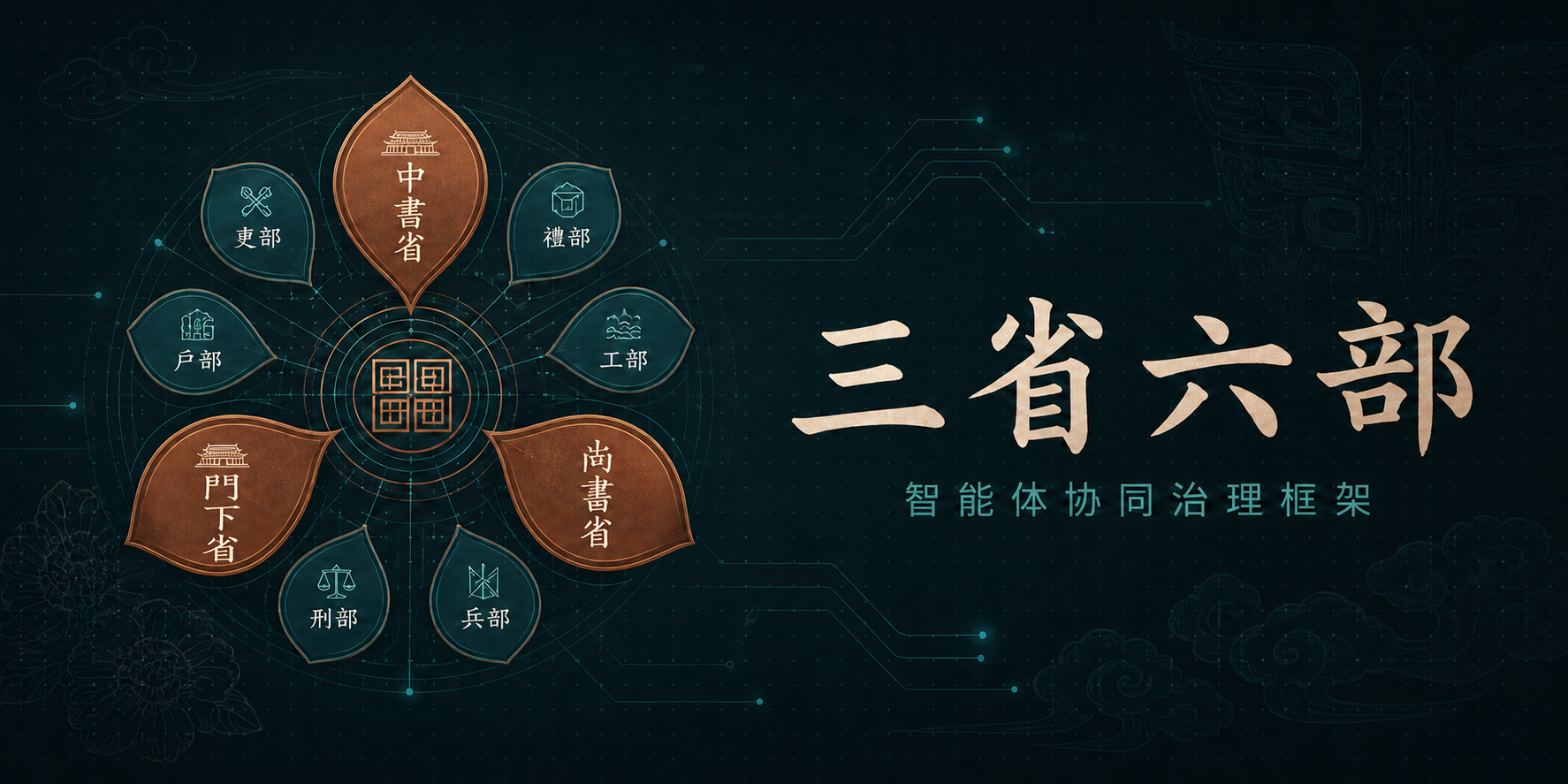
A scale-aware, runtime-enforced multi-agent governance mode for DeepSeek Harness.


Tang Governance is an independent npm bundle that adds a Three Departments and Six Ministries development mode to DeepSeek Harness. It does not patch Harness source code.
The plugin turns a single coding request into an auditable workflow with requirement clarification, independent review, explicit user approval, responsibility-based execution, acceptance testing, and a user-controlled closure gate. Runtime checks enforce the important boundaries instead of relying on prompts alone.
Inspired by the Tang dynasty's administrative structure; designed for modern AI-agent software delivery.
.tang/cases/<case-id>/.
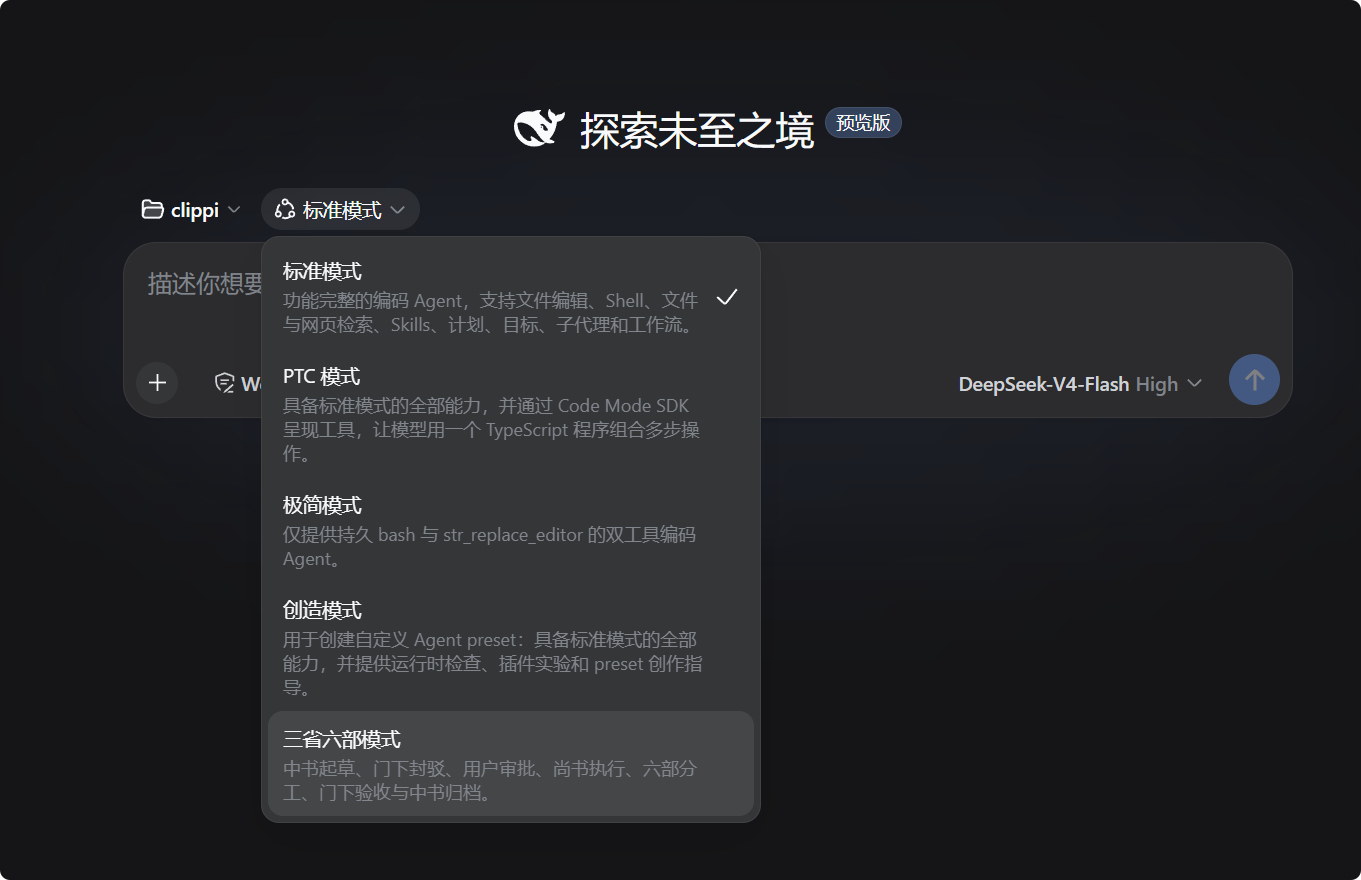
Native mode entry Select the governance mode directly from the Harness preset menu. |
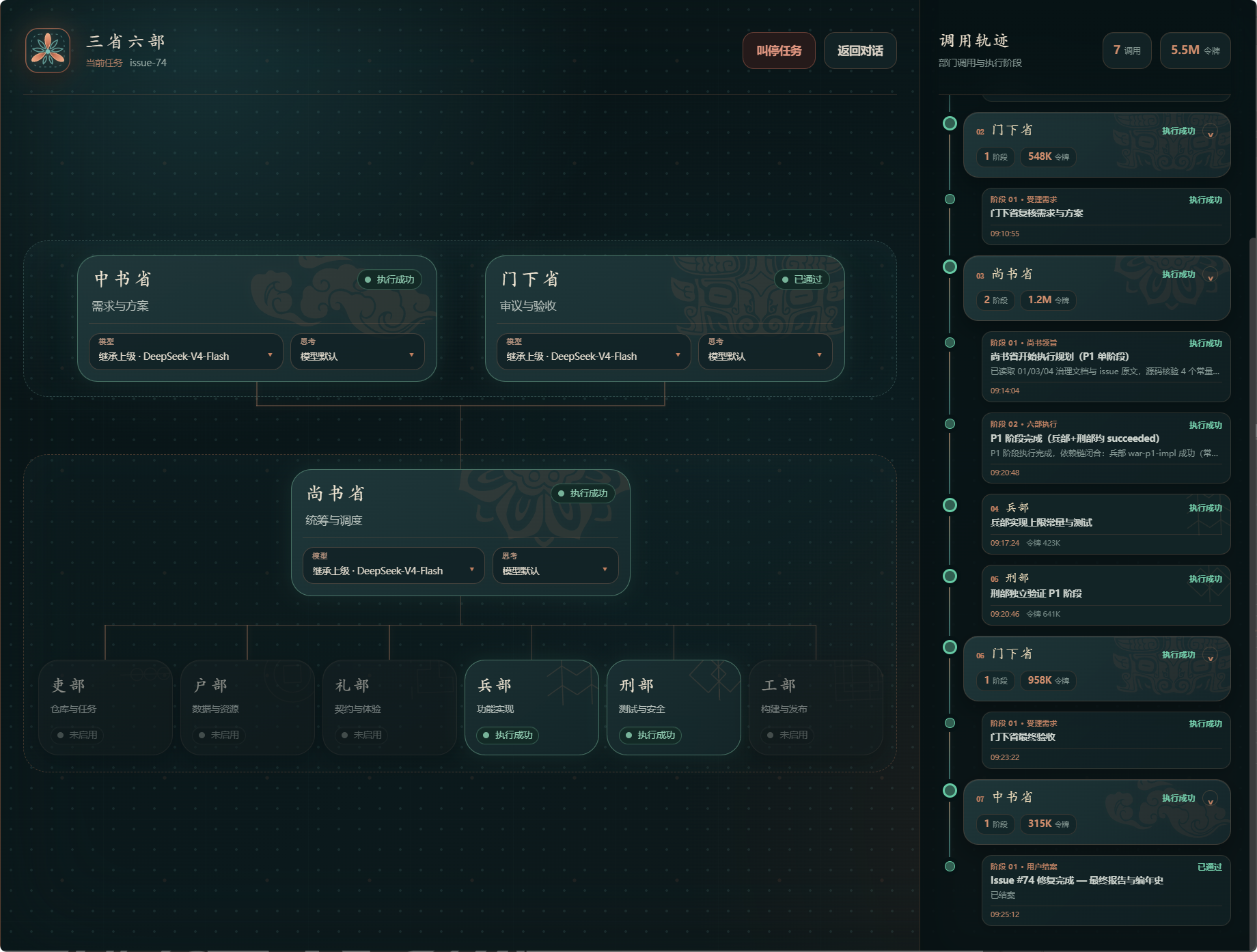
Organization map + live trace Department state, routing controls, real calls, phases, and token usage share one responsive view. |
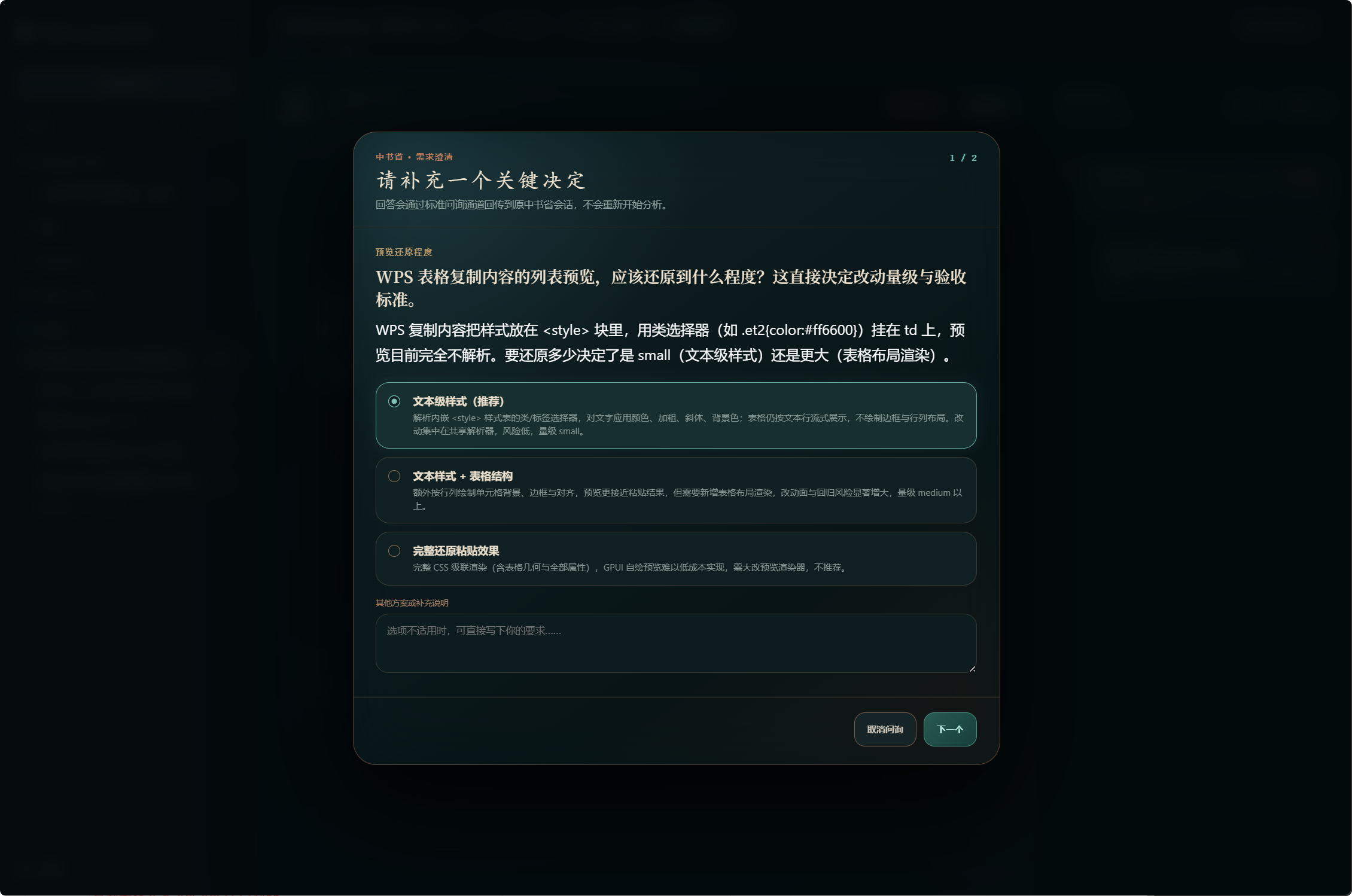
Clarify before planning Zhongshu asks task-specific questions before drafting when the original request is ambiguous. |
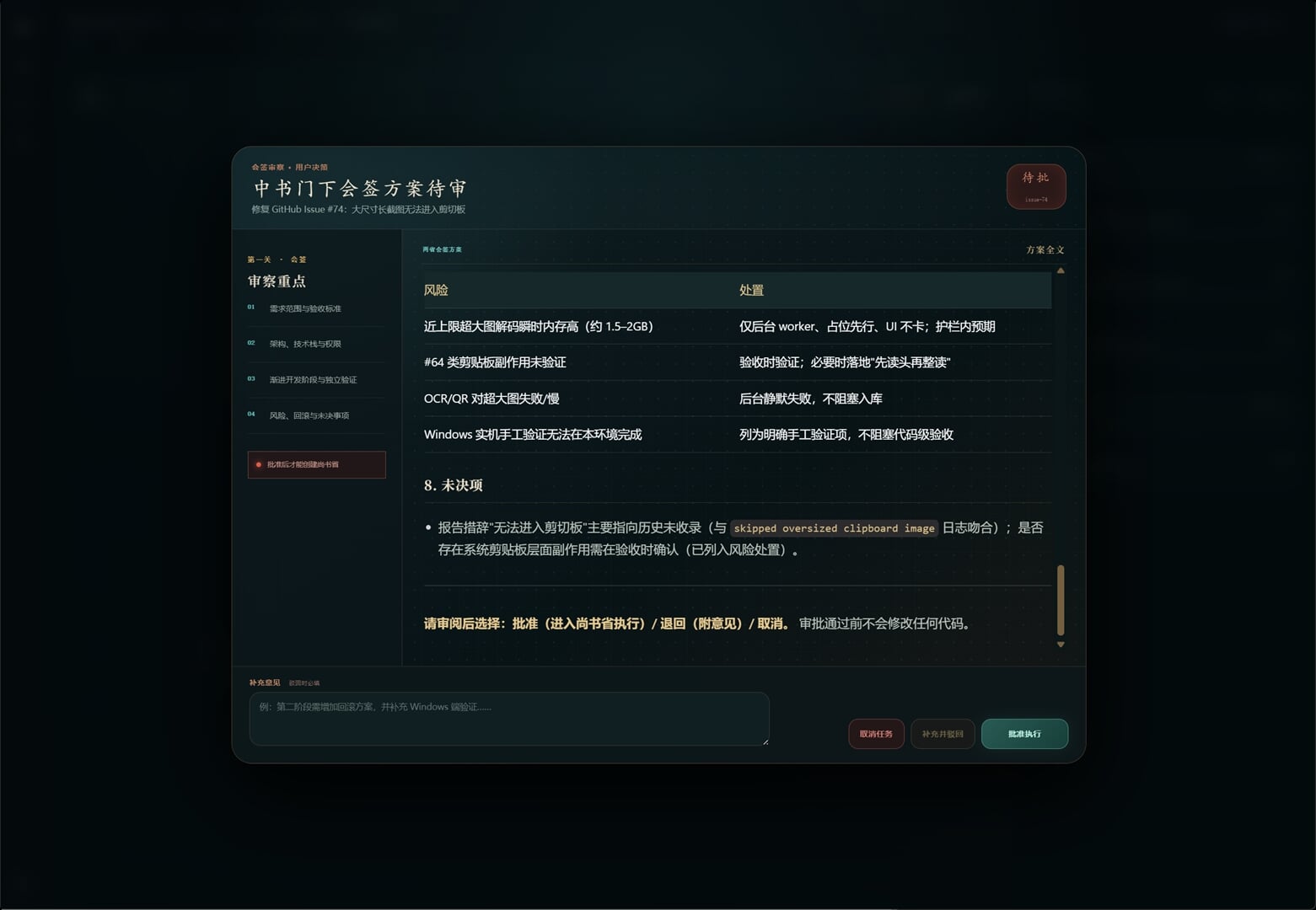
Reviewable approval gate The countersigned Markdown proposal is rendered in a dedicated approval workspace. |
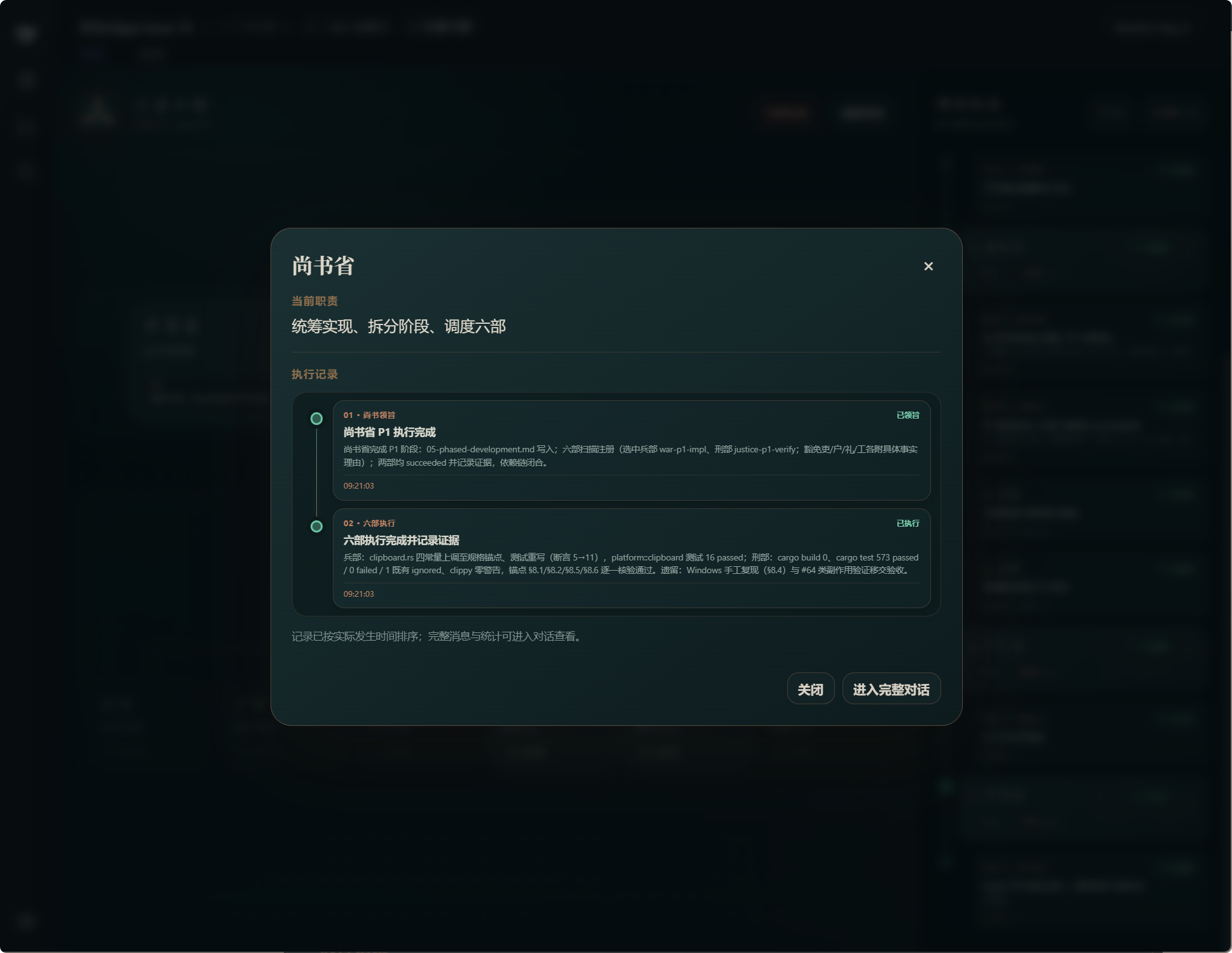
Auditable department records Department cards expose chronological stages, evidence, and final status without leaving the dashboard. |
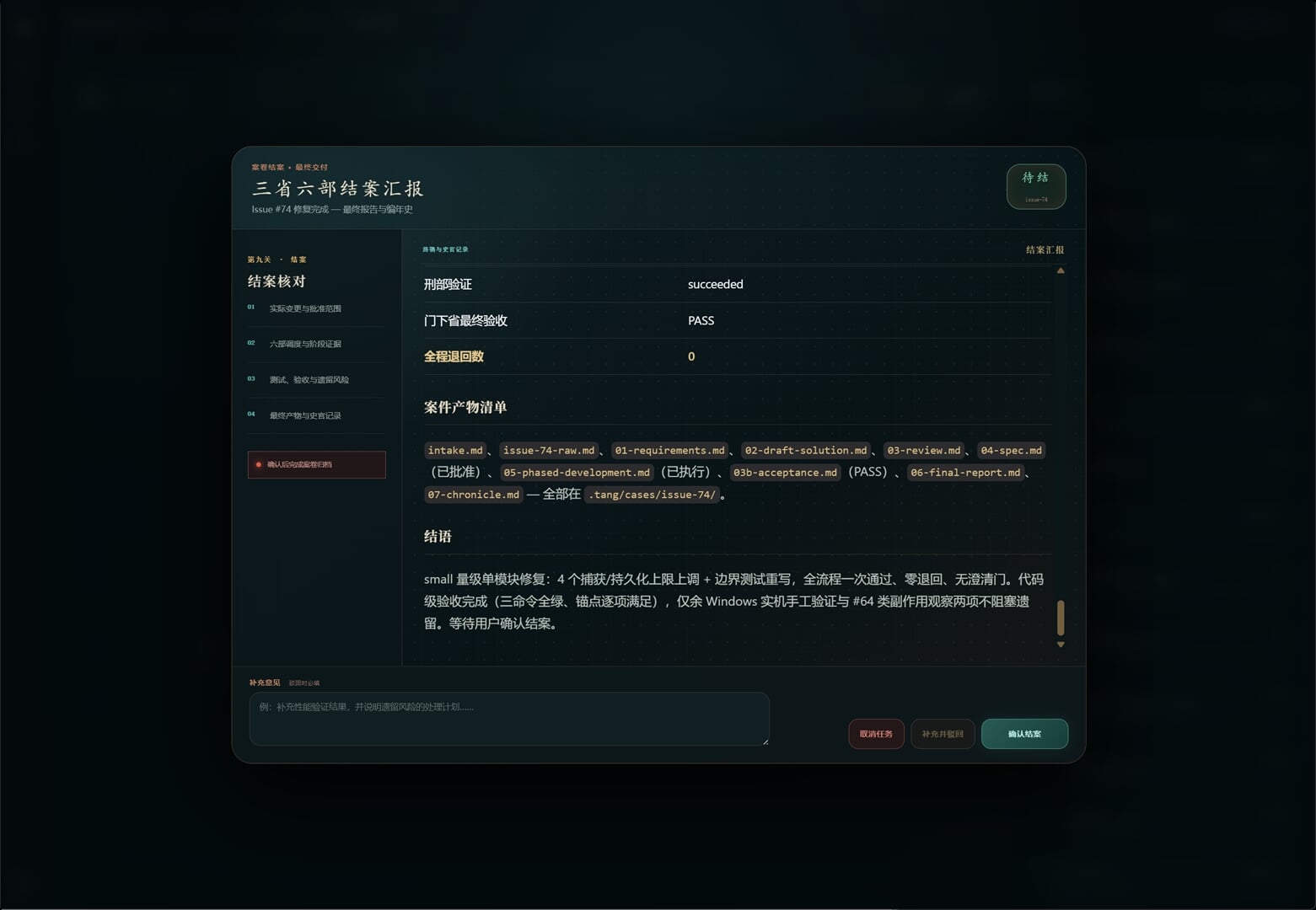
User-controlled closure Acceptance evidence, artifacts, risks, and the chronicle remain reviewable before the case is closed. |
Requirements:
^22.19.0 || >=240.1.1-rc.2 or a compatible 0.1.x releaseInstall from a local checkout:
git clone https://github.com/Ruszero01/dsh-tang-governance.git
cd dsh-tang-governance
pnpm install
pnpm run check
dsh plugin --profile web add link:.
dsh web --no-open
Open http://127.0.0.1:3080 and select the mode for a new task.
On first launch, the plugin copies the installed Harness Standard mode through the public Agent Preset API and appends its governance tools. Shell, file operations, skills, goals, plans, subagents, and workflow primitives therefore follow the installed Harness version rather than a frozen source copy.
User request
    ↓
Zhongshu — intake, scale, clarification, requirements, draft
    ↓
Menxia — independent review and executable specification
    ↕
Zhongshu + Menxia countersignature
    ↓
User approval gate
    ↓
Shangshu — phased plan and uniform Six-Ministry scan
    ↓
Selected Ministries — implementation, infrastructure, data, interfaces, or verification
    ↓
Menxia — final acceptance
    ↓
Zhongshu — final report, chronicle, and reusable knowledge distillation
    ↓
User closure gate| Stage | Owner | Result |
|---|---|---|
| Intake | Zhongshu | Understand the original request, classify its scale, and ask only blocking questions. |
| Requirements & draft | Zhongshu | Write decision-level requirements and a solution draft without prescribing function-level patches. |
| Independent review | Menxia | Validate scope, risks, acceptance criteria, and produce the final executable specification. |
| Countersignature | Zhongshu + Menxia | Agree on the same scale and specification; remand only concrete unresolved issues. |
| Approval | User | Approve, remand with feedback, or cancel before any execution department is created. |
| Execution planning | Shangshu | Write 05-phased-development.md, scan every ministry domain, record assignments and omissions, and order dependencies. |
| Ministry execution | Selected ministries | Produce bounded code, configuration, documentation, measurements, or independent evidence. |
| Acceptance | Menxia | Verify the approved specification and phased plan; remand failures to Shangshu. |
| Reporting | Zhongshu | Write the case-local report and chronicle, then upsert only reusable, source-cited findings into the workspace knowledge base. |
| Closure | User | Optionally request task-specific manual checks, then close, remand, or cancel. Remand feedback is automatically returned to Zhongshu; the coordinator only relays its questions and schedules the required follow-up. |
Task scale is a soft planning signal, not a hard token ceiling. Small requests should stay compact, while difficult work may expand when evidence or implementation requires it. Only explicit user or deployment configuration sets maxTokens.
Shangshu applies the same matching procedure to all six departments. No ministry is preferred, mandatory, exempt, or used as a generic fallback.
| Ministry | Domain | Owns | Does not own |
|---|---|---|---|
| Personnel / 吏部 | repository-governance |
Repository reconnaissance, module ownership, task decomposition, dependencies, and handoff order | Product implementation or test approval |
| Revenue / 户部 | data-dependencies |
Data and state models, migrations, dependency resources, performance impact, and related implementation | Unrelated product features or final acceptance |
| Rites / 礼部 | interfaces-documentation |
API/UI contracts, compatibility, accessibility, documentation, user experience, and related implementation | Unrelated infrastructure or final acceptance |
| War / 兵部 | application-code |
Product behavior, core application code, refactoring, and code migration | Self-approval or default build/release work |
| Justice / 刑部 | quality-security |
Independent testing, reproduction, security and permission review, and regression verification | Implementing the feature currently under independent review |
| Works / 工部 | infrastructure-release |
Build systems, development tooling, infrastructure, integration, packaging, deployment, and release | Generic product implementation or replacing independent verification |
Shangshu is not a seventh implementation agent. It owns scheduling, dependency coordination, evidence collection, and phase progression. Every ministry is either assigned concrete work or receives a specific omission reason. For code-changing phases, every implementation assignment must be covered by an independent Justice verification dependency.
The plugin enforces these rules in code:
user-approval: passed milestone are both required before Shangshu can be created.tang_submit_final_report requires a successful menxia-acceptance: passed milestone.experimental/agent-team packages.The organization view can set provider, model, and reasoning effort for Zhongshu, Menxia, and Shangshu. Settings are stored in the Harness Settings namespace tang-governance and applied through the public request-routing waterfall.
The Six Ministries never choose independent models. They inherit Shangshu's current provider, model, and explicit maxTokens; Shangshu selects task-appropriate reasoning effort for each registered assignment. Unsupported reasoning levels fall back to the model's declared default instead of failing the dispatch.
Optional deployment defaults can be added to .agent-presets/tang/agent.cordis.yml under Harness Home:
- id: tang-governance-tool
  name: 'dsh-tang-governance/tool'
  config:
    autoDispatch: true
    subagentProvider: spawn
    offices:
      zhongshu:
        provider: deepseek-official
        model: deepseek-v4
        reasoningEffort: high
        maxTokens: 16000
      menxia:
        provider: deepseek-official
        model: deepseek-v4
        maxTokens: 16000
      shangshu:
        provider: deepseek-official
        model: deepseek-v4
autoDispatch defaults to true. When disabled, the first request is no longer forcibly dispatched before the coordinator's first model call.
Each case uses the following durable layout:
.tang/
  config.json
  workspace-knowledge.md
  cases/<case-id>/
    01-requirements.md
    02-draft-solution.md
    03-review.md
    04-spec.md
    05-phased-development.md
    06-final-report.md
    07-chronicle.md
The phased plan records objectives, changed surfaces, boundaries, dependencies, ministry deliverables, verification, risks, checkpoints, and rollback. Function bodies and exact patches remain implementation decisions for the selected ministry.
workspace-knowledge.md is the sole cross-case knowledge source. Its compact index is injected at intake; agents expand selected entries and their cited case artifacts only when needed. Stable semantic keys merge corrections and new evidence instead of creating duplicate notes. Case timelines remain in 07-chronicle.md; the shared document keeps only reusable decisions, constraints, patterns, pitfalls, and verification lessons with source case IDs.
Contributions are welcome — code, docs, tests, and reports. Please read CONTRIBUTING.md first. Security vulnerabilities should be reported privately per SECURITY.md.
三省六部治理插件是面向 DeepSeek Harness 的独立 npm Bundle,不修改 Harness 源码。
它把一条开发需求组织成可审计的智能体协作流程:需求澄清、独立审议、用户审批、按职责执行、最终验收、结案汇报与用户确认。关键边界由运行时校验,不只依赖提示词约束。
以唐代三省六部制度为灵感,为现代 AI Agent 软件交付提供清晰的职责分离与治理机制。
.tang/cases/<case-id>/ 下留下结构化文档。环境要求:
^22.19.0 || >=240.1.1-rc.2 或兼容的 0.1.x 版本从本地仓库安装:
git clone https://github.com/Ruszero01/dsh-tang-governance.git
cd dsh-tang-governance
pnpm install
pnpm run check
dsh plugin --profile web add link:.
dsh web --no-open
打开 http://127.0.0.1:3080 即可开始使用。
新建任务时选择 三省六部模式。
插件首次启动会通过公开的 Agent Preset API 复制当前 Harness 安装版本的“标准模式”,再附加治理工具。因此 Shell、文件操作、Skills、目标、计划、子 Agent 和工作流等基础能力会跟随 Harness 版本更新,不会锁死在插件开发时的源码副本。
用户需求
  ↓
中书省:受理、量级判断、澄清、需求与草案
  ↓
门下省:独立审议与可执行规格
  ↕
中书省 + 门下省会签
  ↓
用户审批门
  ↓
尚书省:阶段计划与六部统一扫描
  ↓
按需启用六部:实现、数据、接口、基础设施或独立验证
  ↓
门下省最终验收
  ↓
中书省最终报告、史官记录与经验沉淀
  ↓
用户结案门| 阶段 | 负责人 | 产出与约束 |
|---|---|---|
| 受理 | 中书省 | 理解原始需求、判断量级,只询问阻塞性问题。 |
| 需求与草案 | 中书省 | 编写决策层需求和方案,不预先规定函数级补丁。 |
| 独立审议 | 门下省 | 审查范围、风险和验收标准,形成最终可执行规格。 |
| 两省会签 | 中书省、门下省 | 对同一量级与规格达成一致,只针对实际未决问题封驳。 |
| 用户审批 | 用户 | 批准、附意见驳回或取消;批准前不创建执行部门。 |
| 执行规划 | 尚书省 | 编写 05-phased-development.md,扫描六部职责、记录派发与省略理由、排序依赖。 |
| 六部执行 | 按需选择的部门 | 交付有边界的代码、配置、文档、度量结果或独立证据。 |
| 最终验收 | 门下省 | 按批准规格和阶段计划验收,失败则退回尚书省。 |
| 奏报 | 中书省 | 根据真实执行和验收证据编写本案报告与史官记录,再将有复用价值且标明来源的知识合并到工作区知识案卷。 |
| 结案 | 用户 | 可先要求任务相关的手动检查,再确认、驳回或取消。驳回意见由运行时自动交回中书省,协调器只转交其澄清问题并调度必要的后续流程。 |
任务量级是用于精简规划的软性信号,不是固定 Token 上限。简单任务应保持紧凑,复杂任务可根据证据、实现和验证需要扩展。只有用户或部署配置显式设置的 maxTokens 才会成为请求上限。
尚书省使用同一匹配流程扫描六部。不存在默认优先、强制启用、豁免或兜底部门。
| 部门 | 职责域 | 负责 | 不负责 |
|---|---|---|---|
| 吏部 | repository-governance |
仓库勘察、模块归属、任务拆分、依赖和交接顺序 | 产品实现、测试放行 |
| 户部 | data-dependencies |
数据与状态模型、迁移、依赖资源、性能影响及相关实现 | 无关业务功能、最终验收 |
| 礼部 | interfaces-documentation |
API/UI 契约、兼容性、无障碍、文档、用户体验及相关实现 | 无关基础设施、最终验收 |
| 兵部 | application-code |
产品功能、核心代码、重构与代码迁移 | 自我验收、默认承担构建发布 |
| 刑部 | quality-security |
独立测试、缺陷复现、安全权限审计、回归验证 | 实现自己正在验收的功能 |
| 工部 | infrastructure-release |
构建系统、开发工具、基础设施、集成、打包、部署发布 | 兜底业务开发、替代刑部验证 |
尚书省不是第七个实现 Agent,只负责调度、依赖协调、证据收集和阶段推进。每一部都必须被派发实际任务或记录具体省略理由。任何修改代码的阶段,其实现任务都必须由独立的刑部验证任务覆盖。
插件通过代码强制执行以下规则:
user-approval: passed 里程碑。tang_submit_final_report 只有在 menxia-acceptance: passed 后才能调用。experimental/agent-team 包。组织架构图可分别设置中书省、门下省和尚书省的 provider、model 与 reasoning effort。设置保存在 Harness Settings 的 tang-governance 命名空间,并通过公开请求路由生效。
六部不设置独立模型,始终继承尚书省当前的 provider、model 和显式 maxTokens;尚书省只为具体任务选择合适的思考等级。不支持的 reasoning level 会回退到模型声明的默认值,不再导致派发失败。
可在 Harness Home 的 .agent-presets/tang/agent.cordis.yml 中设置部署默认值:
- id: tang-governance-tool
  name: 'dsh-tang-governance/tool'
  config:
    autoDispatch: true
    subagentProvider: spawn
    offices:
      zhongshu:
        provider: deepseek-official
        model: deepseek-v4
        reasoningEffort: high
        maxTokens: 16000
      menxia:
        provider: deepseek-official
        model: deepseek-v4
        maxTokens: 16000
      shangshu:
        provider: deepseek-official
        model: deepseek-v4
autoDispatch 默认为 true。关闭后,运行时不再在协调器第一次模型请求前强制派发原始需求。
每个任务使用以下持久化结构:
.tang/
  config.json
  workspace-knowledge.md
  cases/<case-id>/
    01-requirements.md
    02-draft-solution.md
    03-review.md
    04-spec.md
    05-phased-development.md
    06-final-report.md
    07-chronicle.md
阶段计划记录目标、变更面、边界、依赖、六部交付物、验证、风险、检查点与回滚。函数实现和具体补丁由被选中的执行部门自行决定。
workspace-knowledge.md 是同一工作区唯一的跨案知识源。新案受理时只注入精简索引,确有相关经验时再按知识 ID 展开详情,必要时继续读取条目引用的原案文件。稳定语义键用于合并修正和新增证据,避免重复记录;执行流水仍留在各案 07-chronicle.md,共享文档只保留带案卷来源的可复用决定、约束、模式、踩坑和验证经验。
欢迎任何形式的贡献——代码、文档、测试与问题反馈。请先阅读 CONTRIBUTING.md;安全漏洞请按 SECURITY.md 私下报告。
CLASSIFICATION EVIDENCE
系统优先读取 GitHub Topics,再与站内分类词典和词根规则比对。当前命中: 无有效分类标签。
deepseek-ai
DeepSeek Harness: Everything is a Plugin.

anywhere-labs
为 DeepSeek Harness (DSH) 插件生态打造的现代化桌面端解决方案。万物皆「插件」,桌面本身也是「插件」。

walkinglabs
Harness engineering beginner tutorial, from 0 to 1