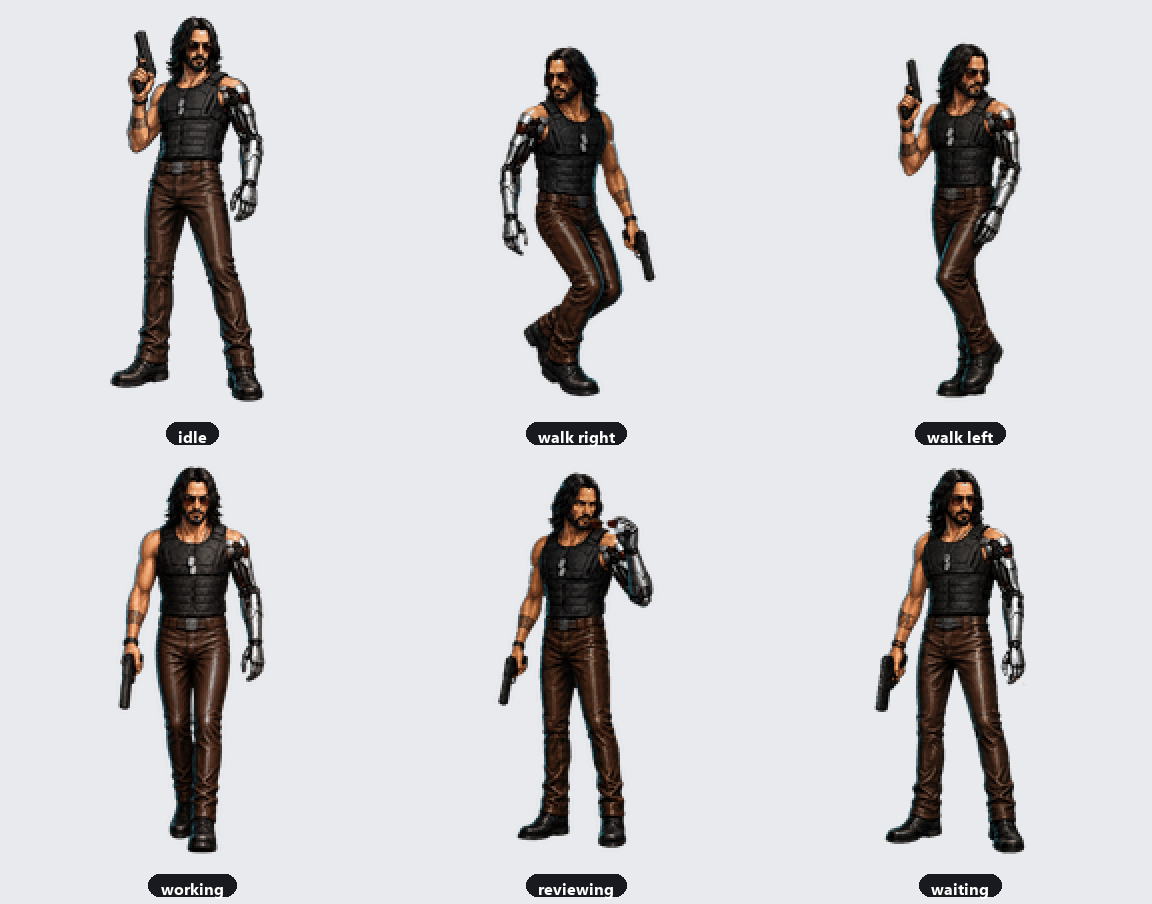
Silverhand — DSH Desktop Pet



A desktop pet for the DeepSeek Harness Web GUI. Silverhand (a cyberpunk
mercenary with a silver cybernetic arm) lives in the bottom-right corner and
reacts to what the agent is doing — idle breathing, active work, reviewing
output, waving hello, celebrating a finished turn, sulking on an error, and
waiting for your approval.
The character artwork is migrated as-is from the Codex pet format — no
redesign, just the original spritesheet.webp + pet.json.
Features
- Renders in the frame-wide
shell.overlay layer, fixed to the bottom-right.
- Click-through by default (only the pet itself is interactive).
- Reacts to real agent state, driven by DSH host events:
idle / running from agent/statusreview from tools/resultfailed from agent/errorwaving from agent/created / agent/session-startjumping when a turn finishes (running → idle)waiting while an approval request is open (approval/request)
- Drag the pet to move it — it walks left/right in the drag direction.
- Hover to see the current state; click (no movement) to make it jump.
Install
This is a standard DSH plugin package. Two ways to install:
From GitHub (recommended)
-
Add it to your profile's dependencies and dsh.profile.bundles
(in ~/.dsh/profiles/<profile>/package.json):
{
  "dependencies": {
    "silverhand-dsh-pet": "github:Qiao-NEYC/silverhand-dsh-pet"
  },
  "dsh": {
    "profile": {
      "bundles": [
        "...your existing bundles...",
        "silverhand-dsh-pet"
      ]
    }
  }
}
-
Run pnpm install in the profile directory (or let the DSH desktop app
install on launch).
-
Restart DSH. The pet appears in the bottom-right.
From npm
Once published: npm i silverhand-dsh-pet, then add "silverhand-dsh-pet" to
dsh.profile.bundles.
Layout
Silverhand/
├── README.md
├── LICENSE
├── .gitignore
├── package.json           # DSH plugin manifest (dsh.client, exports)
├── lib/
│   ├── index.js           # host half: reads the sprite, serves HTTP routes + state
│   └── client.js          # client half: renders the pet, polls state
├── assets/
│   ├── pet.json           # migrated Codex manifest
│   └── spritesheet.webp   # migrated sprite atlas (8×9, 192×208 cells)
├── scripts/
│   ├── make_demo_gif.py   # render docs/demo.gif (animated demo)
│   ├── analyze_frames.py  # measure per-row frame counts / diffs
│   └── contact_sheet.py   # render a labeled contact sheet
└── docs/
    ├── demo.gif           # animated demo (all animations)
    └── sprite-atlas.md    # atlas layout + state mapping
Anatomy
A DSH plugin is a Cordis plugin split into two halves:
- Host (
lib/index.js) runs in the DSH Node process. It reads the sprite
from its own assets/ (via import.meta.url, so it works no matter where
the package is installed) and registers two HTTP routes:
GET /silverhand-pet/spritesheet.webp — the sprite atlas.GET /silverhand-pet/state — { "state": "..." } derived from agent events.
- Client (
lib/client.js) runs in the browser. It registers into
shell.overlay, polls /silverhand-pet/state every 300 ms, and animates the
matching atlas row from /silverhand-pet/spritesheet.webp.
The two halves communicate over plain same-origin HTTP routes.
Configuration
All tunables are constants at the top of each half:
lib/index.js — ROUTE_SPRITE / ROUTE_STATE, and the per-state transient
durations in the event listeners.lib/client.js — ANIMS (row / frame count / cadence per animation),
STATE_ANIM (state → animation), PET_W / PET_H (display size), and the
CSS block (position, shadow, hover).
Troubleshooting blank or missing pet artwork
- Use package version
1.0.1 or newer. The client bundle now declares the
layout dependency explicitly, so shell.overlay is available before the pet
registers.
- The client probes
/silverhand-pet/spritesheet.webp and logs a route error in
the browser console if the Host half is not serving the atlas. A 404 or
500 means the host package is not active; reinstall the bundle and restart
DSH.
- Animation frames are reset whenever the state changes. This prevents a stale
frame index from selecting an empty atlas cell when switching back to the
six-frame
idle or waiting rows.
- If the pet container exists but is transparent, inspect the browser Network
panel for the sprite route and confirm its response is
image/webp with a
payload around 1 MB.
Asset provenance
The artwork was migrated from the local Codex pet directory
(~/.codex/pets/silverhand/). It is your asset — before publishing this
repo to GitHub, confirm you hold (or have) the right to redistribute the
sprite and the Silverhand likeness. The code in this repository is MIT
licensed; the sprite's licensing is yours to state.
Development helpers
# Regenerate docs/demo.gif
python scripts/make_demo_gif.py

# Report per-row opaque-cell counts and consecutive-frame deltas
python scripts/analyze_frames.py

# Render a labeled contact sheet (full + zoomed ambiguous rows)
python scripts/contact_sheet.py
analyze_frames.py / contact_sheet.py require Python 3 with Pillow and
numpy.