
Agent 与会话
插件

nuwa-skill
alchaincyf
你想蒸馏的下一个员工,何必是同事。蒸馏任何人的思维方式——心智模型、决策启发式、表达DNA。Distill how anyone thinks.
PROJECT TOPICS
INSTALL REFERENCE
dsh plugin --profile web add github:Noob-stupid/dsh-connection-card-host-preview
该命令指向仓库当前默认分支;尚无绑定当前 commit 的完整验证结果。
PROJECT README
中文 | English
Contribute: Card & adapter list → · Contribution guide → · 中文清单 Any ordinary DSH plugin can be listed as a card. One row per PR, with evidence.
Let your DSH sessions see each other, talk to each other, and share tools — without getting in each other's way.
Running several DSH sessions at once (one researching, one coding, one running experiments) is normal — but they're isolated: they can't see what the others are doing, and can't hand conclusions over.
This plugin makes a connection a first-class object in DSH: sessions are nodes, a connection is the container, cards are connection-scoped plugins.
|
In practice (screen recording) 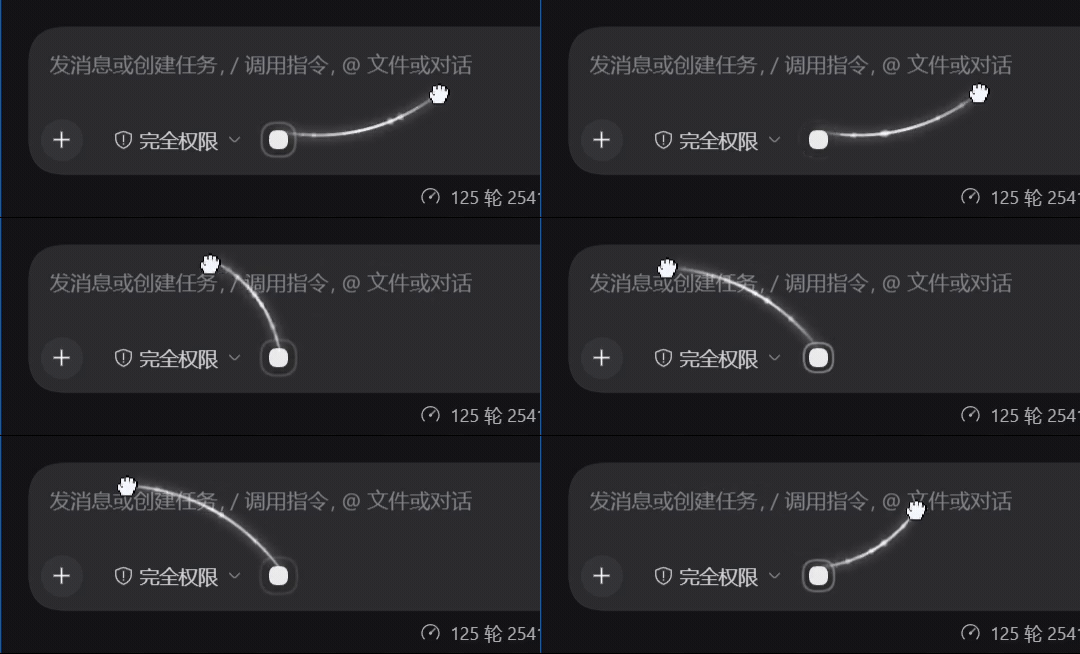
|
Structure (diagram) 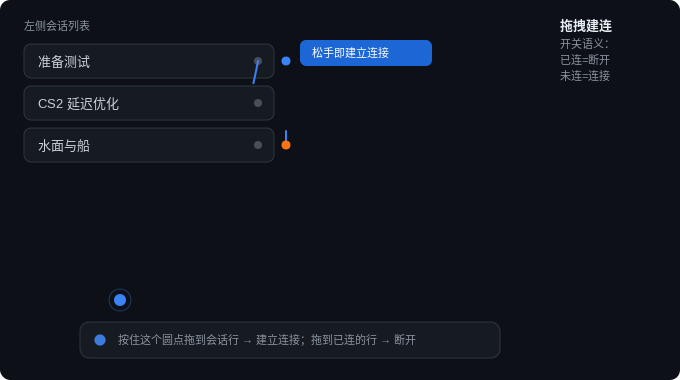
|
Left: the real thing (source video) · Right: the same action as a diagram, showing the toggle semantics
| See each other | Look up which files the other session is editing, how far its plan has got, what tools it last used — collected automatically, no effort required from the other side |
| Talk to each other | Send a message with one of three urgencies you choose: notify only (no interruption) / queue / interject |
| Share tools | Mount cards on a connection: a card can provide tools to the sessions, even with tens of MB of real dependencies |
| Shared premises | A "convention box" holds what you agreed on: interfaces, units, naming, who owns what |
| Stay out of the way | Awareness is pull-based — zero cost unless the other side asks. Unrelated connections never interrupt you |
… on a session row)
and drag it onto a row in the session list.|
Drag from the anchor (recording)
|
Drag from a session row → after connecting (recording) 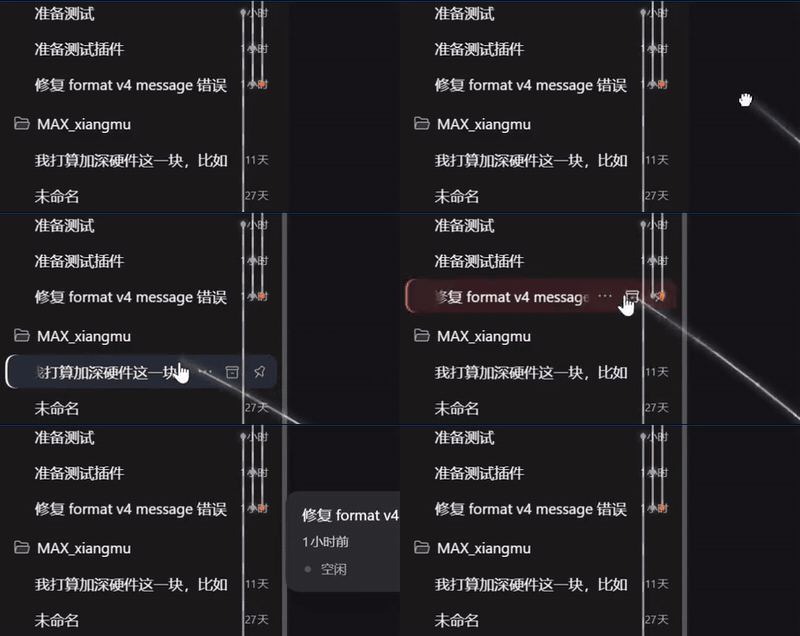
|
anchor source video · session-row source video
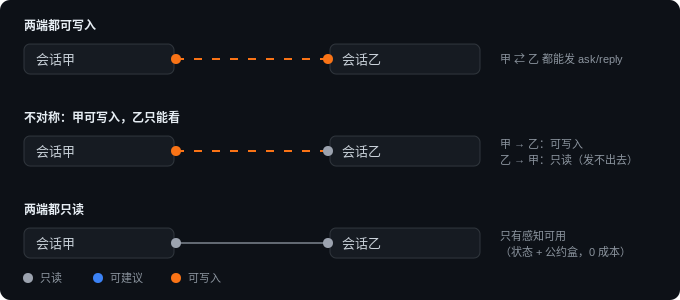
connection_peer_work itself.Once connected, a rail appears beside the session rows, with a coloured dot at each end — that's the permission for that direction:
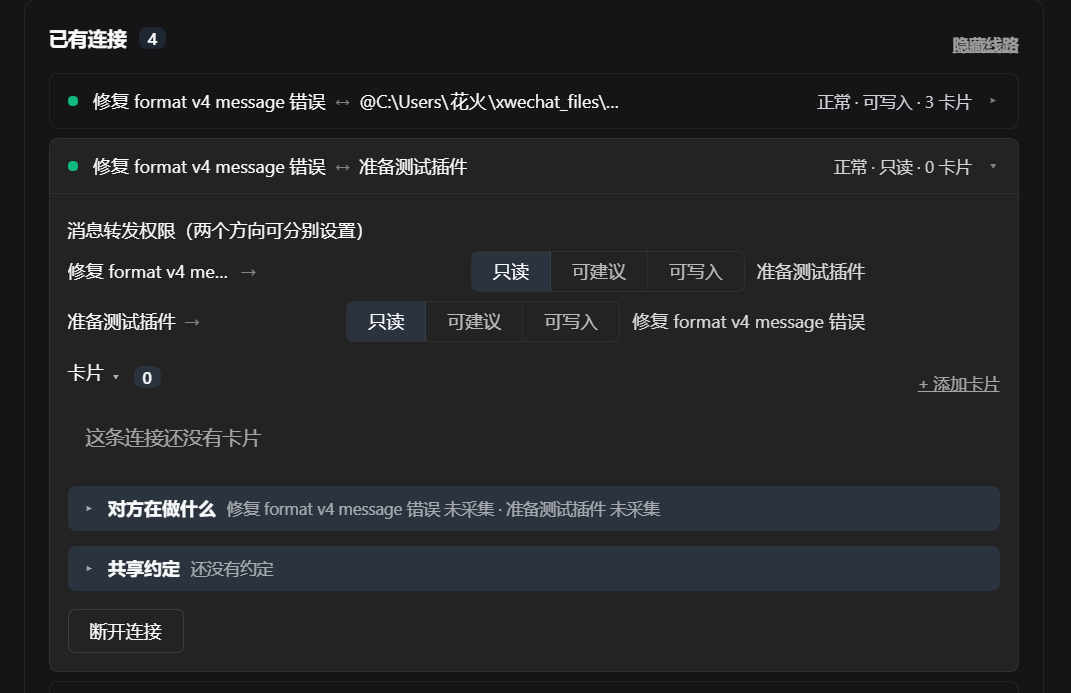
These are separate, because their costs differ enormously:
| Layer | Mechanism | Enters the other's context? | Forces the other to act? | Cost |
|---|---|---|---|---|
| A. Work state | pull (the other asks) | only when it asks | ❌ no | 0 |
| B. Convention box | pull (the other asks) | only when it asks | ❌ no | 0 |
| C. Messaging | push (into its inbox) | unconditionally | ✅ always | every message |
The key fact: in DSH, delivering a message forces the other session to run a turn — the agent loop has no "saw it but ignored it" state. So "talking" and "being aware" have to be built separately: to make the other side know, use A/B; only to make it act, use C.
Collected from runtime events — it asks nothing extra of the model:
【session-bd5ac1b1】
status: running a command (2s ago)
recently touched: water-boat/src/water.js
progress: turn 69 / step 39What you agreed on: interface signatures, units, coordinate systems, naming, who owns what.
Editable in the panel; sessions read and write it with connection_conventions / connection_declare.
Why pull, not push: pushing slowly fills the other's context, and most of it is never needed. Keeping it in a box that the other queries on demand costs zero.
| Urgency | Under the hood | What the other sees |
|---|---|---|
quiet |
inject |
placed in context without waking it — it sees the message next time it works, uninterrupted |
normal |
followup |
queued — it sees the message once it finishes what it's doing |
urgent |
steer |
interjected — inserted into the turn it's currently running, read immediately |
urgent on an idle peer degrades to queued automatically (the next turn starts
immediately, so the effect is the same), and never fails.
The rule (written into the tool description): interrupting has a cost — the other session has to drop its current line of thought. Most messages aren't urgent: default to
normal, and useurgentonly when it genuinely must change behaviour right now.
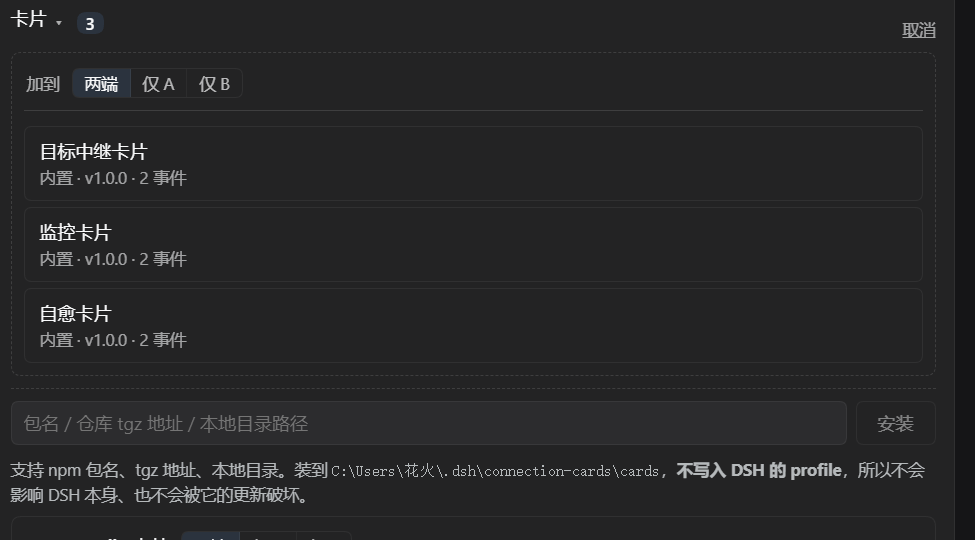
A card = a plugin mounted on a connection, with per-side visibility.
| DSH plugin | Card | |
|---|---|---|
| Mounted on | the whole DSH (profile) | one connection |
| Who can call it | every session | only sessions on that connection |
| Visibility | global | per side: both / A only / B only |
| Lifetime | DSH start/stop | mounted and unmounted with the connection |
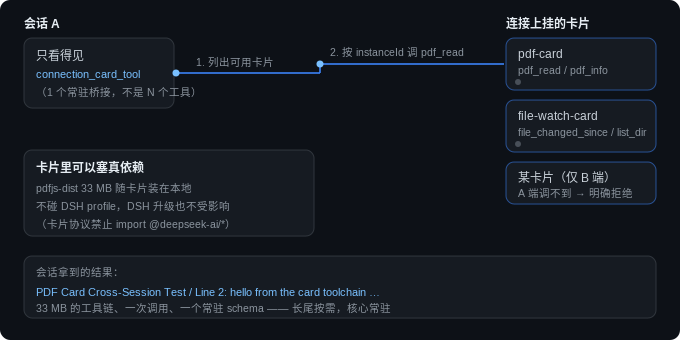
Tools registered with api.registerTool(name, fn) inside a card are reachable by sessions
on that connection through one resident bridge tool:
connection_card_tool                                  ← the only resident one (1 schema)
  ├─ no `tool` argument → list the cards and tools visible to *your* side of this connection
  └─ with `tool`        → call it
Why one bridge instead of one schema per tool: the latter would make every session pay a resident cost for every card tool, while cards are mounted and unmounted dynamically. The bridge costs one schema, and it's the natural place to enforce visibility.
Visibility actually blocks:
Side A can see the card      ✅
Side B cannot see it         ✅
Side B calls it anyway → 「这张卡片只对 A 端可见(你在 B 端)」A card can carry real dependencies: wrapping a parsing core plus
pdfjs-dist as a card, installed under $DSH_HOME/connection-cards/cards/,
without touching the DSH profile. A session called it through the bridge and got real
parse results back.
「检查更新」→「↑ 更新到 x.y.z」/「已是最新」/「无法检查」"Couldn't check" is never shown as "up to date" — that would be lying.
Any ordinary DSH plugin can be mounted as a card on a connection. Three static conditions decide it:
| Condition | Supported | Not supported |
|---|---|---|
| Scope | Registers into a connection-level location (conversation, input area), or is capability-only (no client UI) | Registers into an app-level location (sidebar, overall layout, settings page, theme, title bar, workspace) — those are meant to be installed into the app, not onto a connection |
| Host dependencies | Everything the entry actually loads can be resolved | A real runtime dependency is missing. Install reports it in two classes: missing host capability → the card needs a design change; missing third-party dependency → just add the dependency |
| Host capabilities | Uses only tools / effect / llm / prompt |
Needs other host services (credentials, web server, session control, commands, subprocess, …) — not provided; the mount is refused with a reason |
Only files the entry actually loads count: tests, build scripts, CLIs and type declarations are not runtime dependencies.
| Client shape | Result |
|---|---|
Uses only slot registration and effect hooks (slots / effect) |
Renders, and stays interactive |
| Needs more client services (localization, config forms, connection, routing, settings pages) | Mounts and registers slots, but cannot render — the panel shows the specific reason instead of a blank area |
| Client artifact size | Up to 32 MB (self-contained bundles with inlined assets are fine) |
| Component props | Components are called without props — ones that require slot props will error; the error is contained to that card |
Each card carries one badge: adapter / capability / local / global / undecided. It tells you before mounting whether a plugin suits a connection — advisory only, nothing is blocked.
The built-in cards are a starting point, not the ceiling. Any ordinary DSH plugin can be mounted as a card, and a card is just a package — so this list can grow from outside this repository.
Source of truth: awesome/README.md (send PRs there — one row per PR,
guide) · 中文清单
Shipped with the plugin — pick one in the card candidate list.
| Card | What it does | Needs (read / write) | Events |
|---|---|---|---|
Goal relay (goal-relay-card) |
Relays a goal and its status to the peer so both sides track the same "what are we doing" | goal_status / relay_goal |
goal_updated, goal_completed |
Monitor (monitor-card) |
Watches the peer's preset state and session activity; raises preset_error / session_idle |
preset_status, session_log / — |
preset_error, session_idle |
Self-heal (self-heal-card) |
On preset_error, asks the peer to repair its preset, then reports the outcome |
preset_status / repair_preset |
preset_error, preset_repaired |
Connection etiquette (connection-etiquette) |
Teaches the four urgency levels and forwards notes with the urgency you choose | — / send_message |
— |
| Plugin | What it brings to the connection | Status |
|---|---|---|
dsh-client-ui-voice |
A push-to-talk voice input control | ✅ mounts · UI captured and rendered · 1 slot |
gal-view |
A model/scene viewer panel | ⚠️ mounts · slots registered · rendering needs client hooks |
Listed so you do not spend an evening on it. The panel's refusal names the exact reason.
| Plugin | Why it cannot mount (today) |
|---|---|
dsh-usage |
Its host half imports 11 packages this plugin does not provide (credentials, webServer, session, …) — it needs a different kind of host, not a card |
| Sidebar / theme / layout replacements | Global UI, not connection-scoped: they belong to the app. The candidate list marks them global |
None listed yet — the first one could be yours.
A card is how one plugin teaches a connection: tools for that session, events between the two sides, and UI that sits next to the conversation instead of taking over the app.
Three layers, with hard boundaries — each talks only to the one below:
┌─────────────────────────────────────────────────────────────┐
│  Card layer (connection-scoped plugins)                     │
│  Depends only on CardAPI; NEVER imports @deepseek-ai/*      │
│  → DSH upgrades don't affect cards; our CardAPI changes do  │
│    (guarded by a version declaration)                       │
├─────────────────────────────────────────────────────────────┤
│  Connection layer (this plugin)                             │
│  connections / permissions / awareness / conventions /      │
│  card host / message delivery                               │
│  → on a DSH upgrade, this is the only layer to change       │
├─────────────────────────────────────────────────────────────┤
│  DSH adapter layer (DSHAdapter + allowlist + audit)         │
│  the single exit point for all DSH interaction; we do not   │
│  rewrite DSH's transport, permissions or plugin system      │
└─────────────────────────────────────────────────────────────┘One line, one dot at each end; the colour is the permission for that direction — the two directions are independent, so you can have "A may send, B may only watch":
Read-only does not affect awareness: work state and the convention box are both queried by the other side, independent of permission. Lowering a permission takes effect immediately; raising one requires confirmation from the side being granted it.
Tools registered by cards do not each take a schema — a session sees one resident bridge, discovers on demand, calls on demand, and visibility is enforced at the bridge:
| Item | Number | Notes |
|---|---|---|
| Awareness (layers A + B) | 0 context | pull-based; costs nothing unless the peer queries |
| Card tools | 1 resident schema | instead of one per card tool |
| Automatic mirroring | 0 (disabled) | mostly irrelevant content before it was turned off |
| Unrelated connections | 0 interruptions | connecting doesn't wake anyone; unrelated sessions carry on |
The one fixed cost: this plugin's five connection_* tools cost roughly 1,700 tokens
resident — and only in sessions that have connections: sessions with none have them
stripped automatically by system-prompt/assemble (a 0-connection session has 5
tools removed, logged as 按会话 scope 隐藏了 5 个感知工具).
This plugin is not published to npm (DSH's peer dependencies aren't on the public
registry, so npm install is guaranteed to fail — verified). Install from GitHub:
# Preview line (latest development build — the repo you're reading)
dsh plugin --profile web add github:Noob-stupid/dsh-connection-card-host-preview

# Stable line (the public facade, synced only at release time)
dsh plugin --profile web add github:Noob-stupid/dsh-connection-card-host

# Or a pinned tarball (grab the asset URL from the Releases page)
dsh plugin --profile web add https://github.com/…/releases/download/v1.0.0/noob-stupid-dsh-connection-card-host-1.0.0.tgz
The two
github:commands above are verified working (161 files land inlib, using the profile's own settings:autoInstallPeers: false). The bare namesdsh-connection-card-hostand@noob-stupid/dsh-connection-card-hostboth 404 on npm and won't work for anyone else — don't use them.
Compatibility: peerDependencies declares @deepseek-ai/dsh >=0.2.0-rc.1 <0.3.0 — DSH
gates on version at install time and refuses clearly, with a reason, rather than
installing and crashing later.
A / B / both).quiet / normal / urgent / preempt).Installing the plugin is enough: it registers a connection-card skill through DSH's
skill-provider channel, so any agent in that install finds instructions for the connection
tools in its session catalog — no copying files into ~/.dsh/skills/ and no extra step.
skills/connection-card.md.quiet / normal / urgent / preempt).~/.dsh/skills/connection-card.md.| Setting | Default | What it does |
|---|---|---|
| Adapter layer | off | Allows ordinary DSH plugins to be mounted as cards. Nothing is touched until you turn it on. |
| Automatic mirroring | off | Auto-forwarding session content to the peer. Kept off on purpose (it mostly sends noise). |
| View preferences | per connection | Number of lanes shown on the connection track. |
$DSH_HOME/connection-cards/ and are left untouched.Do I need to install anything for cards?
No. Cards install into the plugin's own directory; no pnpm runs in your profile and your DSH
profile is not modified.
A plugin will not mount. Why? The refusal names the class: host capability (the card needs something this plugin does not provide) or third-party dependency (the dependency is missing). The first requires a change on the card side; the second can be fixed by shipping the dependency with the card.
A mounted card shows no UI. Its client half needs client services beyond slots/effect. The panel shows the exact reason — it is not a blank screen.
Does mounting a card change my DSH install? No. It does not rewrite DSH, does not touch your profile, and can be undone at any time.
MIT — see LICENSE.
A card is just an npm package with a dshCard manifest:
{
  "name": "my-card",
  "version": "1.0.0",
  "main": "index.js",
  "dshCard": { "id": "my-card", "name": "My card", "entry": "index.js", "api": 1 }
}
// index.js — NEVER import anything from @deepseek-ai/*; go through `api`
export function apply(api) {
api.log(`mounted (scope=${api.scope})`)
// provide a tool to sessions on the connection
api.registerTool('greet', async (args) => {
return `Hello, ${args?.name ?? 'world'}`
})
}
// panel HTML (optional)
export function renderPanel(api) {
return `<div>visible to: ${api.scope}</div>`
}api member |
Meaning |
|---|---|
registerTool(name, fn) |
register a tool → sessions call it via connection_card_tool |
send(kind, text) / read() |
send and receive connection messages as one side |
on(event, handler) / emit(event, data) |
connection-scoped events |
scope |
which side this instance serves (both / a / b) |
log(...) |
write to the host log |
dshCard.api declares the CardAPI version the card needs (defaults to 1):
This is our own compatibility guard: cards don't depend on DSH internals, so a DSH upgrade doesn't affect them; but changing our
CardAPIdoes — and DSH's version gate can't see that layer.
See docs/card-protocol.md for details.
| Document | Contents |
|---|---|
docs/capabilities.md |
Capability report: per-item measurements, total context cost, known limits |
docs/card-protocol.md |
Card protocol: manifest, CardAPI, install validation, distribution |
docs/compatibility.md |
Compatibility: how DSH's version gate works, the two lines of defence |
docs/adapter-api.md |
DSH adapter: the stable interface and its allowlist |
MIT · not affiliated with the DSH project
Implemented
connection_* schemas (~1,700 tokens saved), via the official system-prompt/assemble waterfall; the whole chain is fail-open — behaviour introduced in v1.0.1 (v1.0.0 registers them globally)Known gaps
| Item | Notes |
|---|---|
mountUI / requestRemote |
Interface in place, implementation pending (mountUI currently only sets a dataset attribute) |
| Card tool schemas | Deliberately take no separate schema; callers must list before calling |
| Rail layering trade-off | The rail is portaled onto document.body — decoupled from slot containers, which is the only way to keep someone else's skin/overlay from beating it via stacking context (z-index is only comparable within one stacking context). The cost: it always sits at body level, so a future "must be on top" full-screen modal would have the rail drawn over it. pointer-events: none keeps interaction unaffected, so the risk is low; if it ever needs tightening, the suggested fix is a minimal predicate — while [role="dialog"][aria-modal="true"] is present, drop the rail below that modal and restore when it closes (not an unconditional hide) |
CLASSIFICATION EVIDENCE
系统优先读取 GitHub Topics,再与站内分类词典和词根规则比对。当前命中: session、sessions。
alchaincyf
你想蒸馏的下一个员工,何必是同事。蒸馏任何人的思维方式——心智模型、决策启发式、表达DNA。Distill how anyone thinks.

freestylefly
Prompt as Code | GPT Image 2 / 2.5 提示词与案例库,530+ 个案例、20+ 套工业级模板与可复用 Skills,新增 2.5 同提示词对比专区,附完整提示词与生成记录,持续更新。

titanwings
Distilly — Distill how they think into reusable Skills for any Agent or Bot. Formerly Colleague Skill(原同事 Skill).