

模型与 MCP
待识别

rea
morluto
Reverse engineer anything with agents, from app behavior down to native binaries.
PROJECT TOPICS
INSTALL REFERENCE
dsh plugin --profile web add github:NelsonLongxiang/dsh-open-a2a-net
该命令指向仓库当前默认分支;尚无绑定当前 commit 的完整验证结果。
PROJECT README
English | 中文
Open A2A network plugin for DeepSeek Harness (DSH): turns a DSH deployment into one node of a decentralized agent network — no central server, no registry.
Each node publishes a signed, expiring agent card at /.well-known/agent-card.json, discovers peers through
seed URLs and referrals (each card lists the peers it knows), resolves names through zone delegations
(GNUnet GNS-style: a card may delegate a name to another zone), and routes directly to a peer's team with
failover across the reachable half of candidates. Every main session can additionally be exposed as a session
node other hosts can discover and join from the web sidebar.
| The sidebar network panel | Context message display |
|---|---|
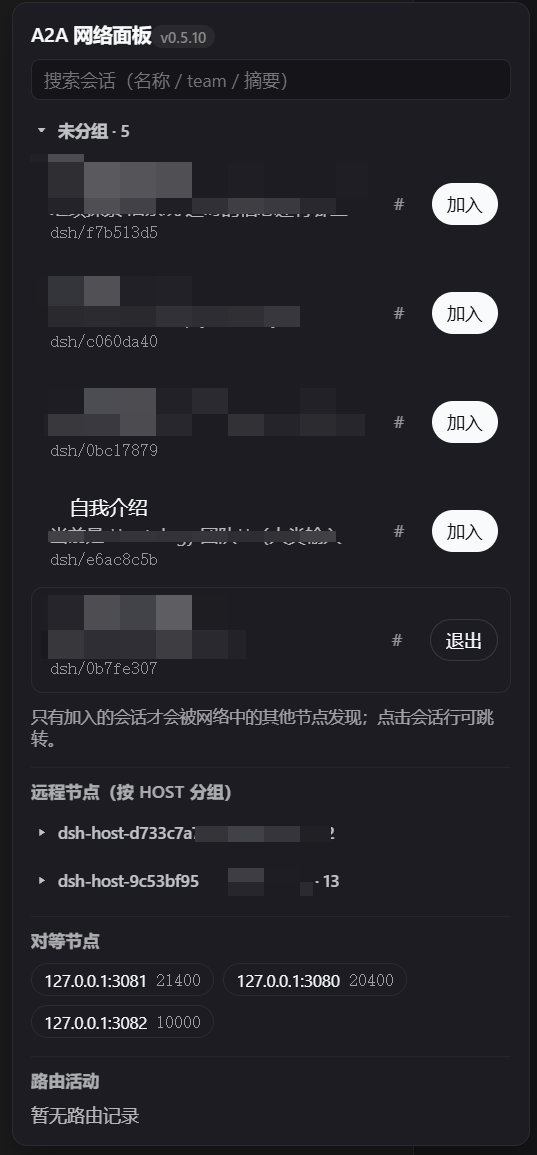 |
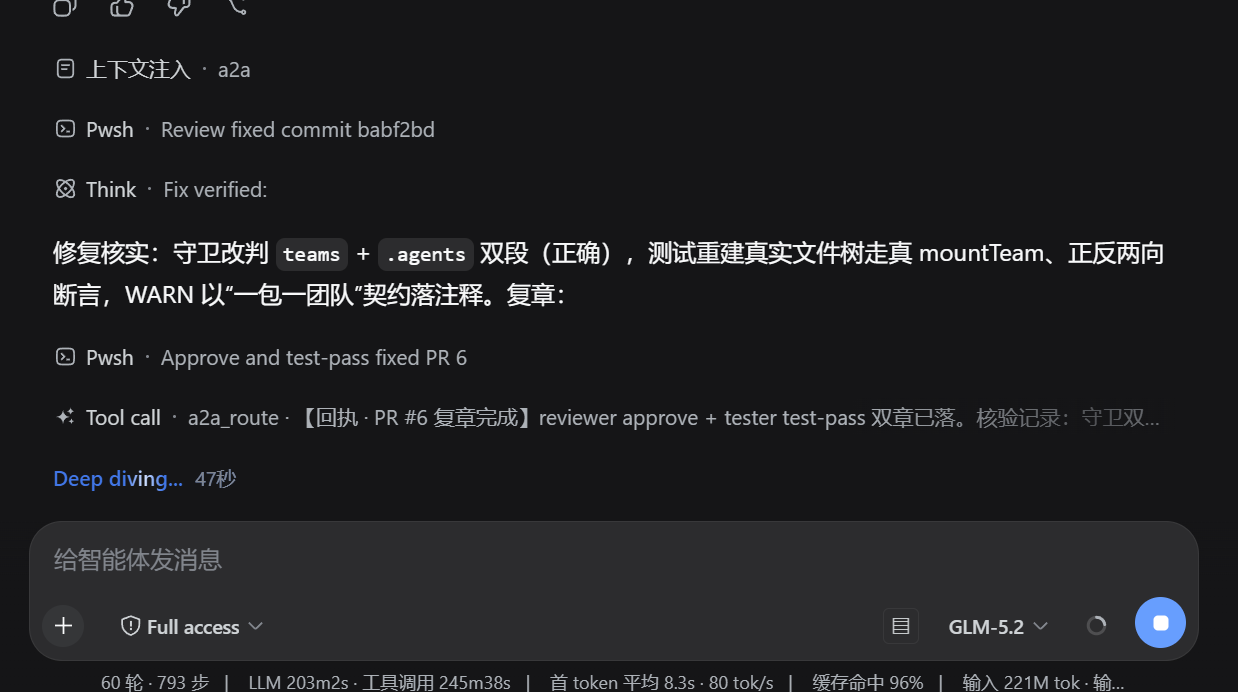 |
dsh plugin --profile web add @nelsonlongxiang/dsh-open-a2a-netRestart dsh web, then open the sidebar network panel (footer action).
(As a package name, a local path, or a Git URL; the argument is handed to pnpm unchanged. The package's prepare
script is pnpm build, but only a Git URL install triggers it, and pnpm 11 blocks a Git package's build script:
dsh plugin reports an error that prints the exact key — add it under allowBuilds in the profile's
pnpm-workspace.yaml and run it again. A package installed from the registry already ships its build output and
does not build; a local-path install does not build either, so run pnpm build in that directory first. Building
needs pnpm >=11.24 and <12 (engines in package.json). A standalone Git install outside a DSH profile can now
build (the @deepseek-ai/* peers come from npm; verified on 0.7.0), so it no longer has to be limited to a registry
or profile install.) The plugin composes beside the stock webserver row: it registers the state and control routes
(/__dsh_a2a/*, while sessionNodes is on — the default) on the shared listener and its model tools on the shared
tool runtime; the card route /.well-known/agent-card.json is registered only when announce: true (off by default).
a2a_teams lists the teams this node can see (its own rows
plus peer teams inside the joined-team scope); a2a_route
sends one message to a team, reuses context_id to continue a remote conversation, and fails over across
candidates when a peer is unreachable. a2a_tasks reconciles the receipt contract across three tiers: every route that leaves a
task owed a reply (async delivery, or a synchronous wait released at its 180s deadline; a synchronous wait the caller aborts is not booked,
and a delivery with no routable callback address is only listed as a visible row with no receipt debt) stays in the owed book as pending until its
[A2A receipt] task <task_id> message correlates — overdue rows auto-dead-letter past the stale TTL (a revived target can still
settle with a late receipt), every settlement lands in the bounded archive instead of being silently evicted, and each row keeps
its follow-up context_id, persisted across
restarts. a2a_probe measures the tracked fleet's reachability and round-trip latency (one verified-card
fetch per peer, optionally narrowed to a single url) for pre-dispatch health checks, naming each miss's
stage — unreachable (transport/HTTP) vs. rejected (distrusted card).docs/design/panel-activity-feed.md): in-flight routes, owed receipts (only settleable debt is listed; the stale conversational tail is
only counted) and the routing activity ring side by side, so a cross-turn wait is visible without asking the model; an activity row for a
same-host session jumps to that session inside the GUI; an unread badge for inbound activity, the package version badge in the title, and an entry
to the workbench. Joining/leaving the network, canvas teams and member arrangement are no longer done in the sidebar — they moved to the
workbench planning board below. Session teams are <team>/<id8>; web sessions use their id's first 8 chars (after dropping the session-
prefix), imported sessions (import-<uuid>) keep the import- prefix plus the uuid's first 8 hex chars so imported ids cannot collapse into a
handful of teams.joined.json
(wiping it on a transient archived reading once left cold sessions that could never wake again); the prune is recorded as archive-prune in the
state face's registry.teamAudit.TASK_STATE_DELIVERED) and the receipt contract (the target answers on its own cadence); a remote
peer reached over the direct route is bound by a 15s transport budget, then the host tries to recover the peer's settled outcome through the task
query (upgrading to the real result if it finished) and otherwise returns -32005 "delivered, not settled" — reconcile by task id, do not
re-dispatch blindly. async: true skips the wait entirely. The network panel dims an in-flight row past 120s as a stale wait instead of
implying live progress./__dsh_a2a_nexus/, a full-page DOM workbench (it replaced the Three.js 3D view in 0.6.0; 0.6.2 merged the planning board
into it: the board is the main stage and Directory / Hosts / Ledger / Activity / Plan ride a collapsible sidebar, plus a Team page when the host
runs a superagent team; responsive — a wider sidebar from 1440px, a drawer sidebar and bottom-sheet detail up to 1023px, a wrapping header up to
680px; the panels fall back to the main area when the canvas face goes down). Directory: local sessions (live / cold), canvas teams, remote nodes,
local logs. Hosts: tracked peers' health and link badges. Ledger: pending / dead letters with in-place clearing. Activity ring. Plan: a derived
action list plus nudge and dispatch drafting (both produce copyable text). The spatial planning board: build canvas teams, arrange members,
join/leave the network, with the layout persisted; ?mode=plan is only an old-link compatibility form — with the canvas face up the board is
already the default.announce: true (default false; needs a web server in the composition) publishes this node's signed card so peers find it
without any directory. Referrals (peers) go only to a signature-verified caller that is a configured seed or already linked; joined session
teams (sessionTeams), rosters and the canvas org go only to a linked caller; every other caller gets the minimal discovery card (name, team,
capabilities, records, signature). Unjoined session nodes are not published.Twelve tools. With teamScopeInfo on (the default), a2a_teams, a2a_status and a2a_probe answer from
this host's joined-team scope: [this host] rows plus peers serving a team this host's nodes declared.
a2a_tasks (this host's own dispatch ledger) stays unscoped.
| Tool | Answers | Notes |
|---|---|---|
a2a_whoami |
Who am I on this network? | The calling session's node id, joined/live state, routable handle, roster + canvas memberships, the owner's teamJoinAllowlist, the teamScopeRouting switch, and recent refused join/leave attempts. |
a2a_teams |
Which teams can I route to? | [this host] rows plus in-scope peer teams, with activity excerpts. |
a2a_route |
Send a message to a team. | context_id continues a conversation; async: true delivers without waiting; fails over across candidates. |
a2a_task_read |
What did that task actually say? | Returns the full original text of an A2A task delivered to THIS session, by task id — for a task a2a_tasks shows (brief only, delivered-unconsumed) whose message reached the session while it was busy and never entered its conversation. Only the receiving session reads it (anyone else is answered as for a missing task); texts are kept 72 hours (64 KiB of UTF-8 each, clipped beyond). Reading consumes the delivery; the result is peer content. A delivery whose text was lost outright (a steer the host never tracked) is also redelivered when the session is idle, as a queued delivery of the original task, so its claim, withdrawal or unknown outcome is reconciled like any queued task and never resent blindly. |
a2a_tasks |
Which async tasks still owe a receipt? | Three tiers: owed rows keep the follow-up context_id; past-TTL rows auto-dead-letter (still settleable); outcomes land in the bounded archive; persisted across restarts. |
a2a_probe |
Is the fleet healthy? | One verified-card fetch per in-scope peer (or one given url); N reachable, M down; misses classified unreachable vs rejected. |
a2a_team_join |
Declare one joined node a member of a team. | Allowlist-gated: only an exact name in teamJoinAllowlist authorizes a join (empty list denies every join). A wildcard/prefix entry is shown by a2a_whoami but authorizes nothing ([PATTERN_NO_MINT]); canvas teams are assigned in the workbench, never here ([CANVAS_TEAM]). Attempts land in the state face's registry.teamAudit. A model tool may only declare membership for the calling session's own node (else [NOT_SELF]), and that node must already be joined (else [NOT_JOINED]). |
a2a_team_leave |
Retract a team membership. | Not subject to the allowlist — leaving only shrinks exposure; it still can only retract a membership the calling session's own node declared ([NOT_SELF], [NOT_JOINED]; nothing to retract if it never declared one). |
a2a_exposure |
How visible is this session? | Sets the session's own tier: linked (the default floor) or fleet (a voluntary opt-up), changeable at any time; requires a joined session. Today the tier is only persisted (a2a/exposure.json) and shown in the exposure field of the state face's session rows; it does not yet change what the card or the directory exposes — "a group's visibility follows its strictest member" is a written rule with neither a group-level API nor an enforcement point in v1 (owner ruling 2026-11-08, #449: documented as is). |
a2a_report |
Tell this host's supervision something while off the network. | The one write-ingress to this host that works while unjoined (the read-only a2a_whoami is exempt from the join gate too): one-way, lands in the state face's reports ring (newest 64 kept), grants no presence or routing. One report per 30s per session, ≤4000 chars; once the same session has reported the same text 3 times within 10 min, the 4th is refused as a loop. |
a2a_status |
What is this node doing right now? | In-scope tracked peers with quality scores, in-flight routes, recent routing activity, and the idempotency window aggregate (occupancy + claim/replay/conflict counters). |
a2a_file_send |
Hand files to a team without putting them in a message. | Stages each file (≤16 per call, ≤64 MiB each) on this host, granted to that team for 24 hours, and routes ONE message of [A2A file] reference lines; the bytes never ride the message (#91). Needs this host to have published a card URL (announce), otherwise it refuses to send. |
a2a_file_grants |
See your file grants and the store's space. | Lists the file-channel grants this session made that are still live — sha256, size, name, target, granted/expiry times, the task it went out in, and whether the target fetched it — plus the store's occupancy and ceilings (256 files, 1 GiB). |
a2a_file_revoke |
Take back a file grant. | Revokes one grant this session made, by sha256 and to; when no grant names the file any more its bytes are deleted, so the space is free at once. Another sender's grant is answered as missing. CLI: a2a-net file grants / a2a-net file revoke <sha256> <to>. |
a2a_file_fetch |
Pull a file someone referenced. | Pulls one [A2A file] reference from the host that staged it, carrying this session as caller_session and this host node's OriginClaim envelope (a reference naming this host reads the local store directly); checks size and sha256 before saving it under <cwd>/a2a-inbox/. A grant names one session (or a whole host, or a canvas team's members); the fetch always marks the session as having read peer content. |
The package also ships a command, a2a-net (bin → cli/a2a.mjs, 0.6.27+), for scripts, terminals
and other agent harnesses that are not a DSH session. It creates its own Ed25519 identity
(<name>/<16 hex>), deposits a signed card on one home host for up to 4h (publish; an expired deposit
stays listed as an offline row until re-published), and receives into a mailbox on that host (64
entries kept) instead of being woken:
a2a-net init review-seat --home http://127.0.0.1:3080   # identity + home host
A2A_KEY=... a2a-net publish                              # deposit (key-gated host)
a2a-net route dsh/1a2b3c4d "status?"                     # async by default; --sync waits for the reply
a2a-net inbox --new                                      # unread mail; --wait blocks, --hook feeds a Claude Code hook
From 0.6.38, forwardDirect defaults to true: after a local miss the home can forward an authenticated online CLI one hop to a linked peer target. Both operators must link: A links the receiving B member; B links the CLI handle and explicitly pins A as its home. For canvas targets A links only the owner host (#282 S3, same team authorizes; the owner host must run 0.6.37 or later): receipts are admitted and settle only from receivers frozen from the owner's signed card, on that owner's key. With scope and settlement enforcement on, the member-host auto-receipt settles A’s forwarded row and lands in the CLI inbox; --sync returns B’s reply, but on the forwarded path a synchronous wait has only a ~15s transport window and times out with -32005 (delivered, not settled): the target still auto-receipts when it finishes, so reconcile by task id / inbox and do not resend blindly; for long work use the default async route, then inbox --wait --renew. Commands, flags, environment
variables and exit codes: src/skill/references/cli.md.
A Pi coding agent can work as a member of a superagent team. Its seat is an a2a-net identity deposited on the team host
whose own signed card declares piSeat (docs/design/superagent-pi-platform.md):
a2a-net init fleet-pi --home <team host URL>   # the seat's identity, home = the team host
a2a-net publish --pi-seat                     # deposit with capabilities.piSeat; renewals keep it (publish --renew)
a2a-net pi install                            # copies the a2a-seat extension into ~/.pi/agent/extensions/ (--dir, --force)
Installing joins no team: the team's owner adds the handle to the team canvas, which pins the seat's key. A renewal
(publish --renew, inbox --wait --renew) signs what the last explicit publish declared, so piSeat stays; an explicit
publish without --pi-seat withdraws it. The extension renews the deposit every hour, keeps its cursor per seat (one
Pi process consumes a seat at a time), keeps a turn end owed until the host takes it, and polls the seat's mailbox, hands each piece of work to the Pi session, and reports read and turn end. The model answers with
a2a-net ticket report|ack|handback|idle|read|error (signed, body-bound requests to the team host). A seat may not change
rules or speak for the owner, and a seat whose home is another host is not supported. A question is a decision card:
ticket report --question Q --options A|B --recommended A. A seat's turn end carries no text, so report what changed
with ticket report.
Deployment guide (install, service files, linking DSH hosts, public-internet caveats; Chinese): docs/guides/standalone-node.md.
a2a-net serve --config node.json runs the network layer in its own Node process: cards and signatures, the peer directory, CLI deposits and mailboxes, one-hop forwarding, canvas ownership, the ledger, the state face and the workbench. It hosts no AI sessions; a CLI's message for a session is handed to a linked DSH host by the one-hop forwarding rule above. "No DSH instance" means no running DSH host is needed; the runtime still needs the @deepseek-ai/* npm packages (when they are missing, serve prints the pinned set to install). Run it on a stable machine as the CLIs' home so a DSH restart does not take their deposits, mailboxes and canvas directory down (they also survive the node's own restart). Install and config: the a2a-net serve section of src/skill/references/cli.md.
Peer/member badges are host-specific display facts: bilateral URL seeds or an exact, nonlocal canvas-member handle uniquely advertised by that host card. Shared zone names (such as dsh) never establish a badge link. A minimal card without session rows remains unconfirmed/stranger unless bilateral seeds establish the host; this conservative display rule does not change caller admission or CLI home validation.
A canvas team is a user-composed, named, multi-member routing group: one atomic session node may sit in many teams, and a route to <team>/canvas/<name> resolves the first live member (member order is the routing priority) or wakes the first cold joined member (wake-on-route); when no local member is usable it falls through to the remote members in order (the directory resolves their handles; remote nodes are never woken from here). The dispatching session itself never occupies the two local tiers (the self-route rule, #41). The canvas/ path segment can never collide with a node alias (<team>/<id8>), so both namespaces coexist untouched.
<dsh-home>/a2a/canvas.json (ordered team entries; caps: 64 teams × 32 members; the file also carries a version, member owner anchors, suspension records and CLI home pins)POST /__dsh_a2a/canvas with action: create | remove | add-member | remove-member; add-member creates a team that does not exist yet. There are also owner actions for member provenance and suspension — confirm-member, restore-suspended, delete-suspended (#334/#335) — and cli-home-options, a read-only lookup for an existing CLI member. Team names are ≤40 characters, contain no /, are not all digits, do not end in @<8 lowercase hex>, and may not be roster-reserved (a roster: prefix, or equal to an allowlist/roster team name); a team holding suspended members cannot be removed.add-member with explicit home, which freshly validates again. A locally held household (live or offline tombstone) instead shows “本机持有,无需指定”, returns held: true with no choices, and rejects explicit home writes until that household is revoked. Online local households receive receipts first. A successful local publish removes a conflicting older pin and leaves a durable inspector notice; expiry during local receipt delivery fails closed instead of resolving another advertiser. This does not weaken automatic pinning or admission.restore-suspended / delete-suspended; see docs/design/canvas-member-provenance.md)zone/a1b2c3d4) the operator adds by hand — the link that admits that remote caller here and entitles it to the full card. On write the host freshly reads the verified cards of linked seed/delegate hosts and pins the handle as zone/a1b2c3d4@<8-hex fingerprint> carrying the owner's key fingerprint; with no unique verifiable owner the write is refused (#334). A legacy handle without a fingerprint is kept only for compatibility (while canvasLegacyBareMembers is true, its default, it still counts, authorizes and routes the old way) and needs the owner's confirm-membera2a_teams lists local and in-scope remote canvas teams with owner URL and member count; CLI teams also includes local canvas and peerOrg, retaining same-name owners as separate rows. a2a_whoami.teams.canvasDetails and CLI whoami --json list local/remote memberships of this identity (legacy teams.canvas stays local-name-only). Owner URLs are discovery metadata, not a requirement to override --home. Failure guidance distinguishes visible-directory absence, known-owner missing prerequisites, and multiple owners (candidates, never guessed). Information scope, candidate selection and admission do not change; /__dsh_a2a/state serves per-member joined/live flags for local members and { id, team, remote: true } for remote onesRow config overlays in the profile's patch layers; every key has a schema default.
| Key | Default | Purpose |
|---|---|---|
announce |
false |
Publish this node's agent card for peer discovery. |
isolated |
false |
Send nothing to any peer: card reads, directory sweeps, routes, remote log reads, canvas pings and fleet canvas-op relays are all refused (gh#193). a2a/peers.json is left untouched and refused fetches do not score peers; inbound faces keep answering; the state face shows isolated: true. For test and acceptance hosts. |
forwardDirect |
true |
From 0.6.38, one-hop forwarding is enabled by default for an authenticated online local CLI after a local target miss; sender scope and the hop guard remain enforced. Link B receiving members at A, and link/pin the CLI home A at B; no second forwarding hop. Set forwardDirect: false to restore local-only CLI delivery. |
superagent |
true |
superagent (design v4, team model v5): run superagent's own domain engine (vendored upstream src/core) in this host. It stays idle until a team is bound; false turns it off. The team is a canvas team: the owner composes it on the canvas (router and members, local or on other hosts) and binds it at /__dsh_a2a/superagent with the router and the allowed senders; its A2A address is the canvas address <zone>/canvas/<name>. The router and members run the shipped superagent-router / superagent-member agent presets; see superagent.md. Host setup for the team's MCP tools (workbench market, ygl-trees outside the presets; Chinese): docs/ops/superagent-mcp.md. |
peers |
[] |
Seed base URLs; referred peers are learned from their cards. |
delegates |
[] |
Zone delegations: { name, url, publicKey } published on the card. |
team |
'dsh' |
Team name this node exposes for direct routing. |
session |
'' |
Caller label; '' derives a stable dsh-host-<8hex> per home. |
agentName |
'DeepSeek Harness A2A node' |
Human-facing name on the card. |
apiKey |
'' |
X-API-Key sent on peer requests (a peer with a linkKeys entry gets its link key instead); non-empty also gates the control routes and this host's own peer faces (/a2a/direct, /a2a/log, /a2a/blob; see linkKeys for when a link key is accepted). Empty leaves the peer faces open, admitting by caller identity. |
sessionNodes |
true |
Expose main sessions as joinable network nodes. |
wakeJoinedOnBoot |
false |
Prewarm cold joined sessions' agents after mount (needs the session controller wake face — without it the prewarm is skipped and the state face records skipped:no-wake-face; with the flag off, cold sessions are still woken on route (wake-on-route) and by the wakeReconcile loop, both of which also need the wake face). The prewarm is deferred, foreground-yielding, and cancellable — it never blocks the boot window (see the two knobs below). |
wakePrewarmDelayMs |
10000 |
Idle delay between loader settlement and the first prewarm wake; 0 restores fire-at-settle. |
wakePrewarmQuietMs |
5000 |
Foreground quiet window: a wake/route demand (or any outbound route in flight) inside this window postpones the next prewarm step; 0 disables the time window, but an outbound route in flight still yields. The reconcile loop (wakeReconcile) yields to the same window, at most 5 times per pass. |
wakeBootStaggerMs |
3000 |
Pause between serial boot-prewarm wakes (caps log-decode saturation after a restart; wake-on-route never waits on it). |
wakeReconcile |
true |
Continuous desired-state reconciliation: each tick re-derives the cold joined intents due and wakes one per pass (post-boot drift, failed wakes, late gateways). Tuned by wakeReconcileIntervalMs (60000), wakeReconcileBackoffBaseMs (5000) and wakeReconcileMaxBackoffMs (600000). |
seatNames |
{} |
Human-owned stable display labels (≤64 characters, at most 1024 entries) keyed by full local session id (session-… form); controls/format characters (Cc/Cf), line/paragraph separators, names without visible content, and address-shaped names (dsh/66abc2cf, zone/canvas/x) are rejected. Invalid boot entries are dropped individually with warnings; owner writes remain all-or-nothing. Set/clear through the workbench owner panel; labels hot-apply to cards, whoami, CLI teams and the board, without changing titles, handles or admission. A2A model-tool naming arguments are refused. |
teamJoinAllowlist |
[] |
Teams a2a_team_join may declare: exact names only (a */prefix entry authorizes nothing). Empty denies every join. The owner can also edit it from the workbench owner panel (/__dsh_a2a/owner-settings). |
teamScopeRouting |
true |
S3 admission: routing checks caller↔target shared team membership; a session with no declared team has no network. false restores the open outbound seam. |
teamScopeInfo |
true |
S5 information-plane scope for a2a_teams / a2a_status / a2a_probe (see the tools section). false restores fleet-wide disclosure. |
peerAllowlist |
[] |
Non-empty: a referral is admitted only when its host matches an entry (exact host[:port], bare domain suffix, or full URL). Seeds are never filtered. |
referralLearning |
true |
false freezes the tracked set to the configured seeds: referrals are neither learned nor offered. |
referralTeamResolution |
false |
gh#8: team names resolve over seeds + delegates only; true restores the legacy whole-store basis (referral-learned peers included). |
exposureExcerpt |
'full' |
How much of a session's activity excerpt the card publishes: full, masked (shape-only prefix) or off. Titles and handles stay. |
originClaimWindow |
true |
OriginClaim transition window: deliveries without an envelope still walk the caller gate (counted as legacyInbound); false rejects them like failed signatures. |
originClaimUrl |
'' |
Override for the envelope's callerUrl (pocket-tunneled hosts); '' derives it. |
originClaimUnboundWindow |
true |
OriginClaim audience-binding window: also sign and accept the legacy envelope that names no audience (accepted ones counted as unboundInbound; those whose bound form missed here also as boundMissInbound); false signs and accepts the audience-bound form only. |
canvasLegacyBareMembers |
true |
#335 migration window: unsuspended historical bare canvas members retain legacy inference; suspended slots never route or authorize. Close only by owner decision after migration and observation. |
originClaimAudiences |
[] |
Extra origins this host answers to as an envelope audience, for port-mapped or proxied hosts whose dialed URL is neither the card URL nor the arrival address. |
linkKeys |
{} |
Link keys (#317): { "<peer origin>": "<key>" }. Requests to that peer carry this key instead of apiKey; this host's peer faces (/a2a/direct, /a2a/log, /a2a/blob) accept it only from a caller whose OriginClaim verifies and names that origin (a POST must be Sig3 body-bound); the control routes never accept it. Lets a public node link to the fleet without holding the fleet apiKey; both ends configure the same link key. |
gateAgentLessCalls |
'audit' |
Host-side (agent-less) routing calls: audit them, or refuse. |
settlementAuth |
'observe' |
Settlement authorization (#114): off, observe (record what would be refused, settle as before), or enforce. |
asyncNudgeDelayMs |
120000 |
Delay before an async task delivered through /a2a/direct but not yet consumed by its target re-wakes it with a one-line nudge (a busy target gets one round of grace, then the nudge escalates to a queued prompt); 0 disables. |
targetQueueCap |
3 |
At most this many unanswered, receipt-owing tasks queue for one target on this host; the next delivery is refused visibly (-32009 target-queue-full, nothing delivered). A receipt for a task this host booked and CLI mailboxes are never refused; a canvas team counts as one target. A refused task id is recorded as failed — retry with a new id. A target-attributed final or its own receipt attempt records answeredAt and releases queue capacity even if receipt delivery fails; the row remains owed, with unchanged expiry, late-receipt and conservation semantics. State/board queue counts use this same rule. 0 disables (#224/#253). |
taskStaleTtlMs |
86400000 |
Owed-task stale TTL (24h): past it a pending row auto-dead-letters (a late receipt can still settle it). |
dshHome |
'' |
DSH home directory override for the plugin's state (<home>/a2a/…); '' resolves the default home. |
cardTtlMs / flushTimeoutMs / routeTimeoutMs |
172800000 / 300000 / 1800000 |
Card lifetime (48h, re-signed every quarter of it); how long a session may go without a final reply before the reply waiter is released with a placeholder answer (5 min); per-call timeout of the a2a_route tool (30 min). |
cardCacheTtlMs / cardCacheNegativeTtlMs / remoteRowsTtlMs / stateColdRowsTtlMs |
60000 / 30000 / 15000 / 5000 |
Peer card cache (hit / miss), remote session rows refresh window, and cold-row refresh window of the state face. |
Example — one announcing node with a seed:
- id: a2a
  name: '@nelsonlongxiang/dsh-open-a2a-net'
  config:
    announce: true
peers: ['http://127.0.0.1:41243']leave is a per-session, per-host gesture (POST /__dsh_a2a/leave, a control route): it removes the join intent locally and unmounts the node, takes the session out of every canvas team (a legacy bare-handle slot is recorded as suspended) and withdraws its roster declarations; sessionTeams on the card this host publishes stops listing it at once. There is no network-wide revocation broadcast — peers keep listing the team until their cached copy of this node's card refreshes (the peer's own cardCacheTtlMs, 60s by default — sessionTeams is an unsigned serve-fresh field, so the card's own 48h TTL does not hold it), and inbound deliveries during that window fail honestly (the host no longer resolves the team). That bound holds only while this node stays reachable: if a peer can no longer read this node's card it keeps using the old card for the cardCacheNegativeTtlMs window (30s by default) and retries, for at most until the old card's own expiry (48h by default; the rows are marked unreachable). A formal revocation-broadcast protocol is tracked in upstream note 2026-08-27-a2a-leave-no-revocation-broadcast.md (proposed).
Cards are Ed25519-signed and expire; the signed core covers only name, session, team, capabilities, expiresAt and the zone-delegation records. peers referrals, sessionTeams listings, teamMemberships, canvasOrg, lanIp, and version on a card
are unsigned and read fresh — the last two exist so operators can audit which build every fleet node actually runs
without visiting each host. A referral URL whose own fetch just proved it serves this node's card (or another spelling of an already tracked peer) is remembered for 6 hours,
and re-offers of it within that window are ignored instead of flickering in and out of the peer store.
Every /__dsh_a2a/* control route — reads included — requires the configured apiKey (the X-API-Key header, or an api_key query parameter for non-browser clients;
constant-time compare) when one is set. With an empty key only a loopback socket is trusted; a
Sec-Fetch-Site header can only refuse (a cross-site page is rejected even on loopback), never grant, and a request carrying X-Forwarded-For, Forwarded or X-Real-IP gets no loopback trust either (a remote caller arriving through a local reverse proxy or tunnel cannot borrow it to skip the key).
Set an apiKey before exposing the listener beyond loopback.
| Control route | Purpose |
|---|---|
GET /__dsh_a2a/state |
The state face the panel and workbench poll (sessions, canvas, peers, remote rows, activity, ledger). |
POST /__dsh_a2a/join · /leave |
Join or leave one session node. |
/__dsh_a2a/canvas · /canvas-layout |
Canvas teams (create/remove/add-member/remove-member, plus the owner's confirm-member / restore-suspended / delete-suspended / cli-home-options) and the board layout. |
POST /__dsh_a2a/roster-op |
Owner-controlled roster teams on the planning board (op: create — at least two joined local sessions — / add-member / remove-member / dissolve), with the exact names in teamJoinAllowlist maintained alongside; it cannot admit remote or unjoined sessions. |
/__dsh_a2a/groups |
Manual session grouping — deprecated since 0.6.6 (canvas teams supersede it), kept for old panels. |
POST /__dsh_a2a/dispatch |
Workbench quick dispatch into a team. |
POST /__dsh_a2a/tasks/abandon · /tasks/cancel |
Settle an owed task from the caller side (cancel also makes a best-effort stop notice to the target: a steered notice for a local one, a wire delivery for a remote one — which also carries cancel_task_id when the peer's card declares queuedTaskCancellation, withdrawing the original task if it is still queued; the reply carries steered and removed); the row lands in archived[]. |
GET/POST /__dsh_a2a/superagent |
Unless superagent: false: the engine state (threads, decisions, replies, tickets with stage, the bound canvas and any binding problem), and the owner's actions settings (bind canvas and router; sources.github and github: { repos, intake } take GitHub issues as requests, owner login required) · sync-github-allowed (add the repositories' push collaborators to allowed.github, owner login required) · request (the workbench Source) · serve (serve another host's team by its canvas id) · stop · retry. |
GET/POST /__dsh_a2a/superagent/decisions |
Unless superagent: false: the decision cards waiting for the owner across this instance's teams; POST { id, how: 'approve' \| 'choose', option?, note?, files?, teamId? } decides one; files are [A2A file] v1 reference lines staged for the card's team. Needs the GUI login on a host that has one. |
GET /__dsh_a2a/superagent/models |
Unless superagent: false: the DSH model catalog for the team's settings (the page falls back to free text) |
GET /__dsh_a2a/superagent/decisions/file |
Unless superagent: false: ?card=&sha256=&teamId= downloads a file a card names (its proposer's, or one sent with the decision) while the file channel still holds it (24 h). Needs the GUI login on a host that has one. |
GET/POST /__dsh_a2a/superagent/teams |
Unless superagent: false: this instance's teams; POST { canvas, router } adds one. The list also has the teams linked instances advertise; POST { action: 'send', address, session, text } sends one a request as that session (design M9). teamId in a POST body or ?teamId= on a GET of /__dsh_a2a/superagent picks a team by id (design M3). |
GET/POST /__dsh_a2a/superagent/staffing |
Staffing changes (S1a): GET lists the ledger; POST { action: 'submit', change: { id, summary?, ops }, agree?: true } or { action: 'agree', id }, from the signed-in DSH interface only. Operations: team.create, member.add (with an optional profile), team.rules.set (scope team / dispatch / member: |
/__dsh_a2a/session-log · /remote-session-log |
Session log reads for the workbench. |
/__dsh_a2a/owner-settings |
The owner panel: read (GET) or write (POST) teamJoinAllowlist, teamScopeInfo, seatNames and announce into the home patch layer (all but announce apply immediately; announce needs a restart, and GET reports announceRestartPending). seatNames is a validated full map; omit a session id to clear its label. This owner-authenticated control face is not a model naming tool; local shell/config writers remain inside the existing operator trust boundary. |
/__dsh_a2a/fleet-canvas-op |
Relay a canvas operation (create, add-member, remove-member, remove) to a peer's /a2a/canvas-op, stamped with this node's OriginClaim; the peer's link gate decides. |
/__dsh_a2a/cli-deposit |
Deposit, list, revoke, mailbox reads and admission queries (admission, which must be signed by the identity itself) for a2a-net CLI identities. |
GET /__dsh_a2a/nodes · POST |
Node identities (docs/design/node-identity.md): GET reads the roster or one node (?name=); POST is an identity write and needs the X-API-Key even on loopback; a host with no apiKey refuses every identity write. |
POST /__dsh_a2a/blob |
Stage a file for a recipient (?to=&name=) — the file channel's write side; peers pull through GET /a2a/blob. |
The state face's ledger: tasks (pending, each with settleable), tasksStaleCount, tasksDead (with
direction when known), and archived — the newest 64 settled rows, newest first, each with outcome,
endedBy (receipt | echo | abandoned | cancelled | evicted), late: true when a receipt arrived after the
caller ended it, and direction when known — plus archivedCount and archivedSplit (count per outcome).
A full-page workbench mounts beside the model tools: /__dsh_a2a_nexus (the
A2A workbench — since 0.6.2 the 2D spatial planning board IS the stage and
the directory / hosts / ledger / activity / plan panels (plus a Team page when the host runs a superagent team) ride a collapsible side rail in
one merged, responsive shell; while the canvas face is down the panels fall
back to the main stack; the Three.js topology viewer was retired in 0.6.0;
?mode=plan still converges on the board). A bare
mount path
redirects (301) onto its trailing-slash form, so both spellings render and
the shell's relative assets always resolve inside the served tree. The earlier office stage /__dsh_a2a_canvas has been removed. For
offline development, nexus-stage/scripts/mockhost.py [port] (default 8780) serves the
built stage (assets/nexusDist); its state comes from LIVE_STATE (default: the state face on local port 3080) and falls back to an empty fleet when that is unreachable. Open /?fault=500 on it to exercise the
on-page fault badge, /?demo=1 to merge a demo federation dataset (2 peers, 2 in-flight routes), and set LAYOUT_FILE=<path> to keep the layout across restarts
(in memory only by default). pnpm verify is pnpm verify:core wrapped in a "zero leftover temp directories" gate; its verify:nexus step runs npm ci for the
stage subpackage and then builds, so the subpackage needs no manual bootstrap (the repo root's own dependencies still need pnpm install first).
Current rules: the A2A collaboration norm (
src/skill/references/collaboration.md, in Chinese, shipped with the plugin to every node). The v0.1 SOP below is kept as history; where they conflict, the norm wins. Each item below says whether the current norm (v1.18) has superseded it.
Distilled from the 0.1.x–0.5.x delivery cycles by the network's research node; adopted by the maintainer.
async: true (wait:false); receipts read
[A2A receipt] task <task_id> <outcome summary>; the task id is caller-born, request-carried,
peer-echoed, and steered-header-transmitted; a receipt correlates to the owed row in the local ledger by that id (when an older peer does not echo it the caller falls back to the id it minted itself, so four-way agreement is not required), and then passes the settlement-authorization verdict.tsdown.config.ts, which fails the build on any non-platform @deepseek-ai/* value import; "production hosts carry no verification duty" has no counterpart in the current norm and is only a historical statement) — shared pure logic extracts to a library; shared runtime capability extracts to a
Service; plugins never value-import each other; production hosts carry no verification duty (no
dev-who-self-tests).Tests are layered by depth (contract: docs/testing-layers.md): each layer
has its own directory and script, so iteration can target one depth.
pnpm install       # auto-install-peers pulls the DSH peer train from npm; `prepare` also runs pnpm build once
pnpm verify        # verify:core wrapped in a "zero leftover temp directories" gate: typecheck + verify:docs (doc drift)
                   #     + build + pnpm test (ALL vitest layers L0-L3; L4 is skipped without its env) + layout gate + nexus-stage suite
pnpm test          # ALL vitest layers L0-L3 (gates included)
pnpm test:unit     # L0 — pure logic, usually no fiber and no sockets (stores, codecs, jsdom components); a few exceptions:
                   #     cli-args / cli-receipt / cli-thread start a loopback HTTP server to test the real CLI,
                   #     receipt-retry / superagent-role-tools-scope build a bare cordis Context
pnpm test:wire     # L1 — ONE real plugin instance over real HTTP against faked peers
pnpm test:mesh     # L2 — >=2 REAL nodes (own homes/keys/peers.json) over real HTTP: the
                   #     cross-machine equivalent, incl. fault injection (clock-skew cards,
                   #     tampered cards, partition/restart, alias collapse, zone delegation,
                   #     referral freeze) and receipt replay — see the fault matrix in
                   #     docs/testing-layers.md
pnpm test:build-layout # L3 — artifact contract (the build layout `exports` points at exists); not a behavior test
pnpm test:live     # L4 — REAL remote machines, env-gated (DSH_A2A_LIVE_MESH=...); skipped
                   #     by default, never in CI — runbook in docs/testing-layers.md
pnpm build         # host lib (including lib/a2a-client.js), client types, the browser bundle (lib/client.js) and the packaged skill (lib/skill/)
Note: the paths in tsconfig.json point first at a checkout of ../deepseek-harness beside this repo (vendor/, packages/) for types; without that sibling checkout typecheck/build falls back to the DSH types on npm, which may lag the source this plugin compiles against (see the note in Install).
A node that is NOT a DeepSeek Harness host can still speak the protocol. The four dependency-free protocol modules are exported subpaths (gh#13) — import them without pulling the DSH peer train:
import { signCard, verifyCard } from '@nelsonlongxiang/dsh-open-a2a-net/card'
import { formatReceipt, parseReceipt } from '@nelsonlongxiang/dsh-open-a2a-net/receipt'
import { withinRouteBodyCap } from '@nelsonlongxiang/dsh-open-a2a-net/transport-caps'
import { A2aClient } from '@nelsonlongxiang/dsh-open-a2a-net/a2a-client'
Implement your own signed card, GET /.well-known/agent-card.json, and
POST /a2a/direct. The wire shapes these modules encode are the contract.
Anonymous card fetches get the minimal discovery face without peers (#312). The referral list requires a verified OriginClaim and either a caller URL explicitly seeded by this host (origin match, exact mount for path-prefixed claims) or an existing operator link. An unrelated self-signed stranger gets no topology; a configured seed may obtain referrals before a bilateral full-card link exists. Session/roster/organization fields still require the full-card link gate. Signed ?discovery=1 requests explicitly ask for only core plus referrals, avoiding recursive full-card bootstrapping. Anonymous-only legacy crawlers must use explicit seeds (or upgrade to signed requests); missing peers remains a valid signed card and delegations are unchanged. The full card needs a
verified OriginClaim envelope (X-A2A-Caller / -Url / -Ts / -Sig,
signed with your own card key) and a link to the serving host: your card
URL shares its origin, your handle is one of its joined session handles, its
operator added your exact handle as a canvas remote member, or both operators
seeded each other (its peers names your origin and your card's peers names
its origin). A verified but unlinked caller still gets the minimal card. See
docs/protocol/delivery-origin-auth.md and the rest of docs/protocol/ for
the envelope details.
Which artifact to build against. npm direct install already includes the
four subpaths: every npm release from 0.6.24 on carries them (there is no
release between 0.5.15 and 0.6.24; latest is currently 0.7.0), so
npm install @nelsonlongxiang/dsh-open-a2a-net works out of the box —
see examples/external-node/ for a runnable external-node example that
exercises all four subpaths against an embedded mock peer. The subpath
exports landed in commit 9cb3852 (0.6.24 has them; the full-card link
gate is from 0.6.25); versions before that (public 0.5.15 included) predate
the admission rules and the OriginClaim envelope above,
and importing the subpaths from them fails with
ERR_PACKAGE_PATH_NOT_EXPORTED — the historical recipe (pin a commit,
pnpm build, npm pack, depend on the tarball) survives below for
pre-0.6.24 deployments only:
# HISTORICAL (0.5.15 and earlier): build the package from a pinned commit
git clone https://github.com/NelsonLongxiang/dsh-open-a2a-net && cd dsh-open-a2a-net
git checkout <commit>              # pin one; any commit at or after 9cb3852 exports the subpaths
pnpm install --frozen-lockfile     # pnpm version from package.json "packageManager"
pnpm build
npm pack                           # → nelsonlongxiang-dsh-open-a2a-net-<version>.tgz
# in your project:
npm install /path/to/nelsonlongxiang-dsh-open-a2a-net-<version>.tgz
Installing the package (npm or the historical tarball) pulls no
@deepseek-ai/* package: the DSH peers are optional and the four
subpaths import only each other and node:crypto.
MIT — see LICENSE. Third-party work is listed in THIRD_PARTY_NOTICES.md, with its licence texts in docs/licenses/;
all three ship in the npm package (#470).
The superagent engine is vendored unchanged from upstream (MIT, © DeepSeek Harness Team).
CLASSIFICATION EVIDENCE
系统优先读取 GitHub Topics,再与站内分类词典和词根规则比对。当前命中: deepseek-harness。
morluto
Reverse engineer anything with agents, from app behavior down to native binaries.

deepseek-ai
DeepSeek Harness: Everything is a Plugin.

nexu-io
The 1st Collaborative AI Design Agent Workspace. Local-first and open source. Create motion, prototypes, websites, apps, dashboards, presentations, images, and videos with your team and AI agents. Share work, exchange feedback, and iterate together in one workspace.