
模型与 MCP
待识别

rea
morluto
Reverse engineer anything with agents, from app behavior down to native binaries.
PROJECT TOPICS
PROJECT README
An agent-native MCP server for composing, tuning, rendering, mixing, and auditing native VOCALOID3/4 projects. Built just for fun.
A coding agent can start from an empty timeline or a short creative brief and work through:
intent
  → form / harmony / melody
  → Japanese note allocation
  → IA delivery (tuning gestures)
  → arrangement
  → original VOCALOID3 Editor rendering
  → stems / mix / master / QC
  → VSQX + hash-bound creative record
This is not a MIDI-to-VSQX converter and not a one-button hit-song generator. Notes, lyrics, phonemes, note expression, vibrato, and control curves compile into native VSQ3/VSQ4 structures, and your own licensed VOCALOID3 Editor does the singing.
っ timing.Passing every engineering gate does not make a song musically successful.
| Engineering can establish | Engineering cannot decide |
|---|---|
| The VSQX is structurally valid | The melody is memorable |
| The requested singer rendered non-silent audio | The performance feels alive |
| Native controls were materialized | The tuning is tasteful |
| The delivery is current and unclipped | IA sits correctly in the mix |
| A phrase avoids concrete theory risks | The phrase says what the listener needs to hear |
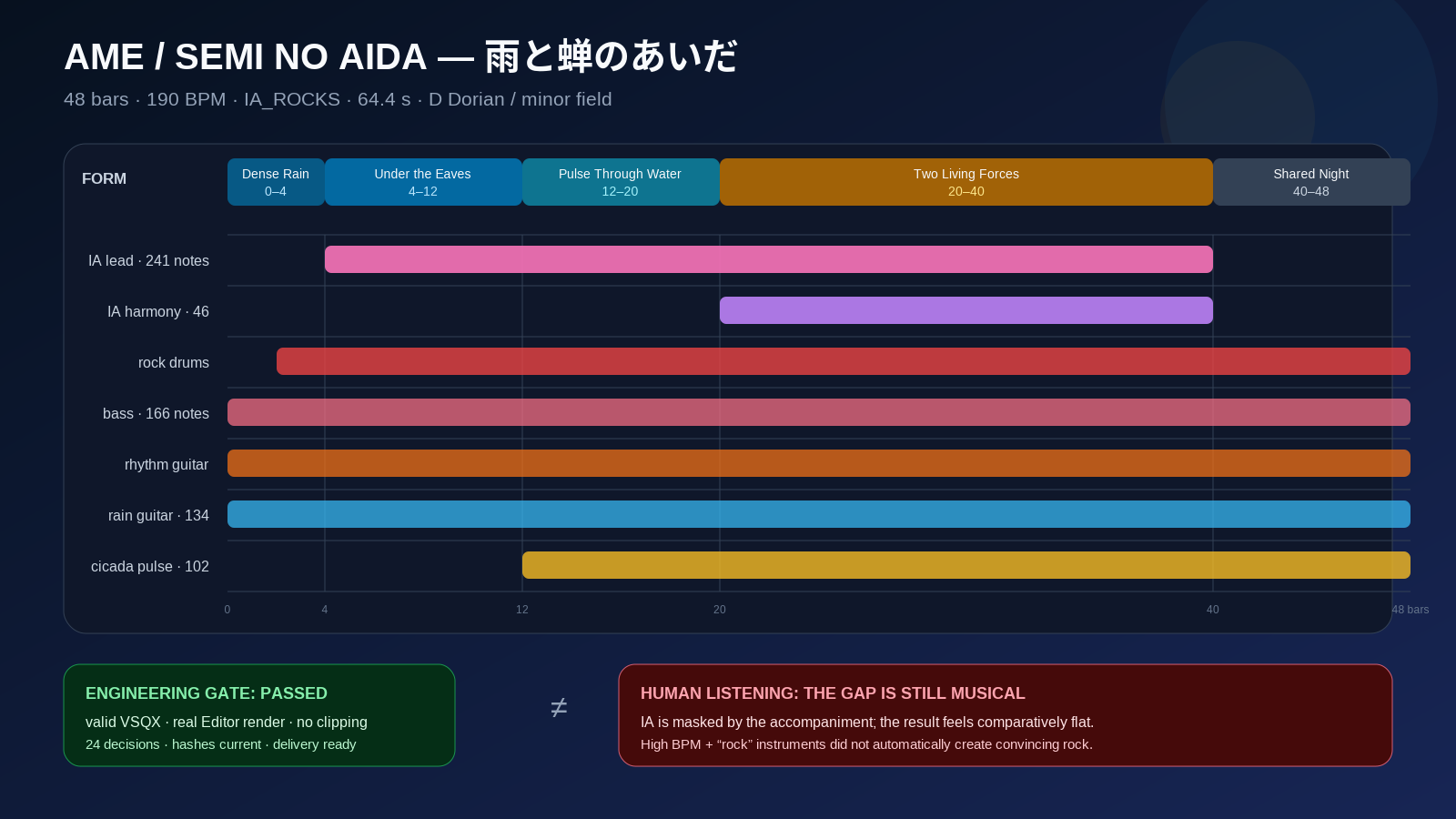
The latest 190 BPM IA_ROCKS test passed every gate, and the honest human verdict was still that the vocal was buried and it did not really feel like rock. Keeping that distinction visible is the point.
xmllint (schema validation), FFmpeg (analysis and mastering), FluidSynth plus a GM SoundFont (default /usr/share/sounds/sf2/FluidR3_GM.sf2).i686-w64-mingw32-gcc cross compiler builds the native export helper.The repository contains no VOCALOID binaries, voicebanks, activation data, or final song audio.
npm install
npm test              # clean TypeScript build + 96 tests (2 skip without local fixtures)
npm run build:native # build/native/vocaloid_export.exe and vsq_probe.exe (needed for rendering)The server speaks MCP over stdio and is meant to be a local, single-user desktop bridge.
claude mcp add vocaloid -- node /absolute/path/to/vocaloid/dist/src/index.jsOr with a generic client configuration:
{
  "mcpServers": {
    "vocaloid": {
      "command": "node",
      "args": ["/absolute/path/to/vocaloid/dist/src/index.js"]
    }
  }
}Defaults match the original development host. Override them with environment variables:
| Variable | Default | Purpose |
|---|---|---|
VOCALOID_EDITOR_PATH |
/mnt/d/Vocaloid/Vocaloid3FE/VOCALOID3.exe |
VOCALOID3 Editor; only allow-listed builds are automated |
VOCALOID_VOICE_DIR |
/mnt/d/Vocaloid/VoiceDB |
VVD voice metadata root |
VOCALOID_EXPORT_HELPER |
build/native/vocaloid_export.exe |
Win32 export helper |
VOCALOID_POWERSHELL_PATH |
/mnt/c/Windows/System32/WindowsPowerShell/v1.0/powershell.exe |
Runs the export wrapper |
VOCALOID_REG_EXE |
/mnt/c/Windows/System32/reg.exe |
Read-only voicebank registration check |
VOCALOID_READ_ROOTS / VOCALOID_WRITE_ROOTS |
repository (+ /mnt/d/Vocaloid for reads) |
Extra :-separated filesystem roots |
VOCALOID_VOICE_CACHE_PATH |
build/runtime/voice-readiness.json |
Voice probe cache (verified results last 7 days) |
VOCALOID_EDITOR_LOCK_PATH |
build/runtime/vocaloid-editor-render.lock |
Host-wide Editor render lease |
FFMPEG_PATH / FLUIDSYNTH_PATH |
/usr/bin/ffmpeg / /usr/bin/fluidsynth |
Audio tools |
Before a long render, call vocaloid_host_readiness and then vocaloid_probe_voice for the exact voice component. If the probe fails, see host troubleshooting.
22 tools, 14 resources (plus one optional local lyric resource), and one prompt.
| Area | Tools |
|---|---|
| Host | vocaloid_host_readiness, vocaloid_probe_voice |
| Composition | vocaloid_phrase_grammar, vocaloid_align_japanese_phrase, vocaloid_creative_journal |
| Manifest | vocaloid_create_song_manifest, vocaloid_import_vsqx_manifest, vocaloid_inspect_song_manifest, vocaloid_get_song_section, vocaloid_edit_song, vocaloid_preflight_song, vocaloid_manifest_history |
| Render | vocaloid_build_song_manifest, vocaloid_render_vocal_stems, vocaloid_render_instrument_stems, vocaloid_render_stem_mix, vocaloid_render_manifest_master, vocaloid_master_manifest_delivery |
| Review | vocaloid_analyze_wav, vocaloid_analyze_vocal_stem, vocaloid_review_audio, vocaloid_review_song |
vocaloid_edit_song is the single write path for score, intent, arrangement, and mix: one action (for example upsert_vocal_part, apply_tuning, upsert_arrangement, upsert_effect_chain, set_composition_intent) with a strict payload. Every action supports dry_run and requires expected_revision. Every tool returns { ok, data, warnings } on success and { ok: false, error: { code, message, retryable, suggested_action } } on failure.
Resources start at vocaloid://capabilities. They include the edit, intent, theory, phrase-grammar, and creative-journal contracts, style palettes, and a from-zero call example. See song manifest workflows for complete payloads.
cp intents/template.intent.json intents/my-song.intent.json   # fill in the brief
npm run --silent compose:prompt -- --intent=intents/my-song.intent.json
The brief declares the voice component, duration, BPM range (optional preferred value), scene, dramatic motion, one listener question, things to avoid, and source boundaries. The rendered prompt (prompts/vocaloid-composition-agent.md plus the validated brief) is the whole task for a fresh agent. The same prompt is available over MCP as vocaloid_compose_from_intent.
vocaloid-composition-intent/v1 declares song, section, and anchor-phrase purpose before any note exists.core/v1 analyzer separates structural errors, musical risks, and style observations. It never decides that a phrase is moving.melody_material=absent; they never produce a pitch sequence.declared a gesture or intent exists in the canonical state
materialized native VSQX notes / styles / controls contain it
rendered the original Editor produced non-silent, identity-checked audio
heard a named listener answered one explicit questionTechnical QC never signs off a human keep decision.
Each tracked package holds a manifest snapshot, the append-only creative journal, a readable report, and a digest-bound index. Final WAV files stay local.
| Composition | Voice | Scale | Record |
|---|---|---|---|
朝がほどく前に |
IA_ROCKS | 28-second intent-first demo | record |
遠い灯、青い夜 |
IA_ROCKS | 2:10 cold-start song | record |
風は名を呼ばない |
IA | 3:10 fresh-agent song | record |
雨と蝉のあいだ |
IA_ROCKS | 64 seconds at 190 BPM | record |
初雪のホーム |
IA_ROCKS | 31 seconds at 108 BPM | record |
Editable native projects are in artifacts/vsqxs/.
src/
  index.ts                stdio entry point
  server/                 MCP server: instructions, results, schemas, resources
    tools/                host, composition, manifest, render, review tools
  song-manifest.ts        public manifest API (barrel)
  song-manifest/          schema, store (hashing/validation/IO), mutations, build
  theory/                 deterministic symbolic analysis and bounded proposals
  intent/                 composition-intent schema, realization, review
  vsqx.ts                 VSQ3/VSQ4 reader/writer
  render.ts               original-Editor export boundary
  stems.ts, stem-mix.ts   isolated rendering, effects, automation, summing
  delivery.ts             mastering and delivery QC
  audio-quality.ts, audio-review.ts, vocal-analysis.ts
native/                   Win32 export helper and Yamaha loader probe (C)
scripts/                  prompt renderer, export wrappers, shared MCP client
prompts/, intents/        composition-agent prompt and per-song briefs
tests/                    unit and stdio integration tests
notes/                    contracts, workflows, troubleshooting, problem log
blogs/                    long-form retrospectives (July 2026 snapshot)
artifacts/ creative records and publishable VSQX projects| Path | Tracked | Contents |
|---|---|---|
artifacts/creative-records/, artifacts/vsqxs/ |
yes | manifests, journals, reports, native projects |
artifacts/songs/, artifacts/evals/ |
no | final listening WAVs, stems, previews, traces |
build/ |
no | working manifests, runtime caches, native helper binaries |
Source code and documentation are under the MIT License. VOCALOID, voicebanks, Yamaha software, supplied lyrics, and other third-party material remain under their owners' licenses and are not redistributed here.
CLASSIFICATION EVIDENCE
系统优先读取 GitHub Topics,再与站内分类词典和词根规则比对。当前命中: mcp、model-context-protocol。
morluto
Reverse engineer anything with agents, from app behavior down to native binaries.

deepseek-ai
DeepSeek Harness: Everything is a Plugin.

nexu-io
The 1st Collaborative AI Design Agent Workspace. Local-first and open source. Create motion, prototypes, websites, apps, dashboards, presentations, images, and videos with your team and AI agents. Share work, exchange feedback, and iterate together in one workspace.