


模型与 MCP
待识别

rea
morluto
Reverse engineer anything with agents, from app behavior down to native binaries.
PROJECT TOPICS
PROJECT README
Chat replies that render as interfaces, not walls of Markdown.
A plugin for DeepSeek Harness (DSH) that upgrades the assistant-message renderer: model-authored OpenUI Lang fences render as cards, tables, charts and diagrams in place, while structured Markdown is automatically compiled into the same visual language. Plain text stays plain text.



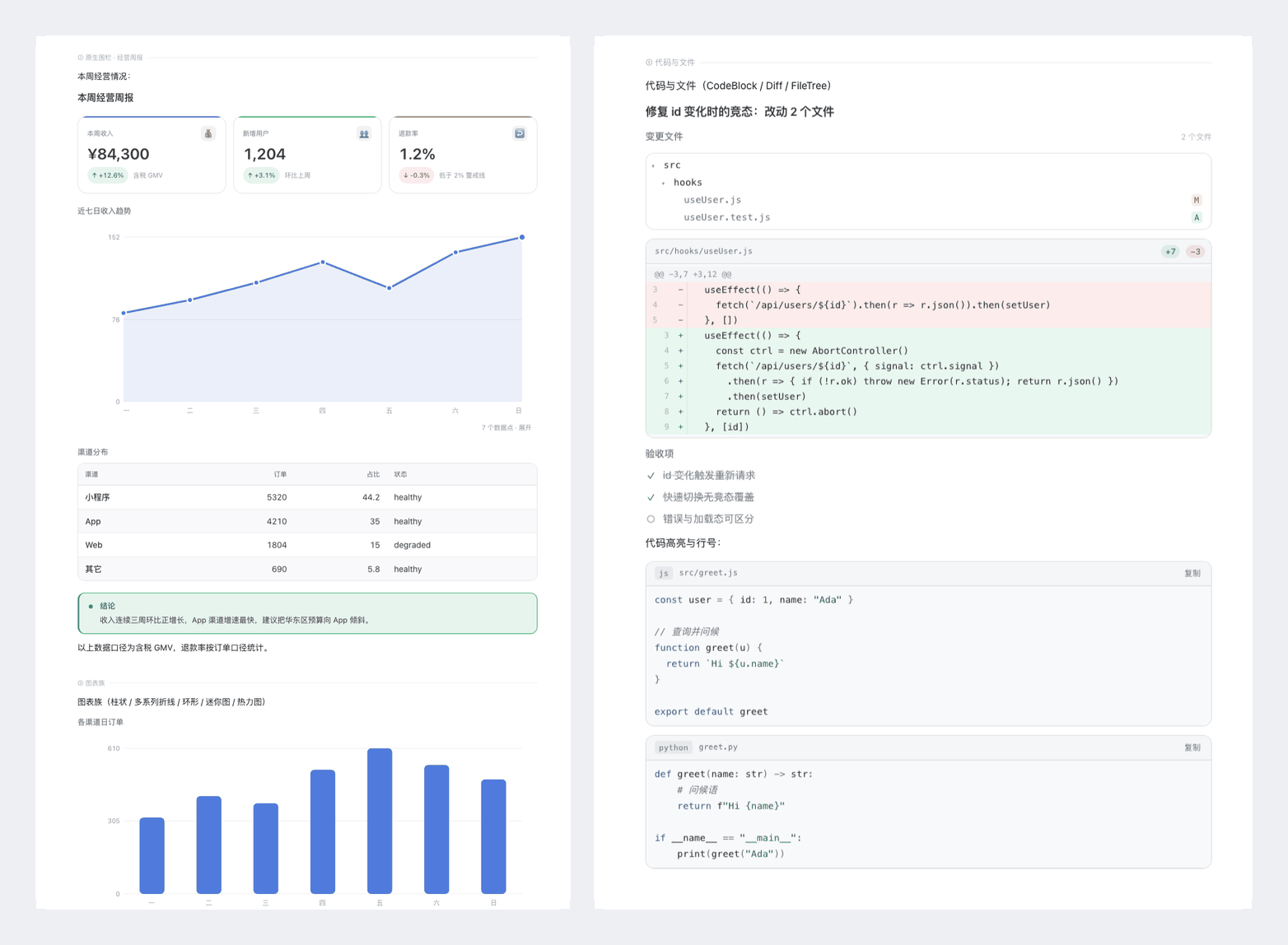
中文说明 · Docs index · Component reference · Design system · Architecture · Gallery (GitHub Pages) · Light / dark / mobile
Status: v1.1.1 · 44 components · MIT · light/dark themes · 390/920px · macOS tested locally, Linux covered by CI.
The gallery page is served by GitHub Pages once enabled in the repository settings (see RELEASING.md); the PNG links work immediately.
Markdown is excellent for prose but poor at structure: KPI comparisons turn into walls of text, tables lose hierarchy on mobile, and trends are invisible. Intelligence UI keeps Markdown for the parts that are prose and upgrades the rest:
An assistant reply can mix prose and interface blocks. The plugin intercepts the
assistant-step renderer (priority −20) and runs a three-mode pipeline:
| Reply shape | Trigger | Rendering |
|---|---|---|
| Native fence | a ```openui program in the reply |
parse → evaluate → render components in place (highest fidelity) |
| Auto-compiled | no fence, but Markdown tables / KPI lists / ordered steps | the client compiler turns them into cards, charts and search tables |
| Plain text | everything else | the host Markdown renderer, unchanged |
Text outside a fence stays Markdown, so one reply can be: explanation → chart → caveat. Rendering is insertion-based: nothing is merged, rewritten or stripped.
root = Stack([kpis, chart, note], "column", 16)
kpis = Grid([a, b], 2, 12, 150)
a = StatCard("Revenue", "¥84,300", "+12.6%", "up", null, "gross, tax included", "brand")
b = StatCard("Refund rate", "1.2%", "-0.3%", "down", null, "below the 2% guardrail", "warning")
chart = Chart("Last 7 days", "area", [{name: "Revenue", values: [82, 94, 110, 129, 105, 138, 152]}], [], ["Mon", "Tue", "Wed", "Thu", "Fri", "Sat", "Sun"], 220)
note = Callout("Takeaway", "Revenue grew three weeks in a row; shift budget toward the fastest channel.", "success")| Host | DeepSeek Harness (DSH) desktop app (source), with a build that exposes plugin bundles (engines.dsh >= 0.2.1-rc.0). This repository is the plugin, not a standalone app. |
| Node.js | >= 20 — only needed to build and run tests (the repository ships a prebuilt lib/client.js). |
| pnpm | 12 — pinned through packageManager (Corepack picks it up automatically). |
| Chrome | Any recent Chrome/Chromium for the browser-based tests (CHROME=/path/to/chrome if auto-detection fails). |
| Platform | macOS (14+) and Linux tested; Windows is expected to work but untested for the Chrome-based suites. |
engines.dshrefers to the host's plugin-bundle API version; check the DSH build notes for the exact minimum.
The plugin renders against the host's --dsw-* theme tokens and platform modules
(@deepseek-ai/dsh-client-*). Those are supplied by the host; nothing needs to be installed
globally.
Five minutes from zero to a rendered reply:
git clone https://github.com/MarkYangKp/dsh-intelligence-ui.git
(no build step: lib/client.js is committed).[dsh-intelligence-ui/1.1.1].If step 3 is unavailable in your DSH build, that build does not expose plugin bundles and cannot load this plugin; upgrade DSH or use a build with bundle support.
pnpm install
pnpm build          # writes lib/client.js
# then install this directory as a bundle, as in step 3
To update: git pull && pnpm install && pnpm build, then reload the chat page (⌘R / Ctrl-R).
To remove: uninstall the bundle in the plugin manager and restart DSH.
Maintainers iterating on the host machine can use
node scripts/deploy.mjs --to <plugin-directory>to rebuild, back up the target and rsync the repository into the directory the host loads.
Write normal Markdown; insert a fence where the interface belongs:
Ops review:

```openui
root = Stack([hd, tl, ok], "column", 16)
hd = Heading("Incident review", 2)
tl = Timeline([{"title": "14:02 alert", "description": "error rate > 15%", "time": "14:02", "variant": "error"}, {"title": "14:26 rollback complete", "description": "error rate back to 0.4%", "time": "14:26", "variant": "success"}])
ok = Callout("Next", "Add a connection-pool limit to the index job.", "info")
```
No fence? Structured Markdown is upgraded automatically. Both paths share one
parse → evaluate → render pipeline.
examples/.localStorage['dsh-intelligence-ui:disable-auto']='1'.44 components across ten groups; full signatures live in docs/COMPONENTS.md.
| Group | Components |
|---|---|
| Primitives | Box Row Col Text Icon Image Link |
| Layout | Stack Grid Divider Spacer |
| Containers | Card CardHeader Section Callout Quote |
| Text | Heading TextContent BulletList KeyValue CodeBlock Badge BadgeGroup |
| Data | StatCard Table SearchTable ProgressBar ComparisonBar Timeline Steps Checklist |
| Charts | Chart PieChart Sparkline Heatmap |
| Geography | Map |
| Code & files | Diff FileTree |
| Process | TreeView Diagram |
| Interactive | Button Tabs Accordion SegmentedControl |
The visual language is "Precision Editorial": host ink typography, a single business-blue accent
for data, hairline structure and layered surfaces. All tokens live in
src/ui/theme.js; rationale, type scale and per-component guidance are in
docs/design.md.
A headless-Chrome design gate measures computed styles (no gradients, no static shadows, no uppercase labels, no horizontal overflow, bounded type scale, WCAG AA text contrast — 4.5:1 for normal text, 3:1 for large text, bounded accent hues) across light/dark × 920/390.
prefers-reduced-motion, and no horizontal overflow at 390px.aria-* labels where needed;
charts carry text labels for series, axes and values.assistant-step text block
├─ ```openui fence ─► parse → evaluate → render components (text outside stays Markdown)
├─ no fence, settled ─► Markdown compiler → OpenUI program → render
└─ otherwise ─► host Markdown rendererThe repository contains both halves of the plugin: a host half that injects prompt modules
(index.js) and a browser half that registers the renderer (src/ → lib/client.js). Component
implementations are split into focused modules under src/ui/; the tolerant binding layer and
render pipeline live in src/openui-runtime.jsx. Isolation boundaries, resource budgets, streaming
identity and clipboard/timer cleanup are described in docs/ARCHITECTURE.md.
pnpm install
pnpm build            # → lib/client.js (committed; CI checks it is up to date)
pnpm test             # build + unit/browser suites (310 checks; browser suites skip without Chrome)
pnpm test:unit        # the same suites without browser tests (no Chrome needed)
pnpm test:design      # computed-style design gates in headless Chrome (36 checks)
pnpm test:interact    # chart/map interaction regressions in headless Chrome (10 checks)
pnpm test:docs        # relative Markdown links must exist and be tracked
pnpm format           # Prettier
pnpm format:check     # verify formatting (CI gate)
pnpm shot             # regenerate docs/gallery{,-dark,-mobile}.png + gallery.html
pnpm preview -- --name me --only "图表" --theme both
Test suites cover a synthetic 56-program corpus, 63 adversarial inputs, the Markdown compiler, theme-token fidelity, prompt modules, bundle budget/schema fingerprint, chart SSR, and real-browser lifecycle/heap checks. See CONTRIBUTING.md for prerequisites and PR expectations.
The gallery and design gate prefer a local snapshot of the host theme. Generate one with
node scripts/extract-theme.mjs (optional; it falls back to an original approximation in
test/fixtures/theme-fallback.css).
Generated artefacts in this repository: lib/client.js (the shipped bundle) and
docs/gallery* / docs/hero.png (rendered by pnpm shot). Do not edit them by hand; CI verifies
the bundle is in sync with src/.
The plugin itself has no analytics, no telemetry and makes no network requests. Installing the
development dependencies does not send telemetry either: the upstream @openuidev/lang-core
install hook is explicitly denied in this repository's pnpm-workspace.yaml (see
SECURITY.md). Remote images
that a user or model references through the Image component are loaded by the host, like any other
chat image. The bundled upstream @openuidev/lang-core telemetry path is disabled unless the host
explicitly sets OPENUI_RUNTIME_TELEMETRY_ENABLED; the browser runtime never enables it (the
inert upstream code is documented in SECURITY.md). Clipboard access happens only
through user-initiated copy buttons.
The component library and host API are locale-neutral. The injected prompt modules, example programs and gallery content are currently written in Chinese, the primary language of the first release; an English prompt set is on the roadmap. UI chrome rendered by the plugin itself is minimal and language-neutral; number and date formatting comes from the content.
| Doc | Contents |
|---|---|
| docs/COMPONENTS.md | All 44 components, signatures, program syntax rules |
| docs/ARCHITECTURE.md | Reply pipeline, module map, robustness, prompt architecture, test matrix |
| docs/design.md | Design-system v3 tokens, type scale, per-component visual guidance |
| docs/README.md | Documentation index |
| Gallery page | Full rendered gallery (generated; served by GitHub Pages) |
Issues and pull requests are welcome — see CONTRIBUTING.md, CODE_OF_CONDUCT.md and SECURITY.md. Visual changes should include light/dark and 920/390 screenshots. Release steps live in RELEASING.md; changes are tracked in CHANGELOG.md.
@openuidev/lang-core, MIT) —
parser, evaluator and type system for the language.world-atlas (ISC)
for the world outline data.Third-party license texts: THIRD_PARTY_NOTICES.md.
MIT © 2026 MarkYangKp
CLASSIFICATION EVIDENCE
系统优先读取 GitHub Topics,再与站内分类词典和词根规则比对。当前命中: llm、deepseek-harness。
morluto
Reverse engineer anything with agents, from app behavior down to native binaries.

deepseek-ai
DeepSeek Harness: Everything is a Plugin.

nexu-io
The 1st Collaborative AI Design Agent Workspace. Local-first and open source. Create motion, prototypes, websites, apps, dashboards, presentations, images, and videos with your team and AI agents. Share work, exchange feedback, and iterate together in one workspace.