模型与 MCP
待识别

rea
morluto
Reverse engineer anything with agents, from app behavior down to native binaries.

MacilyDots/dsh-session-inherit
DSH 插件:会话菜单多一行「继承」。把跑久了的会话机械提取成一份交接单(任务、最近的指令、改过的文件、失败、命令、待办),在干净的新会话里接着干——不调模型、不带旧历史,预设默认一并继承。 | DSH plugin: an "Inherit" row in the session menu. Extracts concrete anchors (task, instructions, files edited, failures, commands, todos) from a long session into a handoff, then continues in a clean one - no LLM call, no old history, preset inherited.
PROJECT TOPICS
INSTALL REFERENCE
dsh plugin --profile web add github:MacilyDots/dsh-session-inherit
该命令指向仓库当前默认分支;尚无绑定当前 commit 的完整验证结果。
PROJECT README

Hand a long-running session off to a clean new session.
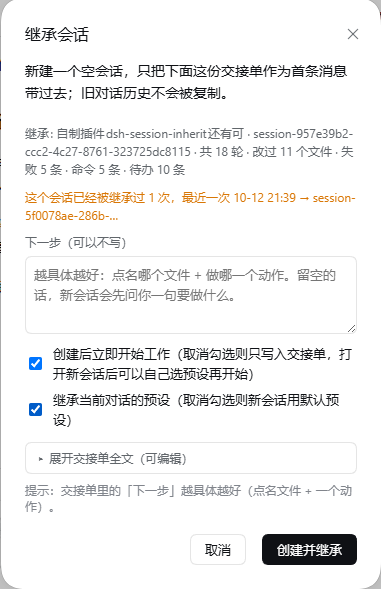
The session row's "…" menu gains an Inherit entry. Click it → preview a handoff document mechanically extracted from the source session → confirm → a new session is created without the old history, and that handoff is sent as its first message. Work continues there. The source session is left untouched.
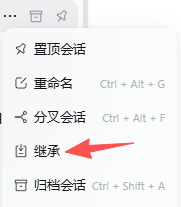
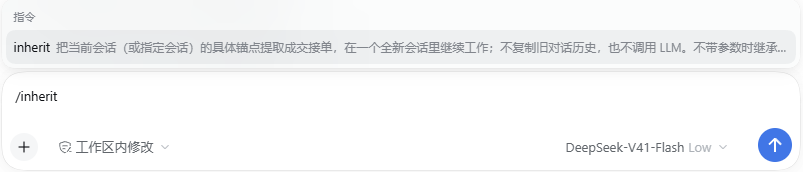
The /inherit command is the same entry point (it shows up in the prompt's hints):
Pin           ← stock DSH
Rename        ← stock DSH
Fork          ← stock DSH
Inherit       ← this plugin (order 350)
Archive       ← stock DSH
All four rows other than "Inherit" ship with DSH itself — they are the official entries
of the sidebar.workspaces.session.menu.item slot. If you have other session-menu plugins
installed, their entries appear here too; this plugin owns only the "Inherit" row.
DSH already has two ways to keep going. This is the third:
| Approach | What it carries over | Why it does not fit |
|---|---|---|
/compact |
Replaces history with a summary; same session | Measured: after compressing 541,227 tokens down to 25,602, degeneration recurred within 4 steps — and the repeated token changed from "做。" to "好。". Length is not the cause, and neither is the content of the context |
| Official Fork | Copies the source session's whole history prefix | Carries the trigger along with it; the new session opens on hundreds of thousands of tokens of history |
| Inherit (this plugin) | Only verifiable concrete anchors; no history at all | The new session's context starts at a few thousand characters |
The /compact evidence was direct: the summary kept abstract intentions such as
"needs acceptance testing, needs a report written", and dropped exactly the concrete
anchors — file paths, next-step parameters. Holding a vague intention, the model kept
telling itself what to do at the abstract level, using almost the same sentence every
time — which is itself fuel for repetitive degeneration.
So this plugin's handoff document makes zero model calls. It only performs mechanical extraction: the original task statement, recent user instructions (verbatim, not rewritten), files touched, commands run, the last todo state, and the source session's final reply. Every line can be traced back to the source session for verification.
The handoff also hard-codes three rules at the top:
Do not restate this document. Do not summarize it. Do not reply "got it / understood". Read it and go straight to the "next step". Take exactly one concrete action first, then stop and report; do not branch out in several directions at once.
The handoff language follows the interface language (the client sends lang with the
preview/commit request): an English UI gets an English handoff, a Chinese UI gets Chinese.
Below is the English output — the real sections, with the ← annotations added here for
readability (they are not part of the output).
📋 Session handoff

> Source: `session-xxx` (title) · 15 turns · last activity 2026-10-08 19:37
> **Rules**: do not restate this document…
> Last state: turn 12 still running (the source session has not stopped…)

## Task                          ← the first message that looks like a request, not a greeting
## Files edited (written/modified by the source session, most recent first)   ← edit/write `file_path`
## Attachments (present in the source session, not copied)   ← names and sizes only, never contents
## Recent failures (last tool errors in the source session — check whether they are already resolved)   ← turn + error code
## Run this first (the source session's most recent verification command)   ← single-line commands only
## Recent user instructions (oldest first)   ← verbatim `source.kind === 'user'` messages
## Files read (read-only, never modified)
## Paths mentioned in text (scraped from tool-argument bodies; may be noise)
## In-project relative references (base directory undetermined; confirm with a file search)
## Recent commands
## Todos (last todo state in the source session)
## Source session's last reply
## Next step                     ← written by you in the preview box
A few sections exist so the new session does not waste its first steps:
aborted, error,
max-tokens, blocked, or still running). A source session that is still live reads as
"still running" — its log genuinely ends mid-turn.npm test, cargo test, tsc, …) and removes it from "Recent commands" so it is not
listed twice. Multi-line scripts are skipped — they cannot be re-run as one command.Section headings carry no numbers. Numbering used to be hard-coded per section and
drifted whenever a section happened to be empty: the client hint said ## 7. 下一步 while
the generated document actually contained ## 8., so anyone following the hint never found
the section.
"Recent user instructions" accepts only source.kind === 'user'. In one real session, 27 of
its 42 user/message events were runtime injections — agent-instructions /
runtime-context / skill-catalog / time-context / memory notices / model selection /
compaction checkpoints — all noise. They are now kept out.
Files edited come only from the structured file_path of writing tools (edit /
write). In one real session: 85 write calls against 58 read calls, touching 17 files
(writes) versus 43 (reads). Mixed together, read-only files push the actually-edited ones
past the cap. Paths that merely appear inside a write body or an edit new_string count
as "mentioned in text" instead.
Recent failures come from tool/result events with isError. In one real session, 11
of 374 tool/result events were failures, e.g.:
- (t5) `edit` FS_STALE_VERSION:cannot write "…\inject-codex.ps1": file changed since it was read — re-read the file, then retryEach entry carries its turn number — failures in that section can span several turns,
and without the marker the new session cannot tell which of them are stale news. That is
the most direct clue for "what to do next", and it is extracted mechanically. The 363
successful ones are dropped, as are user-initiated aborts (AbortError) and interrupted
auto-reviews; identical messages repeated across several tools are merged into one.
Absolute-path anchors also get an existence check: anything already deleted or renamed is marked (已不存在) (no longer exists), so the new session does not waste its first steps looking for it.
sessionQuery.readSession and does not activate an agent.The new session opens automatically, titled 继承: <source title>, with the same working
directory and model route as the source session; its agent preset is inherited from the
source by default (uncheck that box and the new session uses the DSH default preset).
The "start working immediately" checkbox is on by default: the handoff is sent through
sessionController.prompt as a normal user message and work begins right away. Unchecked,
it is written straight into the session log instead (session:append) — recorded but not
triggered, so you can say what to do once you open it.
Degradations are stated, not swallowed. If the host could not start the session
automatically (prompt failed or is unavailable), the dialog does not silently close — it
stays open showing the reason and the new session id, plus an "Open new session" button.
Previously this path only did console.warn, so the dialog vanished and you would assume
the new session was already running.
The "Next step" box and the handoff are two independent sources. If commit receives both, the host writes the box's text into the "## 下一步" section of that handoff — so even when you expand and edit the handoff, neither side gets silently dropped.
Repeat inheritance is flagged. The source session (often cold) cannot be renamed:
sessionTitle.rename(session, title) requires a live session object (it asserts
ctx.sessions.get(id) === session), and sessions.get documents that it returns
undefined for a cold session. So "where did this session get inherited to" is recorded in
%DSH_HOME%\session-inherit\history.json and surfaced the moment you open the preview
again: "This session has been inherited N time(s); most recently … → …". The record stores
only session ids and timestamps, capped at 200 source sessions with 10 entries each.
/inherit command/inherit inherit the current session
/inherit <sessionId> inherit a specific session
/inherit --next run npm test once inherit the current session with a first step
/inherit <sessionId> --next switch files both togetherBare text without --next can only be a session id; if it is not valid you get an honest
error instead of a guess at what you meant by "next step".
session_inherit toolThe same operation exposed to the agent, with parameters sessionId (required),
nextStep, and start. This lets an agent propose a session switch on its own when its
context grows long, or lets you express the intent through the agent.
All three entry points funnel into one path: read the source session → mechanical extraction → create the session → attach the workspace → inject the handoff.
session_read toolThe handoff's first line carries the source session id, but the new session cannot read it
directly: the log lives at
%DSH_HOME%\sessions\<escaped workspace>\session-<id>\session.vN.jsonl.zstd and is a
concatenation of zstd frames (a real 2.7 MB file was split into 1067 frames, and Node's
zstdDecompressSync stops after the first one). So the plugin also registers a read-only
tool to close that gap:
session_read { sessionId, mode: 'search' | 'summary' | 'tail', query?, limit? }search (default): keyword search over the source session, returning surrounding contextsummary: structured digest (task / files edited / recent failures / todos / last reply)tail: the last N events that carry content — "where exactly did it stop?"It reads only; it never creates or modifies anything.
From npm (recommended, one command):
dsh plugin --profile <profile> add dsh-session-inheritOr straight from the repository, without npm. Edit the profile's package.json — both
places:
{
  "dependencies": {
    "dsh-session-inherit": "link:/path/to/dsh-session-inherit"
  },
  "dsh": {
    "profile": {
      "bundles": [
        "dsh-session-inherit"
      ]
    }
  }
}
bundles is what actually loads the plugin — listing it only under dependencies will
not mount it. Restart DSH afterwards.
The desktop app manages its own profile exclusively through Electron and the global CLI refuses to operate on it; in that case edit that profile's
package.jsondirectly and restart.
Verified on DSH 0.2.0-rc.2 (Windows). The plugin depends on a number of DSH internal
services and menu slot names, so a DSH upgrade can break the match. If the menu entry does
not appear, or the plugins page shows an error, check the profile's compatibility.json
first: on startup a profile validates each plugin's peerDependencies against
@deepseek-ai/dsh and dsh-* and skips any bundle that does not satisfy them (it logs
skipping profile bundle). Add the current DSH version to the allowed list in
compatibility.json.
index.mjs: registers POST /__session-inherit/preview,
POST /__session-inherit/commit, POST /__session-inherit/retry and
GET /__session-inherit/health (same-origin check, loopback only)client.js: registers sidebar.workspaces.session.menu.item
(id session-inherit, order 350) and the preview dialog on shell.overlayIt consumes only public services: agents (hard dependency), sessionQuery,
sessionController, workspaceRegistry, sessionTitle, agentPresets,
agentDefaultModel, webServer. Everything except agents is looked up on demand — a
missing service degrades one feature instead of taking the whole plugin down.
Override in the profile's cordis.patch.yml (all optional):
- id: session-inherit
  config:
    enabled: true        # false = register nothing at all
    recentUsers: 6       # how many recent user instructions to include (1–50)
    startByDefault: true # default value of the preview checkbox
    cacheTtlMs: 120000   # reuse one log read between preview and commit; 0 = no cache
    previewTimeoutMs: 30000  # upper bound for reading the source session in the preview
    timeoutMs:               # commit step budget; a step is capped by min(its own, remaining total)
      total: 60000
      build: 20000
      create: 10000
      binding: 2000        # third-party preset ledger call; never blocks the handoff
      workspace: 5000
inject: 15000GET /__session-inherit/health is read-only and answers "what does this plugin
see right now":
services.available / services.missing — which DSH services resolved;bindings — the shape of session-bindings.json (object / legacy /
mixed / invalid / absent) and how many entries actually parse;events.seen vs events.expected — which event types were consumed, against
the ones the extraction depends on;cache — how many derived results are held.It exists because of a silent failure: dsh-tavern 2.7 changed the bindings file from strings to objects, this plugin kept reading strings, and inheriting a session quietly lost its persona — no error anywhere. If something looks wrong after a DSH update, look here first.
A session is created before the handoff is injected, so the plugin treats "session exists" as the point of no return and never hides it behind an error:
200 with state: "pending-injection" and a warnings[] list. The dialog stays open, shows the new
session id, and the session stays in your sidebar — it is never orphaned.code: "create-timeout") and deliberately does not retry: agents.create cannot be
cancelled, so a retry would produce a second session while the first one leaks. The
error text tells you to refresh the sidebar before clicking again.deduplicated); with different parameters the second one is
rejected with 409 conflicting-commit instead of silently reusing the first one's
settings.warnings[] and shown in the dialog.dsh-degen-guard). This plugin does not touch it.read /
grep path) is a whole path on its own — most reliable; (2) anything wrapped in
quotes or backticks has an explicit boundary; (3) the rest is scraped by regex, whose
final segment may not contain whitespace (otherwise it would swallow the following
sentence). So a path embedded directly in prose and followed by more words
(X:\work\My Project Name 这个项目) gets truncated to
X:\work\My Project. In one real session about 4 such fragments survived, all inside the
"paths mentioned in text" section, which is labelled as possibly noise.copy X:\p\a.cs X:\p\b.cs); CJK
punctuation (,。;:、!?()【】《》) is also treated as a separator.compaction/* events), the handoff says so — after
a compaction the earlier original text is no longer in the log, so mechanical extraction
cannot reach it either.agentPreset (it may
stay standard); the preset that actually applies is recorded in the host's
%DSH_HOME%\.agent-presets\session-bindings.json, shaped like
{"session-xxx": "preset-xxxxxxxx"}. The dialog has an "Inherit the current session's
preset" checkbox, checked by default: with it on, the plugin passes that preset id as the
new session's agentPreset at creation time, so the new session really starts with that
preset. Uncheck it and the new session uses the default preset instead. The handoff footer
records the actual outcome — Preset: preset-… → inherited by the new session, or
not inherited this time / mount failed.dsh-tavern's POST /api/tavern/bind-preset only writes that plugin's own bindings ledger;
its source comment says switching the agent preset is the chat preset picker's job. The plugin
still calls it so the ledger stays consistent, but the real inheritance goes through the
host's agentPresets service while the session is being created. Getting this backwards was
the bug that made an earlier version print a preset in the footer while the new session had
no persona at all.node test/extract.test.mjs # extractor pure functions (39)
node test/host.test.mjs # host half: endpoint registration, the full preview/commit path, /inherit argument parsing, preset inheritance, the inherit ledger, health and retry endpoints against a fake ctx (33)
node test/client.test.mjs # client half: module protocol, slot registration, fallback menu row, and menu → preview → collapse/expand → confirm → commit (7)Every release must carry two assets:
dsh-session-inherit-<version>.tgz — the archived builddsh-session-inherit.tgz — the fixed-name oneThe fixed name is what releases/latest/download/dsh-session-inherit.tgz resolves to.
latest points at the most recent Release, so keeping the asset name version-free is
what stops the install command printed in plugin marketplaces from breaking on every bump —
forget it and that URL 404s on the next release.
npm test                  # 1) run the tests
# 2) bump the version → commit & push → push the tag (the script checks it matches package.json)
node scripts/release.mjs  # 3) pack, create the Release, upload both assets
--dry-run lists the package contents without packing or uploading; --tag v1.2.3 picks
the tag explicitly. The script never touches git — committing and tagging stay manual, it
only packs and uploads.
Existing options were surveyed before writing this; none overlaps completely:
dsh-session-handoff)
— closest match: a /handoff command that creates a session in the same workspace,
injects a handoff document, and opens it. Differences: it summarizes the last N turns
with an LLM, and it only works from a command typed in the current session. This
plugin's entry point is the session row menu, it works on any session (including cold
ones), it makes no model calls, and it moves only concrete anchors.HANDOFF.md, but does not create a session.@michengai/dsh-archive-manager — also registers a delete-session entry in the
same menu (order 500). This plugin uses order 350, so they do not conflict.MIT
CLASSIFICATION EVIDENCE
系统优先读取 GitHub Topics,再与站内分类词典和词根规则比对。当前命中: deepseek-harness、deepseek-harness-plugin。
morluto
Reverse engineer anything with agents, from app behavior down to native binaries.

deepseek-ai
DeepSeek Harness: Everything is a Plugin.

nexu-io
The 1st Collaborative AI Design Agent Workspace. Local-first and open source. Create motion, prototypes, websites, apps, dashboards, presentations, images, and videos with your team and AI agents. Share work, exchange feedback, and iterate together in one workspace.