

其他
完整应用

deepseek-harness
deepseek-ai
DeepSeek Harness: Everything is a Plugin.
PROJECT TOPICS
INSTALL REFERENCE
dsh plugin --profile web add github:LivXue/dsh-plugin-shop
该命令指向仓库当前默认分支;尚无绑定当前 commit 的完整验证结果。
PROJECT README
The plugin shop for DeepSeek Harness — discover, install, enable and update dsh plugins from a browsable, git-auditable catalog.



English | 中文
Two tracks. They do the same thing; pick the one that matches who is reading.
Prerequisites: Node.js. Running the harness itself needs no install — the
upstream-documented form is npx -y @deepseek-ai/dsh web. Plugin management
goes through dsh plugin, which spawns both the dsh command and pnpm —
install them once with npm install -g @deepseek-ai/dsh pnpm and verify with
dsh --version and pnpm --version.
# dsh on PATH (global install). Pin the version: pnpm 11 holds back very
# recent releases, so a bare `add dsh-plugin-shop` can hand you an older
# version for a while. This is the current release — refresh it with
# `npm view dsh-plugin-shop version`.
dsh plugin --profile web add dsh-plugin-shop@0.8.2
# or straight through npx, nothing installed:
npx -y @deepseek-ai/dsh plugin --profile web add dsh-plugin-shop@0.8.2
Replace web with your profile if you use another one. Restart dsh once — a newly
added bundle is not applied to a running process — then open
Settings → Plugins → Plugin shop
Non-interactive. --profile is mandatory; without it dsh plugin exits with
error: required option '--profile <name>' not specified.
# 1. resolve a profile name ($DSH_HOME defaults to ~/.dsh; node_modules is not a profile)
ls -1 "${DSH_HOME:-$HOME/.dsh}/profiles" | grep -v '^node_modules$'

# 2. install — pin the version: it bypasses pnpm's release cooldown and
#    deterministic installs are the point of the agent path
dsh plugin --profile <profile> add dsh-plugin-shop@0.8.2

# 3. verify — a zero exit above only means pnpm resolved the package
dsh plugin --profile <profile> list --depth 0   # dsh-plugin-shop must appear

# 4. restart the profile; a new bundle is not hot-applied
dsh --profile <profile>
The same fact as step 3 lives in $DSH_HOME/profiles/<profile>/package.json under
dsh.profile.bundles, if you would rather read the manifest than parse CLI output.
Per-failure diagnostics are in the
package README.
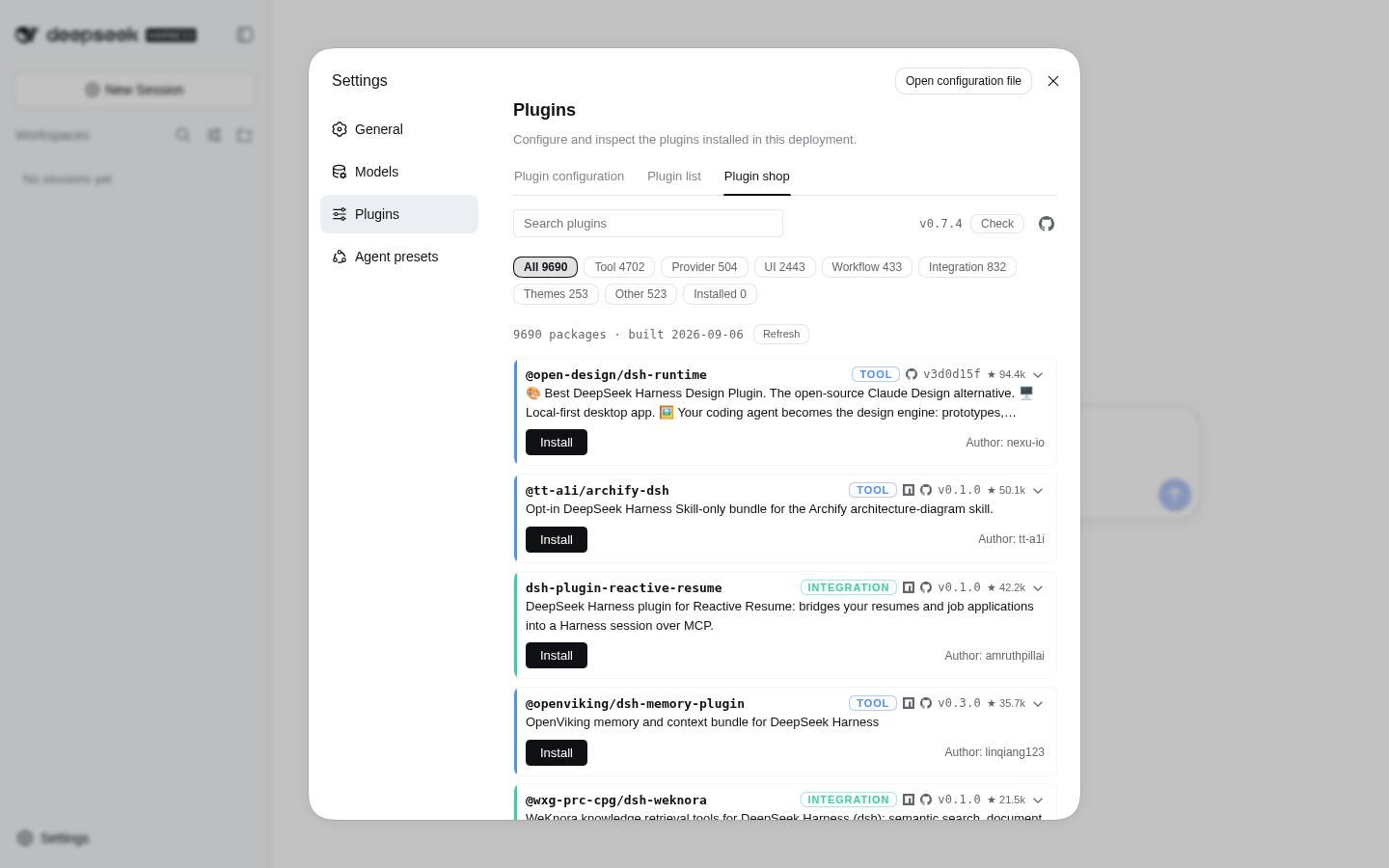
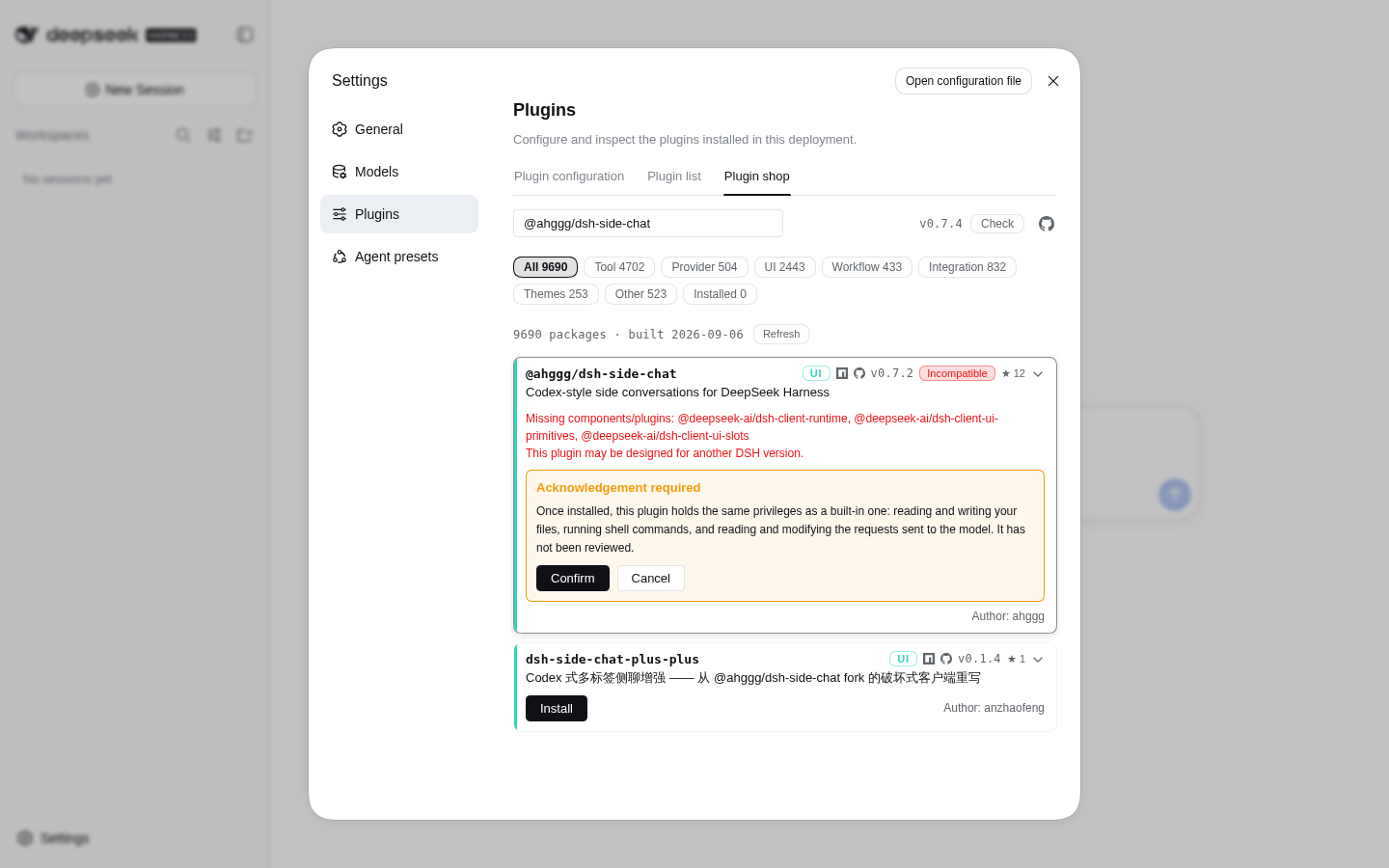 |
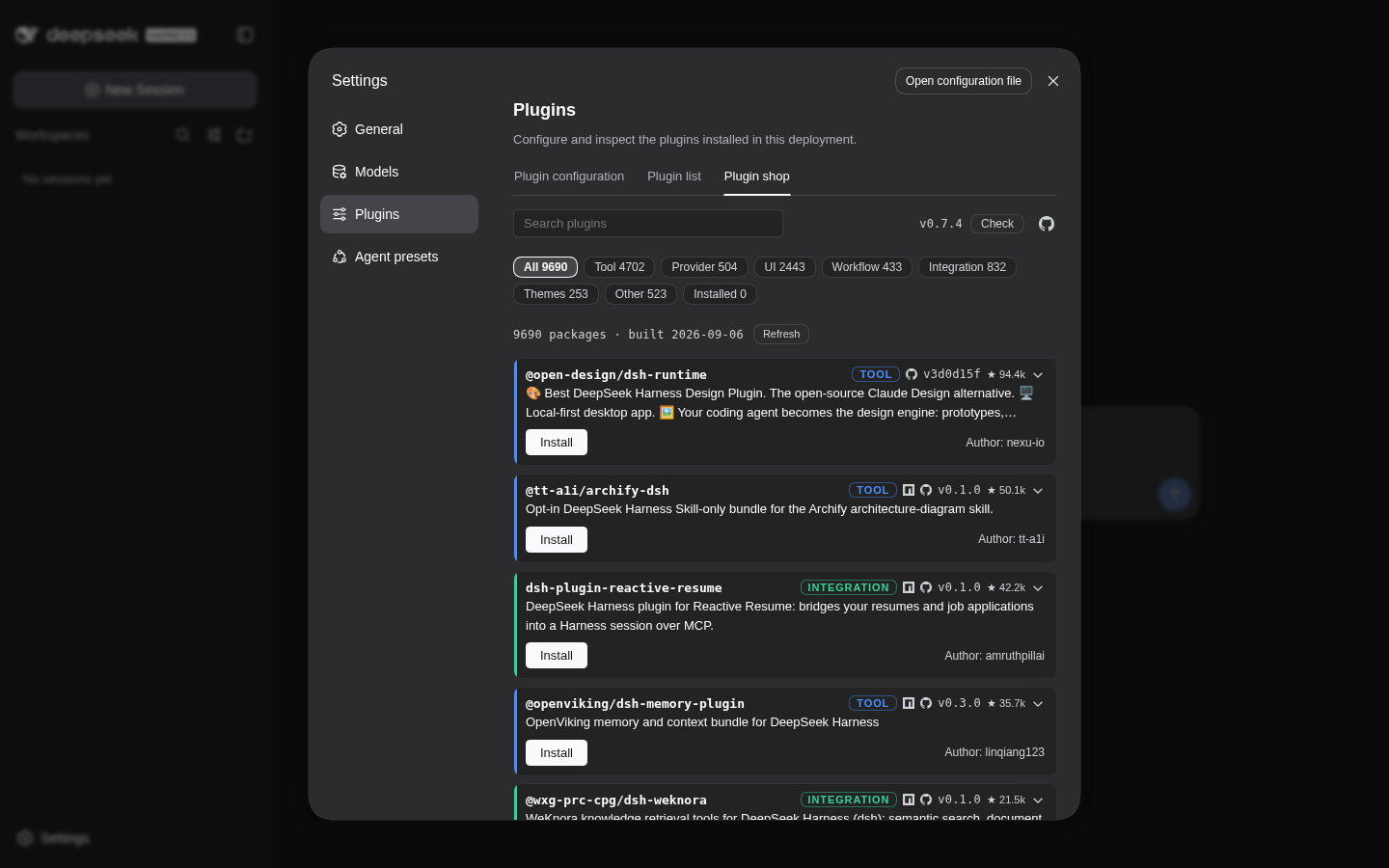 |
| Installing an unreviewed plugin requires an explicit acknowledgement | The same shelf in the dark theme |
dsh-plugin or
deepseek-harness, plus every GitHub repository using them as topics. Nothing is
submitted here; there is no queue to join.plugins and filtered badges above count both
sides, live.dsh.catalog picks their own; the
rest are classified for them.In this repository — the daily build. Everything here is registry/.
flowchart TB
  subgraph HARVEST["1 · Harvest — the whole public registry, every day"]
    direction LR
    NPM(["npm packages<br/>keyword dsh-plugin<br/>keyword deepseek-harness"])
    GH(["GitHub repositories<br/>the same keywords,<br/>used as topics"])
  end

  subgraph GATE["2 · Gate — every candidate must clear all five, on every build"]
    direction LR
    G1["a plugin at all?<br/><br/>a dsh.bundle the<br/>loader can mount"]
    G2["auditable?<br/><br/>a license,<br/>a live repository"]
    G3["installable?<br/><br/>not deprecated on npm ·<br/>repo listings also need<br/>no build scripts and<br/>no workspace: deps"]
    G4["what it claims?<br/><br/>tarball integrity, publish time,<br/>not a near-miss of another name"]
    G5["anything to show?<br/><br/>a valid dsh.catalog,<br/>or an npm description"]
  end

  subgraph SHELVE["3 · Shelve — what the catalog records"]
    direction LR
    CAT["one of 7 categories"]
    PEER["the declared peer NAMES,<br/>never their version ranges"]
  end

  NPM --> G1
  GH --> G1
  G1 -.-> REJ
  G2 -.-> REJ
  G3 -.-> REJ
  G4 -.-> REJ
  G5 -.-> REJ
  REJ[["rejected — one author-readable reason per name"]]
  G5 ==>|"all five clear"| CAT
  PEER ==> PUB[["4 · Publish — content-addressed JSON, committed to git, then GitHub Pages and npm"]]
On your machine — the npm package. Everything here is packages/dsh-plugin-shop/.
The two halves share no code, only the schema.
flowchart LR
  CAT[["the catalog<br/>index.json + plugins.sha256.json"]]
  CAT ==> HOST["5 · Host half<br/>races every origin<br/>verifies sha256 · caches"]
  HOST ==> DEP{"6 · Dependency check<br/>resolve each recorded peer<br/>against YOUR profile"}
  DEP -->|"one or more absent"| BAD["Incompatible<br/>the card names<br/>what is missing"]
  DEP -->|"all resolve"| GOOD["installable"]
  BAD --> CLIENT["Client half — the Settings tab<br/>nine shop/* methods<br/>no network · no filesystem"]
  GOOD --> CLIENT
  CLIENT ==>|"dsh plugin add"| PROF[("your dsh profile")]
Two parts are worth naming, because they are the ones people expect to work differently:
"*" and the harness's own prereleases do not satisfy ordinary ranges, so checking
them would accuse plugins that work. Whether a name resolves is decided by your
installation, against your profile.| Public and community-run | Publishing to npm with the dsh-plugin or deepseek-harness keyword is all it takes to be discovered. Nothing is submitted to this project. |
| Git-auditable | Every daily catalog change is a reviewable diff, not a row in someone's database. |
| Tiered trust, honestly reported | A review is pinned to the exact version it covered, so an author who passes review once cannot publish a malicious version and inherit the trust. Today registry/verified.yml is empty: no listing has been read by a human, every entry is community-tier, and every install asks for the acknowledgement. The filtering above is mechanical, and it is not a substitute for reading the code you are about to run. |
| Zero-privilege UI | Compromising the browser interface does not compromise the runtime. |
It is not a sandbox. A dsh plugin, once mounted, holds the full
ctx— your filesystem, your shell, and the requests going to the model. Installing one is complete trust. This project does not change that; it tells you the truth before you click.
It also carries no download counts, ratings, or reviews, and it will never offer an
"install from arbitrary URL" button. That capability stays in dsh plugin add, where
enabling build scripts and pinning a commit are decisions you make explicitly.
Built daily and published as static JSON, to two places at once: the npm package
dsh-plugin-shop-catalog and GitHub Pages. Your installation races them — the
registry you have configured, npmmirror, npmjs, then Pages — and takes whichever
answers first, because the link to one of them can be far slower than the link to
another from where you sit. All of them carry the same bytes, and the sha256 in the
pointer is checked before any of them is trusted. DSH_SHOP_CATALOG_URL opts out of
the race and reads only what you name.
| Artifact | Purpose |
|---|---|
/v1/index.json |
The pointer — schemaVersion, builtAt, the entry count and rejected totals (the badges above read them live), and the content hash. Small enough to poll. |
/v1/plugins.<sha256>.json |
The data — content-addressed, safe to cache indefinitely. |
/v1/stars.<sha256>.json |
GitHub star counts by package name, when the daily build could fetch them |
Each build's rejection report, carrying an author-readable reason for every rejected package, is attached to the workflow run. Nothing disappears without a reason attached to its name.
The data files are content-addressed, so each build publishes new names and the previous
ones stop existing, while the pointer above them is cached for ten minutes. If you fetch
/v1/ yourself, re-read index.json whenever a data URL answers 404 — or read the same
bytes from the npm package dsh-plugin-shop-catalog, where the pointer and the data it
names always ship in one tarball.
Add a harvest keyword (dsh-plugin or deepseek-harness) to your package.json and publish to npm; the daily build picks it up. A plugin that never publishes to npm is listed from its GitHub repository instead: add the same keyword as a repo topic and keep a package.json at the root with a name and dsh.bundle — the catalog pins the default-branch commit as the version.
A dsh.catalog section is optional — declare it to control your own category, summary
and capabilities, or omit it and the catalog derives a listing from your npm
description instead.
{
  "name": "dsh-hello-plugin",
  "keywords": ["dsh-plugin"],
  "dsh": {
    "bundle":  { "patch": "./cordis.patch.yml" },
    "catalog": {
      "category": "tool",
      "summary": { "en": "...", "zh": "..." },
      "capabilities": ["fs", "shell"]
    }
  }
}
Full field reference: docs/schema.md.
Not listed, and why: a package without dsh.bundle is a library rather than an
installable plugin. A package without a license or a repository cannot be audited. A
package with neither a dsh.catalog section nor an npm description has nothing to
show.
The harvest reads declared keywords, never package names: dsh-plugin and
deepseek-harness are the two it accepts, in npm keywords and as GitHub repo
topics. cordis-plugin names the underlying framework, so it does not show
that a package is an installable DSH bundle. The plugins that ship inside dsh are
a separate matter: they declare no npm keywords at all, so no keyword choice
would reach them.
If your community plugin is built on Cordis and integrates with DSH, declare one
of those two keywords and put a dsh.bundle section where the harvest reads it:
on the npm path, in the manifest of the package you publish; on the GitHub path,
in the root package.json, which also needs a name, or, in a monorepo, in the
subpackage that is the plugin. A reusable Cordis library with no dsh.bundle is
a library rather than an installable plugin.
| Path | What lives there |
|---|---|
registry/ |
The catalog pipeline — a pure core (gate, tier, emit, pipeline) behind an impure shell (npm-client, build) |
registry/verified.yml |
The human review record, pinned per version |
registry/denied.yml |
The denylist; every entry states why |
registry/snapshots/ |
manifest.lock, committed daily |
packages/dsh-plugin-shop/ |
The npm package — Host half and Client half |
docs/design/ |
The specification. It is the authority; code follows it. |
pnpm install
pnpm test        # vitest
pnpm typecheck
pnpm build:catalog runs the real harvest against npm and GitHub — thousands of live
requests and several minutes. The tests cover every policy decision without a
network, so reach for it only when you have changed the fetching or writing layer.
Status and open work: docs/plans/2026-08-18-remaining-work.md. Specification: docs/design/2026-08-18-dsh-plugin-shop-design.md.
Three ways in, cheapest first.
docs/design/ is the specification and
the authority; CLAUDE.md is the working agreement.All three in full: CONTRIBUTING.md. Be decent to each other: Code of Conduct. Vulnerabilities and malicious plugins go privately, never to a public issue.
Apache-2.0 © LivXue
CLASSIFICATION EVIDENCE
系统优先读取 GitHub Topics,再与站内分类词典和词根规则比对。当前命中: 无有效分类标签。
deepseek-ai
DeepSeek Harness: Everything is a Plugin.

anywhere-labs
为 DeepSeek Harness (DSH) 插件生态打造的现代化桌面端解决方案。万物皆「插件」,桌面本身也是「插件」。

awesome-dsh-plugin
A curated list of plugins for DeepSeek Harness (dsh) · DeepSeek Harness 插件精选列表