
其他
插件

dsh-bili-scroll
c1overzz
DSH 插件:每天替你刷一轮 B站,读字幕挑出值得的、写一份日报,值得的 @ 你
PROJECT TOPICS
INSTALL REFERENCE
dsh plugin --profile web add github:LittleBlackTong/dsh-plugin-heartbeat
该命令指向仓库当前默认分支;尚无绑定当前 commit 的完整验证结果。
PROJECT README
English | 中文



An autonomic heartbeat for DeepSeek Harness: it pulses in silence, reads the session's own projections, and only opens a turn when something actually changed — a report (L1), a decision question (L2), or an escalation (L4). No signal, no message.
A Cordis plugin for DeepSeek Harness. v0.5 made the heartbeat task-aware; v0.6.0 turns it from a metronome into an autonomic nervous system: every pulse reads the session silently, measures arousal, and speaks only when there is a reason. When there is nothing to say, the pulse is recorded in its vitals and nothing is injected at all.
intervalSeconds, whether or not anything happened (the task snapshot was re-read and repeated).intervalSeconds → baseIntervalSeconds, plus rhythm / quiet-hours / dedupe / budget / L3 / workspace fields. An existing v1 heartbeat.json is migrated automatically on load — nothing to do.<dshHome>/heartbeat-vitals.json (separate from the config, so hand-editing the config never pollutes runtime state). It survives restarts, and after a restart the plugin stays quiet for restartCooldownSeconds (default 5 minutes) before it may speak again.A host-plane Cordis plugin attaches one runtime to every root agent (subagents are skipped), including sessions that already exist when the plugin is hot-mounted.
Each pulse runs the same four steps — the plugin itself never asks an LLM to decide:
sensors → rhythm → gate → actionlib/sensors.js): synchronously read the session's public projections — todos, agentTeam, goal, userQuestions, plus contextPressure — and diff them against what the last pulse saw. Only changes become signals, each with a weight; the weights sum into an arousal score (0–8). Repeating the same todo list on every beat is exactly the noise v0.6 removes.lib/rhythm.js): the next interval is baseInterval × (1 + missed) × mood(arousal), clamped to 30 s – 24 h, where higher arousal shortens the interval (arousal 4 → one third). Quiet hours suspend pulses entirely, a refractory window enforces a minimum silence after a delivery, and a small deterministic jitter stops several sessions from firing on the same tick.lib/gate.js): decides L0 (silent) / L1 (report) / L2 (ask) / L4 (escalation), applies the dedupe window and the daily budget, and refuses to speak when you just spoke, when context pressure is high, during quiet hours, or while paused/snoozed.lib/runtime.js): for L1/L2/L4 it optionally compacts long history first, then injects one message carrying a why-now line, the task snapshot (when taskNudge is on) and a level-specific instruction. An L0 pulse injects nothing — it only records a row in the vitals history.Delivery mechanics (unchanged from v0.5):
next-turn inbox and is claimed when the current turn ends — at most one pending beat, replaced in place (inbox.replace), never stacked;pauseAfterMissed (default 3); only a real message from you revives the heartbeat and resets its phase;maxBeatsPerHour) protects against the "sporadic replies keep resetting the backoff" worst case.Event-driven beats (new in v0.6): when the host exposes sessionProjections.onChanged, a change in todos / agentTeam / goal / userQuestions marks the session and runs one extra pulse after a 2 s debounce — still through every gate (dedupe, budget, quiet hours). Without that service the plugin falls back to pure timer mode.
| Level | Behaviour | Default in v0.6 |
|---|---|---|
| L0 | Silent pulse: read, diff, record — inject nothing | ✅ the default for every tick without a signal |
| L1 | Open a turn and report progress / risks / blockers only | ✅ when there are progress-only signals |
| L2 | Open a turn and ask (ask_user_question) whether to act / which option |
✅ when a decision-bearing signal appears |
| L3 | Within granted categories, proceed without asking first | ⛔ off by default (l3Allow: []); instruction-level authorization only |
| L4 | Same ask as L2 but with escalated wording when a decision signal has already gone unanswered (missed ≥ 2) — frequency never increases |
✅ |
Signals that require a decision (and therefore L2/L4): a team task becoming ready, a team task becoming blocked, the goal entering blocked / paused, and a pending unanswered user question. Progress-only signals (a team task completed, todos changing) produce L1.
L3 is a per-category grant list — read (search / read files), test (run tests / lint / build), notes (write workspace docs / notes), continue (continue an already-agreed draft). It is empty by default, so v0.6 behaves as "ask, never act". When you grant categories, L2/L4 messages carry one extra line authorizing the agent to proceed inside those categories only; everything else still asks first. L3 is not a sandbox: publishing, deploying, deleting, rm, git push and any external write are never whitelisted, and irreversible operations are still stopped by the host's approval flow. The grant only changes the instruction, not the host's safety checks.
| Signal | Source (projection diff) | Dedupe key | Weight |
|---|---|---|---|
| Team task became ready | agentTeam |
team:<id>:ready |
+5 |
| Team task became blocked | agentTeam |
team:<id>:blocked |
+4 |
| Goal blocked / paused | goal |
goal:<id>:<phase> |
+4 |
| Pending user question | userQuestions |
question:<callId> |
+3 |
| Todos changed (open items) | todos |
todos:<signature> |
+2 |
| Team task completed | agentTeam |
— (reported, not deduped) | +1 |
arousal = clamp(Σ weights, 0, 8); as arousal rises the interval shortens.
What suppresses a pulse before it can speak (all in lib/gate.js):
proactiveCooldownSeconds (default 180) of that speaker's claim the beat yields as L0 · proactive-cooldown; Beat now is the exception;L0 · child-active and nothing is injected or compacted (v0.6.1; set quietWhileChildrenActive: false to restore the old behaviour);23:00–08:00, configurable; null disables them);mode: "silent";dedupeWindowMinutes (default 90) is dropped;maxBeatsPerDay (default 12, 0 = unlimited) delivered beats per calendar day, counted process-wide across sessions.The one exception is the panel's Beat now button: a manual beat skips the politeness gates (quiet hours, budget, dedupe, "user recently spoke", an active child session) but still picks its level and still checks that the agent has a usable driver surface.
Since v0.5 a beat can carry a compact task snapshot; the sensors reuse the same projections, so the message and the signals cannot disagree.
| Projection | Read | Snapshot rule |
|---|---|---|
todos |
session todo list (content / status) |
only in_progress / pending; completed dropped |
agentTeam |
Agent Team board (subject / status / blockedBy) |
open items only, sorted "ready → in progress → blocked"; blockers named |
goal |
persistent goal (objective / phase) |
only active / paused / blocked phases |
Two things to know:
agentTeam projection is only registered when the Agent Team optional package is enabled — without it the read degrades silently;todos projection resets at the start of every turn: a beat sees the todos of the most recent turn, not a session-wide long-term list.Robustness:
taskNudgeMaxItems caps items per bucket (default 5, range 1–20);prompt without {{tasks}} gets the block appended.The Settings → Heartbeat panel shows the heartbeat's own life signs, fed by GET /api/heartbeat/status (refreshed every 10 s):
maxBeatsPerDay;Buttons (POST /api/heartbeat/control):
| Action | Effect |
|---|---|
| Beat now | force one pulse immediately (manual: skips the politeness gates, still picks a level) |
| Snooze 30m | no pulses for 30 minutes (minutes is configurable through the API, 1–1440) |
| Pause | stop this session's heartbeat until resumed |
| Resume | lift pause / snooze and re-arm from the current rhythm |
| Reset | clear snooze + pause and resume |
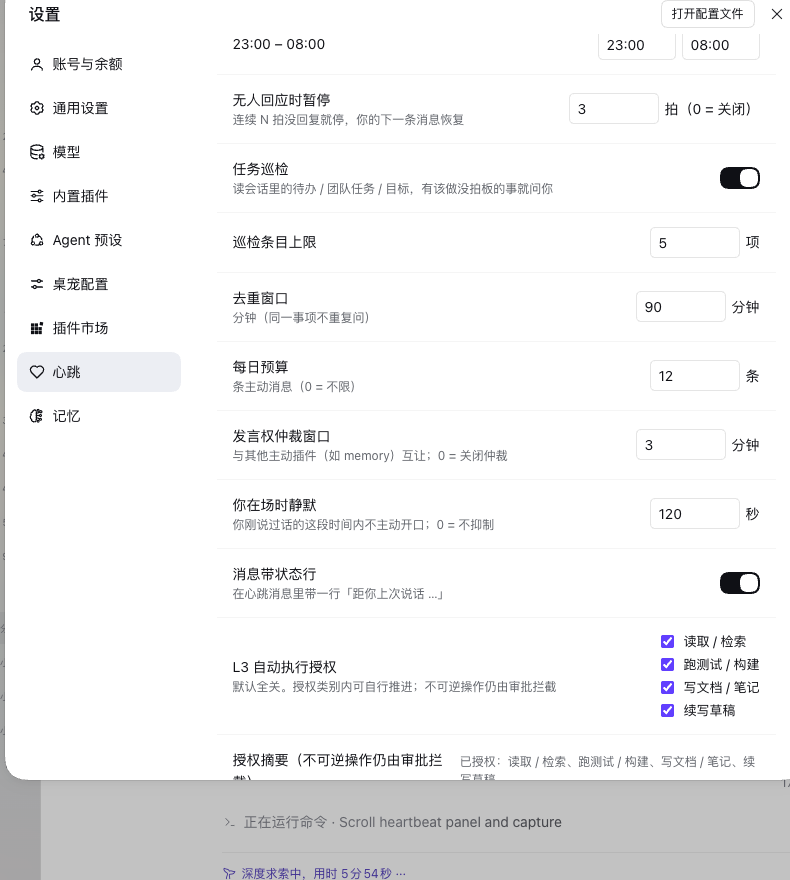
Routes (loopback, plugin-owned):
| Method | Path | Purpose |
|---|---|---|
| GET / POST | /api/heartbeat/config |
read the v2 config / patch it (validated, hot-applied) |
| GET | /api/heartbeat/status |
config summary, today's budget, per-session vitals + nextBeatAt + last 5 pulses |
| POST | /api/heartbeat/control |
{action: "beat-now" \| "snooze" \| "pause" \| "resume" \| "reset", sessionId?, minutes?} |
Every control action targets the given sessionId, or all live sessions when omitted.
The panel's wording is localised through DSH's own locale layer: the client half injects locale, registers a heartbeat namespace with zh/en packs and declares locale: 'heartbeat' on the settings section, so the panel follows Settings → General → Language and re-renders immediately when you switch the app language (it does not guess from the browser). The sidebar label follows the same setting — 中文「心跳」/ English Heartbeat — and the heart-icon claim re-runs after a language switch, so the mark always sits on the current row.
The panel can answer "why didn't it say anything?" without digging through logs: a diagnostics block lists the last 5 pulses with time, level and reason (e.g. 没有新信号, 静默时段, proactive-cooldown(让位给 memory), child-active), and shows who currently holds the speech floor from the status route's new lock field — so a quiet run is explainable at a glance. The L3 section also summarises the granted categories instead of only showing the checkboxes.
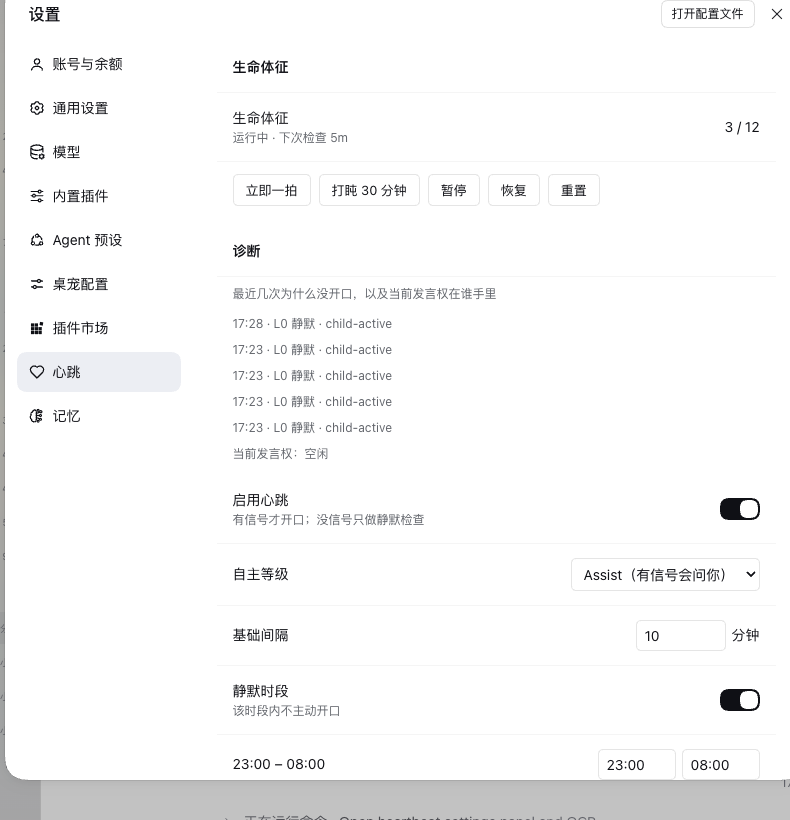
Several proactive plugins may want to speak in the same conversation. v0.7 adds a tiny shared protocol so two of them cannot talk over each other:
${DSH_HOME:-~/.dsh}/proactive-cooldown.json — { version: 1, speaker: "heartbeat" | "memory", at: <epoch ms> }, written atomically (tmp + rename);proactiveCooldownSeconds (default 180, 0 disables) and belongs to another speaker, this beat yields and records L0 · proactive-cooldown (yielded to …), then retries on a later pulse;The heartbeat is not a cron job: it has a body. L1/L2/L4 messages can carry one short line right after "why now", e.g. 〔状态:距你上次说话 2h · 今天第 3 次找你〕:
lib/physiology.js, hard-capped at 60 characters; physiologyLine (default true) is a master switch, and custom prompts can place it with the {{physiology}} placeholder;lastUserMessageAt / lastTurnEndAt / busyMsToday, so the line survives restarts;userActiveSuppressSeconds (default 120, 0 disables) makes the "you just spoke → stay quiet" window configurable; it uses the persisted lastUserMessageAt, so it also holds across restarts.
While a background subagent is still running, the conversation header can look finished.
Known host behaviour this compensates for: DSH recomputes a session list's running flag only when agents are created or disposed, and forwards child api-session/status per session resource — while the parent is idle, its view may not receive the child's run-state change, so the header may show "N sub-agents" instead of "running" and the main conversation appears complete.
The plugin now reports children: { total, running, runningIds } per session on GET /api/heartbeat/status (from the subagentCatalog / agentTeam wire views plus the live agent registry — the same host truth the runtime uses to stay silent), and the client registers a header pill 「子智能体执行中 · N」 in conversation.session.header.actions, polling every 5 s; it hides automatically once the children settle and follows the app language. Polling pauses while the browser tab is hidden and resumes immediately when you return. Pure plugin layer — no host change.

dsh plugin --profile <profile> add dsh-plugin-heartbeat(The package declares a dsh.bundle manifest, so dsh plugin add mounts it into the profile's bundles layer automatically; one-click install in dsh-market uses the same path.)
Restart DSH. Then use Settings → Heartbeat to change the mode, interval, quiet hours, dedupe window, budget, L3 grants and task inspection at any time; saving applies hot (no restart).
⚠️ Don't hand-write
- insert: {id: dsh-heartbeat, ...}into the profile'scordis.patch.yml: it collides with the bundle manifest's automatic mount and the whole profile fails to start withduplicate loader entry id "dsh-heartbeat"(real incident on 2026-08-18, colliding with the memory plugin's entry). Runtime config lives in<dshHome>/heartbeat.json; override composition keys (such asprompt) with an id-only override entry, no insert — see below.
The settings sidebar entry carries a stroked heart mark: a 16×16 grid, stroke-width: 1.3 (the shared ICON_MEDIUM_STROKE), pure-black alpha painted through mask-image so the visible colour follows currentColor in both light and dark themes. It matches the dsh-plugin-memory icon spec exactly. The official settings.section slot projects only id / order / label — there is no icon field — so the plugin claims its own nav row by the exact localized label text (心跳 or Heartbeat), mirrors it with a MutationObserver (re-claimed after a language switch — the claim key changes with the label — or a remount) and cleans everything up on dispose.
package.json declares engines.dsh: "^0.2.1-rc.5 || ^0.2.2-rc.2"; the host gates with semver (includePrerelease: true). On DSH 0.2.2-rc.2 you must upgrade to 0.8.1+: rc.2 replaced ctx.agents.roots() with agents.list(), and the old call threw inside the serial agent/created listener, which rejects agent registration — the symptom is no session can be created while the plugin is enabled. 0.8.1 reads the registry compatibly (roots() first, list() as fallback, never throws), guards every listener, and keeps the legacy semantics on older hosts; the change needs a full DSH restart.plugin:heartbeat; v4's native admission rejects the v3 {kind:'plugin', plugin:'heartbeat'} wrapper. The v4 and v3 allowlists are mutually exclusive.stateOf() returns raw state, so the subagent identity {} was treated as "this is a subagent" and no heartbeat attached at all, while the child-active gate never fired; 0.6.2 fixed that, 0.7.0 added speech-right arbitration, the physiology line and the child-activity pill, and 0.8.0 adds the diagnostics panel, panel controls for the arbitration/physiology keys and a lighter activity pill.GET /api/heartbeat/status → 200 with both live sessions (sessionId / cwd / nextBeatAt / budget / history), and /api/heartbeat/config returns the v2 config;heartbeat.json was migrated automatically (intervalSeconds → baseIntervalSeconds, plus the new mode / quiet-hours / budget fields) and heartbeat-vitals.json was created;L0 · no new signal · delivered: false vitals row while the daily budget stayed at 0 (zero injections); the 600 s / jitter 60 s config was restored afterwards;dsh plugin remove while running turned /status from 200 into 401 (route gone, no crash), and add brought it back to 200 with the session restored;snooze sets snoozeUntil, reset clears it;Heartbeat section render correctly.
Not separately verified on a live host (unit tests only): event-driven latency (≤10 s), pre-beat compaction, and a real L2 question delivery. The v0.6 autonomy layer is covered by the 186-test suite.The user config lives in <dshHome>/heartbeat.json (written by the panel or by hand; validated with schemastery). Composition config is the base layer, the user file overrides it, and a matching workspaces entry overrides both.
| Key | Default | Meaning |
|---|---|---|
enabled |
true |
master switch |
mode |
"assist" |
"assist" = speak on signals; "silent" = never speak (pulses still run and are recorded) |
baseIntervalSeconds |
600 |
base pulse interval (30–86400 s); the per-missed backoff tiers scale from it |
pauseAfterMissed |
3 |
hard stop after N unanswered beats (0 = off); your next message revives it |
backoffSeconds |
null |
explicit backoff tier array (null = derive [base, 2×base, 3×base]) |
compactBeforeBeat |
true |
fold long history into a checkpoint before speaking (best-effort) |
maxBeatsPerHour |
0 |
sliding hourly cap on delivered beats (0 = off) |
maxBeatsPerDay |
12 |
daily budget of delivered beats (0 = unlimited), shared across sessions in the process |
dedupeWindowMinutes |
90 |
never re-ask the same signal key inside this window (0 = off) |
refractorySeconds |
300 |
minimum silence after a delivery before the next beat |
jitterSeconds |
60 |
deterministic per-session jitter (0–600 s) so sessions spread out |
restartCooldownSeconds |
300 |
after a restart, stay silent this long even if signals are waiting |
quietHours |
{"start":"23:00","end":"08:00"} |
never speak inside this window (overnight windows supported; null disables) |
quietWhileChildrenActive |
true |
stay silent (L0 · child-active) while a child subagent / teammate session is still working; manual Beat now is the exception (v0.6.1) |
proactiveCooldownSeconds |
180 |
shared speech-floor cooldown against other proactive plugins (0 = off; manual Beat now bypasses) |
userActiveSuppressSeconds |
120 |
ignore signals this long after the user's last message (0 = never suppress) |
physiologyLine |
true |
include the one-line physiology signature in beats (custom prompts can place it with {{physiology}}) |
taskNudge |
true |
include the task snapshot + ask instruction in beats |
taskNudgeMaxItems |
5 |
per-bucket item cap in the task snapshot (1–20) |
l3Allow |
[] |
granted L3 categories: read / test / notes / continue |
prompt |
null |
custom prompt template ({{time}} / {{tasks}} / {{reason}} / {{physiology}}); null = built-in per-level prompt |
workspaces |
{} |
per-workspace overrides keyed by the session's absolute cwd |
A workspaces entry accepts: enabled, mode, baseIntervalSeconds, quietHours (object or null), maxBeatsPerDay, l3Allow. Precedence: composition config < user config < matching workspace override.
v1 → v2 migration: a v1 file (intervalSeconds, no version) is migrated on load — intervalSeconds becomes baseIntervalSeconds, the other fields keep their meaning, missing keys take the v2 defaults — and is written back as v2. A corrupt config file is ignored (the last good config stays in memory, defaults on the next start); unrecognised keys are not persisted. Runtime state is separate: <dshHome>/heartbeat-vitals.json.
Custom heartbeat prompt (composition config, no insert, to avoid duplicating the bundle layer):
- id: dsh-heartbeat
  config:
    prompt: |
      【Heartbeat】{{time}} — why now: {{reason}}
      {{tasks}}
Report progress/risks briefly; ask before doing anything.{{time}}, {{tasks}} and {{reason}} are substituted. A template without {{tasks}} gets the task block appended; a template without {{reason}} gets the why-now line appended.
node --testNo-arg node --test discovers test/*.test.mjs; the suite covers runtime, tasks, sensors, rhythm, gate, vitals, config-store-v2, prompt-levels, wiring-v06, settings-nav-icon, client-half, proactive-lock, physiology, prompt-physiology and activity — 186 tests at the moment; CI runs the same suite via .github/workflows/ci.yml.
Design and implementation notes live in the repo (not shipped in the npm package): docs/specs/2026-10-30-heartbeat-v0.6-design.md and docs/plans/2026-10-30-heartbeat-v0.6.md. The cross-plugin speech-floor protocol is documented publicly in docs/PROACTIVE-PROTOCOL.md; contrib/security policies are in CONTRIBUTING.md and SECURITY.md.
mode/dedupe/quiet settings if you want more voice.L0 · child-active and inject nothing until every child settles; Beat now still forces one beat.mode: "continuable" children, and a user can re-open or resume one from the sidebar as if it were a top-level chat. Per host semantics such a resumed child can count as a root (no owner), which is why attach() reads the session's subagent projection identity and skips any non-empty one (log heartbeat: skip subagent session); a running runtime also checks the identity on every tick and disposes itself if it ever finds it is on a subagent session. Real-host check: all live runtimes were user root sessions, and scanning teammate child-session logs found 0 heartbeat injections (the plugin:heartbeat strings in those logs are tool output / doc content, not injected messages). One caveat that is not the plugin's call: fork-type subagents inherit the parent's history, so a heartbeat message already present before the fork is carried into the seed — that's fork semantics; spawn-type subagents are unaffected.heartbeat-vitals.json) is process-local with atomic writes and a short debounce; two DSH processes sharing one home are best-effort, not strongly consistent.sessionProjections.onChanged; without it the plugin is timer-only (same gating, just less reactive).agent/created.agent.followup / agent.inbox — not part of DSH's public API catalog — and is pinned to DSH 0.2.x; if the host changes the implementation, at worst one beat is dropped with a warning.taskNudge: false removes both the snapshot and the inspection/ask instruction from beats.engines.dsh: "^0.2.1-rc.5" — see "Version requirements" above.MIT
CLASSIFICATION EVIDENCE
系统优先读取 GitHub Topics,再与站内分类词典和词根规则比对。当前命中: 无有效分类标签。
c1overzz
DSH 插件:每天替你刷一轮 B站,读字幕挑出值得的、写一份日报,值得的 @ 你

hellowind777
一个自主的高级智能伙伴,不仅分析问题,更持续工作直到完成实现和验证。

xing-shuyin
Just open your browser — get all your work done.