
模型与 MCP
待识别

rea
morluto
Reverse engineer anything with agents, from app behavior down to native binaries.
PROJECT TOPICS
INSTALL REFERENCE
dsh plugin --profile web add github:LexVolkov/dsh-ledger-kitty
该命令指向仓库当前默认分支;尚无绑定当前 commit 的完整验证结果。
PROJECT README

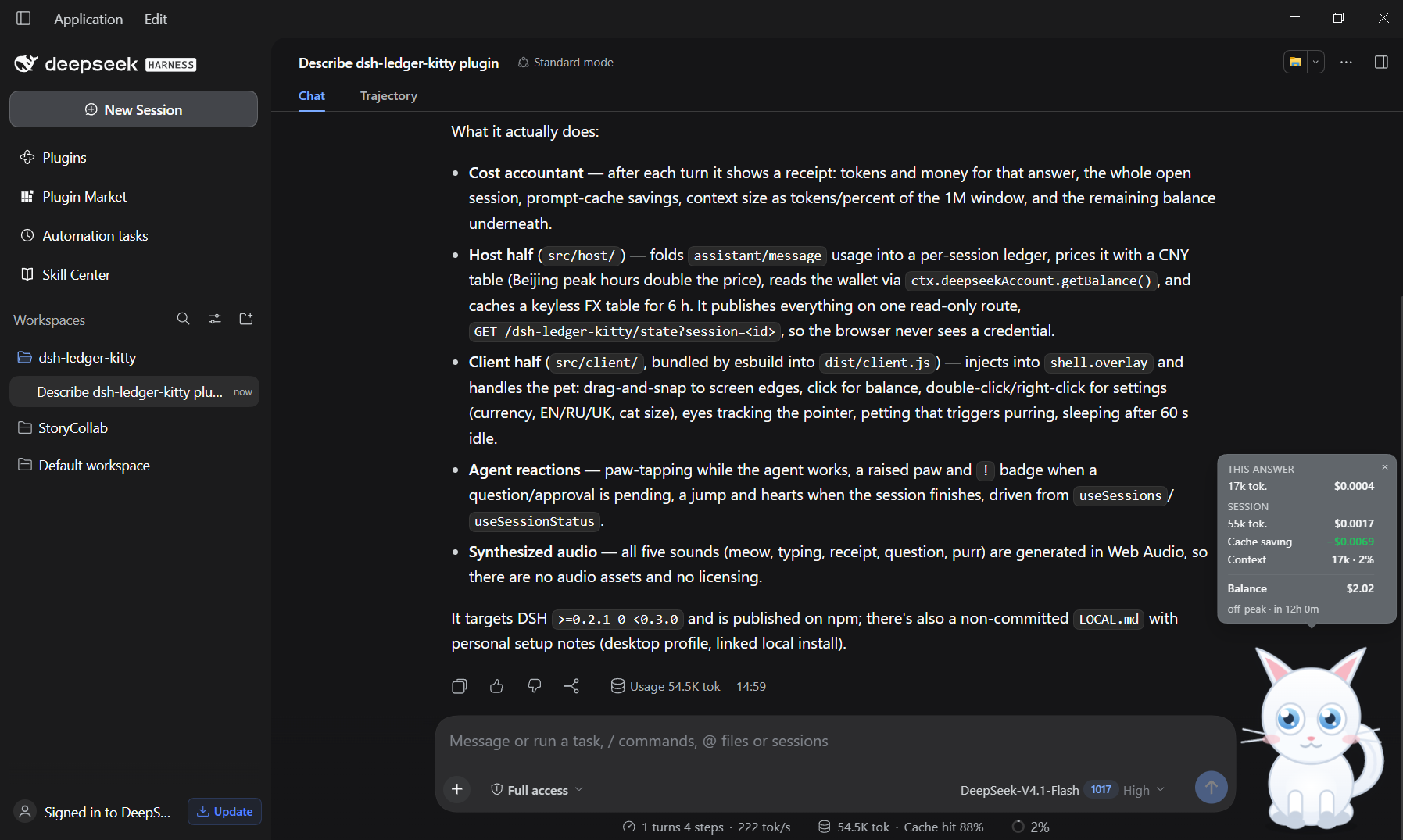
A white kitten accountant on the window sill. It is drawn as one inline SVG, so every part can be animated separately and nothing is rasterized at a fixed size; on top of that it keeps the numbers: cost of the last answer, cost of the whole open session and the remaining balance, in one chosen currency.
dblclick
unreliable on this element.STRINGS; the picker is
independent of the app locale, which only seeds the initial value.z z; any pointer movement wakes it.prefers-reduced-motion turns the looping animations off.The Host half folds every assistant/message event into a per-session ledger and
publishes it on one read-only route, GET /dsh-ledger-kitty/state?session=<id>:
{ "ok": true,
  "balance": { "CNY": 41.2, "USD": null }, "balanceReason": "ok",
  "rates": { "USD": 0.14 }, "ratesReason": "ok",
  "session": { "tokens": 1204000, "cost": 0.82, "saved": 0.25,
               "last": { "tokens": 12480, "cost": 0.013, "context": 400000 } },
"peak": false, "nextChangeAt": 1792770000000, "contextWindow": 1000000 }cacheReadTokens × (miss − hit)), the context size as tokens and percent of
the 1M window, and the remaining balance underneath.$0.00.непик · через 1 ч 15 мин: the Host
returns the next Beijing price boundary (nextChangeAt), so the cat tells you
when the cheap tariff starts.inputTokens, cacheReadTokens,
outputTokens) times the CNY price table; weekday peak hours in Beijing
(09:00–12:00, 14:00–18:00) double the price.https://open.er-api.com/v6/latest/CNY
(keyless), caches it for six hours and includes the whole table in the state
payload. There is no manual rate field: if the request fails the previous table
is kept, and a unit without a quote shows “—”.ctx.deepseekAccount.getBalance() — the DSH account login,
no API key needed. Without a signed-in account the card shows “—”.The cat watches the agent through the standard Slot hooks useSessions and
useSessionStatus (root-scope hooks provided by ui-session); it reads only the
main-view session, so a background subagent does not make it celebrate.
! badge appears and the bubble says “Нужен твой ответ”.All five effects are synthesized in Web Audio (src/client/audio.js): no audio files, no licensing, nothing to download.
| Sound | When | How it is made |
|---|---|---|
meow |
click on the cat | sawtooth with a pitch envelope through a band-pass formant |
typing |
agent working | low sine thump (88→58 Hz), a dark noise body (~1.2 kHz low-pass) and a small band-passed click (~2.4–3.1 kHz); spacing is random: 150–400 ms, quick doubles, occasional 0.65–1.5 s pauses |
receipt |
the receipt appears | two sine notes, 880 → 1320 Hz |
question |
a question or approval is pending | two triangle blips, 660 → 990 Hz |
purr |
the head is stroked | filtered noise amplitude-modulated at 26 Hz, looping until the stroke ends |
Settings open with a Звуки button that leads to its own sub-menu: a
checkbox per sound, a ▶ preview button beside each one, a master volume
slider and the autoplay hint. A preview plays even when that sound's checkbox
is off, so a switch can be auditioned before it is enabled (typing previews
three ticks, the purr runs for 1.3 s). Browsers only allow audio after a user
gesture, so the AudioContext is created and resumed on the first pointer-down
or key press anywhere in the app; until then the cat is silent and the panel
says so.
The state is a pure function of two snapshots (readAgentState), so the pet adds
no polling and no Host traffic.
Both Standard hooks are selector hooks (useSessions(selector) /
useSessionStatus(selector)), implemented with useSyncExternalStoreWithSelector,
which calls selector(snapshot) unconditionally. Calling either one without a
selector throws selector is not a function during render, and the slot renderer
then removes the whole entry — the cat disappears without a visible error. The
plugin therefore passes an identity selector (selectSnapshot) and runs the
watcher in a child behind an error boundary, so a future hook change can only
cost the reactions, never the cat.
The cat is a rig, not a picture: head, ears, tail, body and four legs are separate groups. Movement is CSS transforms on those groups, so:
A PNG (or sprite-sheet) sequence only wins when the art needs painted texture
(fur, watercolor, pixel art). Then 8–12 frames per action are stored and played
with steps(). The behavior layer would stay the same; only the art layer would
be swapped.
Every leg already sits in its own group (.dpp-leg-fl, .dpp-leg-fr,
.dpp-leg-bl, .dpp-leg-br), so the next step is:
Agent reactions, the receipt and the sounds are already in place.
The loader accepts exactly one browser artifact per package, so the sources are
ES modules under src/ and esbuild bundles them into dist/client.js.
index.js                  Host entry: re-exports src/host
src/host/
  index.js                apply(ctx): subscriptions + route
  pricing.js              prices, peak hours, token total
  ledger.js               usage fold, per-session ledger, log seeding
  balance.js              account wallet reader (30 s cache, failure reasons)
  rates.js                keyless FX table (6 h cache, stale fallback)
  route.js                GET /dsh-ledger-kitty/state
src/client/
  index.js                createPlugin(require): locale + slot registration
  runtime.js              lazy React surface (initRuntime)
  constants.js            sizes, storage keys, symbols
  store.js                localStorage + legacy key migration
  format.js               tokens, money, currency conversion
  geometry.js             clamp / default position / edge snap
  agent.js                readAgentState + AgentWatcher
  styles.js               all CSS
  i18n/{en,ru,uk}.js      dictionaries, i18n/index.js assembles them
  ui/cat.js               the SVG character
  ui/pet.js               container: state, effects, handlers
  ui/pet-view.js          render tree
  ui/card.js              balance / receipt card
  ui/settings.js          settings panel
  ui/boundaries.js        error boundaries (built lazily)
dist/client.js            build output, served to the page
assets/                   cat art, storefront icon, screenshot
screenshots.json          storefront gallery (1-8 paths)
npm install # once, installs esbuild
npm run build # src/ -> dist/client.js
npm run watch # rebuild on saveclient-hmr watches dist/client.js, so after a build the running page swaps the
plugin by itself; a Host change still needs an app restart.
| Want to change | Where |
|---|---|
| The cat | src/client/ui/cat.js — one SVG, viewBox 0 0 120 140 |
| Fur / eye colors | the gradients dpp-fur, dpp-iris, dpp-belly in cat.js |
| Speech lines | src/client/i18n/{en,ru,uk}.js (line.1 … line.6) |
| Card / menu wording | the same dictionaries |
| Sizes | SIZES in src/client/constants.js |
| Sleep delay | SLEEP_AFTER_MS in constants.js |
| Edge snap distance | SNAP_ZONE in constants.js |
| Motion | src/client/styles.js: dpp-idle, dpp-hop, dpp-breathe, dpp-sway, dpp-twitch-* |
| Prices / peak hours | src/host/pricing.js |
| Route path | src/host/route.js (and fetchState in src/client/format.js) |
package.json declares dsh.bundle.patch (Host row) and dsh.client
(browser half: platform: "web", immediately: true), with
exports["./client"] pointing at the built dist/client.js.window.__ModuleLoader__.load, then
ctx.slots.inject('shell.overlay', () => ctx.slots.register(...)).createPlugin(require) hands it to
initRuntime() before the first render.locale service and the pet's own language picker.Requires DSH >=0.2.1-0 <0.3.0, declared as engines.dsh.
dsh plugin --profile web add dsh-ledger-kittyListed in the DSH plugin catalog since 2026-10-24, category Usage & Billing: catalog page · npm. The storefront gallery is driven by screenshots.json.
For local development the profile can link this directory instead; after
npm run build the page reloads the plugin, while a Host-side change needs an
app restart.
version in package.json.npx -y npm@12 stage publish --access public, then approve the staged
version on https://www.npmjs.com/package/dsh-ledger-kitty (2FA).repository field, so no catalog PR is needed for an update.MIT for the code; the artwork is original SVG drawn by this plugin.
CLASSIFICATION EVIDENCE
系统优先读取 GitHub Topics,再与站内分类词典和词根规则比对。当前命中: deepseek-harness。
morluto
Reverse engineer anything with agents, from app behavior down to native binaries.

deepseek-ai
DeepSeek Harness: Everything is a Plugin.

nexu-io
The 1st Collaborative AI Design Agent Workspace. Local-first and open source. Create motion, prototypes, websites, apps, dashboards, presentations, images, and videos with your team and AI agents. Share work, exchange feedback, and iterate together in one workspace.