
文件与数据
渠道适配

WeKnora
Tencent
Open-source LLM knowledge platform: turn raw documents into a queryable RAG, an autonomous reasoning agent, and a self-maintaining Wiki.
PROJECT TOPICS
INSTALL REFERENCE
dsh plugin --profile web add github:LeemanCheung/dsh-image-gen
该命令指向仓库当前默认分支;尚无绑定当前 commit 的完整验证结果。
PROJECT README




Generate images in DeepSeek Harness with OpenAI gpt-image-2.5-flare (or gpt-image-2.5-sunburst and gpt-image-2), using a signed-in Codex subscription by default or an API key when explicitly configured.
Linked development installs also resolve Codex Connect from the active DSH Profile. This uses the connector's public store, including its selected account in the current multi-account format, instead of mistaking an inaccessible optional dependency for a signed-out account. The same path has been verified against the installed Profile without displaying credential values.
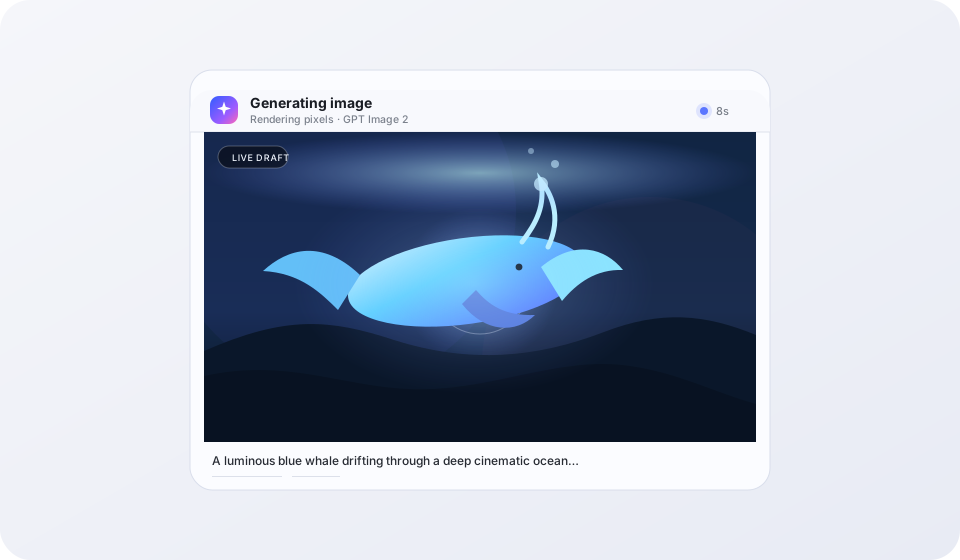
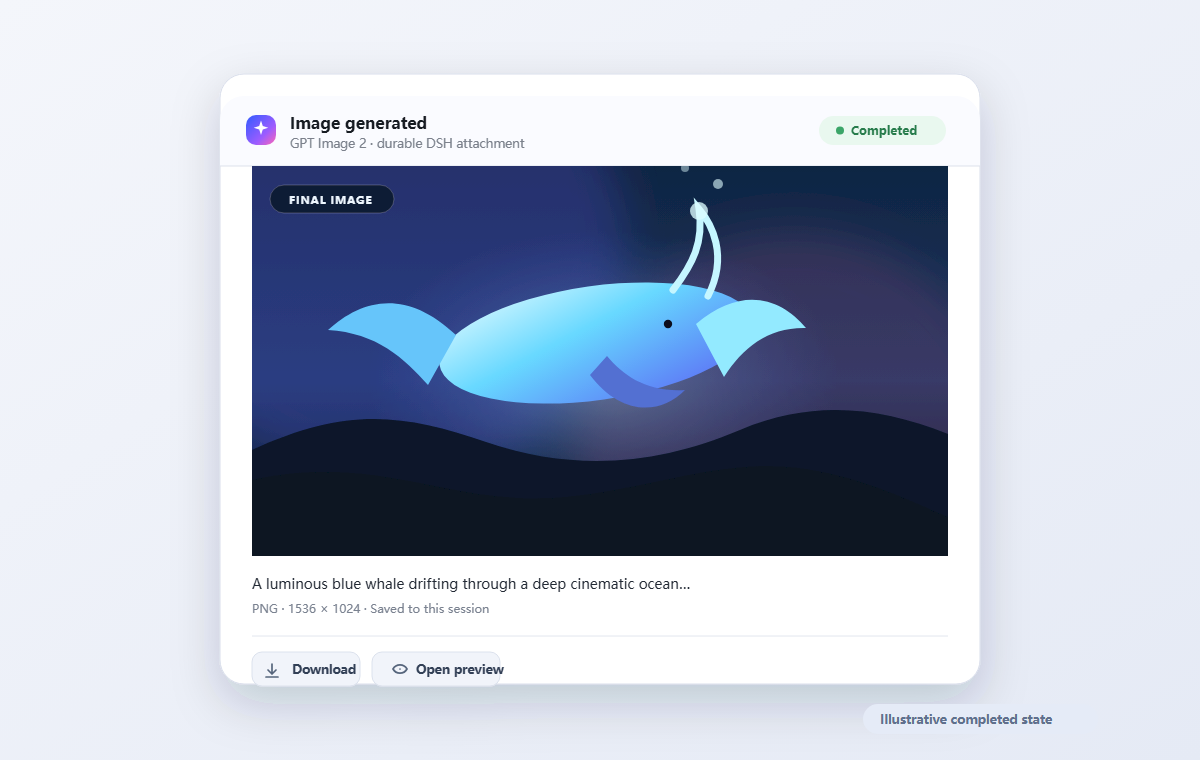
These illustrations mirror the shipped developing and completed card states. API-key mode can replace the light field with real streamed drafts; Codex subscription mode animates until its non-streaming response arrives. The completed state remains available as a durable DSH attachment with preview and download controls.
| Area | Delivered behavior |
|---|---|
| Tool and access paths | Exposes the Codex-compatible image_gen tool for gpt-image-2.5-flare, gpt-image-2.5-sunburst, and gpt-image-2; defaults to refreshable dsh-codex-connect subscription OAuth and can explicitly use a DSH API-key credential. |
| Progressive experience | Subscription requests show a developing animation until their non-streaming result; API-key requests can show up to three provider-sent partial images, cross-faded in place. |
| Durable results | Saves only the completed image as a DSH immutable attachment, so the same card can replay, preview in a lightbox, and download after a session reload. |
| Conversation compatibility | Returns text-only tool output to the model while retaining the image reference in UI metadata, including for nested Code Mode calls. |
| Safety boundaries | Resolves credentials per request, pins the subscription endpoint, rejects redirects, bounds response sizes and concurrency, validates image bytes through DSH, and retries only transient failures. |
image_gen.gpt-image-2.auto, low, medium, high, xhigh, max); both access paths accept the aliases, and the subscription endpoint budgets its own output from the requested tier.dsh-codex-connect; no OPENAI_API_KEY is required for Codex subscription mode.prefers-reduced-motion support.OpenAI Codex's built-in image_gen tool hardcodes gpt-image-2, calls the ChatGPT Codex Images endpoint with subscription OAuth, records one working state, and saves the completed image under Codex's generated-images directory. Its public backend currently requests a non-streaming JSON response and its UI does not expose a distinctive diffusion animation.
dsh-image-gen keeps the compatible image_gen name and improves the visible process:
| Experience | Codex | dsh-image-gen |
|---|---|---|
| GPT Image 2 (subscription endpoint) | Yes | Yes |
| GPT Image 2.5 Flare / Sunburst | No | Selectable per call or per deployment on both access paths |
GPT Image 2.5 xhigh / max quality |
No | Accepted and forwarded; the subscription endpoint still serves its own quality |
| Progressive provider frames | Subscription path is currently non-streaming | Subscription animation; API-key mode supports up to 3 live frames |
| Before first frame | Generic working state | Animated developing plate, scan, and light field |
| Frame transition | Generic activity | In-place cross-fade and focus development |
| Final result | Saved image | Durable DSH attachment, replay, lightbox, download |
| Text-only model compatibility | Not applicable to DSH history | Model receives text; image reference stays in UI metadata |
| Reduced motion | Platform dependent | Explicitly supported |
Primary references:
Verified environment:
0.1.5-rc.1 (real Web host boot from this repository, plugin-tree load, image_gen registration, served client module, plus typecheck, deterministic build, tests, and package smoke)0.1.2-rc.1 (QA Web Profile load, plugin enablement, Host image_gen registration, Client tool-view load, and historical generated-card replay)dsh-codex-connect 0.1.0-alpha.4.34 for the live subscription runs (0.1.0-alpha.4.4 was the version verified for the 0.3.x releases)24.15.0 (package support: ^22.19.0 or >=24.0.0)The machine-readable manifest still records only 0.1.2-rc.1 as compatible (>=0.1.2-rc.1 <0.1.3-0). The 0.1.5-rc.1 result above is a separately recorded host integration check; it has not widened that manifest range or established compatibility with intervening/newer releases. CI uses the exact DSH peer versions resolved by package-lock.json.
The 0.3.2 release introduced the 0.1.2-rc.1 compatibility record and stopped inheriting alpha-build claims. The earlier 0.1.2-alpha.5 lifecycle result belonged to dsh-image-gen 0.3.1; it is retained as history. The compatible rc.1 manifest entry records the verified DSH Host/Client/tool-view integration above. A fresh subscription generation on rc.1 had reached the provider but returned HTTP 403; later, on DSH 0.1.5-rc.1, the subscription path returned HTTP 200 for gpt-image-2.5-flare and gpt-image-2.5-sunburst (2026-09-11). Those provider results apply to their recorded environments.
Issue #6 reported attachment.originalDimensions is not a declared property with plugin 0.1.7 and DSH 0.1.1-rc.2. The current 0.4.1 implementation projects saved and re-read attachments to the plugin's declared fields; a keyless regression verifies strict output-schema validation when the Host returns extra metadata. This does not establish backward compatibility with 0.1.1-rc.2. For a current reproduction, include the exact DSH, plugin, and Node.js versions and the redacted error.
Version 0.4.0 adds GPT Image 2.5 support (gpt-image-2.5-flare / gpt-image-2.5-sunburst, a per-call model, and the xhigh / max quality tiers). The keyless suite verifies the request shaping; live Codex subscription requests then confirmed the private endpoint accepts both 2.5 aliases, so the subscription path defaults to gpt-image-2.5-flare too. The real subscription runs used the signed-in ChatGPT quota, not a billed API account, so no API billing was incurred.
The same release fixes a real DSH mount failure that mocked tests could not see. connection.rpc.handle() registers the plugin's loopback route through webServer.register(), and on DSH 0.1.5-rc.1 the connection loader entry carries webRuntime but not webServer, so the whole plugin tree failed at boot with cannot get property "webServer" without inject. Because a loader entry — not a module's exported inject array — owns the runtime capability boundary, cordis.patch.yml now grants webServer to the connection entry and declares the plugin's own services. Verified by booting a real DSH Web host from this repository with an empty profile patch: the plugin tree loads, the server answers HTTP 200, and the served client module is this build.
Review third-party source before installation and pin release tags or commits. For the default keyless subscription path, install Codex Connect, sign in once, then install this plugin:
dsh plugin --profile web add dsh-codex-connect
dsh openai-codex login
dsh plugin --profile web add github:LeemanCheung/dsh-image-gen#v0.4.1
v0.4.1 is the current release (GPT Image 2.5 support plus the image-read recovery fix). For production, pin the exact commit you reviewed (.../dsh-image-gen#<sha>) rather than a moving branch; main carries unreleased work between tags.
This repository does not publish to npm. The npm package named dsh-image-gen belongs to a different project by another author, so npm install dsh-image-gen or a bare dsh plugin add dsh-image-gen will not install this plugin. Install from this GitHub repository.
For local development:
git clone https://github.com/LeemanCheung/dsh-image-gen.git
cd dsh-image-gen
npm install
npm run check
dsh plugin --profile web add .
The repository commits lib/index.js and lib/client.js, so a pinned Git install does not need to run a dependency build script. Restart the DSH Host after installation and refresh the Web page.
authMode: auto is the default. It first asks the installed dsh-codex-connect package for its DSH-owned, refreshable ChatGPT OAuth credential and sends it only to the fixed first-party endpoint https://chatgpt.com/backend-api/codex/images/generations. If Codex credential resolution, compatibility checking, or refresh fails for any non-cancelled reason, it then tries the DSH credential reference named by apiKeyEnv (default OPENAI_API_KEY); if neither works, it returns the combined failure. codex-subscription never falls back.
Use authMode: codex-subscription to forbid API-key fallback, or authMode: api-key to use only the configured Images API account. Never put an OAuth token or API key in cordis.patch.yml, chat messages, Git, or screenshots. The plugin resolves authentication for every generation and does not retain it after the request.
Ask naturally in a DSH conversation, for example:
Generate a cinematic 16:9 product photograph of a translucent mechanical keyboard on a dark glass desk, violet rim light, no text.
The model calls image_gen. While it runs, the card shows the developing animation. API-key mode replaces the light field with each real streamed partial; Codex subscription mode reveals the final image when its JSON response arrives. DSH's existing interrupt control cancels the request. The settled card supports preview and download.
Tool options:
prompt: detailed generation instructions, 1–32,000 characters and at most 64,000 UTF-8 bytes.model: optional provider image model for this call, such as gpt-image-2.5-flare, gpt-image-2.5-sunburst, or gpt-image-2. Omit it to use the deployment model, or the subscription default when the subscription path is active. It accepts letters, digits, and . _ : - up to 128 characters. Both access paths accept the GPT Image 2.5 aliases.reference_image_path: optional PNG, JPEG, or WebP path. DSH asks for one-time approval naming the file and upload origin before reading it. The bytes are validated without storage, sent only to the API-key /images/edits endpoint, and committed as a durable audit attachment only after the Provider succeeds. This mode needs authMode: api-key, or auto with an API-key fallback; the private Codex subscription endpoint is not treated as an edit API.size: auto or arbitrary WIDTHxHEIGHT accepted by GPT Image 2.x: each edge divisible by 16, no edge above 3840, aspect ratio 1:3–3:1, and 655,360–8,294,400 total pixels.quality: auto, low, medium, high, xhigh, or max. GPT Image 2 accepts the first four; xhigh and max are GPT Image 2.5 tiers and are rejected by the provider on older image models.output_format: png, jpeg, or webp in API-key mode. Codex subscription mode currently returns PNG.output_compression: 0–100 for API-key JPEG/WebP only.background: auto, opaque, or transparent. Transparent output is a preview feature of the public Image API, requires API-key mode, and supports PNG/WebP but not JPEG.Completed results keep the request and result distinct. size is derived from the validated final image bytes; requestedSize / requestedQuality preserve the call settings. qualitySource says whether the displayed quality came from Provider metadata or is only the requested fallback. model reports the model that actually served the request.
The bundle inserts the image-gen row with safe defaults. Override it in the selected profile's cordis.patch.yml:
- id: image-gen
  name: dsh-image-gen
  config:
    authMode: auto # auto | codex-subscription | api-key
    apiKeyEnv: OPENAI_API_KEY
    baseUrl: https://api.openai.com/v1
    model: gpt-image-2.5-flare
    defaultSize: auto
    defaultQuality: auto
    defaultOutputFormat: png
    defaultOutputCompression: 90
    defaultBackground: auto
    moderation: auto
    partialImages: 3
    requestTimeoutMs: 120000
    maxRetries: 2
    retryBaseMs: 1000
maxConcurrent: 2baseUrl, model, moderation, partialImages, output compression, and API pricing apply only to API-key mode. The default model is gpt-image-2.5-flare; set it to gpt-image-2.5-sunburst for edit-heavy work or to gpt-image-2 to stay on the older model. Codex subscription mode serves gpt-image-2.5-flare by default, accepts a per-call model, uses the fixed first-party Codex endpoint, returns PNG, and never sends OAuth to baseUrl. Configuration fails at load for an invalid provider URL, model, or default image size. Plain HTTP is accepted only for loopback development endpoints. Every credential-bearing request uses redirect: "error".
A live subscription request on DSH 0.1.5-rc.1 (2026-09-11) confirmed that the private Codex endpoint accepts gpt-image-2.5-flare and gpt-image-2.5-sunburst; every probe returned HTTP 200 and echoed the requested model back. The endpoint does not honor the requested size and quality literally. It picks the delivered size and quality itself, and its own quality budget follows the requested tier: high returned 1774x887 with 1030 image-output tokens, while max returned 1536x1024 with 1372 tokens. The same tier therefore costs and returns more than the API-key path's documented per-tier counts, and results always describe the returned facts while requestedSize / requestedQuality keep the call's request.
Create a DSH credential named by apiKeyEnv (default OPENAI_API_KEY) or export that environment variable before starting the DSH Host, then set authMode: api-key. Never put the secret in the profile patch.
A custom baseUrl must expose <baseUrl>/images/generations and, when reference_image_path is used, <baseUrl>/images/edits. Both endpoints return an OpenAI-compatible data[0].b64_json response; generations may instead stream SSE image_generation.partial_image / image_generation.completed events carrying b64_json. It must be HTTPS outside loopback.
| Setting | Accepted range / behavior |
|---|---|
partialImages |
0–3; API-key mode only. |
requestTimeoutMs |
10,000–300,000 ms for the whole operation. |
maxRetries |
0–5; total attempts are maxRetries + 1. |
retryBaseMs |
100–30,000 ms before bounded exponential backoff. |
maxConcurrent |
1–8; an operation at the limit is rejected immediately rather than queued. |
Only transient provider failures (429, 5xx, retryable protocol/response errors, and network failures) are retried. Provider moderation and user-input errors fail immediately.
Codex subscription calls consume the image-generation allowance associated with the signed-in ChatGPT plan. API-key calls are billed by the selected model, quality, and size; each requested partial costs additional image-output tokens according to the provider guide. GPT Image 2.5 keeps the token rates of GPT Image 2 but consumes a different number of image-output tokens per quality tier — xhigh and max cost more than GPT Image 2's former high. partialImages does not apply to subscription mode.
https://chatgpt.com/backend-api/codex/images/generations; API-key mode sends them to baseUrl. An approved reference edit also uploads the validated reference bytes to that configured API origin.dsh-codex-connect for its DSH-owned OAuth credential; API-key mode resolves the configured DSH credential reference. Neither secret is stored in plugin state, logs, metadata, or session history.reference_image_path only after DSH records a one-time approval for that exact tool call.OpenAI Codex is signed outInstall dsh-codex-connect, sign in from its DSH settings page or run dsh openai-codex login, then retry. Never paste the OAuth token into chat.
No credential is configured for OPENAI_API_KEYThis appears in explicit API-key mode, or after automatic Codex fallback. Configure the credential for the DSH Host process or switch to a signed-in Codex subscription. Never send the key in chat.
Revise the prompt. The plugin does not retry provider moderation or user-input errors.
Refresh the page. If the card still cannot load, inspect Host logs and verify that the profile still mounts dsh-image-gen and its attachment store is available.
dsh plugin --profile web why dsh-image-gen
dsh --profile web --dump-configIncrease requestTimeoutMs within its 10–300 second range or select a lower quality. API-key mode can also use JPEG. DSH interruption still aborts the upstream request.
Before changing a production profile, take a DSH config snapshot when the undo plugin is installed. To uninstall:
dsh plugin --profile web remove dsh-image-genRestart the DSH Host and refresh the page. Existing image records remain in session history; their custom card requires the plugin to be installed.
npm install
npm run typecheck
npm test
npm run build
npm pack --dry-run
The keyless suite uses deterministic mocked SSE/JSON responses and a local redirect server. It covers both authentication modes without reading real secrets, including the GPT Image 2.5 model and xhigh / max quality request bodies. Real-provider checks are manual because they consume a Codex subscription allowance or bill an API account. The 0.2.0 release was manually verified with one signed-in Codex subscription generation and cold-session browser replay.
For the 0.4.0 work, npm run check covered typecheck, 51 keyless tests, the deterministic build, the built-artifact smoke (which now also asserts the loader-entry grants), and publint. Beyond that: a real DSH 0.1.5-rc.1 Web host booted from this repository with an empty profile patch, and live Codex subscription requests exercised gpt-image-2.5-flare / gpt-image-2.5-sunburst with the high and max tiers. Those live runs drew on the signed-in ChatGPT quota.
The build emits:
lib/index.js: Host Cordis plugin.lib/client.js: browser module-loader bundle.lib/client.js.map: browser source map.approval: never sessions reject such uploads.xhigh / max tiers, but it ignores the literal requested size and quality and serves its own (2026-09-11 runs: 1774x887 / 1030 tokens at high, 1536x1024 / 1372 tokens at max). It is still not documented as an Image API edit endpoint, so subscription reference edits and public-API-only output options stay disabled.size and quality shape the provider's own budget rather than a literal request, so the same tier can deliver a different size and cost than the API-key contract documents.0.4.1 treats that case as recoverable rather than terminal: the Host keeps the just-generated reference for servedResultTtlMs (default 5 minutes; never a long-term authorization path), answers with a distinct pending reason, and the card retries with bounded backoff before showing an actionable message. Set servedResultTtlMs: 0 to make the session store the sole authority at every moment.gpt-image-2.5-flare and gpt-image-2.5-sunburst; a real API-key call and gpt-image-2 on the subscription endpoint remain unverified.See SECURITY.md for private reporting. Do not include OAuth tokens, API keys, private prompts, or generated private images in a public issue.
CLASSIFICATION EVIDENCE
系统优先读取 GitHub Topics,再与站内分类词典和词根规则比对。当前命中: gpt-image-2、gpt-image-25、image-generation。
Tencent
Open-source LLM knowledge platform: turn raw documents into a queryable RAG, an autonomous reasoning agent, and a self-maintaining Wiki.

liustack
The first vision plugin for DeepSeek Harness, and the vision bridge for every text-only coding agent. Paste an image, get structured JSON evidence (OCR, layout, semantics). | 全网最强 DeepSeek Harness 外挂视觉插件,为 DeepSeek、GLM 等纯文本模型外挂视觉能力,粘贴图片即得结构化 JSON 证据(OCR、版面、语义)。

dream-num
An open-source Office workspace where people and AI agents create, collaborate, and review together.