模型与 MCP
待识别

rea
morluto
Reverse engineer anything with agents, from app behavior down to native binaries.

Kachchi3739/dsh-fallback
Router fallback and pooled opencode-go accounts for DeepSeek Harness: when the active router exhausts its quota, the same request continues on the next connected router. Host interceptor + dsh-desktop Web UI panel.
PROJECT TOPICS
INSTALL REFERENCE
dsh plugin --profile web add github:Kachchi3739/dsh-fallback
该命令指向仓库当前默认分支;尚无绑定当前 commit 的完整验证结果。
PROJECT README
Router fallback for DeepSeek Harness (dsh / dsh-desktop).
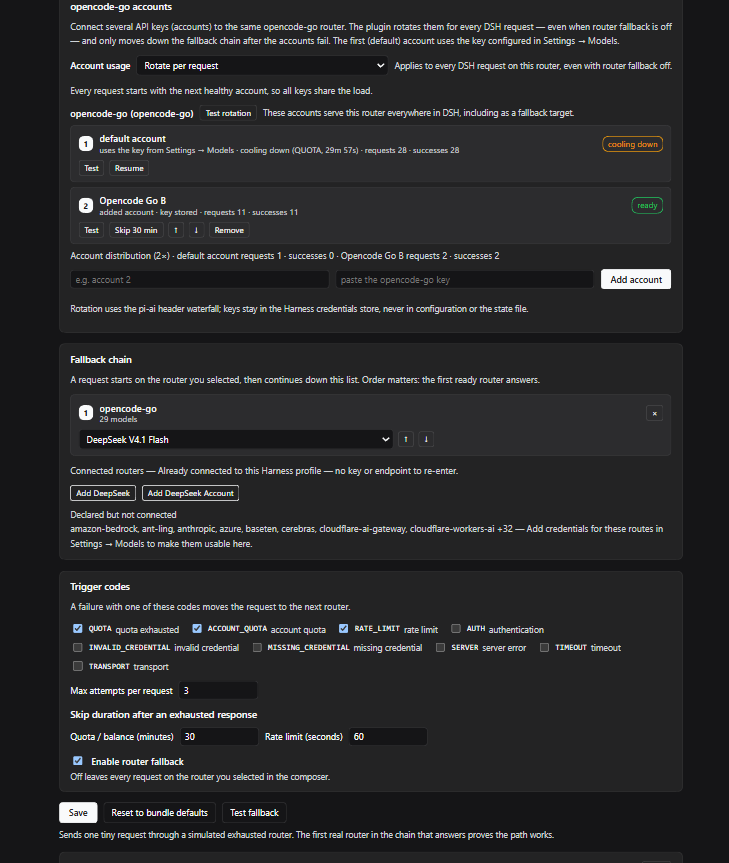
When the router (LLM provider route) the current request is using reports an exhausted quota or limit, the same request continues on the next router in your fallback chain — with no re-typed API keys, no second credential store, and no app restart. The chain is built from the routers already connected to your Harness profile.
QUOTA, ACCOUNT_QUOTA, or RATE_LIMIT is re-dispatched to the next ready
router in the chain. The terminal failure only reaches the conversation when
no router can answer.opencode-go, opencode,
deepseek-account, deepseek-official, custom gateways, …) together with
each route's own model catalog. Adding a router to the chain needs no key,
endpoint, or model list.opencode-go (or opencode) accounts to the same router. The plugin rotates
the account key through the documented llm-pi-ai/request-headers waterfall
for every DSH request on that route — including ordinary chats, subagents,
and the route's turn as a fallback target — even when router fallback is off.
Choose rotate-per-request (default), sticky-per-session, or priority/failover;
an exhausted account gets its own cooldown and falls through to the next
account before the chain moves on. Keys live in the Harness credentials store
— never in configuration or the state file. Accounts are tested, skipped,
resumed and reordered from the panel.RATE_LIMIT uses a short window, quota/balance codes use a
longer one; a provider-supplied retry-after always wins.off level, so a
fallback is not rejected for missing another provider's thinking blocks.A bundle install links this directory into the running profile; no build step,
no dependencies, no @deepseek-ai package imports.
plugin_manager install_bundle <absolute path to this directory>or from a shell with the plugin manager available:
dsh plugin install /path/to/dsh-fallbackAfter the first install, refresh the app window (or restart dsh-desktop) so the Web shell loads the new client module. Afterwards an entry named Router fallback / 라우터 폴백 appears in the left sidebar panel row.
Use the selected model keeps the model id you
selected in the composer (useful when the same model is served by several
routers); otherwise choose an explicit model.Requests start at the router selected in the composer and walk down the chain. If the selected router is not in the chain, it is tried first and the chain is used as its fallback list. Routes in cooldown are skipped.
In the opencode-go accounts section:
OPENCODE_GO_API_KEY in the profile).DSH_FALLBACK_OPENCODE_GO_* reference; the account joins the pool in the
order shown (use ↑/↓ to change it).The account pool works independently of the Enable router fallback switch:
turning fallback off disables the chain, not the account rotation. maxAttempts
still caps the total attempts (accounts plus chain), so raise it when you pool
more accounts than that. Rotate-per-request gives every key an equal share; if
the provider caches prompts per key, sticky-per-session keeps cache hits while
still spreading different conversations across accounts.
Because rotation happens at the pi-ai header seam, it works for every model on
the route — including anthropic-messages models (x-api-key) and
google-generative-ai models (x-goog-api-key). The plugin reads the model →
protocol map from the pi-ai catalog shipped with the running Harness and keeps
an embedded snapshot for installations where that catalog cannot be read.
Account keys are only written to the Harness credentials store. Deleting an account removes its key reference; the plugin never logs a key, and the state file contains labels and references only.
The bundle row's config is the deployment default (empty chain, quota codes,
3 attempts). Everything edited from the panel is stored as overrides in the
profile's state file so the user's cordis.patch.yml is never rewritten:
<DSH_HOME>/fallback/state.json # e.g. C:\Users\<you>\.dsh\fallback\state.jsonThe file contains provider/model ids, failure codes and timings — no credentials. Deleting it resets the chain and all counters; a malformed or missing file simply falls back to the bundle defaults.
| Setting | Default | Meaning |
|---|---|---|
| Enable router fallback | on | Off disables the chain; pooled accounts still rotate. |
| Fallback chain | empty | Ordered routers; first ready one answers. |
| Account usage | rotate per request | How pooled keys are chosen: rotate, sticky per session, or priority/failover. |
| Trigger codes | QUOTA, ACCOUNT_QUOTA, RATE_LIMIT |
Failures that move the request to the next router. |
| Max attempts per request | 3 | Hard cap including the selected router. |
| Quota/balance skip | 30 min | Cooldown after QUOTA/ACCOUNT_QUOTA, unless the provider reports retry-after. |
| Rate-limit skip | 60 s | Cooldown after RATE_LIMIT. |
The Host half attaches one llm/stream waterfall listener (a documented,
interceptable seam of @deepseek-ai/dsh-llm; the plugin imports no Harness
package). For each model call it plans the attempt list, dispatches the first
attempt through the normal adapter path, and only re-dispatches
{...request, provider, model} when the attempt failed with a trigger code
before any content became visible. Everything else — session log, streaming,
tool calls, turn errors — is the shipped behavior.
Pooled accounts are an attempt dimension on the same route, applied to the
selected route and to every chain route that supports accounts. Before each
call the pool orders its healthy accounts — round-robin, sticky per session, or
the configured priority — and each attempt carries its own health key, followed
by the chain. Each attempt's key is carried into
llm-pi-ai/request-headers through Node's async-local storage, because that
waterfall receives only routing metadata. Writing the protocol's auth header
there overrides the route's configured key for that request only (verified
against the live pi-ai adapter: a wrong contributed key fails with AUTH).
Known consequences of doing this at the LLM seam:
RATE_LIMIT is also in the default Harness retry set, so a
fallback-capable chain answers faster than the retry backoff.[dsh-fallback: fallback chain exhausted] suffix on the message.AUTH to the trigger codes if an invalid
account key should fall through to the next account/router instead.opencode-go and opencode; the underlying
key override works for any pi-ai route, but the panel intentionally limits
the list. Model → protocol mapping prefers the installed pi-ai catalog and
falls back to an embedded snapshot; an unknown model is assumed
OpenAI-compatible (authorization: Bearer).deepseek-official may advertise no model catalog in some profiles; it can
still be added with Use the selected model.Pure Node.js ESM; no bundler and no dependencies.
node --test --test-isolation=none "test/*.test.mjs"lib/engine.mjs — attempt planning, failure classification, cooldowns,
reasoning-history sanitization, the buffering stream runner (pure, unit
tested).lib/accounts.mjs — the pooled-account model, credential references and
validation.lib/rotation.mjs — rotate/sticky/failover account ordering (pure, unit
tested).lib/providers.mjs — live provider/model discovery over the llm service.lib/probe.mjs — the quota probe adapter and self-test request.lib/state.mjs — durable overrides, health and event log.index.js — Cordis wiring, interception, self-test, HTTP API.client.js — the Web UI page (plain React from the host module table).MIT — see LICENSE. Third-party attribution is in THIRD_PARTY_NOTICES.md.
CLASSIFICATION EVIDENCE
系统优先读取 GitHub Topics,再与站内分类词典和词根规则比对。当前命中: llm、deepseek-harness。
morluto
Reverse engineer anything with agents, from app behavior down to native binaries.

deepseek-ai
DeepSeek Harness: Everything is a Plugin.

nexu-io
The 1st Collaborative AI Design Agent Workspace. Local-first and open source. Create motion, prototypes, websites, apps, dashboards, presentations, images, and videos with your team and AI agents. Share work, exchange feedback, and iterate together in one workspace.