
模型与 MCP
待识别

rea
morluto
Reverse engineer anything with agents, from app behavior down to native binaries.
PROJECT TOPICS
INSTALL REFERENCE
dsh plugin --profile web add github:JayC-L/dsh-skills-management
该命令指向仓库当前默认分支;尚无绑定当前 commit 的完整验证结果。
PROJECT README
English | 简体中文
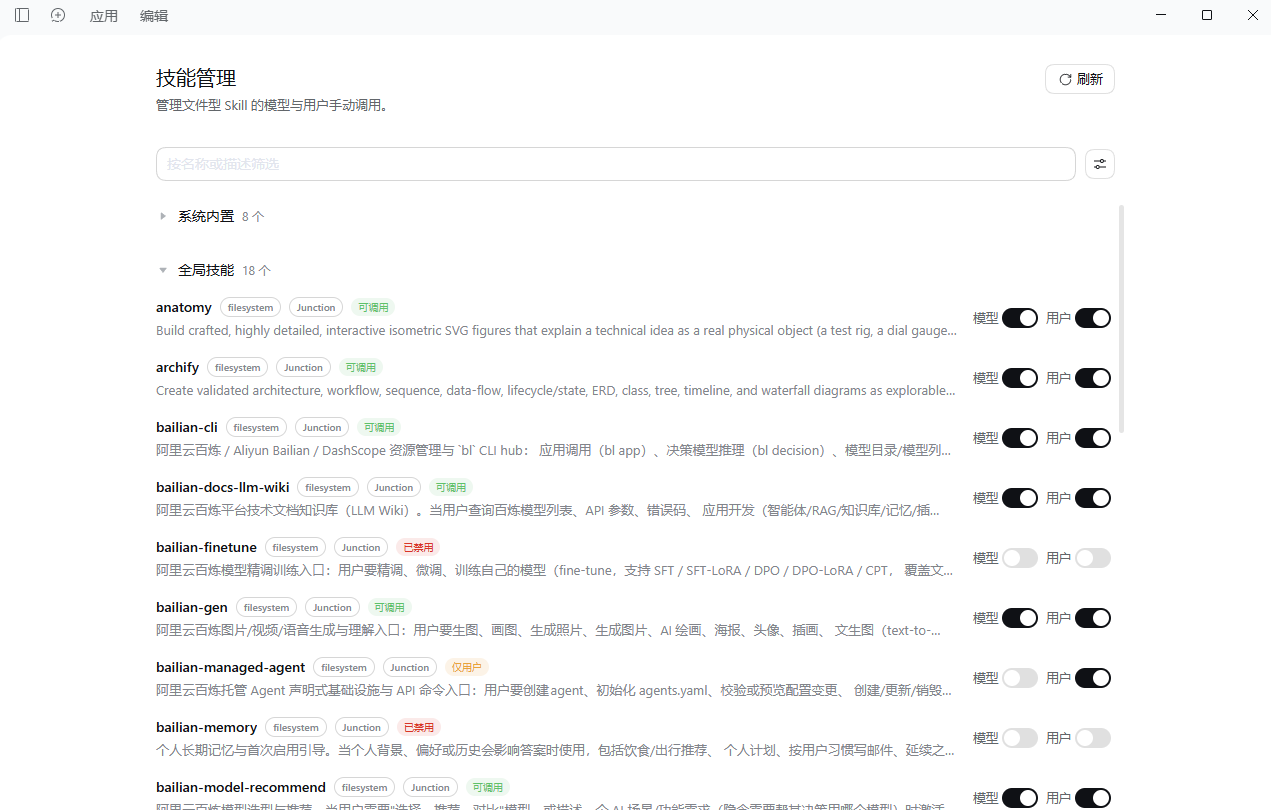
A DeepSeek Harness (DSH) Skill catalog and invocation-policy plugin. Skills from every Provider remain visible, while file-backed Skills support independent model and user manual invocation controls. The plugin reads current source files without modifying SKILL.md, frontmatter, references, scripts, Junctions, or Git workspaces.
Repository: https://github.com/JayC-L/dsh-skills-management
/name) independently.>=0.2.1-rc.5 <0.3.0-0.0.2.2-rc.1, Cordis 4.1.0, and the Desktop Profile.Add this repository in the DSH plugin manager, or use the prebuilt Release package:
https://github.com/JayC-L/dsh-skills-management/releases/latest/download/dsh-skills-management.tgzOn DSH Desktop, use the application's built-in plugin manager. After installation and activation, refresh the page and open Skills Management in the sidebar.
pnpm install
pnpm run check
pnpm test
pnpm packA manageable Skill must meet all of these conditions:
Regular directories, flat Markdown files, and Junctions are supported. A file discovered on disk but not registered with DSH is not treated as a manageable invocation target.
Non-file Providers continue to supply their own catalog entries and content. This plugin does not take over, copy, or persist their bodies, and it does not infer a local path from a source label. These rows show Read only, and direct management API requests are rejected too. Bundled Provider assets are read-only even when a SKILL.md file exists.
User manual invocation means that a user explicitly selects a Skill with /name. It is independent of automatic selection by the model.
| Model | User manual | Status | Behavior |
|---|---|---|---|
| On | On | Available | Both model and user manual invocation are available |
| Off | On | User manual only | The model cannot invoke it, but /name remains available |
| On | Off | Model only | The model can invoke it, but user manual invocation is disabled |
| Off | Off | Disabled | Neither channel can invoke it |
Policy is global by Skill name, so same-name Skills are managed together. Restoring the original invocation defaults removes the policy record; those defaults are not necessarily both channels enabled.
Before saving a single-channel policy, the Host reads the current original definitions and compares their content, resources, and original invocation flags across scopes. Conflicting same-name definitions are rejected instead of risking the wrong content. You can explicitly disable both channels without reading or sharing same-name bodies.
Each row shows:
The management catalog is requested again when:
Refresh rereads policy, scans explicitly configured Skill directories, and aggregates the Registry and scopes. File-backed metadata is read when the Registry recomputes its catalog. Every get() reads the current body, so body updates do not require toggling a policy.
Search by name or description and combine invocation-status and source filters. Built-in groups start collapsed and expand automatically for searches and filters.
A Skill is marked missing only when a complete catalog or verifiable file evidence confirms that its original definition is gone. Scope failures, incomplete Registries, and indeterminate states return an error instead of being misreported as missing.
Missing rows replace the two switches with a native Delete button:
Opening the page or performing a normal refresh never deletes policy automatically.
Default location:
~/.dsh/skills-management/disabled.jsonEach record contains only invocation policy and file-location metadata:
| Field | Purpose |
|---|---|
modelInvocable |
Effective model invocation state |
userInvocable |
Effective user manual invocation state |
originalInvocation |
Original defaults captured for correct restoration |
display |
Original description, Provider, source, and optional usage guidance |
liveFile |
File-backed policy marker, currently true |
sourcePath |
Current source file location |
sourceBase |
Resource-resolution directory |
Policy never stores Skill bodies or the contents of references and scripts. sourcePath and sourceBase are internal to the Host and are not returned by the management list API.
Writes use a serial queue, a strict disk reread before mutation, a temporary file in the same directory, fsync, and atomic replacement. A damaged policy may temporarily fall back to the last valid in-memory state for reads, but all writes are rejected so stale memory cannot overwrite the damaged file.
Management endpoints:
GET  /api/dsh-skills-management/list
POST /api/dsh-skills-management/set
/set supports model, user, and both channel changes, plus action: "remove" after a fresh missing-state check.
Uninstalling disposes global and Agent-scoped policy Providers, page Slots, and management endpoints, restoring original Providers. The policy file is retained so the same file-backed policies can be applied after reinstallation. To remove it completely, restore each Skill's defaults or delete its missing policy before uninstalling.
pnpm run check
pnpm test
Coverage includes independent channels, original defaults, same-name conflicts, live body and metadata reads, resource paths, flat files, Junctions, missing recovery and deletion, read-only non-file Providers, atomic writes, damaged-policy protection, the real DSH Registry, Agent scopes, and plugin teardown.
CLASSIFICATION EVIDENCE
系统优先读取 GitHub Topics,再与站内分类词典和词根规则比对。当前命中: deepseek-harness。
morluto
Reverse engineer anything with agents, from app behavior down to native binaries.

deepseek-ai
DeepSeek Harness: Everything is a Plugin.

nexu-io
The 1st Collaborative AI Design Agent Workspace. Local-first and open source. Create motion, prototypes, websites, apps, dashboards, presentations, images, and videos with your team and AI agents. Share work, exchange feedback, and iterate together in one workspace.