
模型与 MCP
待识别

rea
morluto
Reverse engineer anything with agents, from app behavior down to native binaries.
PROJECT TOPICS
INSTALL REFERENCE
dsh plugin --profile web add github:HudsonHuang/dsh-moss-live
该命令指向仓库当前默认分支;尚无绑定当前 commit 的完整验证结果。
PROJECT README
Full-duplex voice for DeepSeek Harness.
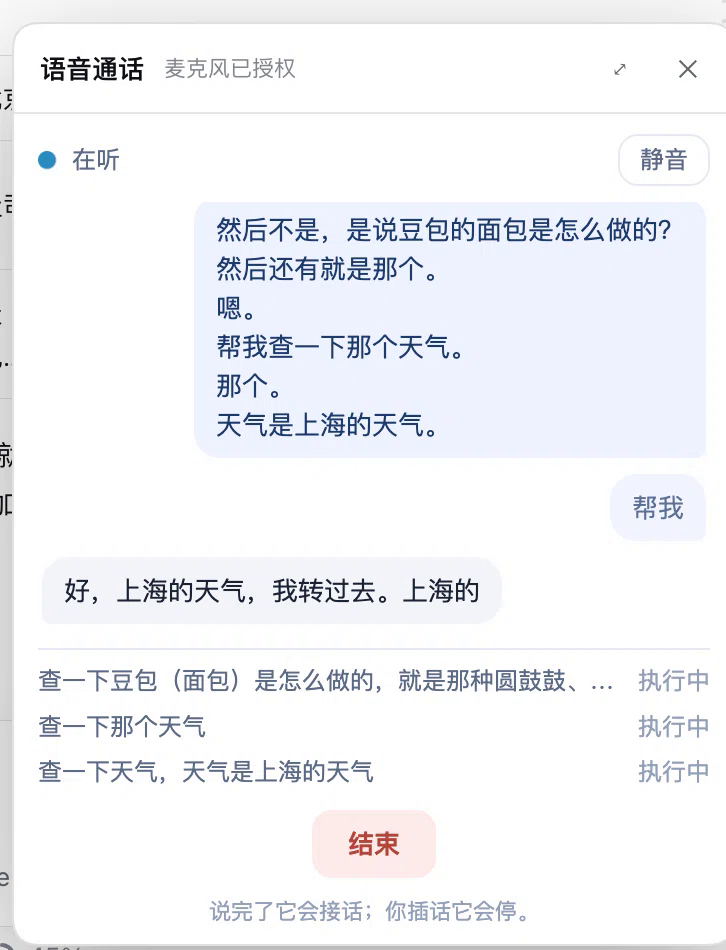
A phone button next to the composer opens a small call panel. You speak, MOSS-Live answers out loud, and anything that needs real work is delegated to the DSH agent — which figures out how to do it (immediately, in the background, or as a scheduled task) and runs it in a subagent.
The difference is what you get: real-time gives you something that can answer back; offline gives you something that cuts precisely. They are complementary — this plugin does not transcribe files, and agent-ear does not run a live call.
you speak ──► MOSS-Live (full duplex, barge-in)
                 │  dsh_task(objective)          ← text only
                 ▼
           DSH main agent (decides, clarifies, schedules)
                 │  spawn
                 ▼
              subagent (tools, files, shell, web)
                 │  final text
                 ▼
           MOSS speaks the answer
The wrapper is thin on purpose. Capture, playback, barge-in and playback acknowledgements are MOSS's own browser demo; the harness only adds a local relay that holds the API key, one tool call, and the subagent runner.
| Layer | Owns | Talks to the next layer with |
|---|---|---|
| MOSS-Live (front) | listening, speaking, interruptions | one async tool call |
| Relay (this plugin) | API key, protocol translation, call log | sessionController.prompt + subagents |
| DSH main agent | clarification, planning, scheduling | child agents |
| Subagents | the actual work | final text |
Two tools are registered on each call session:
dsh_task(objective) — forward one request; the agent decides how to execute it.dsh_tasks() — summarize what is running and what finished.While a task runs the user keeps talking; results are spoken as they land. A task that outlives MOSS's 120 s tool window gets an immediate "on it" and its result is delivered later as commentary.
Requirements: DeepSeek Harness with a MOSS API key (from the MOSS console at
platform.mosi.cn, model moss-live-1.0), Node.js ≥ 22.19.
The package is on npm as dsh-moss-live:
npm install dsh-moss-liveThen install it as a bundle in your DSH profile, using the absolute path:
plugin_manager action=install_bundle target=/absolute/path/to/node_modules/dsh-moss-livedsh plugin --profile web add dshmarketThen install dsh-moss-live from the market.
git clone https://github.com/HudsonHuang/dsh-moss-live.git
cd dsh-moss-live
npm ci            # required — see the note below
Then register that directory as a bundle:
plugin_manager action=install_bundle target=/absolute/path/to/dsh-moss-liveinstall_bundle links a local directory into the profile (pnpm link:); it
does not install that directory's dependencies. The plugin's runtime imports
ws and @mossai/mosslive at load, so a clone without npm ci is recorded as
installed and then fails on first use; the panel names the missing package, and
npm run doctor prints the exact command.
Finally reload the plugin row if needed, refresh the DSH page, and click the phone button next to the composer.
Put your MOSS key in one of these places:
.moss-api-key in the plugin directory (one line, mode 600), orapiKey field of the plugin config, orMOSS_API_KEY environment variable.Run it from the plugin directory (the clone, or node_modules/dsh-moss-live after
npm install):
npm run doctorIt checks the Node version, required files, ws/@mossai/mosslive resolution,
the vendored relay's module load, the relay port (default 127.0.0.1:17861), the
key, and — unless --offline — one real MOSS WebSocket handshake plus
attach_session (an empty session, no audio).
It exits non-zero on failure and prints the fix. A pass covers only the checks
printed as [ok]: it does not test audio, microphone permission, DSH
delegation, the desktop shell's iframe microphone injection, or billing/quotas.
Those are printed as not covered, and --offline explicitly says the key and
reachability were not verified. There is no blanket "all checks passed" line.
If the key exists only in the plugin's apiKey config, the CLI cannot read it;
pass --key-file <path> or set MOSS_API_KEY for the handshake check.
| Field | Default | Meaning |
|---|---|---|
apiKey |
— | MOSS API key (overrides the file/env) |
keyFile |
.moss-api-key |
Key file, relative to the plugin directory |
listen |
127.0.0.1:17861 |
Local relay address |
mossUrl |
wss://api.mosi.cn/v1/realtime |
Upstream endpoint |
model |
moss-live-1.0 |
Realtime model |
sessionTimeoutMs |
180000 |
How long a task may take before the agent reports back |
Every call writes calls/YYYYMMDD-HHMMSS.md (transcript, dispatched tasks, results)
and leaves a single line with that path in the conversation. An append-only
.calls/YYYY-MM-DD.jsonl keeps the raw stream. Both stay local.
| Symptom | Fix |
|---|---|
ERR_MODULE_NOT_FOUND: Cannot find package 'ws' |
You installed from a clone without npm ci. Run it in the plugin directory and reload the plugin. npm run doctor reports this as well. |
| Panel says MOSS rejected the key (HTTP 401/403) | Set the key in plugin config apiKey, MOSS_API_KEY, or .moss-api-key (one line), then start the call again. |
| Panel says it cannot reach MOSS | Check network/proxy and mossUrl (default wss://api.mosi.cn/v1/realtime); run npm run doctor. |
EADDRINUSE / port 17861 is busy |
Change the plugin's listen to 127.0.0.1:17862; or find the owner with lsof -nP -iTCP:17861 -sTCP:LISTEN (macOS/Linux) or netstat -ano | findstr :17861 (Windows) and stop it. |
PUBLIC_WSS_URL_REQUIRED |
mossUrl must be wss:// (loopback ws:// only for development), with no credentials, query or hash. |
API_KEY_REQUIRED |
The key is empty or contains a newline; write exactly one line. |
attach_session; it does
not send audio or exercise the microphone, DSH delegation or billing.dsh-app:// origin is not a secure context, so the harness page captures audio and
hands the stream to the call page. In a plain browser the call page can capture on
its own.index.js Host half: relay lifecycle, session policy, delegation → subagents
client.js Client half: the phone button and the in-app panel
vendor/runtime/ MOSS browser demo relay (MIT), with the wrapper changes below
vendor/web/ MOSS demo front end + a purpose-built compact call page
test/ Error-message tests + delegation / barge-in end-to-end scriptsWrapper changes inside vendor/ (everything else is upstream):
runtime/server.mjs — session policy + tools injected after session_attached,
dsh_task/dsh_tasks handling, delegation to run(), per-call log, pinned token,
harness origin allowed; failed MOSS handshakes are classified (auth vs network)
and sent to the page as relay.error before the socket is closed.web/js/mic.js — prefer a stream injected by the parent page.web/js/client-demo.js — keep the query string, report real errors, relay override.web/product/embed.html, web/js/embed-app.js, web/product/embed.css — the
compact panel UI (new, not upstream); embed-app.js shows the relay's actionable
error and the microphone guidance instead of a generic disconnect message.Built on @mossai/mosslive 0.1.0 and
its examples/browser-demo (MIT — see vendor/LICENSE). MOSS-Live is a product of
MOSS / OpenMOSS. DeepSeek Harness is a DeepSeek project. This repository is an
independent integration, not affiliated with either.
MIT — see LICENSE.
CLASSIFICATION EVIDENCE
系统优先读取 GitHub Topics,再与站内分类词典和词根规则比对。当前命中: deepseek-harness。
morluto
Reverse engineer anything with agents, from app behavior down to native binaries.

deepseek-ai
DeepSeek Harness: Everything is a Plugin.

nexu-io
The 1st Collaborative AI Design Agent Workspace. Local-first and open source. Create motion, prototypes, websites, apps, dashboards, presentations, images, and videos with your team and AI agents. Share work, exchange feedback, and iterate together in one workspace.