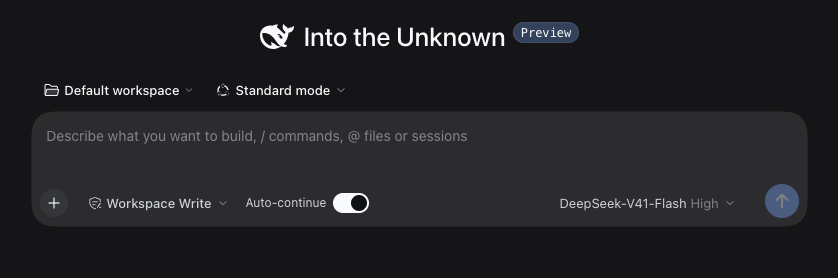
Automatic recovery for DeepSeek Harness, in the Web UI and desktop app. When a recoverable failure interrupts a session, the plugin sends your configured continuation prompt through DSH. The engine runs inside the host process, so it keeps watching while browser tabs are closed; all tabs share that engine. Recovery is enabled by default. Continuing after successful turns is a separate, opt-in autonomous loop.
Smart recovery (all configurable):
Composer switch — enable or pause auto-continue directly beside the message input, using DSH's native switch. It controls all sessions in the current profile and saves immediately. Prefer a quieter toolbar? Hide it in the plugin settings without pausing recovery
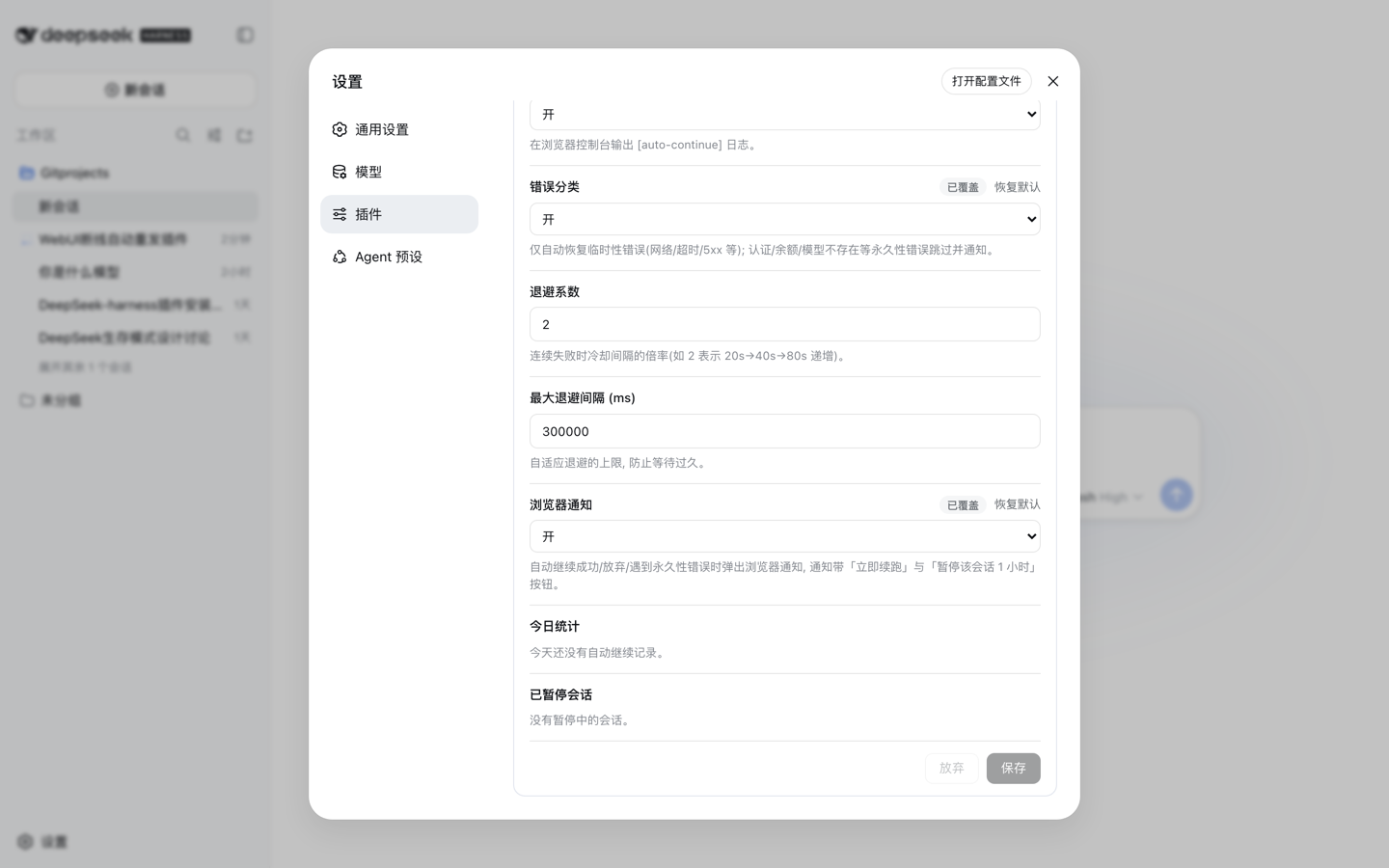
Error classification — transient failures (network / timeout / 5xx / 429…) are auto-resumed; permanent ones are skipped and notified, because retrying them never helps. A failure counts as permanent when its HTTP status is 401/403 or its code/message matches auth, credential/API-key, balance/quota, unknown-model, or context-length/overflow keywords. Provider-specific exceptions can be opted into with literal custom retryable patterns; turn classification off to resume everything
Adaptive backoff — consecutive failures wait longer each time (cooldown × factor: 20s → 40s → 80s…), capped at the max backoff, instead of hammering a broken upstream
English / Chinese localization — the settings card, built-in resume / guard / loop text, and browser notifications follow DSH's active UI language (initially selected from the browser language). Only en and zh are supported; other languages fall back to Chinese. Switching languages updates built-in defaults without overwriting custom text
Templated continue text — continueText supports {code}{message}{status}{tool}{turn}{errorCount}{elapsed} placeholders, so the resume message can carry the failure context ("Continue ({tool} failed: {code})"); a separate template fires on max-tokens (e.g. "Continue the output without repeating anything already generated")
Idempotency guard — before resuming, the plugin inspects the last tool call: if its result is unconfirmed (the turn died mid-tool, e.g. a git push that may have gone through), the resume message tells the model to check state first and not to rerun; if the tool is confirmed done, it says so and asks not to repeat it; a failed tool gets no guard (retrying it is the point). Both guard texts are configurable ({tool} / {result} placeholders)
Silent turn resume — recover an observed model step or reasoning-only response that completes without visible output. A no-op turn with no model activity is left alone. Text, tool calls, images and extension blocks count as visible, including streamed output. Unobserved turns are not guessed to be silent. Explicit no-visible-output markers also recover after restart. Disabling Resume silent turns cancels queued silent sends; silent turns never reset the retry cap, even while the option is off.
Autonomous loop — off by default (resumeCompletedTurns). When enabled, normally completed turns continue after the grace period, without the recovery cooldown or attempt cap. Reasoning-only turns and explicit no-visible-output endings still consume the recovery budget and obey backoff. Global pause, session pause, manual Stop and disabling the option stop the loop. Its prompt is separate from the loop guard’s prompt (continueTextLoop, default Continue).
Pause — turning off Auto-continue in General and saving stops automatic sends from live events and startup scanning; per-session pauses (e.g. via a notification button) suspend only one session until they expire. Resume now requests one send even when both pauses are active. It leaves the pauses in place, so later automatic recovery and autonomous-loop sends remain paused
Notification buttons — notifications carry Resume now (send immediately, ignoring cooldown, the consecutive cap and any pause) and Pause this session 1h actions
Loop guard — watches running turns too. Four signals trip the guard, which cancels the turn and restarts it with a configurable loop text ("stop repeating, try another way"): the model repeating the exact same message several times (any length — e.g. "Let me test variants of the regex…" ×7), repeated near-duplicate paragraphs inside one streamed assistant message, many short messages inside a short time window with no tool call in between (the "Let me read…" spin), or the same tool called repeatedly with the same arguments and the same results (a changed argument or result counts as progress). The cancel carries an internal marker so it is never confused with a user stop — the restart only happens for guard-initiated cancels. Thresholds, the time window and the loop text are configurable
Stats panel — the settings card shows today's auto-continue count, recoveries, failures, permanent skips, give-ups and loop breaks, broken down by error code, with a one-click reset
Browser notifications — optional alerts for auto-continue events and successful settings saves. Saving a change to the notification switch confirms its new state, including one final confirmation when turning it off. The browser may ask for permission when you enable it; a denial is explained in the settings page and does not prevent saving.
It watches the live event streams and reacts to:
Event
Meaning
turn/end → error
Turn failed (model / network / timeout, …)
turn/end → interrupted
Crash-orphaned turn left behind by a host restart (recovered by the startup scan)
turn/end → max-tokens
Output token ceiling reached
turn/end → completed / no-visible-output with no visible output
Observed model activity without visible output, or an explicit silent-ending marker
turn/end → completed
Continue a normal completion only when autonomous loop is enabled
Recovery stops for: manual Stop, policy rejection (blocked), paused sessions, subagent sessions and the consecutive-attempt cap. A new turn or manual user message cancels a queued continuation. Live interrupted markers are left to the startup recovery scan. Recoverable failures during cooldown are deferred, not discarded. If an interrupted session already has queued turns, the continuation runs first and the existing turns retain their order behind it. The loop guard can separately cancel and restart a running turn that is repeating itself.
Subagent sessions stay under their parent agent's control. The plugin skips them during live recovery and startup scanning, ignores Resume now for them, and leaves them out of loop-guard cancellation. Any queued recovery is cancelled when a session is identified as a subagent.
How It Works
The host-side engine subscribes to the session event firehose inside the dsh host process — one engine shared by every browser tab. On an interruption it waits a grace period (default 3 s) — if the host starts a new turn by itself (turn/start), the auto-continue is cancelled — then sends the configured text through the agent registry (agent.followup, the same queue the Send button uses). When that queue already contains turns, the engine promotes only its newly inserted continuation before the host wakes the agent; it does not remove or reorder the queued user turns.
On host boot it also scans the live sessions: a session whose last turn ended with a non-human reason within the scan window (default 15 minutes), with no later turn/start or user message, gets resumed automatically too (e.g. the host crashed while the browser was closed — the agent-loop resumes the session and the engine picks it up).
The browser provides the settings card and composer switch, plus a status bridge that shows notifications (with Resume now / Pause this session 1h buttons, routed back to the host engine) and feeds the card's stats / paused-sessions panels.
Recovery workflow
The diagram summarizes the automatic recovery path, the loop-guard restart path, and the exit to human intervention. Click it to open the full-size version.
Quick Start
DSH plugins install into a profile (dsh web → web profile). The commands below install into the web profile; restart dsh web after installation. In the desktop app, install through its Plugins page instead.
Compatibility
DSH runtime
Plugin version
Configuration entry point
0.2.1-alpha.1
0.14.1 verified
Plugins → dsh-client-auto-continue
0.2.0-rc.1
0.12.1 or newer
Plugins → dsh-client-auto-continue
0.1.7-rc.2
0.11.9 or newer
Same Plugins page
Older hosts with the legacy settings API
Legacy UI retained
Settings → Plugins → Plugin configuration
DSH 0.1.0-rc.6 and earlier are unsupported. Automated runtime checks cover 0.1.7-rc.2, 0.2.0-rc.1 and 0.2.1-alpha.1. Desktop app versions and embedded DSH runtime versions are different; use the runtime version when checking compatibility. For the CLI, run dsh --version; see official DSH releases for available versions.
Plugins 0.11.9 and 0.12.0 are rejected by DSH 0.2.0-rc.1’s version check. Upgrade the plugin to 0.12.1 or newer; its existing configuration-form integration works on this runtime. See #50.
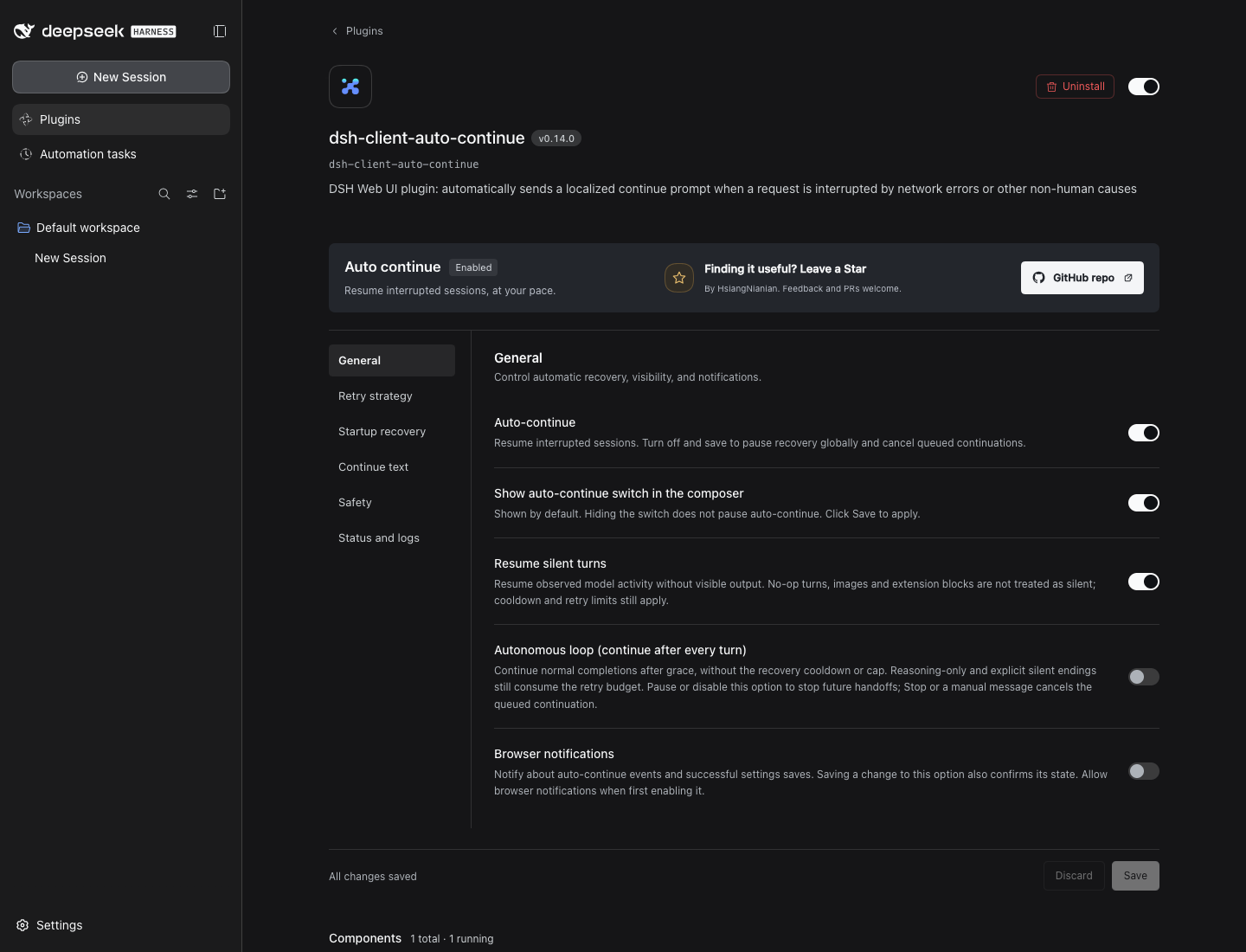
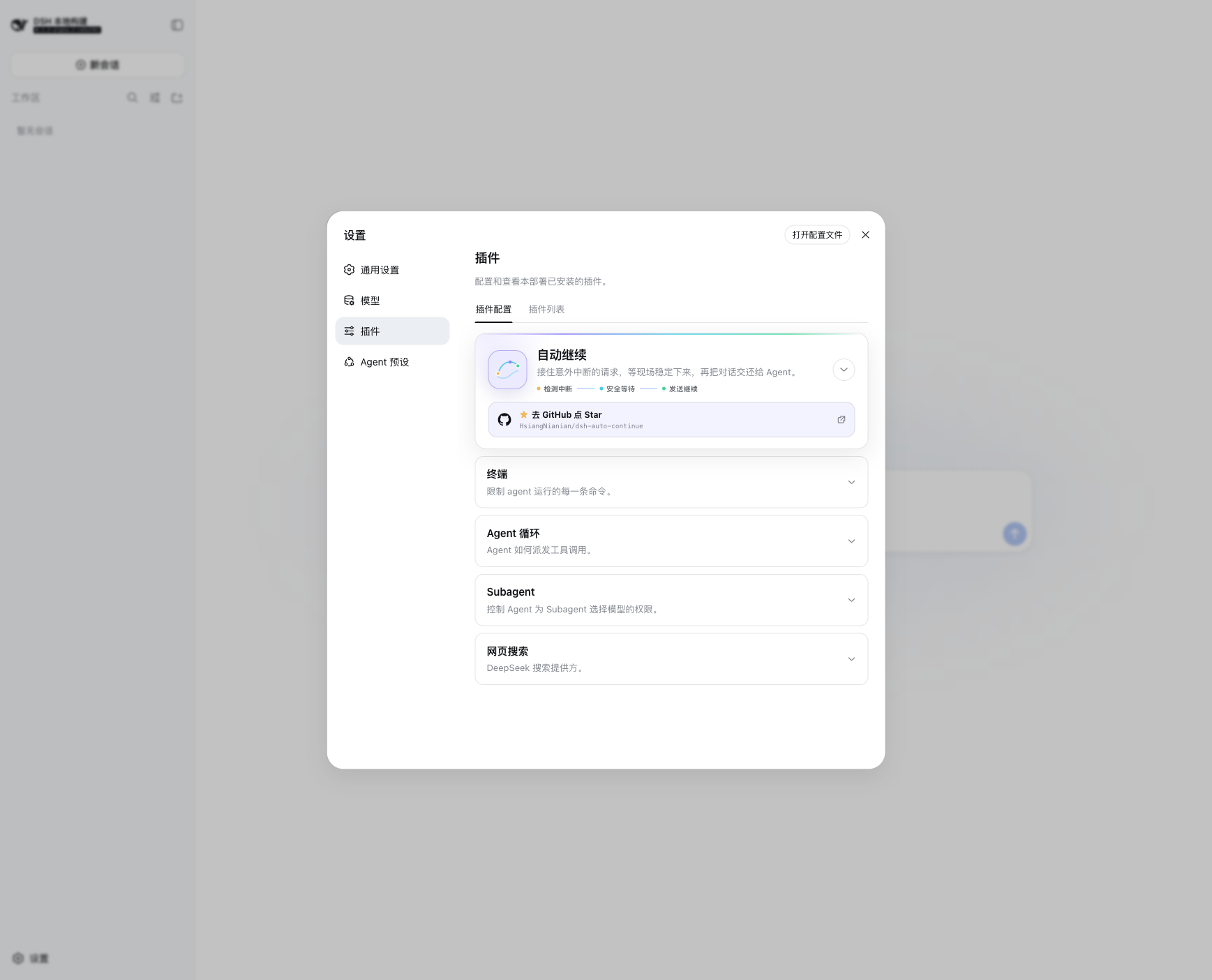
On current DSH, Settings → Built-in plugins is a component inventory, not the configuration editor. Use the main Plugins page. The screenshots below show plugin 0.14.0 on DSH 0.2.1-alpha.1. If you previously installed with a symlink or hand-written loader entry, see Migrating an older installation.
dsh plugin --profile web add dsh-client-auto-continue@latest
dsh web
Updating an installed plugin
Let active work finish and stop DSH. Run the npm command above again to replace the installed version with @latest, then restart DSH and reload the browser. Existing configuration overrides remain in the profile. For a desktop installation, update the plugin from that app’s Plugins page and restart the app; updating the CLI’s web profile does not update the desktop profile.
Directly from GitHub (no clone needed)
Installs straight from the repository's default branch — built artifacts are committed, so no local clone or build step:
dsh plugin --profile web add github:HsiangNianian/dsh-auto-continue
dsh web
This tracks the main branch rather than released tags — great for trying the latest changes, while the npm method above is the stable choice. Switching between install sources is just re-running dsh plugin --profile web add <other-spec>; the profile dependency is replaced in place.
From this repository
Use Node.js 22, the version used by CI.
git clone https://github.com/HsiangNianian/dsh-auto-continue.git
cd dsh-auto-continue
npm ci
npm run build

# the package carries its own cordis.patch.yml (dsh.bundle.patch),
# so the plugin row registers itself
dsh plugin --profile web add "link:$(pwd)"

dsh web
Migrating an older installation
A manual loader entry can start the engine without registering a bundle in the Plugins page. Use the profile's package manager to install the bundle; a symlink and insert entry alone are no longer the recommended setup.
Let active work finish, then stop dsh web. Back up package.json, cordis.patch.yml and pnpm-lock.yaml in ~/.dsh/profiles/web/, plus ~/.dsh/settings.yaml if it exists. If you set DSH_HOME, use that directory instead of ~/.dsh.
Keep your existing auto-continue values. Remove only the manually added auto-continue row inside an insert list (and the list if it becomes empty). The installed bundle supplies that row. A top-level - id: auto-continue with config: is a configuration override: keep it.
Install with either the npm or GitHub command above. In the profile's package.json, dsh.profile.bundles should now include dsh-client-auto-continue, alongside the existing DSH bundles. If it already does and the plugin appears in Plugins, this part is already complete.
On DSH 0.1.7 / 0.2, merge any saved values from the old settings.yaml → auto-continue section or the removed row's config into the profile's cordis.patch.yml. For example, a custom cooldown becomes:
- id: auto-continue
  config:
    cooldownMs: 45000 # example: preserve your own saved value
Merge into an existing override instead of adding another one. Keep unrelated settings intact. DSH 0.1.7 / 0.2 reads this entry config; editing the old settings.yaml section will not update the new form.
Start dsh web again and reload the browser. Open Plugins → dsh-client-auto-continue, select the appropriate settings category, and check that your values are present. Save a change and reload to confirm it persists.
The include:auto-continue label in Built-in plugins is a normal loader prefix. It does not, by itself, indicate a legacy install or a duplicate engine.
Verify & uninstall
dsh --profile web --dump-config | grep -A 4 'id: auto-continue'
The composed config should contain one id: auto-continue entry. In Plugins → dsh-client-auto-continue, check that the component is Running and that the General category shows editable fields. With verbose logging enabled, engine activity appears in the terminal running DSH.
dsh plugin --profile web remove dsh-client-auto-continue   # npm / repo install
# also remove this plugin's config override from cordis.patch.yml, if present
dsh web
Troubleshooting
“Skipping profile bundle” / “incompatible with dsh 0.2.0-rc.1”: update to plugin 0.12.1 or newer in the profile the app actually uses, then restart it. A version exemption is not needed for this fix.
Enabled, but no configuration fields: open the main Plugins page, select the package and open General. The Built-in plugins status page has no editable fields.
/api/auto-continue-bridge returns 404: check the DSH startup log and composed config to confirm the host component loaded. Refreshing the settings card cannot start a missing host component.
Composer switch
Starting with 0.13.0, an Auto-continue switch appears beside the message input by default. It uses DSH's native Switch and follows the active theme.
On allows automatic recovery; Off sets the existing global paused option. The change saves immediately and applies to all sessions in the current profile, with other open tabs updating too. This is separate from the notification action that pauses one session for an hour. Enabling it does not clear a session's individual pause.
To hide the switch, open Plugins → dsh-client-auto-continue → General, turn off Show auto-continue switch in the composer, then click Save. This only changes visibility; recovery keeps its current state. The corresponding config key is showComposerToggle, default true. Older hosts without the composer slot retain the settings card.
Configuration
On DSH 0.1.7 / 0.2, open Plugins from the main sidebar, choose dsh-client-auto-continue, then select a settings category. This is separate from Settings → Built-in plugins, which only lists component status. Older DSH versions use Settings → Plugins → Plugin configuration.
Use General, Retry strategy, Startup recovery, Continue text, Safety, and Status and logs to find controls. Switching categories preserves unsaved changes. Status and logs contains today's activity and paused sessions.
The header places the plugin status and GitHub invitation side by side on one shared charcoal background. The status shows the saved global setting; edits take effect when you click Save.
With Browser notifications enabled, each successful save sends one confirmation from the tab where you saved. Turning notifications off sends a final confirmation if browser permission is already granted; later saves stay quiet. Discarded changes, invalid values, and failed saves do not send success notifications. If the browser blocks notifications, the settings page still confirms the save and explains the permission issue.
DSH 0.1.7 / 0.2 stores these values in the auto-continue entry's config in the active profile patch (~/.dsh/profiles/web/cordis.patch.yml for the default web profile). Save applies changes live without restarting the engine. Omitted fields use the defaults below.
Startup recovery polls every three seconds for sessions that load late, up to freshMs after the engine starts. Each settled session history is inspected once. scanLimit limits eligible recoveries per pass, so healthy or permanent-error sessions cannot crowd out interrupted ones. Pausing suspends recovery within the same window; unloading cancels the poller.
The browser mirrors DSH's active language into the internal locale field. Leave the seven localized text fields empty or omit them to follow that language automatically; any non-empty value is treated as your own template and is never rewritten when the language changes:
Older hosts store user settings in ~/.dsh/settings.yaml under the plugin namespace instead of a profile entry:
auto-continue:
  cooldownMs: 45000
When migrating from the legacy settings file to DSH 0.1.7 / 0.2, move these values into the profile entry's config as described in Migrating an older installation.
How the card works:
Edits are staged — nothing reaches the disk until you hit Save; the footer indicates pending changes, and Discard drops them
If you edit or reset a field while a save is in progress, the newer draft stays in the card. Click Save again after the current save finishes to apply it
An overridden field shows a Reset to default button that removes the override and restores the inherited value (normally the built-in default)
Boolean fields use native switches and are staged until Save. Reset to default removes the override and restores the inherited value. Auto-continue is on when recovery is enabled (paused: false)
Invalid drafts (non-numbers, values below the minimum) block the save and mark their category, even when another category is selected
In a read-only deployment the card shows the stored values but disables editing while keeping category navigation available
Changes apply immediately after Save and persist in the active profile config (or ~/.dsh/settings.yaml on older hosts)
Live status and the Save / Discard buttons
Field
Default
Description
Pause auto-continue
off
Global pause: no live or scan auto-send fires, queued pending sends are cancelled
Show auto-continue switch in the composer
on
Show the composer switch (showComposerToggle); hiding it does not pause recovery
Continue text
Continue
Text automatically sent after an interruption
Continue text (max tokens)
Continue
Text sent when the output token ceiling is reached (same placeholders)
Resume silent turns
on
Resume a turn that ended normally with reasoning only (no text, no tool call); does not reset the consecutive count
Continue text (silent turn)
Continue. Your previous turn ended with internal reasoning only, ...
Text sent to resume a silent turn (same placeholders)
Autonomous loop (continue after every turn)
off
Continue normal completions after grace, bypassing recovery cooldown/cap; reasoning-only and explicit silent endings still consume the retry budget
Continue text (autonomous loop)
Continue
Text sent on each autonomous-loop resume (same placeholders)
Idempotency guard
on
Inspect the last tool call before resuming and steer the model (see What It Does)
Loop guard
on
Detect a running turn spinning in place and restart it (see What It Does)
Short-sentence max (chars)
40
A model message shorter than this counts as a short sentence (spinning signal)
Short-sentence window (ms)
30000
Consecutive short sentences must land inside this window; normal thinking spread over time is not misjudged
Short-sentence threshold
12
Consecutive short sentences inside the window, with no tool call in between, trip the loop guard
Identical message count
4
Consecutive identical messages (any length) trip the loop guard — the strongest spinning signal; the same threshold is also used for repeated near-duplicate streamed paragraphs inside one message
Same-tool repeat count
5
Consecutive calls of the same tool with identical arguments and results trip the loop guard
Loop text
(You may be stuck in a loop. Stop repeating the last action and continue with a different approach.)
Text sent after the loop guard restarts a turn; {tool} placeholder
Guard text (unconfirmed result)
(The previous tool "{tool}" may not have completed. Check its state before continuing and do not run it again.)
Appended when the last tool may have partially executed; {tool} placeholder
Guard text (tool succeeded)
(The previous tool "{tool}" completed successfully. Result: {result}; do not run it again. Continue from there.)
Appended when the last tool is confirmed done; {tool} / {result} placeholders
Grace period (ms)
3000
Wait after an interruption; cancelled if the host recovers on its own
Cooldown (ms)
20000
Min interval between recovery attempts per session; failures during cooldown wait for the remaining interval, then grace
Max consecutive
3
Consecutive recovery-attempt cap; resets on user intervention or an observed completion with visible output. Normal autonomous-loop handoffs are exempt
Scan on host startup
on
Recover interrupted sessions that become available during the startup window
Scan limit
8
Maximum eligible recoveries per pass, most recently active first
Scan window (ms)
900000
Maximum interruption age and duration of startup polling
Verbose logs
on
[auto-continue] engine logs in the DSH terminal
Classify errors
on
Auto-resume transient failures only; auth / balance / model errors are skipped and notified
Custom retryable errors
empty
One case-insensitive literal per line; matching the error code, HTTP status, or message explicitly overrides the built-in classifier
Notify about auto-continue events and successful settings saves; confirm switching notifications on or off
For a provider-specific error that is safe to resume (confirm first that manually sending "continue" recovers), add a narrow, stable fragment rather than disabling classification globally:
- id: auto-continue
  config:
    retryableErrorPatterns: |-
      Upstream rejected the request as invalid
Patterns are literal substrings, not regular expressions. Blank lines are ignored; any matching line wins before the built-in permanent-error rules. Cooldown and consecutive-attempt limits still apply.
continueText (and continueTextMaxTokens, continueTextSilent, continueTextLoop) accept the placeholders {code}, {message}, {status}, {tool} (last tool call before the failure), {turn}, {errorCount} (consecutive failures including this one) and {elapsed} (time since the failure, e.g. 1m5s) — e.g. Continue ({tool}: {code}) becomes Continue (git push: UPSTREAM). The guard texts accept {tool} and {result} (a truncated excerpt of the last tool output). The host engine currently leaves {sessionTitle} empty.
Privacy & permissions
The recovery engine runs inside the DSH host. The browser provides the configuration card, live status and optional notifications:
The engine reads session events and history through DSH's services. The browser talks to that host; the plugin adds no third-party service or credential store
Recovery sends your configured text through agent.followup. The loop guard can cancel a looping turn through agent.cancel before sending its recovery prompt. Resumed agents continue with the session's existing tools and permissions
Saving configuration uses DSH's settings API: the active profile patch on DSH 0.1.7 / 0.2, or ~/.dsh/settings.yaml on older hosts
Retry counters, cooldown timestamps, per-session pauses and stats stay in host process memory and reset when the engine restarts. The global paused setting is saved with your other configuration
Browser notifications are opt-in (notify setting). Enabling and saving can request browser permission; denied permission is not requested again. Turning the option off never requests permission.
Development
Use Node.js 22. Install both pinned runtime fixtures to reproduce CI locally:
npm ci
npm ci --prefix tests/fixtures/dsh-0.1.7
npm ci --prefix tests/fixtures/dsh-0.2.0
npm run typecheck
npm run build
npm test
npm run test:runtime
npm test covers recovery, autonomous-loop limits and toggles, child-session exclusion, manual resume during pauses, startup scanning, queue ordering, statistics, localization, settings UI lifecycle and edits made during pending saves. npm run test:runtime uses published DSH 0.1.7-rc.2 and 0.2.0-rc.1 Settings, Loader and HTTP services. It also runs the actual 0.2 profile compatibility gate and checks client activation with Cordis 4.0.4 when one settings provider is absent. The runtime harness controls agent events; it does not send requests to a model provider.
After editing a linked checkout, run npm run build to write the updated lib/ files, then restart DSH and refresh the browser. Hosts with client HMR enabled can reload a rebuilt client bundle automatically.
CI typechecks, rebuilds, runs both test suites, verifies committed lib/ artifacts and runs dsh-plugin-check. The same checks gate releases. See screenshot capture notes when updating the UI documentation.
DeepSeek Harness (DSH) Web 插件聚合生态 · 万物皆插件,通过创意工坊分发||DeepSeek Harness (DSH) Web Plugin Aggregation Ecosystem · Everything is a plugin, distributed via the Creative Workshop
开放的侧边栏底座,支持三方拓展注册新侧边栏页面。内置文件渲染编辑/终端/侧边对话/Git/子代理页面 | Open sidebar foundation, supports third-party extensions to register new sidebar pages. Built-in file rendering/editing, terminal, side chat, Git, and sub-agent pages.