
模型与 MCP
待识别

rea
morluto
Reverse engineer anything with agents, from app behavior down to native binaries.
PROJECT TOPICS
PROJECT README
English · 中文
The model + thinking control of the dsh composer, merged from two plugins that both replaced the same seat and therefore could not be installed together:
Use this one instead of either original — not beside them:
dsh plugin remove dsh-client-ui-gpt-helper
dsh plugin remove dsh-model-provider-prefix
Maintaining this file: see MAINTENANCE.md (Chinese) for the code map, the invariants that keep the card stable, the test matrix and the real-app verification recipes. Changes per release: CHANGELOG.md.
Who it is for / 适用场景:
| You are… | This plugin gives you |
|---|---|
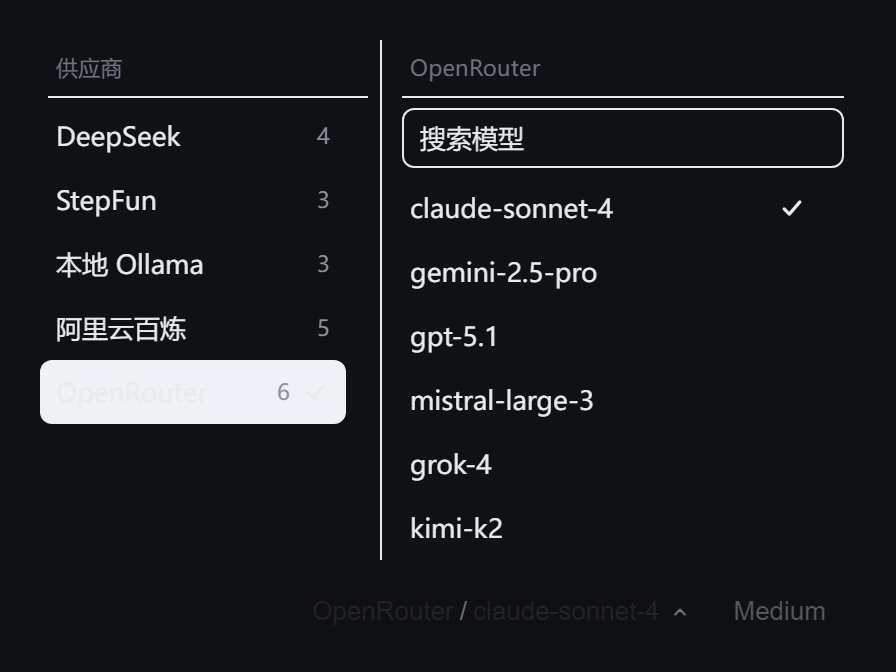
| Someone who needs the provider next to the model | One trigger showing provider/model, one card with both columns. |
| Someone whose provider list is long | Hover the provider column; the model column swaps and the card stays put. |
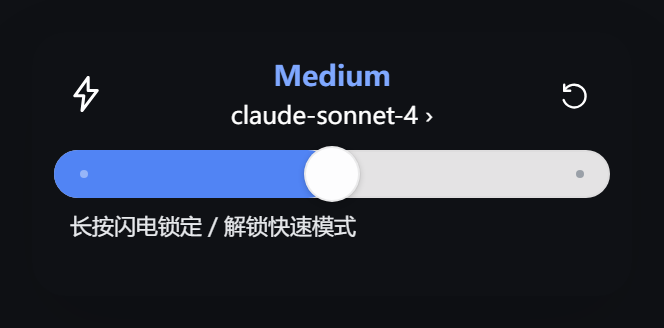
| Someone who tunes reasoning effort | The effort trigger and its particle slider; the drift on the track is always running. |
| Someone carrying both original plugins | One seat instead of two that cannot coexist. |
Requires dsh >= 0.2.1-rc.2 (engines.dsh). Client-side only: no network calls,
no credential access, no host module.
| Surface | Behaviour |
|---|---|
| Model trigger | provider/model as one run of text, plus a caret. Opens the card on the provider+model columns; a second click closes it. When the composer row already names the provider — dsh-providers-hub's JetHub badge sits in conversation.input.right beside the seat — the trigger drops its own prefix and shows the model alone, so the provider is printed once. |
| Effort trigger | The current thinking level (Max, Medium, …). Opens the card on the particle slider; rendered only when the selected model declares thinking levels. |
| Provider column | Every provider in the session directory with its model count, a check on the current provider, and a retry row for a provider whose list failed to load. |
| Model column | Head shows the provider under the pointer; a 30 px search box sits inside the column. Hovering the provider column swaps the models without moving the card. |
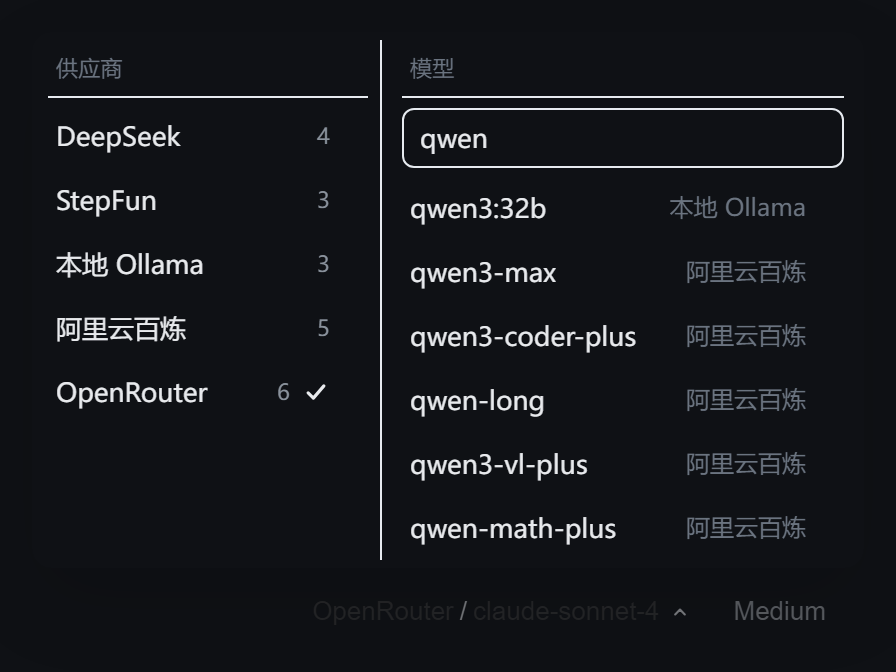
| Search | Typing searches every provider at once and shows the provider name on each row. The card keeps its two-column shape while typing — a re-shaping card is exactly the resize flicker this plugin removes. |
| Thinking slider | The particle slider from the shell, over the level ladder of the selected model, with keyboard arrows/Home/End. |
| Thinking head | The current level on the left (click it to return to the two columns), a bolt that jumps to the highest level and back to the one you left, and a reset button that restores the model's default level. |
| Appearance panel | Ctrl+Shift+Alt+G. Colour tokens per side (light/dark), scheme library, JSON import/export, reset, cross-apply to the other side, live preview. |
Geometry: the card is 416 px wide in the column layout and 300 px in the
thinking panel, both clamped to the viewport. Each layout keeps its own floor —
eight model rows, i.e. 333 px, for the columns and 96 px for the thinking
panel — so the card never drops below its own body, and both cap at 420 px.
The card flips above the trigger when that gives more room.
The upstream card was anchored by its bottom edge and sized by its content, while its content was chosen by the row under the pointer. With one provider holding more models than the card could show, that closed a loop:
The merged card breaks the loop by making the frame a function of the anchor and the layout only:
frame(anchor, layout, natural, floor) is pure: it clamps width and height to
the viewport and flips above the trigger when that gives back more room.data-ready="false"), and then frozen for as
long as the card stays open on that key.scrollbar-gutter: stable), so a long model
list never changes the card outer height.box-sizing: border-box keeps the inline height equal to what was measured.floor is the height the card already had, so any later re-measure inside the
same placement can only grow the card, never collapse it over the pointer. A
new anchor (resize, scroll) starts the floor over at zero.Re-measurement happens only on open, pane change, anchor move (scroll/resize) or a status change — never on hover.
Everything user-facing is edited in the appearance panel; there is no profile
config key. One localStorage record holds the state:
| Key | Shape |
|---|---|
dsh-client-ui-model-seat:config:v1 |
{ version: 3, hotkey, paused, crossApply, slots: { light: { scheme }, dark: { scheme } }, schemes: { name: { name, colors } }, sides: { light, dark } } |
paused: true switches every custom colour off (the panel master switch);
slots[side].scheme names the active scheme for a side, sides[side] holds the
per-token tune-ups (they win over the active scheme, so a manual edit is never
swallowed), and crossApply makes one side colour both.
Records written by the shell plugin (dsh-client-ui-gpt-helper:config:v1) are
not read: the schema changed and a silent half-migration would be worse than
the defaults. The record is read on load, on a storage event, and when the
window regains focus.
dsh-client-ui-model-seat:fast:v1 is neither read nor written any more: the drift
runs unconditionally and the key is left untouched, so rolling back to 0.1.2
still finds its lock state.
Stable hooks, for CSS and for tests:
| Element | Attribute |
|---|---|
| Root | [data-model-seat="root"], plus data-build |
| Triggers | [data-model-seat="model-trigger"], [data-model-seat="effort-trigger"] |
| Card | [data-model-seat="menu"] with data-pane, data-layout, data-ready, data-flipped, data-ultra |
| Columns | .ms-col[data-col="providers"], .ms-col[data-col="models"] |
| Column head | .ms-colHead, separator .ms-sep |
| Search | .ms-search (inside the models column) |
| Rows | .ms-row[data-kind="provider"\|model\|retry"], data-active, data-current, count .ms-count, note .ms-rowNote |
| Slider | [data-model-seat="thinking-slider"] |
| Colour panel | [data-model-seat="config-panel"], backdrop [data-model-seat="config-backdrop"] |
| Fallback | [data-model-seat="fallback"] — what the error boundary renders |
That is the whole contract: since 0.1.1 nothing emits data-gpt-helper or
data-dsh-pm-*. CSS written against either upstream plugin no longer matches,
which is the point — a leftover [data-gpt-helper] rule from the shell plugin
would otherwise restyle this card. npm run validate fails if either prefix
comes back.
dsh plugin add dsh-client-ui-model-seat@0.2.2                        # from the registry (pin it, see below)
dsh plugin add dsh-client-ui-model-seat                              # from the registry (bare name)
dsh plugin add github:HimA6652/dsh-client-ui-model-seat              # from source
dsh plugin add link:/absolute/path/to/dsh-client-ui-model-seat       # local checkout
Both channels ship the same tree. The npm page is
npmjs.com/package/dsh-client-ui-model-seat;
the first release on it is 0.1.2 and the current one is 0.2.2.
A bare name installs an older version. pnpm 11 gates fresh releases with
minimumReleaseAge(1440 minutes) by default, so a bare spec resolves to the newest version that is at least a day old — measured on 2026-10-29, right after publishing0.2.1,pnpm add dsh-client-ui-model-seatinstalled0.1.2. This is the mechanism, not a one-off: the day0.2.2ships, the newest version that is at least a day old is still0.2.1, so a bare name resolves to0.2.1. Pin the version (@0.2.2) to get it now; pnpm then records it in the profile'sminimumReleaseAgeExclude.
The plugin bundle inserts one row into the profile (id: model-seat) and
registers its seat at priority: -2, so a leftover copy of either original
(-1) or the shipped control (0) is shadowed instead of colliding.
A desktop profile cannot be edited by the plain CLI — it answers
profile "desktop" is managed exclusively by the Electron application. Use the
desktop host CLI instead (see MAINTENANCE.md, "安装、升级、回滚").
Screenshots are generated, not hand-cropped: npm run shots renders the real
bundle in the harness over a demo provider set and clips each PNG at 2x.
npm run e2e runs the bundle against a fixture page. To check the same bundle
inside a real dsh web app without touching your own store, give it a throwaway
DSH_HOME:
SEAT_HOME=C:/Users/you/AppData/Local/Temp/seat-live-home
mkdir -p "$SEAT_HOME" && cp ~/.dsh/.credentials.yaml "$SEAT_HOME/"
export DSH_HOME=$SEAT_HOME
DSH=<checkout>/node_modules/@deepseek-ai/dsh/lib/bin.js
node "$DSH" --profile seatcheck --from-default-profile web --help   # creates seatcheck from the web template
node "$DSH" plugin --profile seatcheck add link:$PWD
node "$DSH" --profile seatcheck --port 6124 --host 127.0.0.1 --no-open
The credentials copy is what makes the account model directory resolve; without
it the card is empty. The banner prints the URL with its ?token=; hand that to
npm run live -- --url "http://127.0.0.1:6124/?token=..."--publish also clicks a model row and asserts the trigger relabels. That writes
the account model selection, which is why it is off by default and why the run
belongs on a throwaway DSH_HOME. The check reports the trigger labels, the
card layout/height/width, a 900 ms frame sample, the thinking pane, and any
console error naming the seat; it exits non-zero on a problem. Your own ~/.dsh
store and the desktop app are never involved.
npm run check       # secrets + pack + validate + doc anchors + css audit + load check + tests
npm run check:secret # dev paths, tokens, private keys in every text file
npm run check:pack   # `files` vs the real npm artifact, in both directions
npm run validate     # manifest, patch row, entry module, bundle load, apply
npm run docs         # MAINTENANCE.md line anchors still point at the right lines
npm run css          # stylesheet scoping and dead-class audit
npm run loadcheck    # against the installed dsh checkout (skips when absent)
npm test             # node:test unit and integration tests
npm run e2e          # drives the real bundle in headless Edge over CDP (light)
npm run e2e:dark     # same run under prefers-color-scheme: dark
npm run check:all    # check + e2e + e2e:dark
npm run live -- --url URL   # the same checks inside a real dsh
npm run release 0.2.2       # gates → npm → commit → tag → push (see CHANGELOG rule)
npm run e2e (--scheme light|dark) serves test/harness/ on a loopback port, opens it in headless
Edge over CDP and asserts, in fourteen sections: the two-column card, a constant
height while the pointer rests over 60 models, close/reopen determinism, the
cross-provider query, the empty-query note (one padded .ms-empty, zero rows),
the thinking pane (the bolt, drift always on, its own height, equal top and
bottom inset, icon and label contrast), the reduced-motion branch, the head
status button returning to the columns, the eight-row floor under the model
column, the colour-panel hotkey, the bolt surviving a reload, a restart on a new
origin and a restart into a new conversation, a channel badge in the same row
suppressing the provider prefix, and a clean console. --shot DIR writes screenshots;
--dump prints the card box and its children. The e2e loads React from the
committed test/vendor/ UMD builds, so a fresh clone needs no external
directory and no network; --vendor DIR / REACT_VENDOR=DIR override it.
lib/client.js is hand-written — a 3671-line single-file bundle with no
build step, because dsh.client takes one ./client entry. tools/merge/gen-client.mjs
produced the first draft from the shell bundle and is kept only as a record. It
now refuses to run without --force, and even then backs the current file up to
lib/client.js.bak-gen-<timestamp> first.
priority: -2 for
conversation.input.model. Another plugin registering the same priority for the
same slot is resolved by mount order, not by this plugin.localStorage (dsh-client-ui-model-seat:config:v1) per
browser profile. They do not follow the account across machines; the panel's
JSON import/export is the only way to move them.ollama finds
ollama/qwen through the model, not through the provider column.dsh.client.platform: "web", which the desktop app
renders). The terminal surface is untouched.lib/client.js is one hand-written file with no build step; dsh.client
takes a single ./client entry. There is no per-model override layer: the
plugin edits the seat, not the model list.MIT, see LICENSE.
CLASSIFICATION EVIDENCE
系统优先读取 GitHub Topics,再与站内分类词典和词根规则比对。当前命中: deepseek-harness。
morluto
Reverse engineer anything with agents, from app behavior down to native binaries.

deepseek-ai
DeepSeek Harness: Everything is a Plugin.

nexu-io
The 1st Collaborative AI Design Agent Workspace. Local-first and open source. Create motion, prototypes, websites, apps, dashboards, presentations, images, and videos with your team and AI agents. Share work, exchange feedback, and iterate together in one workspace.