Threadline / 脉络
A read-only DSH plugin that turns what a conversation did to your workspace into a drillable timeline.
中文






Overview
Threadline is a plugin for DeepSeek Harness (DSH) that answers a
narrow question well: what did this conversation actually change in my workspace?
It collects the files a turn touched, the commands it ran, the subagents it spawned and the relations
between turns, then presents them as one drillable timeline embedded in the DSH session view. Everything
is read-only: the plugin never writes to your workspace, never stores anything, never opens an extra
entry point.
It is built for people who let an agent work in a repository and then need to review the result — not for
planning, task assignment or code editing.
Features
- Relation graph of the current directory. A deterministic force-directed layout where folders are
rounded cards and files are dots. Edges are layered (skeleton, top-3 co-occurrence, the rest on hover),
capped at
1.6 × node count so the graph never turns into a spider web.
- Folder-to-folder links. Aggregated from real cross-directory relations only. Folders with no real
relation go to a perimeter ring and are never connected by a fabricated edge.
- Node cap with an honest switch. Up to 40 files by default; a persistent
Show N/M chip switches to
the full set in place and auto-degrades density, labels and radius. Hard ceiling 300.
- Dual-track timeline. An activity histogram per time bucket on the upper track, one row per session on
the lower track, a single playhead label, and exactly three scale ticks.
- Turn strip with lock-first selection. Click a turn to lock it, hover another turn without losing the
lock, click again to release. Double-click the timeline to snap back to "now".
- Workspace file browser. Starts at the workspace root, navigates to any depth, breadcrumb / back /
refresh, card or list view, virtualization beyond 200 rows.
- Zero third-party runtime dependencies.
dependencies is an empty object; React and @deepseek-ai/*
are peer dependencies provided by the host.
Installation
Threadline is a DSH plugin. Install it through the DSH plugin manager, or with npm:
npm install dsh-plugin-control-your-development
Requirements:
- DSH with runtime
0.2.1-rc.5 or later (@deepseek-ai/dsh-session >= 0.2.0-0)
- React 18 and React DOM 18 provided by the host (not bundled)
Restart DSH after installing or replacing the package. Replacing an already-loaded plugin requires a
process restart; a page refresh alone does not reload it.
Usage
Three surfaces, no fourth entry point:
| Surface |
Where |
What you get |
| Threadline tab |
conversation.view, id threadline |
Left column: relation graph of the current directory + dual-track timeline + turn strip. Right column: workspace file browser. Both columns scroll independently. |
| Impact count |
assistant message actions, id threadline-impact |
Files / commands / subagents touched by that turn. Clicking jumps to the Threadline tab focused on that turn — no dialog. |
/threadline |
input box command (also /脉络) |
Jumps to the Threadline tab for the current session. |
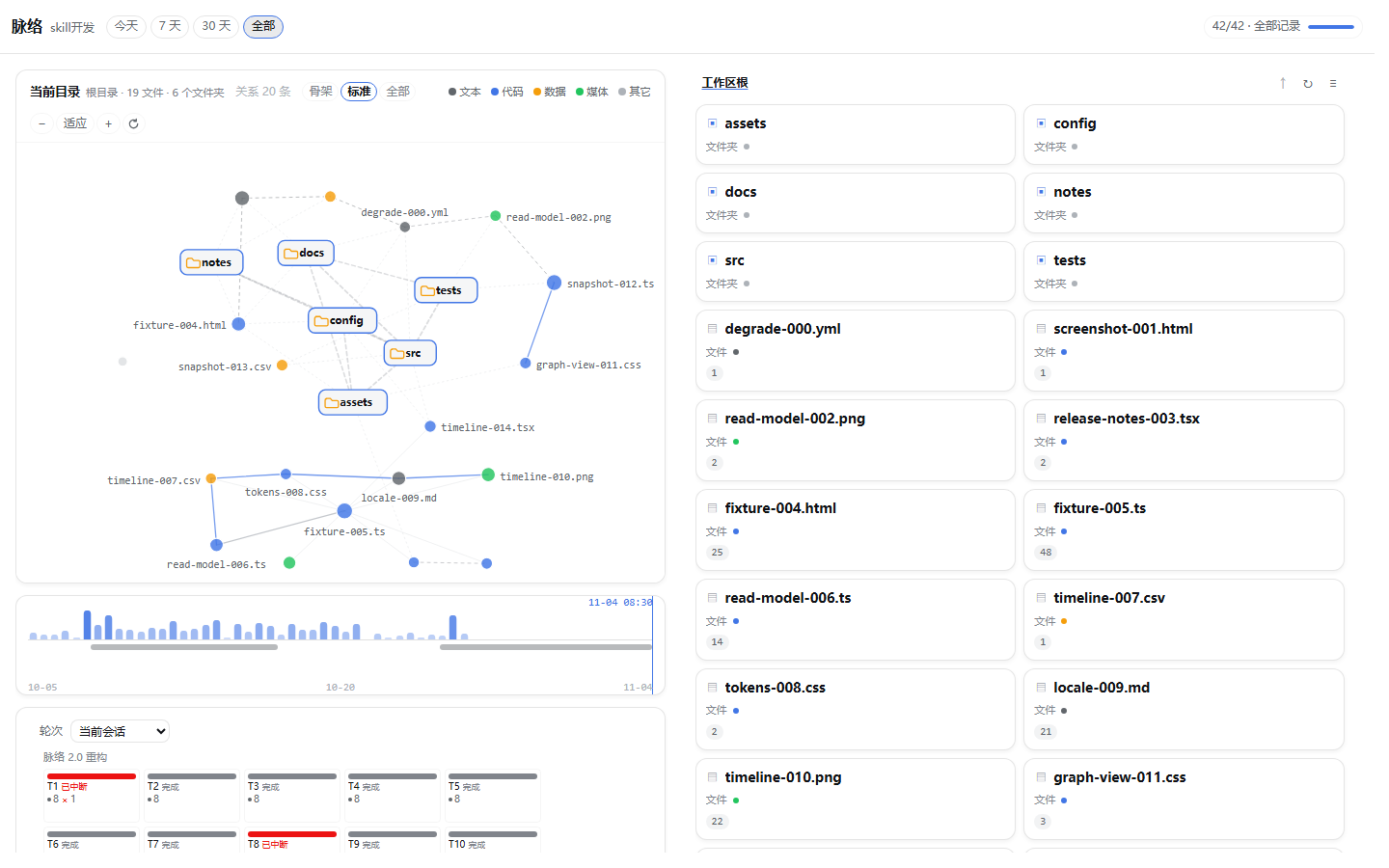
Typical flow:
- Open a session and switch to the Threadline tab.
- The left graph shows the current directory. Click a folder card to enter it; the right column follows.
- Hover a file to highlight its relations; click to pin the evidence panel.
- Click a turn in the strip to lock that turn's file graph. Click it again to release.
- Drag a folder card or a file dot to rearrange. Use
Fit to reset the camera and Reset to clear drags.
Folder-to-folder links
A directory with many subfolders is not a scatter of isolated cards: folders that really exchanged
files are connected, so you can see which parts of the workspace move together.
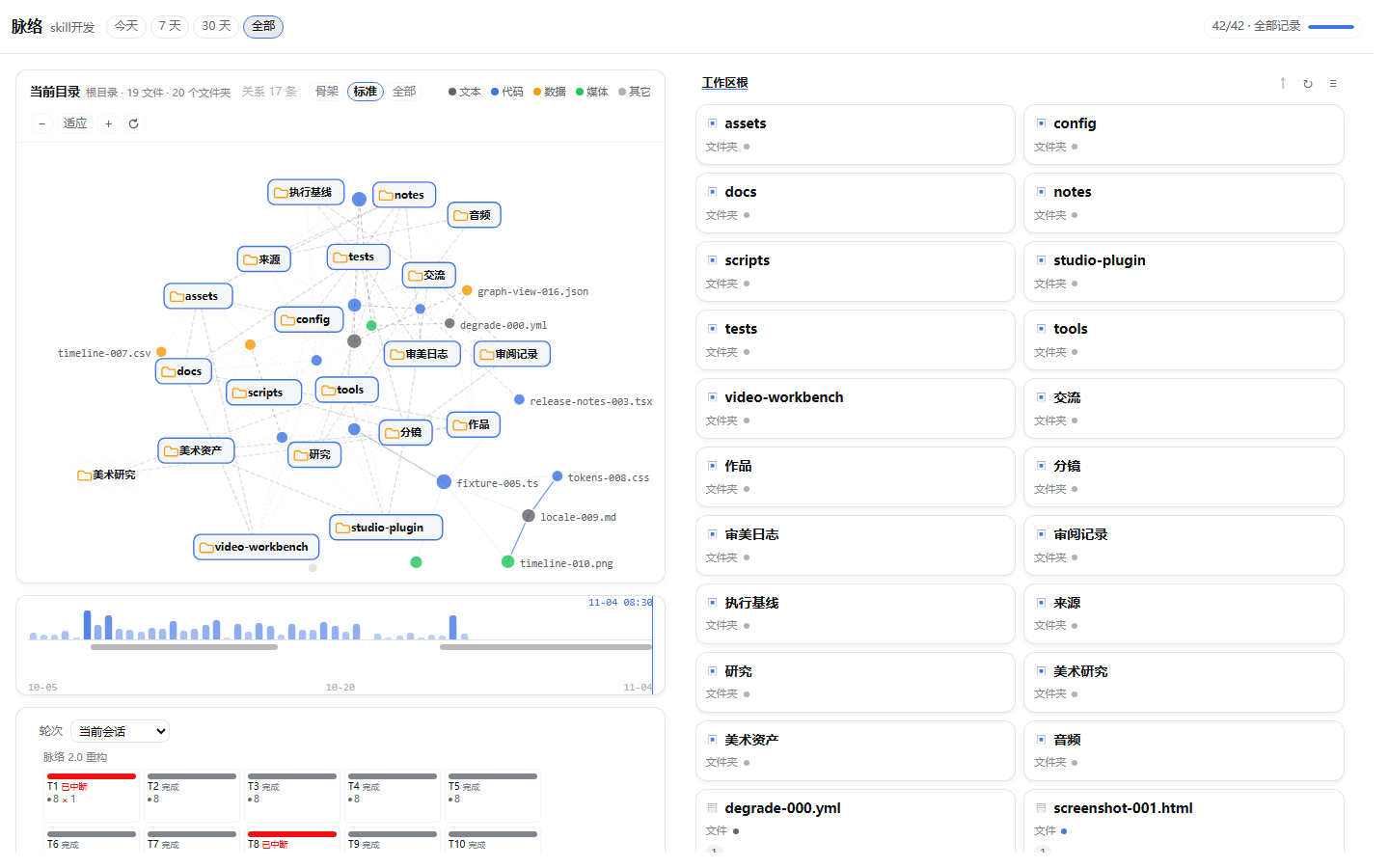
One turn in isolation
Clicking a turn switches the left graph to that turn's files and overlays the read / write line counts.
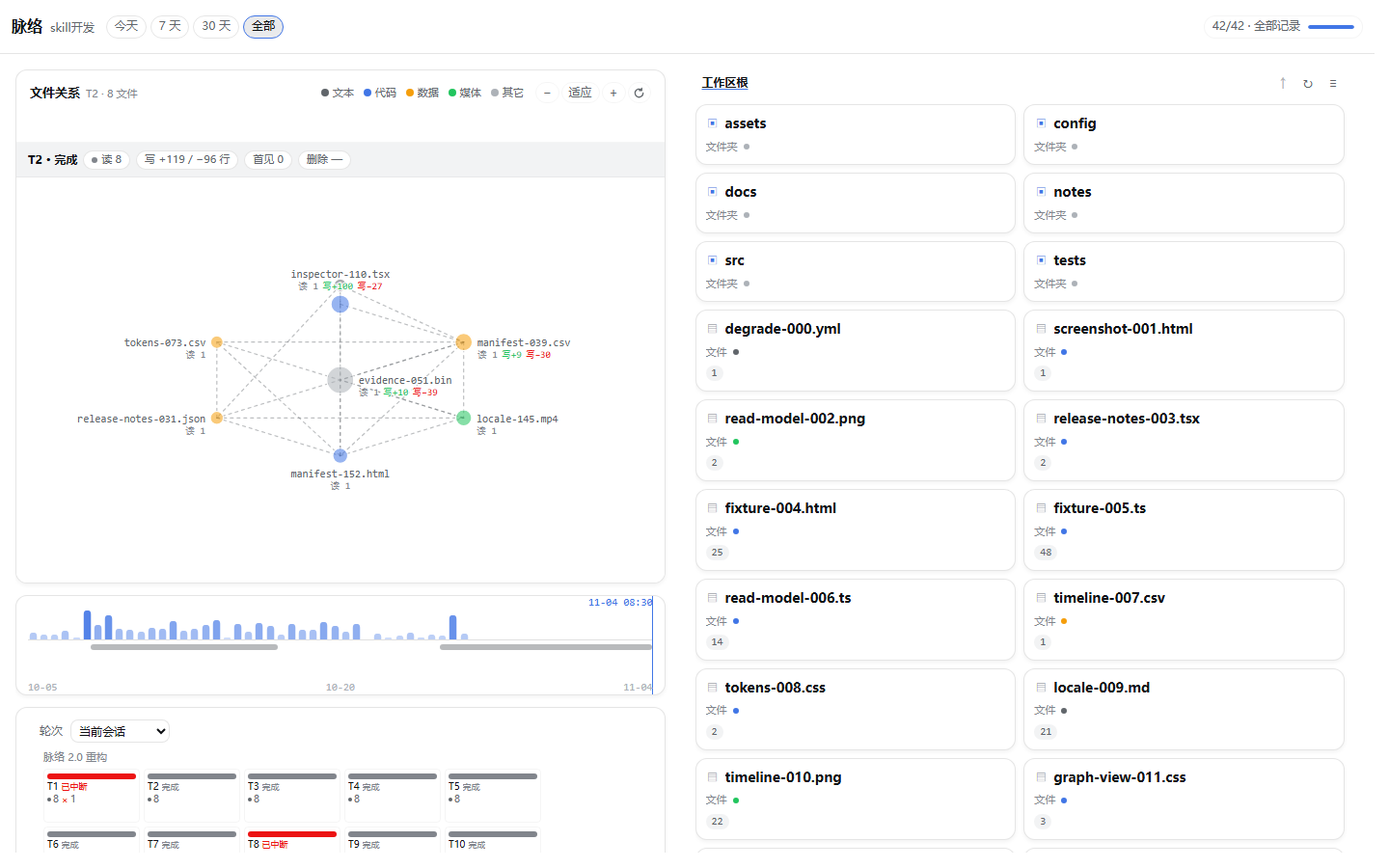
Node cap
Directories with more than 40 files keep the most active ones and show a persistent Show N/M chip.
Switching to the full set degrades density, labels and radius automatically.
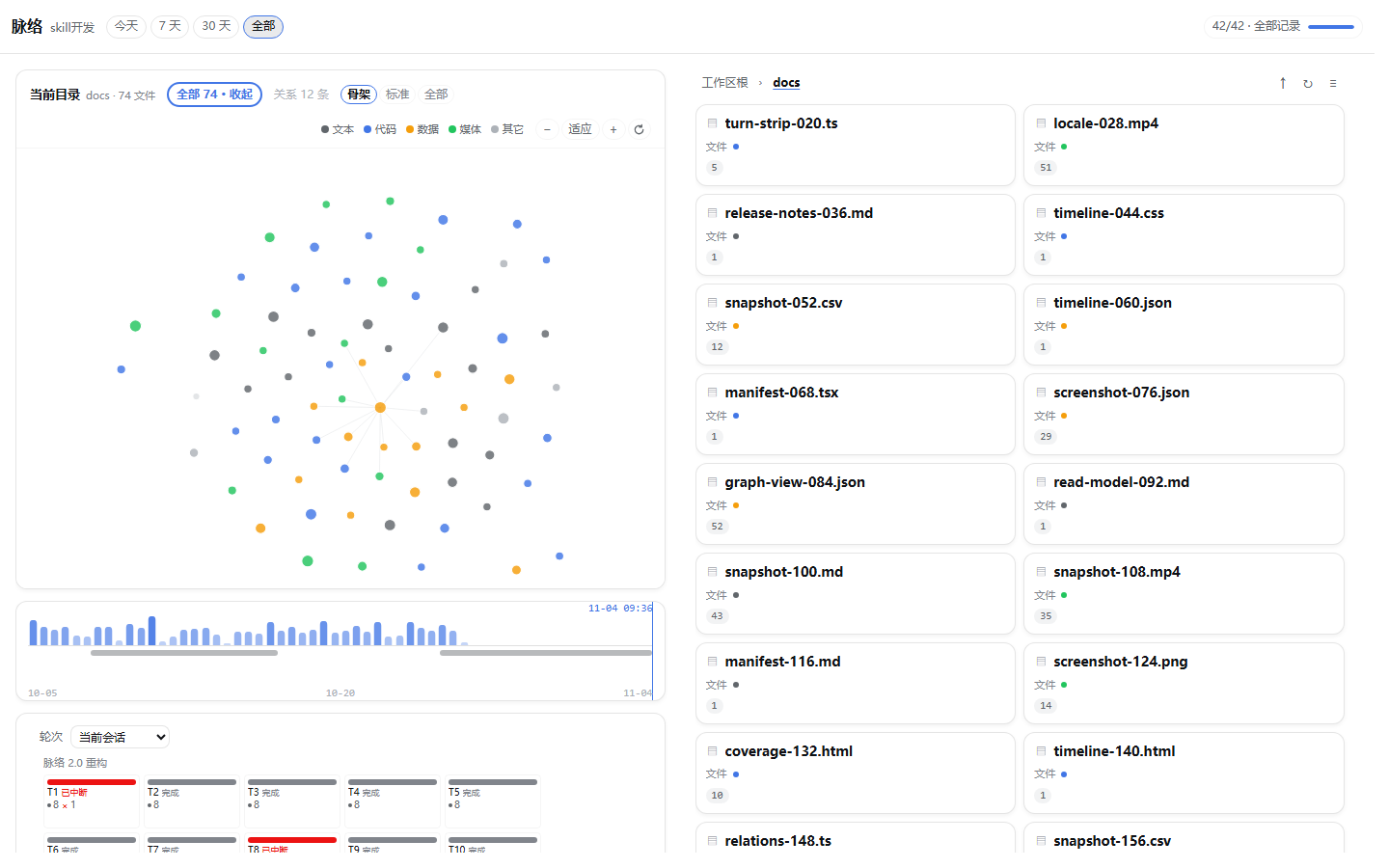
The screenshots above are rendered from the real component with a synthetic fixture dataset, so the
file names are test data; the interface itself is not a mock-up.
The Reasoning tab
A second tab, Reasoning, answers a different question about the same conversation: how much thinking
went into it, and of what kind? It reads the reasoning blocks DSH already records, so it adds no
execution cost and no writes.
Three views share one selection, one KPI strip and one detail band — switching views never changes the
page height:
| View |
What it shows |
Best for |
| Treemap |
True squarified layout, area = characters. Up to 12 cells; the rest merge into an "Other" cell you can drill into. Each cell clips its own label, so long phrases never bleed into a neighbour. |
Seeing which groups dominate at a glance |
| Word cloud |
Text as the graphic, sized by weight. Two-phase layout: canvas measureText first, then deterministic spiral placement with collision detection. Words that do not fit are counted, never silently dropped. |
Scanning vocabulary |
| List |
Sortable table with ratio bars. Group and sentence rows are paged, so a dimension with tens of thousands of groups still renders instantly. |
Auditing exact numbers |
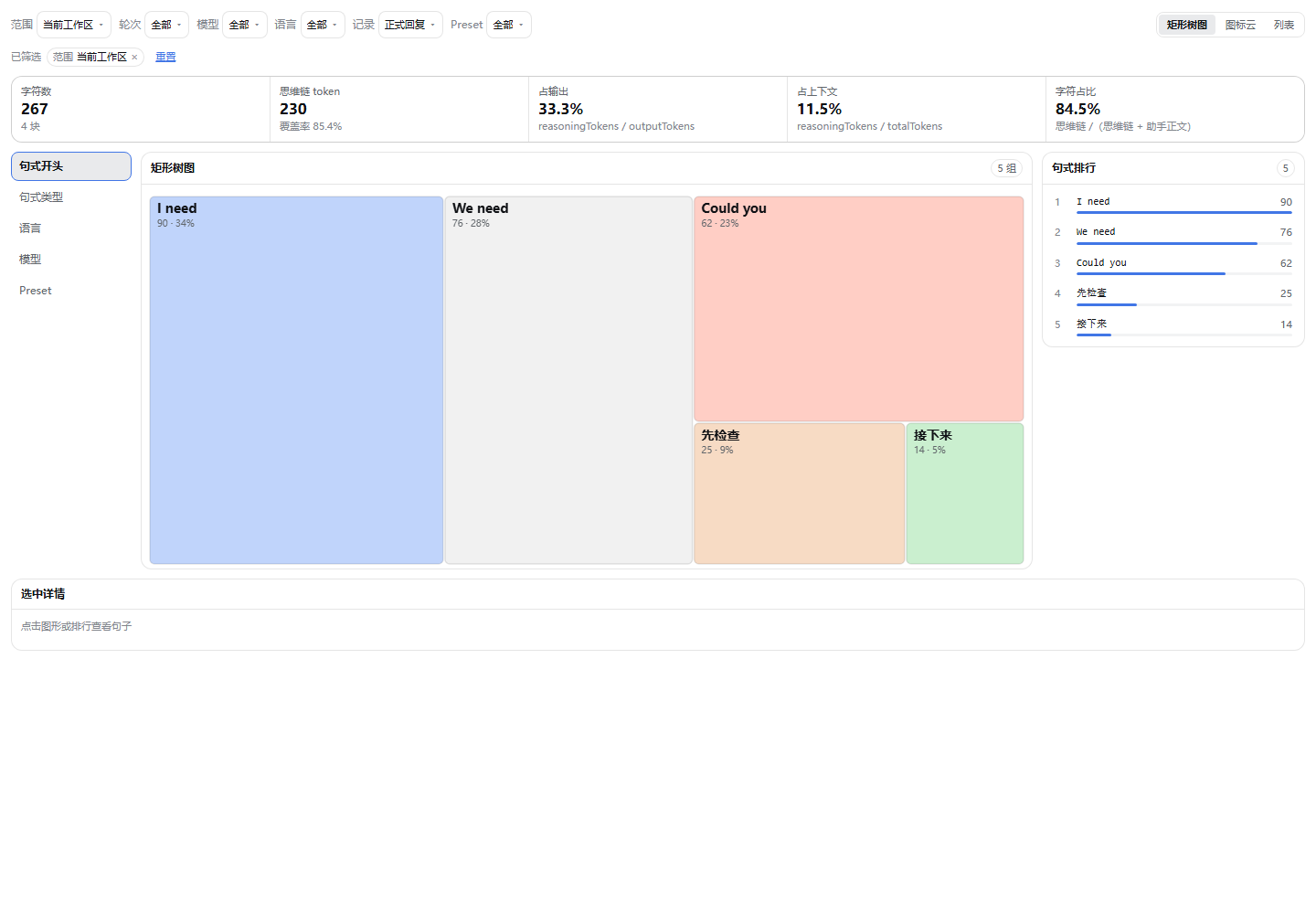
Filters that actually filter
Six controls, and every one of them changes the derived data:
- Scope — current session (default), unarchived sessions, or the whole workspace.
- Turn — a single turn, or all turns. The turn list is enumerated from the data, not hard-coded.
- Model and Preset — enumerated from the samples that actually exist.
- Language — applied at sentence level, because language is a per-sentence property; filtering it at
sample level would invent a second definition.
- Records — committed replies only, or include interrupted attempts.
An active-filter row appears only when something is filtered, names each condition, and offers a
one-click reset. An empty result says which conditions produced it rather than claiming there is no data.
Honest numbers
The three ratios have three different denominators, and the UI labels each one:
| Figure |
Definition |
| Share of output |
reasoningTokens / outputTokens — how much of the reply's output was thinking |
| Share of context |
reasoningTokens / totalTokens — how much of the whole context (including input and cache) was thinking |
| Character share |
reasoning characters / (reasoning + answer text). Shows — when a scope has no answer text at all, instead of reporting an inflated percentage |
Provider usage is reported per reply, not per sentence. So group-level token counts are distributed by
character share within that reply — the columns sum back to the true total, and the UI marks the value as an
estimate rather than pretending to sentence-level precision.
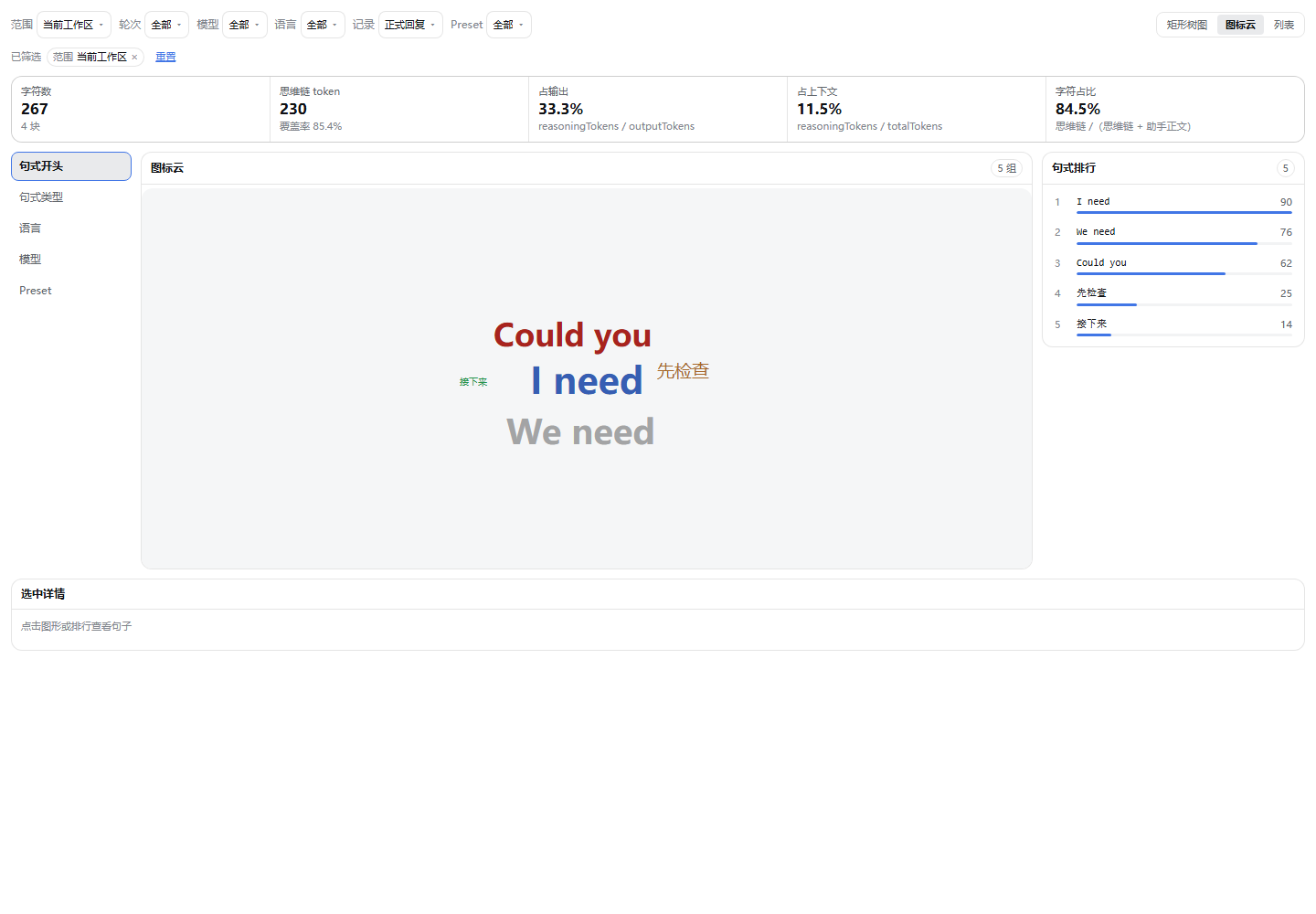
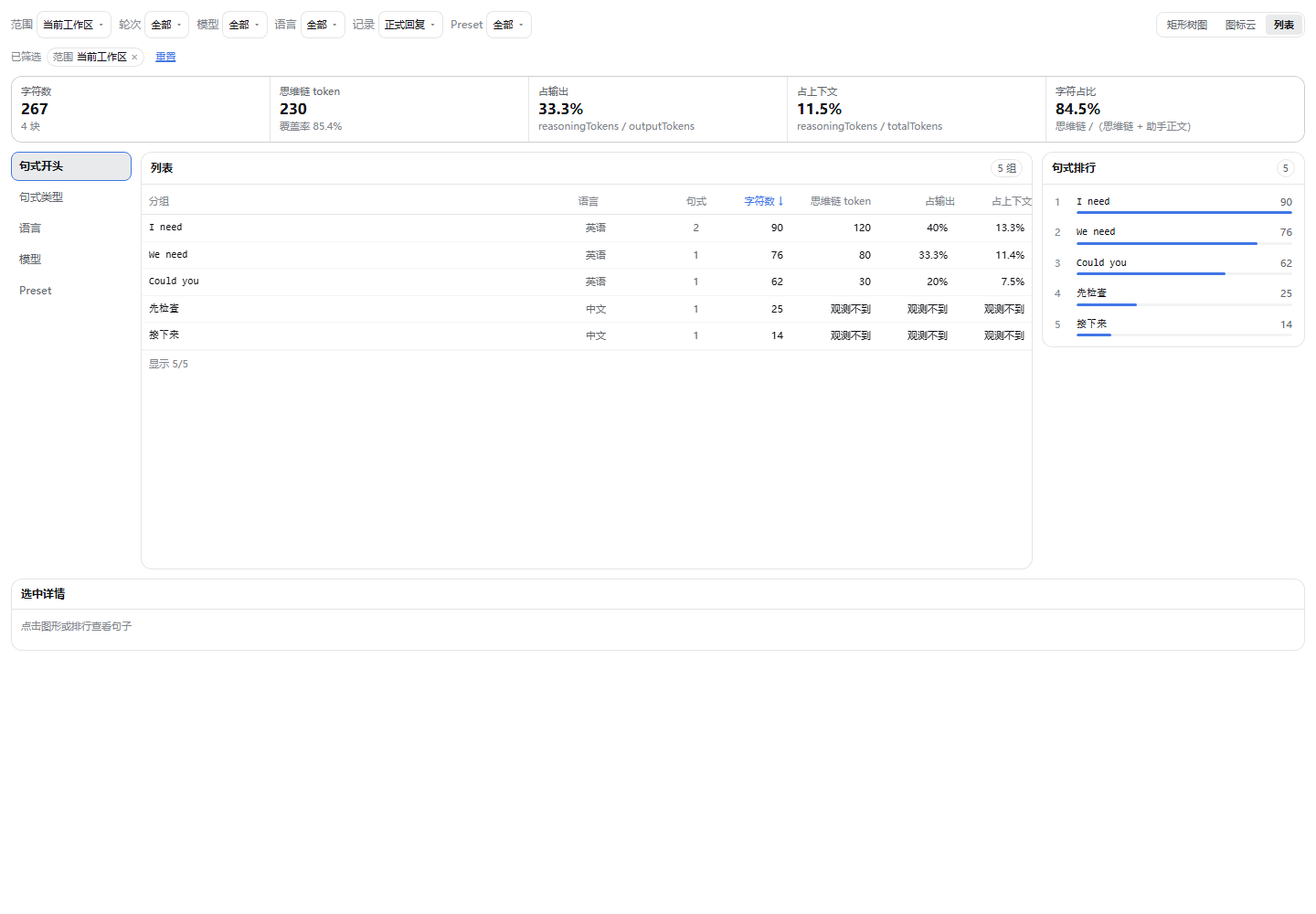
Cost and coverage
The first open reads the current session plus the four most recently updated sessions. That is deliberate —
reading every log in a large workspace costs seconds. When the scope is wider than what is loaded, the page
shows "loaded N/M sessions" with a failure count and explicit load more / load all actions, so a
partial sample is never presented as a full-workspace statistic.
Configuration
No configuration is required. The plugin reads the session's working directory from DSH and needs no
environment variables, tokens or storage paths.
Project structure
plugin/
  src/host/       read-only directory listing, routes, session scan
  src/client/     UI: graph, timeline, turn strip, file browser, inspector
  src/shared/     relation model, path utilities, parsers
  lib/            build output (generated; never edit by hand)
  tests/          node --test suites and browser harness
Project status
v1.5.6 is the default version on npm (latest) and is still being iterated on.
It works, but a few things are worth knowing up front:
- The Reasoning tab is functionally complete. Treemap / word cloud / list, and all six filters
(range, turn, model, language, record, preset) genuinely change the derived data. The language and
preset filters actually take effect, and the page honestly reports "loaded N/M sessions".
List rows are paged rather than rendered all at once. Visuals and interaction will keep being adjusted.
- "Standalone page" is a visual claim, not an architectural one. A DSH UI plugin can only
register into an existing slot (this one uses
conversation.view); there is no public API for
opening an independent window or route. The Reasoning tab fills the area, has an opaque
background and scrolls internally, but it is still rendered inside the conversation container.
- Performance only gained an "unchanged log is not re-read" cache. The first open still pays a
full scan; going further needs incremental log reading, which conflicts with this project's
"permanently read-only" rule — not decided yet.
- Upgrades are not automatic. An already-installed copy must be uninstalled and reinstalled to
pick up a new version (host limitation).
For concrete problems, please file an issue with the scenario.
Releases
Current release: panel plugin v1.5.6 (npm latest, actively being polished).
v1.5.6: bug-fix release on top of 1.5.5. The graph no longer flashes twice on load — it used to
paint once with a fallback canvas size and then re-lay out at the real size, which read as two separate
entrances (the measurement now happens before paint). The Reasoning tab no longer renders blank: its
view-entrance animation used fill-mode: both with a zero-opacity start frame, so any frame in which the
animation did not advance left the whole layer invisible. Treemap geometry was also corrected so the
viewBox matches the content box instead of double-subtracting padding. The README now documents the
Reasoning tab with real screenshots.
v1.5.5 was the structural pass: both tabs share a single ConversationSurface (the Reasoning tab no
longer leaks the host input box); Threadline collapses nodes, folder cards, icons, labels and all three
edge classes onto one rAF geometry clock, with edge endpoints derived per frame from the current node
coordinates — the separate edgeSync interpolation path is gone. The language and preset filters now
really feed the derivation pipeline; the treemap is a true squarified layout with per-cell clipping,
key-stable colors and a drillable "Other"; the word cloud measures text on a canvas and detects
collisions; lists are paged.
v1.5.4 fixed eight items from real-device feedback (per-frame edge interpolation, node entry animation,
the Reasoning tab filling the host area, a muted pastel palette, a real word cloud, the model filter
enumerating real sample values instead of hard-coded names, the layout rework, and treemap Top 50).
v1.5.3 fixed the rail list tail misalignment, added layout transitions, colored the treemap and capped
it at Top 10, and gave host /detail an updatedAt cache hit.
See the 1.5.6 / 1.5.5 / 1.5.4 / 1.5.3 / 1.5.1 sections in CHANGELOG.md.
License
MIT — see LICENSE.


