
模型与 MCP
待识别

rea
morluto
Reverse engineer anything with agents, from app behavior down to native binaries.
PROJECT TOPICS
INSTALL REFERENCE
dsh plugin --profile web add github:Garybot126/dsh-subagent-models
该命令指向仓库当前默认分支;尚无绑定当前 commit 的完整验证结果。
PROJECT README
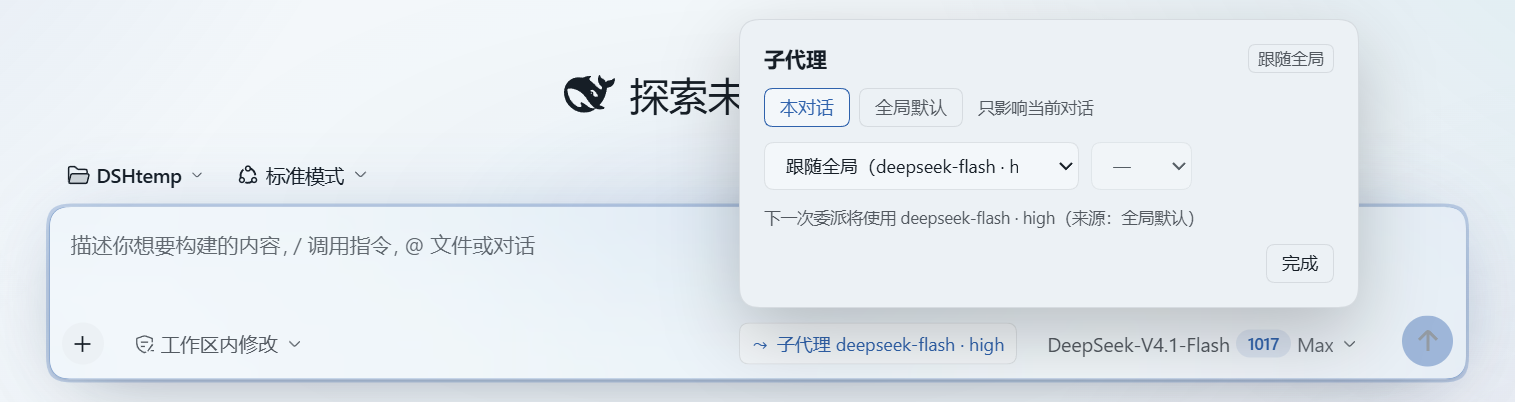
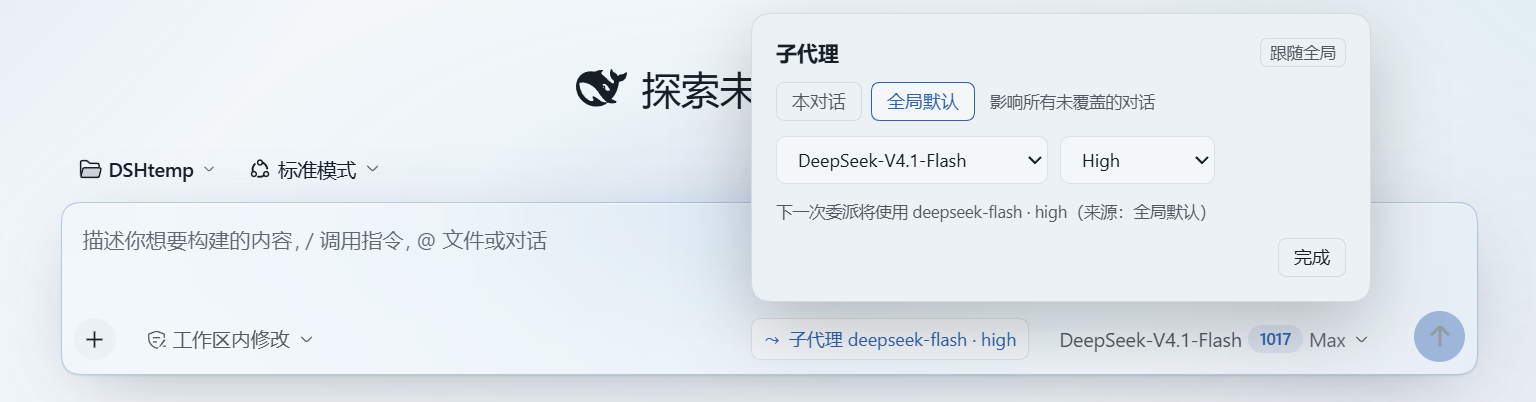
Set the provider, model and reasoning effort that DeepSeek Harness subagents run with — from one entry, the chip beside the composer. The card it opens has two scopes over the same two DSH-style pickers: a searchable, provider-grouped model menu and that model's own effort menu.
为 DeepSeek Harness 的子代理统一指定用哪个模型、思考强度多深:只有一个入口——输入框旁的「子代理」 胶囊;点开的卡片里用「本对话 / 全局默认」两个范围切换,两处都是同一组 DSH 风格的「模型 + 思考强度」 浮层菜单(可搜索、按提供方分组、行内勾选)。
agent/created selection (index.js)client.js)@deepseek-ai/dsh-client-ui-primitives when present (a frozen platform module — nothing to
install), with hand-drawn .dsm-* fallbacks on hosts that do not ship it.| 本对话 | 全局默认 |
|---|---|
 |
 |
# npm
dsh plugin --profile <profile> add dsh-subagent-models

# or straight from this repository
dsh plugin --profile <profile> add github:Garybot126/dsh-subagent-models
Then restart dsh once if the plugin row was not hot-loaded.
| Where | What |
|---|---|
| Composer → 「子代理 …」 chip | The only entry. Opens the card |
| Card → 「本对话」 scope | This conversation's override; the model menu's first row is 「跟随全局」 |
| Card → 「全局默认」 scope | The profile-wide default for every conversation without an override |
The chip's label is the effective route for the conversation (e.g. 子代理 DeepSeek-V4.1-Flash · high), so the composer always says what a delegation will actually use. The card's footer repeats
it with its source: 下一次委派将使用 …(来源:本对话 / 全局默认).
The card's two rows are DSH-style cells — click one to open a menu anchored above it. The model menu matches the built-in composer model picker: a search box for catalogs above four models, provider groups with sticky headings, rounded hover rows and an inline check mark on the current choice. The effort menu lists 「模型默认」 plus only the levels that model advertises.
Both menus are driven by the live LLM catalog (ctx.llm): models are grouped by provider, and the
effort list is the one that model advertises (resolveModelInfo().reasoning.efforts), so an
unsupported level is never offered.
No settings page is registered by this plugin. The built-in 设置 → 插件 → 子智能体 page belongs to dsh itself (recursion depth, concurrency, model whitelist) and is unrelated; see below.
本对话 override → 全局默认 → no route (child inherits the parent session)The delegation tool (subagent) is composed in the agent-plane preset, not in the Profile
patch, and it carries its own static agentOptions. A plugin cannot rewrite that composition, so
the route is applied to the delegated child itself:
agent/created → agent.model.select({ provider, model, reasoningEffort })DSH ≥ 0.2.2 fixes a step's model selection before the agent/request waterfall runs and now
rejects any proposal that changes provider, model or reasoning effort (the error it throws says
“… after step preparation fixed …; use agent.model.select() before step preparation”), so that
seam is no longer usable for routing. agent.model.select() appends a model/selection event —
the projection a step reads its selection from — and agent/created is emitted (and awaited,
it is a serial event) after the child is constructed but before its first step prepares. The
listener is registered once and only touches a Session whose origin is subagent; a top-level
Session is never touched, and the conversation root for the per-conversation scope is found by
walking parentSession up until a non-subagent Session is reached. Consequences:
subagent tool, without editing the preset and without adding
model-selection parameters to the tool schema;subagent, subagent_fork and Agent Teams members all count as delegated agents (every
in-process child is created with origin: "subagent");[subagent-models] warning — a stale route degrades to "no routing" instead of breaking the
child.$DSH_HOME/plugin-data/subagent-models.json (falls back to ~/.dsh/plugin-data/), hot-reloaded on
mtime, so editing it by hand also works:
{
  "version": 1,
  "global": {
    "default": { "provider": "deepseek-official", "model": "deepseek-flash", "effort": "high" },
    "presets": {}
  },
  "sessions": {
    "<sessionId>": { "default": { "provider": "...", "model": "...", "effort": null }, "presets": {} }
  }
}
global.default: null means no profile default; an absent sessions[sessionId] means the
conversation follows it.
Capability disclosure: reads and writes this one JSON file; binds no network port beyond the loopback
HTTP prefix /plugin/subagent-models used by the Web UI; never reads conversation content,
credentials, or any other file.
subagent_fork children are overridden too. A fork shares the parent's prefix, so a different
model costs its KV cache; clear the route (or keep the preset's own agentOptions) if that
matters to you.agentOptions
because the recorded selection is read before that fallback; context-window and metering
metadata follow the selected route for the child's whole lifetime. Changing the route does not
re-route a child that is already running.Several plugins in the market move subagent routing: dsh-subagent-custom (task-class routing),
dsh-subagent-model-picker (a per-session picker), dsh-subagent-default-model (settings.yaml
default), dsh-model-settings (a settings panel), dsh-orquestrator (a fixed forced route). This
one keeps the surface at one composer chip: two scopes, one pair of DSH-style pickers, and a label
that always shows the effective value.
Since dsh 0.2.2 the host also ships its own subagent model-selection policy (an allowlist plus
per-call provider / model parameters on the tool). That one permits a selection; this plugin
forces one when the child is created.
On dsh 0.2.2-rc.1 (desktop profile):
opencode-go / deepseek-v4.1-flash / max → a delegated child's
model/selection and its first request/header both carried that route, and the child
completed its turn;[subagent-models] warning
instead of being forced (handler-level harness; not exercised end-to-end);GET /plugin/subagent-models/state?sessionId=… → 200 with global, session and the catalog;POST /plugin/subagent-models/route with scope: "session" / "global" → 200 and the JSON file
updates on disk;MIT © Gary Gai
CLASSIFICATION EVIDENCE
系统优先读取 GitHub Topics,再与站内分类词典和词根规则比对。当前命中: deepseek-harness。
morluto
Reverse engineer anything with agents, from app behavior down to native binaries.

deepseek-ai
DeepSeek Harness: Everything is a Plugin.

nexu-io
The 1st Collaborative AI Design Agent Workspace. Local-first and open source. Create motion, prototypes, websites, apps, dashboards, presentations, images, and videos with your team and AI agents. Share work, exchange feedback, and iterate together in one workspace.