
模型与 MCP
待识别

rea
morluto
Reverse engineer anything with agents, from app behavior down to native binaries.
PROJECT TOPICS
INSTALL REFERENCE
dsh plugin --profile web add github:FrankieeW/dsh-remote-agents
该命令指向仓库当前默认分支;尚无绑定当前 commit 的完整验证结果。
PROJECT README
Unified DSH workspaces for Claude Code, Codex and OMP, with local and SSH conversations, tool approvals and persistent history. Native DSH sessions share the same sidebar and retain their original conversation interface.
Unofficial community plugin, independently developed and maintained; not affiliated with DeepSeek. User messages and provider output are never translated or rewritten.
0.5.0 moves the backend to Rust. Every backend operation now runs in a bundled Rust sidecar while the DSH interface and state files stay the same. Install
dsh-remote-agents@latest, ordsh-remote-agents@0.4.1for the previous, frozen JavaScript release preserved on thelegacy-jsbranch. See native architecture and builds.
/ commands in Claude Code, Codex and OMP conversations: searchable keyboard completion, status/help, model/effort/permissions, rename/pin/archive, fresh conversations, interruption and Markdown/JSON export. Commands retain drafts on failure and never become model prompts. See conversation commands.See agent views and automatic titles for behavior and limits.
Captured in an isolated demonstration profile from the interface as of 0.4.1; 0.5.0 keeps this layout and adds the per-conversation Models tab, which is not yet shown here. Conversations, project paths, and CLI/SSH responses use fixtures; the images contain no production conversations, credentials, personal paths or real server identities. They illustrate the interface, not live-server verification.
Unified workspace sessions — browse Claude Code, Codex and OMP conversations together, with nested local workspaces and a separate SSH workspace.
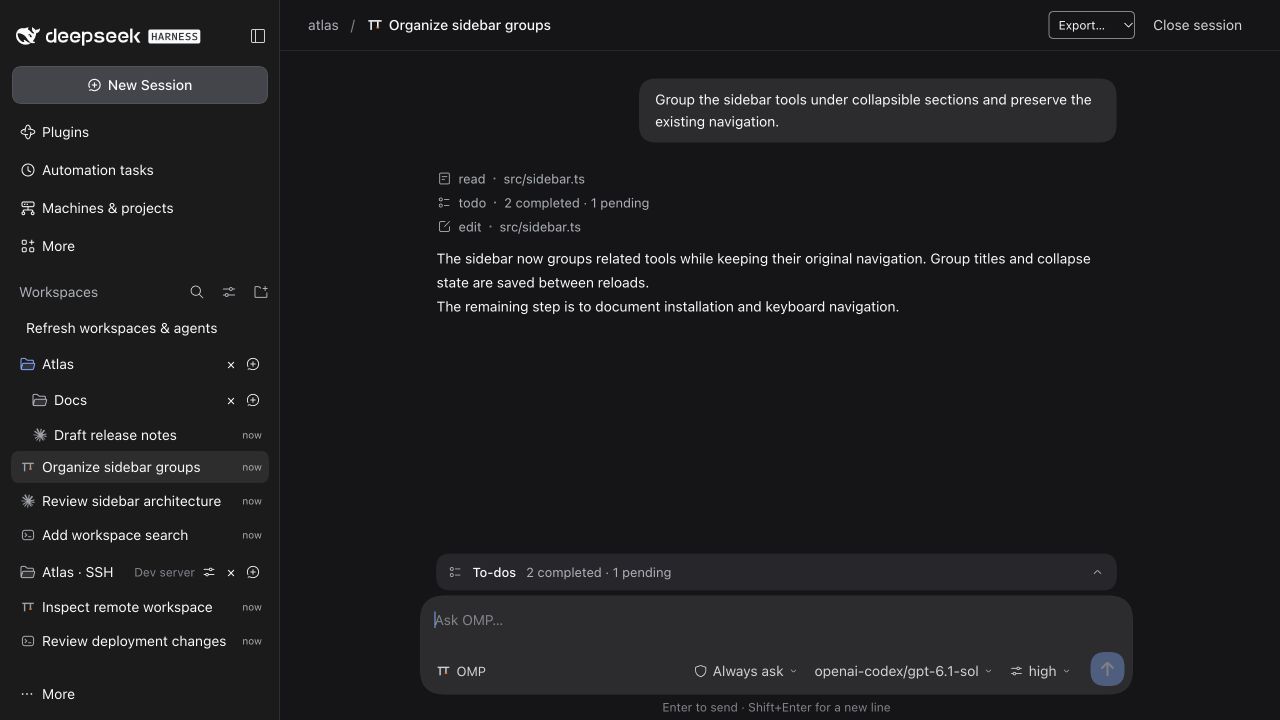
| OMP to-dos and tool calls | SSH workspace |
|---|---|
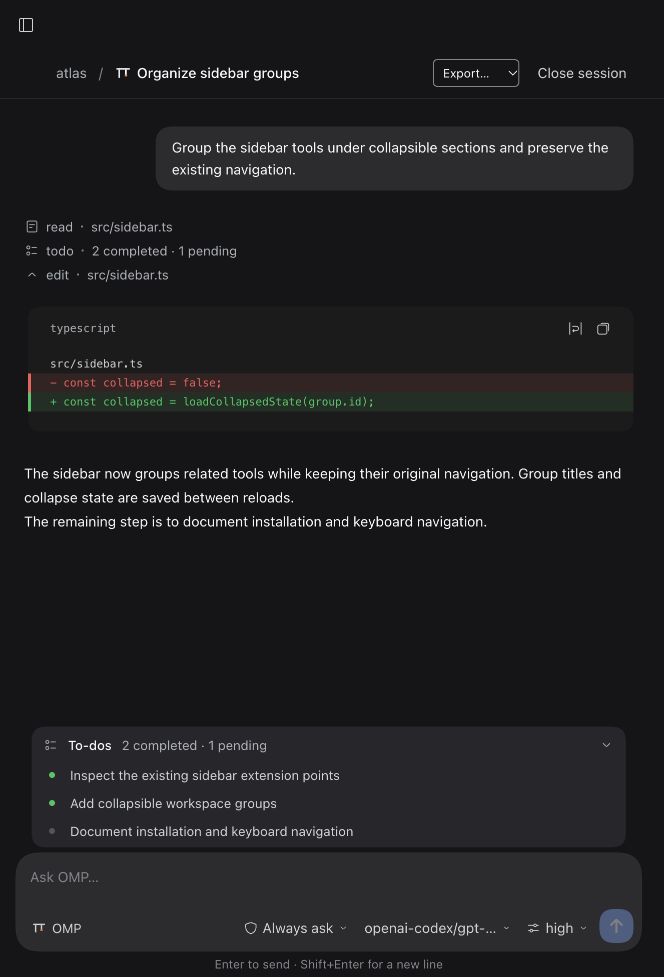 |
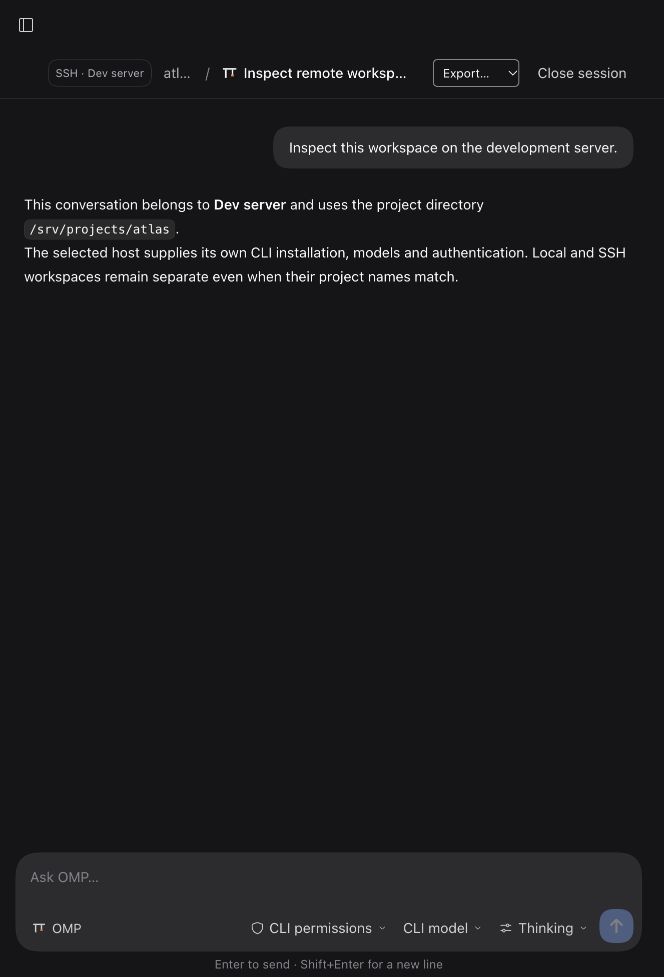 |
| Phased tasks and structured tool results stay beside the composer. | The host badge and remote directory identify where the conversation runs. |
Use dsh-remote-agents@latest in the plugin manager for your running DSH profile, or pin dsh-remote-agents@0.5.0. For an explicitly selected web profile:
dsh plugin --profile web add dsh-remote-agents@latestFor the desktop app, install into its existing profile through its plugin manager; the command above does not update the desktop profile.
latest now resolves to this Rust release. The package ships macOS and Linux executables for arm64 and x64, and npm verifies each build with a signed provenance attestation from this repository's release workflow. See also Build and install.
Versions up to 0.4.1 are the JavaScript-backed implementation. 0.4.1 remains installable from npm by exact version, and its source is preserved, frozen, on the legacy-js branch. That line receives no new features. Installing 0.4.1 over 0.5.0 downgrades the plugin; conversations and workspace registrations use a compatible state format, so they remain readable.
/help, /status, /model, /effort, /permissions, /rename, /pin, /archive, /new, /stop and /export with keyboard completion, executed by the backend and never sent to the model.alias, user@host, host:port, ssh://…) are tested before saving, with per-machine connection results and safe rename/removal.todo records (op/list input and details.phases output).~/ expansion, directory suggestions, Tab completion and arrow-key selection. Remote sessions use the selected host's CLI, models and authentication.Current scope: Claude, Codex and OMP structured chat supports local and registered SSH hosts with compatible CLIs. Attachments, rich questions and cross-engine migration are not implemented. Native DSH sessions remain local to the DSH Host. Unsupported dialogs are cancelled/denied rather than guessed. Native DSH conversation capabilities are unchanged; the replacement sidebar's limits are listed above.
See the architecture, protocol references and capability boundaries.
Open Machines & projects for:
user@host, host:port or ssh://user@host:port) that are tested before saving, with an explicit Save without testing override. Destination fields suggest the Host aliases of ~/.ssh/config that are not machines yet. They are read without running ssh.herdr-import Skill. See the import guide and Skill.This is not a full Herdr/T3 clone. There is no terminal emulation, live Herdr takeover, existing terminal discovery, Git worktree orchestration or inferred agent task status. In the legacy terminal view, running means the process is alive—not that an LLM task is finished.
0.2.2-rc.1 (verified on 0.2.2-rc.1). Other DSH minor versions require revalidation.The plugin uses owner-only exact Fetch routes on DSH's existing authenticated /api HTTP/IPC carrier. It does not start another Web server.
Building the Rust implementation requires a stable Rust toolchain in addition to Node.js. Packaged installations use the bundled executable and do not compile Rust. A local build includes only the current platform; use the native distribution workflow for a package containing all four macOS/Linux architectures.
npm ci --ignore-scripts
npm run check       # builds Rust + JS, then runs regression and native tests
npm run test:package
npm pack
Install the resulting package through the plugin manager of the same profile as your running GUI. For an explicitly selected web profile:
dsh plugin --profile web add /absolute/path/dsh-remote-agents-0.5.0.tgzFor the desktop application, use its plugin management entry rather than installing into an unrelated web profile. Restart the desktop application after the update; no automatic HMR is promised without a matching dev:web watcher.
A locally packed tarball contains only the current platform's executable. The release artifact and the npm package contain all four macOS/Linux builds. Repacking an older tarball at its existing installed path can retain pnpm's old file integrity/cache; a new version and filename avoid that ambiguity.
The historical v0.2.0 release does not include unified chat.
Build artifacts contain a Host ESM entry and a DSH lazy client factory. React is shared with the Host. The pinned Claude SDK remains an ordinary runtime dependency rather than being embedded into the browser bundle.
Use existing OpenSSH configuration for keys and jump hosts:
Host dev-box
  HostName 192.0.2.10
  User developer
  Port 22
  IdentityFile ~/.ssh/id_ed25519
  IdentitiesOnly yes
Verify the host key and authentication yourself first:
ssh dev-box
ssh -o BatchMode=yes -o StrictHostKeyChecking=yes dev-box 'tmux -V'
Then add the alias and use an absolute remote project path. The plugin uses BatchMode=yes and StrictHostKeyChecking=yes; it never accepts an unknown fingerprint, stores SSH passwords/private keys, or automatically installs/updates remote software. Remote discovery runs only when you browse a directory, open a remote session/agent menu, or explicitly refresh versions. Herdr imports can preserve safe separate user/port fields.
All operations require the DSH owner. Tool/terminal access is not an OS sandbox and can have the privileges of the corresponding local/SSH account. Do not share owner access with untrusted users.
See permissions and storage for precise CLI policy semantics and limits. Conversation messages/tool data are stored in mode-0600 files next to the fleet state. Live processes and approval callbacks are not serialized. Closing the browser does not stop them; closing a session or unloading the plugin denies pending approvals and stops its structured subprocesses. An interrupted turn is never automatically resent.
Only one live ChatManager may own a chat state directory; configure separate state paths for simultaneous profiles. Existing CLI policy grants can permit tools without a new dialog; the UI only answers actual live requests and never selects remembered approvals automatically.
~/.dsh/remote-agents/fleet.json, respecting DSH_HOME. Override with DSH_REMOTE_AGENTS_STATE or Host option statePath.sshMultiplexing: true Host option or DSH_REMOTE_AGENTS_SSH_MULTIPLEX=1) shares one connection per destination for the plugin's own SSH commands. On a local OpenSSH 10.5 server, a two-command directory listing dropped from about 105 ms to about 25 ms. It is off by default; see the Fleet API for its trade-offs. It stores machine/project metadata and launch arguments, not terminal transcripts. Never put secrets in launch arguments.npm test
npm run build
npm run test:package
# Optional real isolated tmux test; creates and cleans up only its own test session:
DSH_FLEET_SMOKE=1 node --test test/local-smoke.test.jsUnit and component tests cover protocol framing, completion correlation, permissions/cancellation, persistence, duplicate admission, workspace grouping, settings conflicts, stale reads, reconnects, search and management. The installed-package test uses the actual packed host and client with a real deterministic CLI subprocess and fixture DSH UI primitives. It verifies tools, approval denial, interrupt/resume, process restart, settings and metadata persistence, export, and startup failure/reconnect. The tmux smoke test uses a real isolated terminal session. Live desktop checks have exercised local Codex and OMP replies and Netcup SSH directory browsing; provider authentication/quota and remote CLI versions remain environment-specific. Remote updater execution is tested with controlled commands; existing servers are not upgraded by verification.
CLASSIFICATION EVIDENCE
系统优先读取 GitHub Topics,再与站内分类词典和词根规则比对。当前命中: deepseek-harness。
morluto
Reverse engineer anything with agents, from app behavior down to native binaries.

deepseek-ai
DeepSeek Harness: Everything is a Plugin.

nexu-io
The 1st Collaborative AI Design Agent Workspace. Local-first and open source. Create motion, prototypes, websites, apps, dashboards, presentations, images, and videos with your team and AI agents. Share work, exchange feedback, and iterate together in one workspace.