dsh-mcp-diff
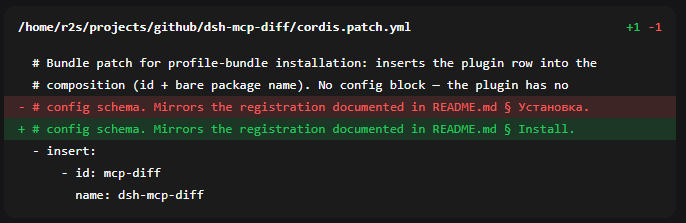
A client plugin for the DeepSeek Harness (Web GUI) that turns every file
mutation it can confidently parse into a uniform diff card in the chat —
collapsed by default, with per-line highlighting (green for additions, red for
deletions).
Covers the filesystem MCP server (edit_file / write_file / move_file /
create_directory),
the built-in DSH tools (edit / write), and recognizable file-mutating
bash commands — one look for all of them. Bash shapes the parser cannot
confidently identify (chmod, ln, rsync, dd, git state changes, …)
keep the plain terminal card: a missed card beats a wrong one.
Why
By default DSH draws a diff only for its own file tools (edit, write), with
its own renderer. When the agent edits files through the
@modelcontextprotocol/server-filesystem MCP server, the call is named
mcp__filesystem__edit_file / mcp__filesystem__write_file — there is no
registered toolview for it, so the chat shows only a generic block with no diff.
The plugin:
- registers a toolview under the MCP keys and builds the diff from the server
response (a ready unified diff with context and
@@ headers) or from the call
arguments when there is no response yet (write_file, a still-running
edit_file);
- also overrides the built-in
edit / write, unifying their contextual hunks
(a per-line LCS: shared lines read as neutral context instead of being
doubled);
- renders
move_file and create_directory as compact informational cards —
source → destination, the created path, both workspace-relative — since
they carry no diff lines;
- makes every card's path openable: a click hands it to the host's file
opener (the same channel the native tool rows use), which resolves it
against the session workspace and opens the file in your IDE/editor;
- renders everything as one card built on a native
<details> — collapsed by
default, the header shows the path + +N -M, and it expands on click.
Bash edit cards
When the agent edits files through bash instead of a file tool (a python3 -
heredoc with old/new blocks, sed -i, cat > file <<EOF, tee,
> file redirects), DSH shows a plain terminal block and tracks no "files
touched" — so the plugin owns the bash toolview and adds a card only for
commands it can confidently parse as line mutations:
- replace — a heredoc script that reads a file,
.replace()s old/new
triple-quoted blocks and writes it back: the card shows the file, real
del/add lines and +N -M derived from those blocks;
- write —
cat > f <<EOF, tee [-a] f <<EOF, bare > f / >> f: the
path always, the added lines when the content is spelled out in the command;
- in-place —
sed -i / perl -pi with explicit file tokens: the path only;
- path ops —
mkdir, mv, cp, rm, touch with literal path
arguments: an informational card naming the operation and its paths (no diff
lines exist for these). Anything non-literal — $VAR, globs, cd
chaining — keeps the plain terminal card.
Every other bash call (ls, git status, builds, grep…) keeps a plain
terminal-like card — it is never turned into a diff. Such a card gains a small
warning chip when the command matches an unambiguous destructive signature
(rm -rf, chmod 777, git reset --hard, git checkout ., git clean -f,
curl … | sh, mkfs, dd of=, shred) — an annotation of the command text,
never a mutation claim.
The card is marked bash edit and carries a footnote: intended change
parsed from the bash command — not an edit/MCP tool result. The client sees
only the command text and its output (no filesystem access), so the diff is
what the script claims to do, with the full command and the output tail
one click away. Dynamic paths ($VAR, globs) and unsupported shapes are left
unrendered on purpose: a missed card is better than a wrong one.
Open file links
Every path a card shows — the diff header, a move_file destination, the
paths of a bash mutation — is a link: clicking it calls the host's file
opener (openFile), the same channel the native tool rows use. The host
resolves the path against the session workspace (bash paths against the
command's own working directory) and opens the file in your IDE/editor.
A path without a workspace context (an unusual host setup) stays plain text,
and so does any path that would resolve outside the session workspace —
an absolute or ~ target parsed out of a bash command, .. traversal, a
bash call working outside the workspace. Rendered content never triggers an
open of an arbitrary host file.
Install
# from npm (prebuilt, recommended)
dsh plugin --profile web add dsh-mcp-diff

# or from GitHub (built on install)
dsh plugin --profile web add github:Fakek0f3sT/dsh-mcp-diff
dsh plugin add is a pnpm forwarder: it adds the package to your profile
(~/.dsh/profiles/web) and, since the plugin declares dsh.bundle,
automatically includes it in dsh.profile.bundles — nothing to wire by hand.
Installed from GitHub, lib/ is built in place (the prepare script); from npm
it ships prebuilt.
Important: DSH picks up its plugin set only at startup — after installing,
restart dsh web and refresh the GUI page.
Check that the bundle is served:
curl -s http://127.0.0.1:3080/plugins/dsh-mcp-diff/client.js | head -c 80
Manually from a clone
git clone https://github.com/Fakek0f3sT/dsh-mcp-diff.git
cd dsh-mcp-diff && npm install && npm run build
cd ~/.dsh/profiles/web
npm install /path/to/dsh-mcp-diff
{
  "dependencies": { "dsh-mcp-diff": "link:./node_modules/dsh-mcp-diff" },
  "dsh": { "profile": { "bundles": [ "…", "dsh-mcp-diff" ] } }
}
Configuring for another MCP server
The toolview keys are set for the server name filesystem. If your filesystem
MCP server is named differently (the serverName field in the config), edit the
key constants in src/client/index.tsx (MCP_TOOL_KEYS, MCP_MOVE_FILE_KEY,
MCP_CREATE_DIR_KEY — keys of the form mcp__<serverName>__…). The edit / write keys live there
too — remove them if you do not want to override the built-in renderer.
Development
npm install
npm run build
npm run test   # the self-checks (bash-mutation, diff, path-containment) via tsx
Compatibility
Tested on DSH 0.1.1-rc.2. The plugin imports only platform modules (react,
ui-primitives, ui-slots, runtime/client) — ui-tool internals are not imported.
License
MIT


