
Agent 与会话
插件

nuwa-skill
alchaincyf
你想蒸馏的下一个员工,何必是同事。蒸馏任何人的思维方式——心智模型、决策启发式、表达DNA。Distill how anyone thinks.
PROJECT TOPICS
INSTALL REFERENCE
dsh plugin --profile web add github:EricMoin/rolebox
该命令指向仓库当前默认分支;尚无绑定当前 commit 的完整验证结果。
PROJECT README
Turn one coding agent into a configured engineering team.
Specialist YAML roles with their own prompts, models, skills and permissions — run as explicit
graphs, with memory that survives the session.
One plugin for opencode, pi, dsh and Codex.






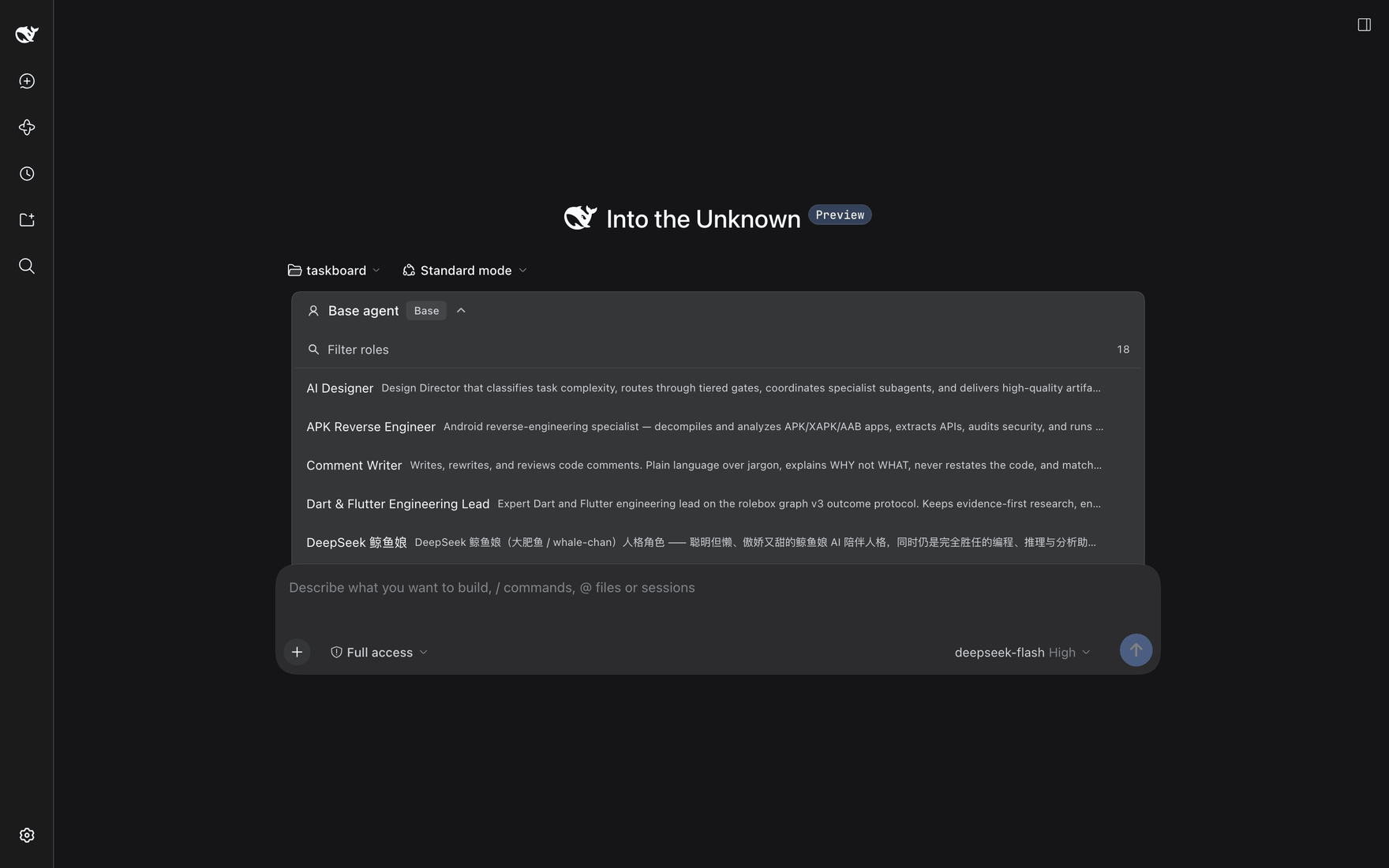
The role switcher in the composer tool row, left of the model selector: the chip names the active role and carries an Active marker; its list opens upward, and Filter roles searches the 20 loaded roles. Here TypeScript Engineer is active and checked.
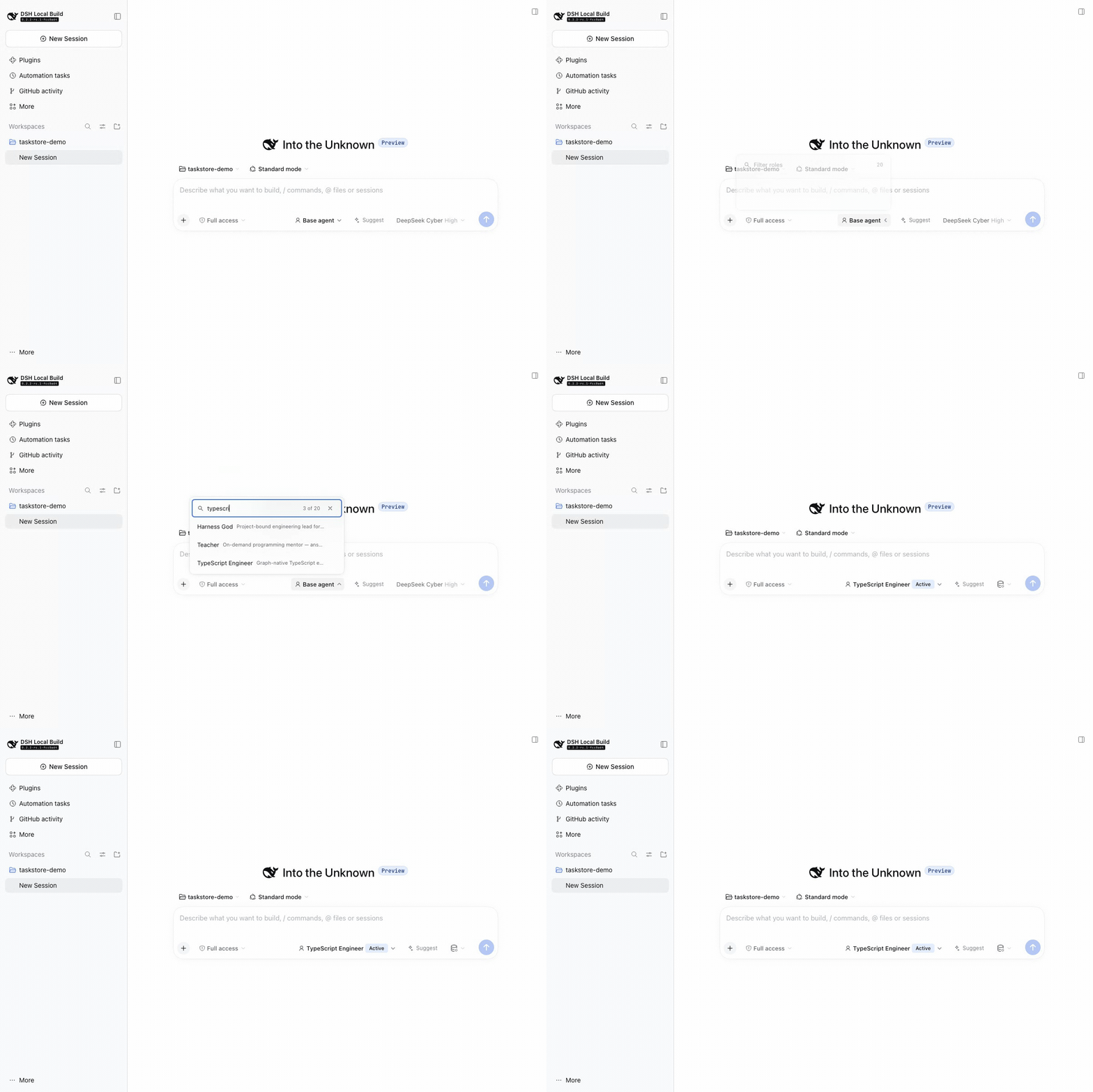
Switching roles from the composer: the chip opens its list upward, typing typescript narrows the 20 loaded roles to 3, and selecting TypeScript Engineer sets the chip to that name with an Active marker while the model seat collapses to the role-pinned indicator. Playback is 1×; the clip is trimmed to 1.9–14.1 s of a 15 s recording and ends on a 2 s hold.
What it is · See it work · Install · Roles · What you get · Engine · CLI · Docs
A general coding agent is one agent with one prompt. rolebox turns it into your configured team: specialists defined in YAML, each with its own prompt, model, skills and permissions, working the same task together. What they learn survives the session — decisions, conventions and lessons persist in memory and come back at the next session start.
On DSH, roles can collaborate through persistent peer teams: invite complementary specialists, exchange events, claim tasks, and continue work across turns. Team execution on other hosts is deferred. Structured workflows use declared graphs: graph_declare names each node's agent, brief, and permitted outcomes; the host dispatches entry nodes and workers settle them with graph_submit_outcome. Graph nodes advance only through accepted outcomes, with bounded loops and inspectable state.
At a glance
lsp_* language-server tools, hashline_* edits anchored to content hashes, skills, references, custom functions and hooks.computer_* family: computer_screenshot, computer_windows, computer_displays, computer_focus, computer_click, computer_move, computer_scroll, computer_drag, computer_type, computer_key, computer_status, computer_permissions, computer_record.browse_* family for semantic web-page automation: browse_status, browse_open, browse_snapshot, browse_read, browse_click, browse_drag, browse_type, browse_press, browse_select, browse_hover, browse_scroll, browse_wait, browse_eval, browse_screenshot, browse_record, browse_upload, browse_downloads, browse_dialog, browse_tabs, browse_history, browse_console, browse_network, browse_cookies, browse_close. Gated by browseUse; actions need the optional Playwright peer (npm install playwright, then npx playwright install chromium).rolebox monitor TUI, and channel-filtered logs.Every screenshot and the role-switch clip in this README was captured from a live dsh session on a demo workspace. Each caption states only what that capture shows.
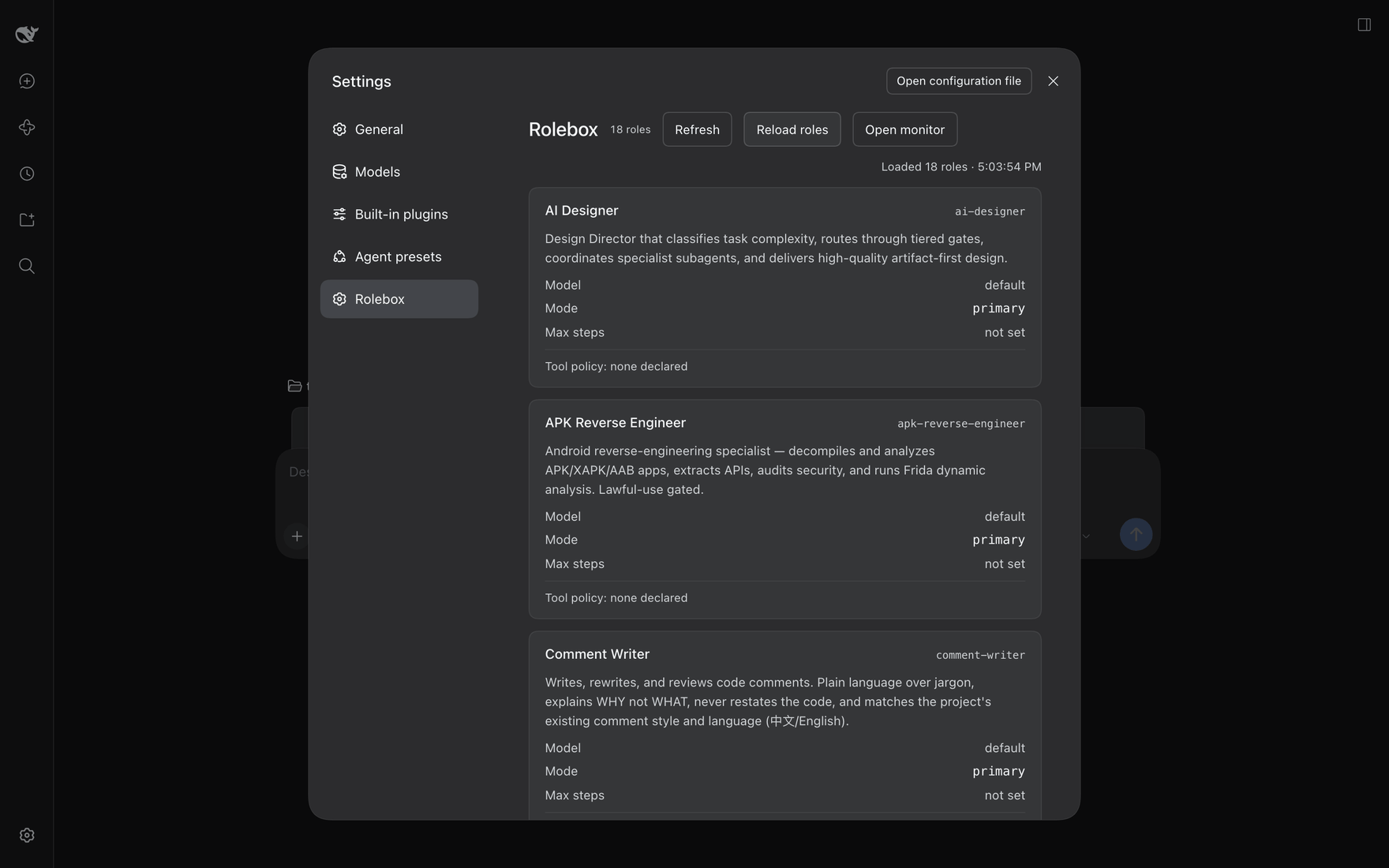
Settings → Rolebox: the 20 roles that loaded, each with its slug, description and declared tool policy.
Each card carries the display name, the slug at the right (ai-designer, apk-reverse-engineer, dart-flutter in the capture), a description paragraph, then three label/value rows — Model, Mode, Max steps — and a Tool policy: footer. In this capture every visible card reads Model deepseek-official/deepseek-flash-cyber, Mode primary, Max steps not set and Tool policy: none declared; no card names a source or origin path. The header carries the 20 roles badge, the Refresh and Reload roles buttons, and a Loaded 20 roles · <time> line recording when the load happened; the page points readers to the Rolebox conversation tab for monitoring, because monitoring is a conversation view, not a settings page.
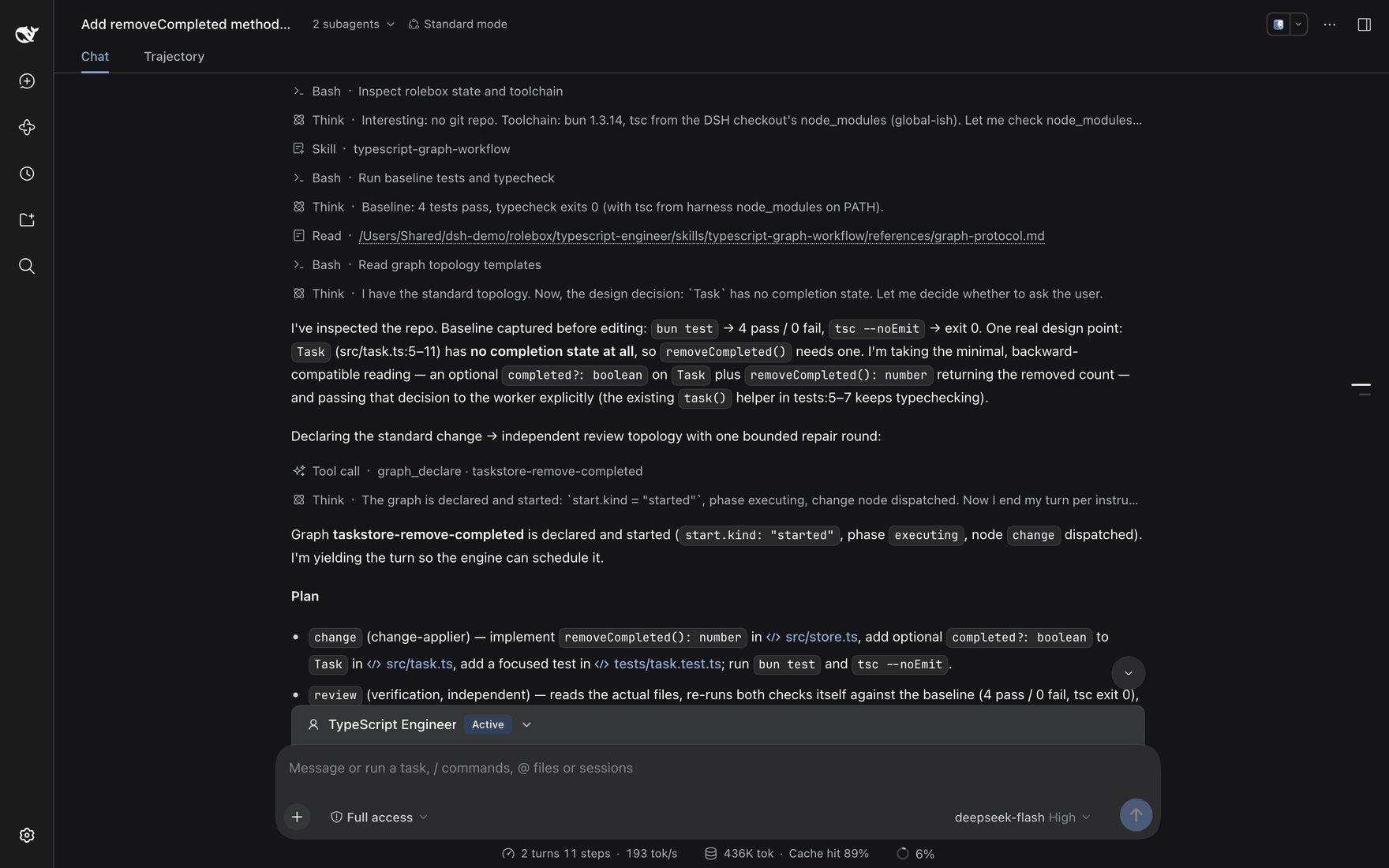
The TypeScript Engineer declares the work with graph_declare; the expanded row shows the two-node declaration and its result.
The role does not do the work inline. It inspects the repo and records a baseline before editing — bun test → 4 pass / 0 fail / 8 expect() calls, exit 0; npx tsc --noEmit → exit 0 — then names one real design point: Task has no completion state at all, so removeCompleted() needs one. It takes the minimal, backward-compatible reading — an optional completed?: boolean on Task plus removeCompleted(): number returning the removed count — and passes that decision to the worker explicitly.
It then declares graph_declare · taskstore-remove-completed and yields the turn so the engine can schedule it. The declaration records max_executions: 4 and names exactly two nodes and one bounded repair round:
change (change-applier) — implement removeCompleted(): number in src/store.ts, add the optional completed?: boolean field to Task in src/task.ts, add a focused test in tests/store.test.ts, and run the sample project’s test command and tsc --noEmit.review (verification, independent) — read the actual files and re-run both checks against the same baseline.The turn closes with the declaration started: start.kind: "started", persisted: true, runnable: true, and change#1 dispatched.
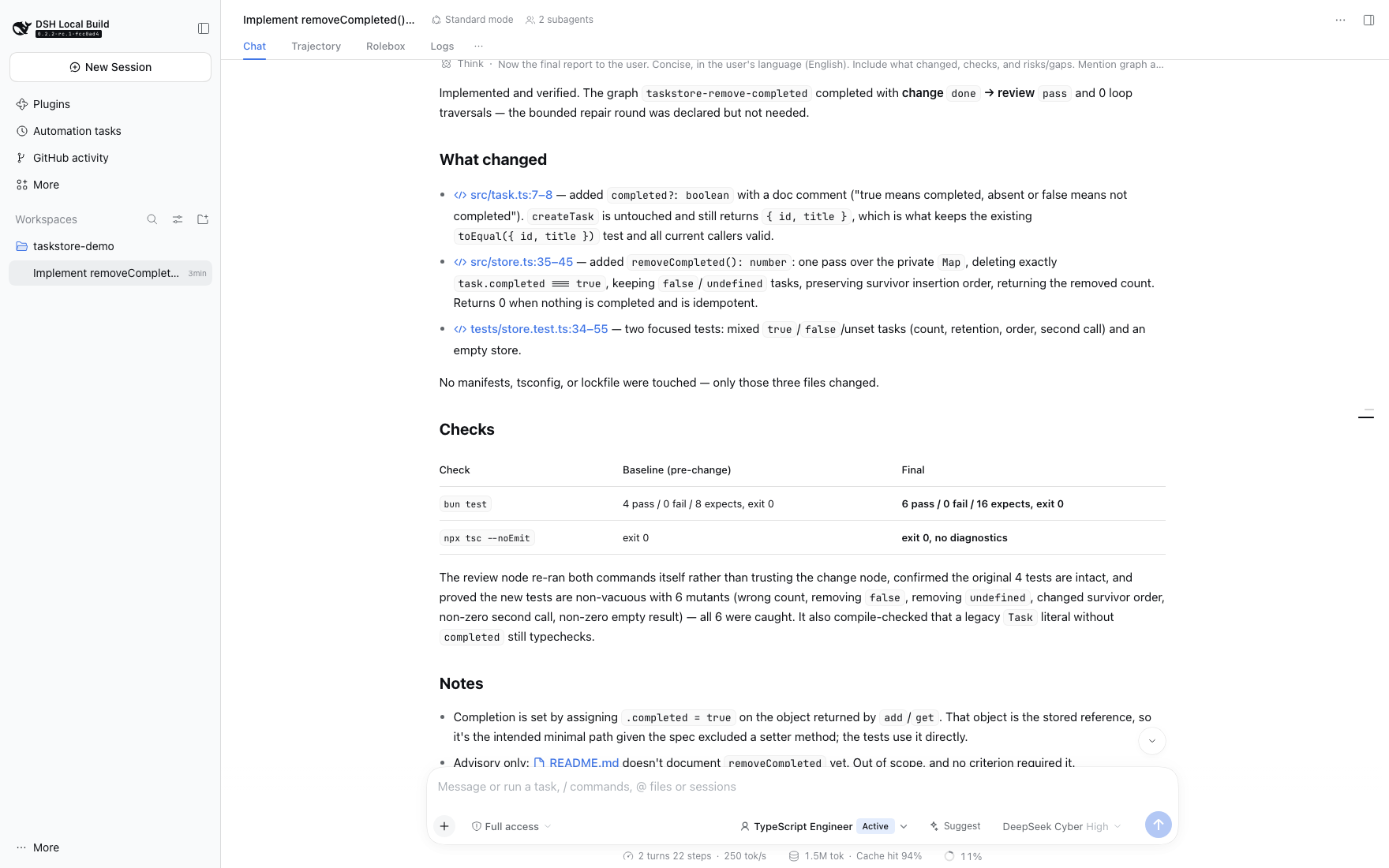
Accepted results come back; the parent reconciles them, re-runs both checks itself, and records what changed and what is advisory.
Both nodes ran in their own sessions, and the verifying node is not the node that wrote the code. The closing synthesis names three changed files and no manifests, tsconfig or lockfile: src/task.ts:7-8 adds the optional field, src/store.ts:35-45 adds removeCompleted(): number, and tests/store.test.ts:34-55 adds two focused tests — a mixed true/false/unset store (count, retention, order and a second call) and an empty store.
A Checks table sets each check against its baseline: bun test went from 4 pass / 0 fail / 8 expect() calls, exit 0 to 6 pass / 0 fail / 16 expect() calls, exit 0, and npx tsc --noEmit stayed at exit 0 with no diagnostics. The review node re-ran both commands itself, confirmed the original four tests were intact, and proved the new tests non-vacuous by catching all 6 mutants (wrong count, removing false, removing undefined, changed survivor order, a non-zero second call and a non-zero empty-store result); it also compile-checked that a legacy Task literal without completed still typechecks. The parent re-ran both required commands after the reviewers settled.
The closing Notes section records two points: completion is set by assigning .completed = true on the object returned by add / get, which is the stored reference and therefore the intended minimal path for a spec that excluded a setter method; and README.md does not document removeCompleted, which was judged out of scope and required by no acceptance criterion. The declaration also records that the workspace has no git repository, so scope was confirmed from the file inventory plus the pre-change baseline rather than a machine diff.
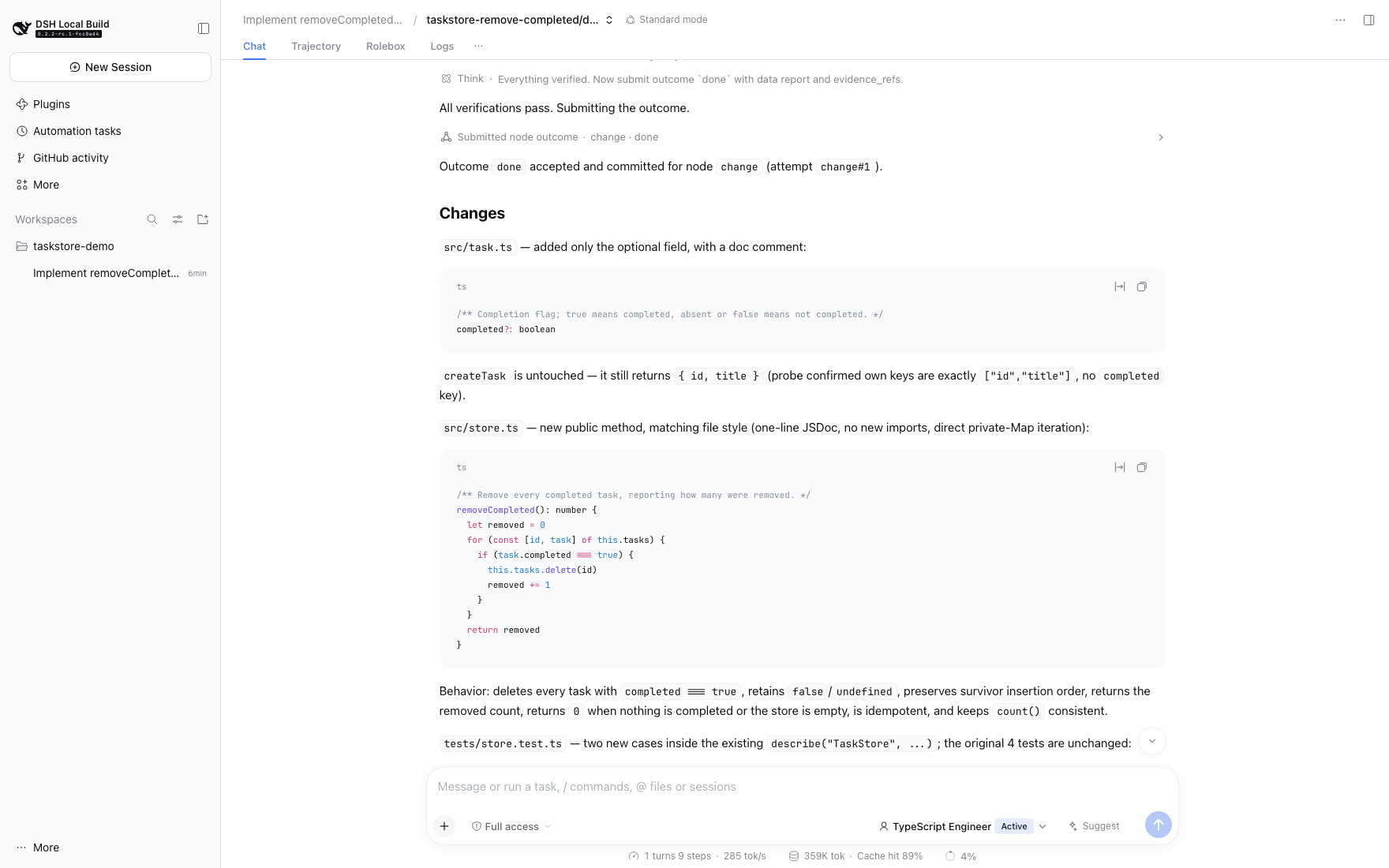
One brief in, one outcome out: the worker makes the scoped edits, runs both checks, and settles node change with the done outcome.
The capture shows a dsh worker closing its assigned brief with graph_submit_outcome: "All verifications pass. Submitting the outcome.", the Submitted node outcome · change · done row, and "Outcome done accepted and committed for node change (attempt change#1)." Current workers use the host's native command and file tools. Workers inherit the parent’s authorized task tools with native schemas exposed by default. Node tool lists do not restrict them; discovery and code presentation remain optional; see Worker tools. Workers cannot read or steer graph state. Under Changes, the worker shows the optional completed?: boolean field with its doc comment, the removeCompleted() implementation, a behavior summary (deletes every task with completed === true, retains false / undefined, preserves survivor insertion order, returns the removed count, returns 0 when nothing is completed or the store is empty, is idempotent and keeps count() consistent) and the tests/store.test.ts intro line. Its own report records 6 pass / 0 fail / 16 expect() calls and npx tsc --noEmit exit 0 with no diagnostics, plus an extra probe at exit 0.
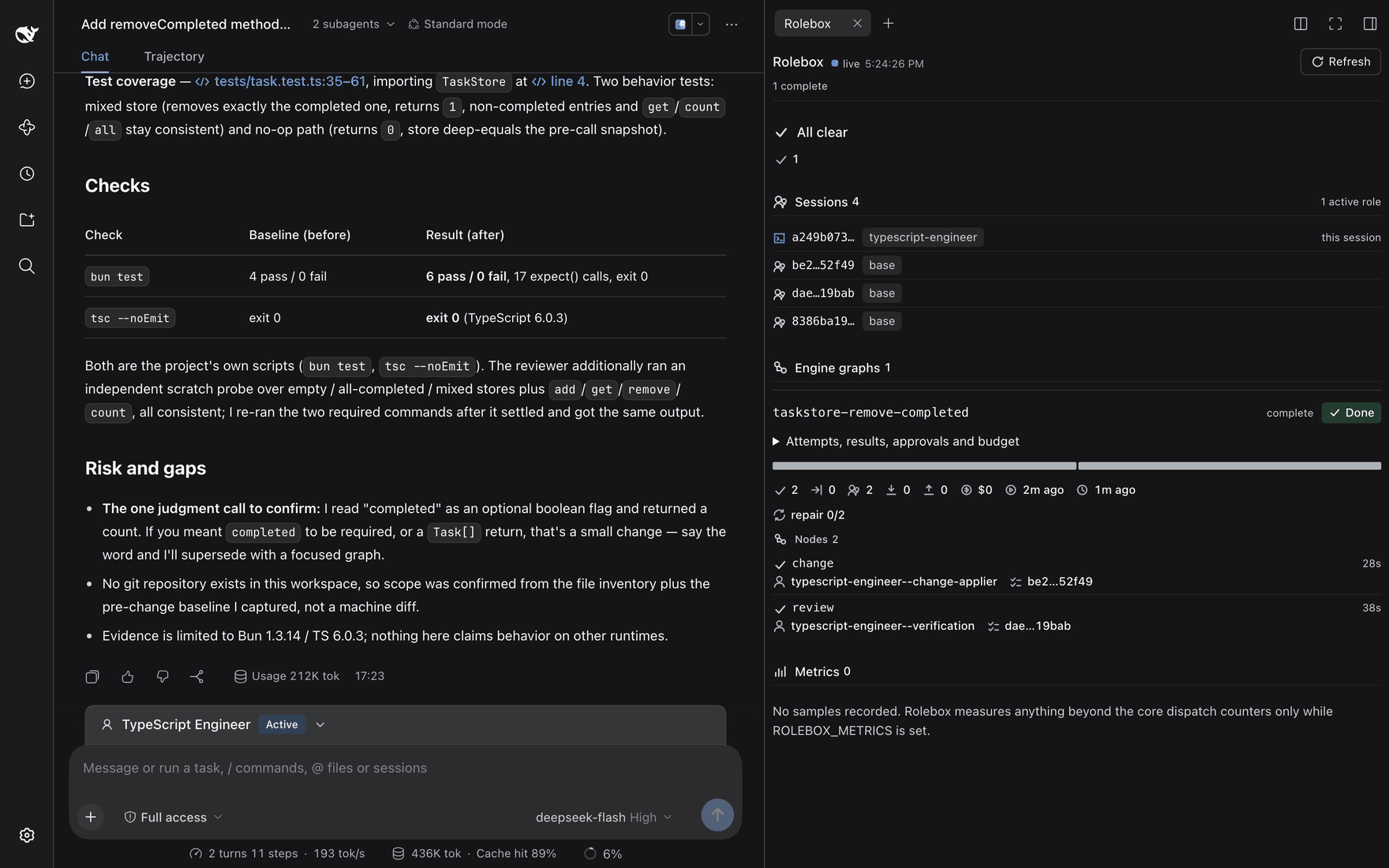
The Rolebox view: the session's selected graph, each node's agent and duration, the repair counter and the budget expander.
The Rolebox view is the session's engine view: it is a conversation view beside Chat, Trajectory and Logs, and it follows the session whose evidence it shows. In the capture it reports 1 complete, the graph picker selected taskstore-remove-completed · complete · 2 nodes, and Session graphs 1. The selected graph shows repair 0/1, an expander for attempts, results, approvals and budget, and Nodes 2: change ran typescript-engineer--change-applier in 25s and review ran typescript-engineer--verification in 57s. Sessions 1 · 1 active role lists the viewed session as typescript-engineer · this session. Metrics 0 reports No samples recorded and says the view measures anything beyond the core dispatch counters only while ROLEBOX_METRICS is set.
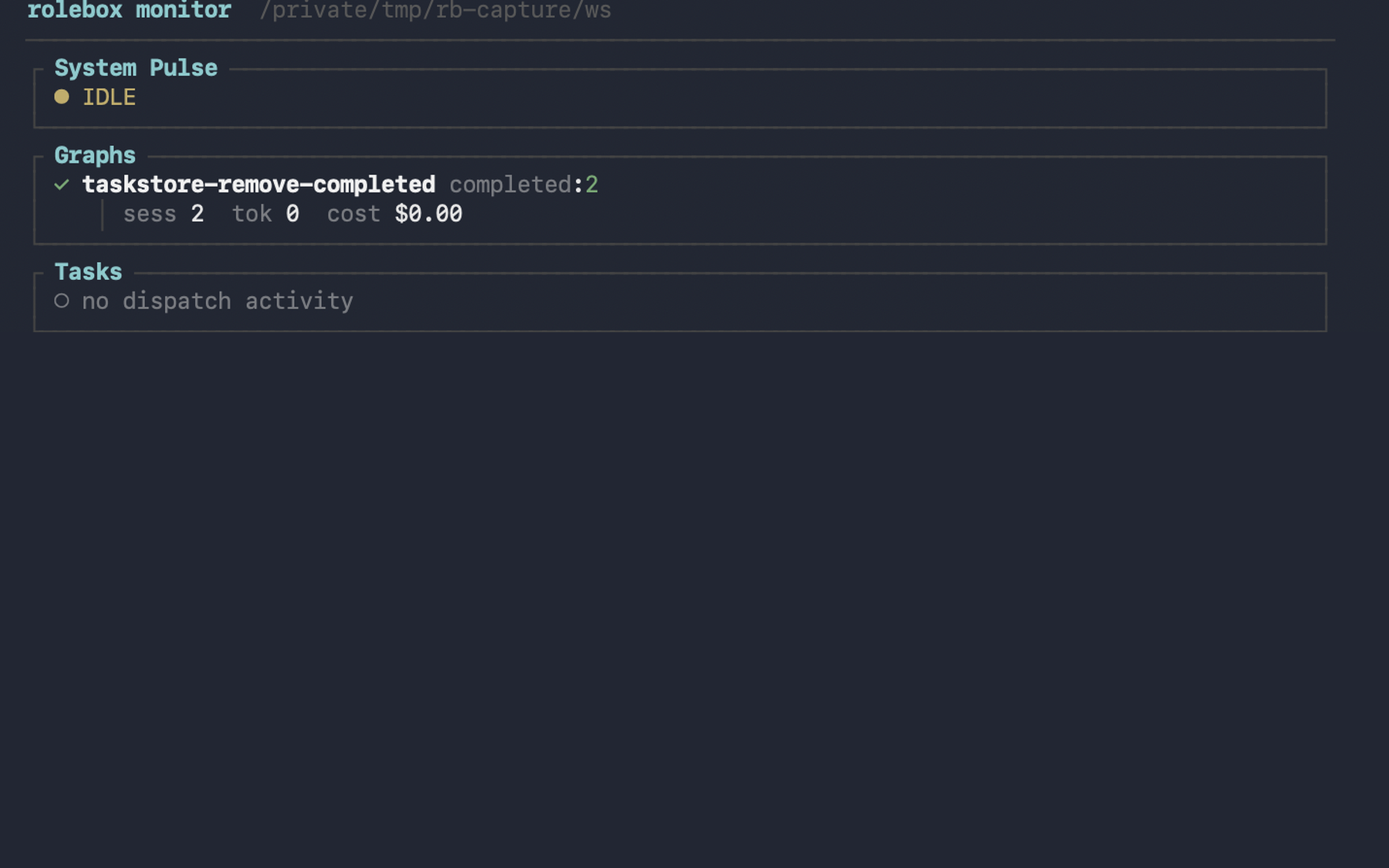
The same run from the terminal: rolebox monitor as System Pulse, Graphs and Tasks panes.
rolebox monitor renders the project's persisted dispatch state as a dashboard of boxed panes under a header naming the command and the workspace it read. At capture time System Pulse reads IDLE; Graphs lists taskstore-remove-completed completed: 2 with sess 2 tok 0 cost $0.00 beneath it; and Tasks reports no dispatch activity.
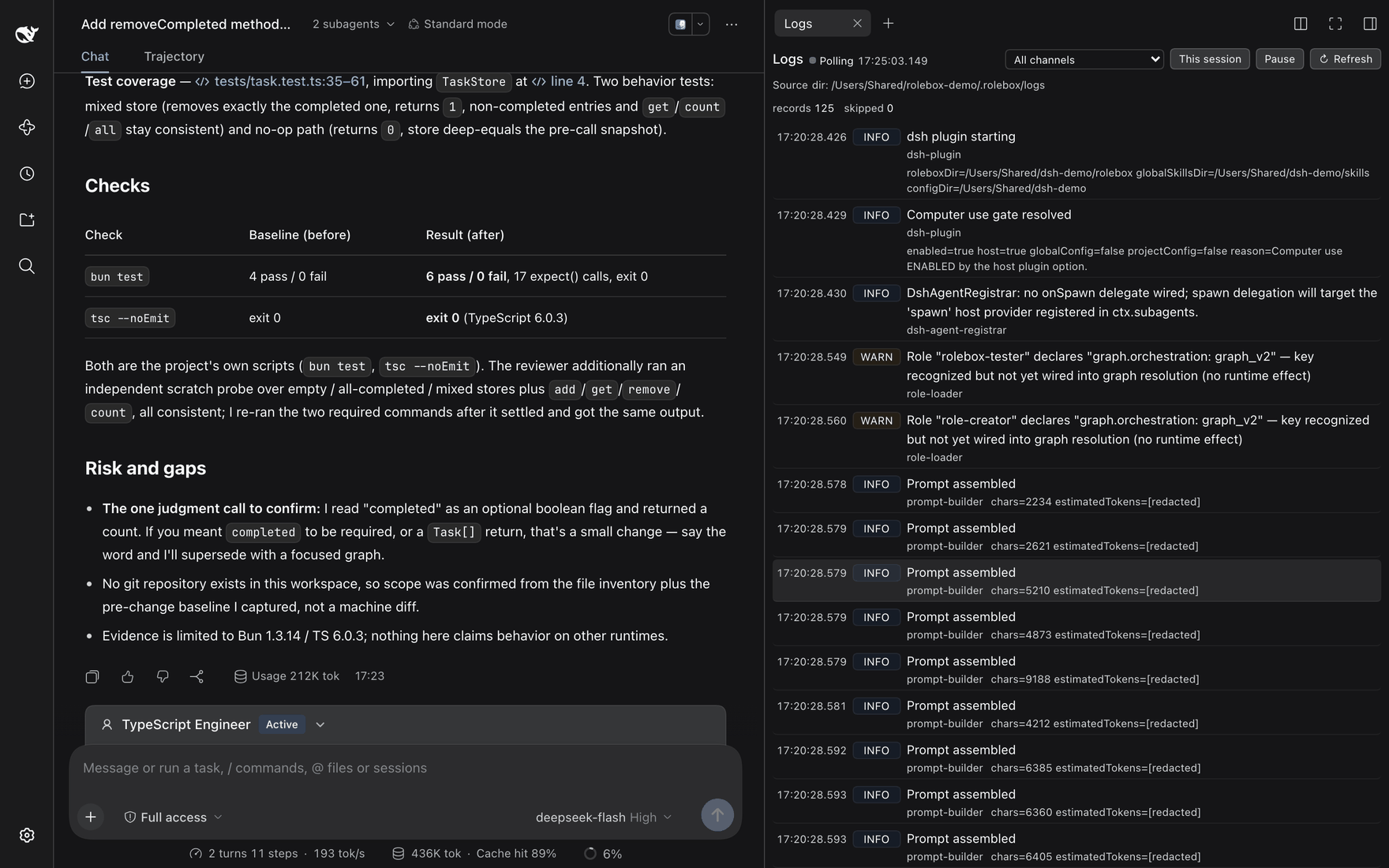
Plugin startup, LSP discovery, graph-host boot and the role switch, one record per event, filterable by channel or by session.
The Logs view is a conversation view beside Chat, Trajectory and Rolebox, and it polls the workspace's .rolebox/logs directory (records 144, skipped 0 in this run), rendering one line per record: timestamp, level, title, channel and details. The records in this capture are all INFO: the computer-use and browse-use gates from dsh-computer-use-policy / dsh-browse-use-policy; dsh-plugin lines for the computer-use and browse-use policies, the system-prompt contribution, the skill provider (candidateRoles=20), the route registration (prefix=/rolebox surfaces=role-switch + monitor + copilot draft), the logs route and Plugin initialized — discovered=20 resolved=20 skipped=0 registeredTools=112 registeredAgents=116 computerUse=true browseUse=true; lsp-servers lines detecting the TypeScript, Python, Rust, C, C++ and Kotlin servers; graph-host lines for "dsh outcome graph capabilities installed" and the declared-graph boot sweep resumed=taskstore-remove-completed:complete; and the dsh-role-switcher / dsh-role-switch-route pair recording role=typescript-engineer. The controls are an All channels dropdown, a This session filter, Pause and Refresh. The view and rolebox logs read the same log files, so what ran in the UI is debuggable from a shell.
Loop mode runs the same task across N rounds, each dispatched to its own fresh session. |loop:3| seeds every round with the previous round's summary (inherit, the default); |loop:3,fresh| starts each round from a clean slate. The parser (src/loop/params.ts) also accepts on/true for inherit and no-inherit/off/false for fresh, and clamps N to a hard cap of 50. Useful for refinement passes, batch fixes and self-correcting workflows.
Also in the box, reachable from the same session: persistent memory (rolebox memory), skills and references, LINE#HASH-anchored hashline_* editing, MCP servers, custom hooks, composer draft suggestions, and rolebox's own computer-use family.
Rolebox's CLI and development tools require Node.js 26.4+ and npm. For a source checkout, run npm ci, npm run build, and module-scoped tests with npm test -- tests/<module>/. See Node runtime and development and Repository structure. The TUI additionally needs Node's --experimental-ffi flag; the test command supplies it.
rolebox runs on four harnesses. A rolebox/ directory in the current working directory takes precedence over the global roles directory; registry roles install with rolebox install <name> and deploy with rolebox sync <opencode|pi|dsh|codex>. Each harness has a minimum version — Harness versions lists them and why.
| Harness | Config directory | Roles directory | Global skills | Env override |
|---|---|---|---|---|
| opencode | ~/.config/opencode |
~/.config/opencode/rolebox |
~/.config/opencode/skills |
XDG_CONFIG_HOME |
| pi | ~/.pi/agent |
~/.pi/agent/rolebox |
~/.pi/agent/skills |
PI_CODING_AGENT_DIR |
| dsh | ~/.dsh |
~/.dsh/rolebox |
~/.dsh/skills |
DSH_HOME |
| Codex | ~/.codex |
~/.codex/rolebox |
~/.codex/skills |
CODEX_HOME |
cd ~/.config/opencode && npm install rolebox
mkdir -p ~/.config/opencode/rolebox && cd ~/.config/opencode/rolebox && rolebox init my-agent -y
// ~/.config/opencode/opencode.jsonc
{ "plugin": ["rolebox"] }opencode 1.x loads the package root ({ id, server }); opencode v2 resolves the same installed package through its plugin entrypoint rolebox/server ({ id, setup }, src/entries/opencode2.ts) instead, so no second package or extra install step is needed. What v2 registers — and every surface where it degrades — is listed in compatibility.md.
pi install npm:rolebox     # project-local instead: pi install -l npm:rolebox
mkdir -p ~/.pi/agent/rolebox && cd ~/.pi/agent/rolebox && rolebox init my-agent -y
# from a checkout instead: add "extensions": ["/path/to/rolebox/dist/entries/pi.js"] to ~/.pi/agent/settings.json
dsh plugin --profile <name> add rolebox # installs the bundle into that profile
dsh plugin --profile web add rolebox # installs the bundle into the web profile
mkdir -p ~/.dsh/rolebox && cd ~/.dsh/rolebox && rolebox init my-agent -y # $DSH_HOME/rolebox if setRestart the harness. A non-bundle dsh install instead needs one - insert: row naming the profile-relative ./node_modules/rolebox/dist/entries/dsh.js in the profile's cordis.patch.yml — see examples/dsh/cordis.patch.yml. Profile patch semantics, the web role-switch dock, and the /rolebox REST surface are documented in docs/dsh-plugin-contract.md.
DSH exposes all 32 lsp_* tools by default. Install the appropriate language
server on the host's PATH; an explicit enabledNamespaces allow-list must
include lsp. Start with lsp_servers, then call lsp_diagnostics on an absolute
project file path. See LSP setup and usage
for workspace scope, server binaries and tool behavior.
npm install -g rolebox     # or run from a checkout built with `npm run build`
rolebox sync codex
codex plugin add rolebox@rolebox
rolebox sync codex registers a local plugin marketplace, deploys installed roles,
and generates public native agents under $CODEX_HOME/agents (~/.codex/agents by
default). Restart Codex, then ask it to delegate using a generated agent such as
rolebox--reviewer.
Private children remain scoped graph targets. The MCP runtime exposes 30 base tools,
including native session browsing and declared-graph execution, plus optional desktop
and browser families. Delegated workers require Codex's host-supplied sandbox metadata
and use native Codex tools inside that sandbox. After declaring a graph, inspect
parent_notification.available: a verified shared app-server can wake the parent
after its turn ends. Otherwise, use graph_wait as the fallback instead of polling
graph_status. An external UI-owned stdio conversation needs its own host connection
before background notifications can wake it.
Details and supported boundaries: docs/codex.md.
The former dist/index.js, dist/pi-extension.js, and dist/dsh-plugin.js artifacts still resolve as generated re-export aliases, but they are deprecated — new checkouts and profile rows should use the canonical dist/entries/*.js paths instead.
Eighteen roles are published on the oh-my-role registry. rolebox install <name> fetches one, rolebox sync <harness> deploys it, and rolebox init scaffolds your own.
| Role | What it does |
|---|---|
| emperor | Top-level orchestrator — triages the request, dispatches planner/executor subtrees, synthesises results with closed-loop validation. Never writes code itself. |
| software-architecture | Architecture orchestrator — design, review, ADRs, migration plans, and architecture-shaping implementation through specialist subagents. |
| ai-designer | Design director — tiered routing, artifact-first output, severity-layered quality gates. |
| typescript-engineer | Graph-native TypeScript engineer — type modelling, runtime debugging, API design, module packaging, workspace builds. |
| react-frontend | React/Next.js developer — component architecture, hooks, state, Tailwind, data fetching, accessibility, TDD. |
| dart-flutter | Dart & Flutter engineering lead — evidence-first research, engineering briefs, risk-based specialist gates. |
| jetpack-compose | Jetpack Compose and Android lead — invariant-driven design, encapsulation-preserving tests, AOSP/AndroidX source tracing. |
| rust-engineer | Rust lead — complexity-tier routing with safety, async, API, performance and platform gates. |
| tauri | Tauri desktop developer — IPC, plugins, permissions, system tray, window customisation, testing. |
| git-master | Git operations specialist — working tree, commits, branches, merge/rebase, stash, tags, history, undo, worktrees. Safe by default. |
| apk-reverse-engineer | Android reverse engineering — decompile APK/XAPK/AAB, extract APIs, audit security, run Frida dynamic analysis. Lawful-use gated. |
| oss-finder | Open-source research — finds, source-traces, evaluates and recommends implementations with evidence. |
| supersearch | Search specialist — triangulates local files, code, git history, web, GitHub and official docs. |
| teacher | On-demand programming mentor — conceptual answers, idiomatic patterns, code critique, library internals. |
| comment-writer | Comment specialist — writes, rewrites and reviews comments; explains WHY, not WHAT. |
| role-creator | Meta-role — interviews you, scaffolds a new role, then verifies it through four tiers. |
| rolebox-tester | Functional tester for rolebox itself — runs chosen test modules on demand, or the full suite. |
| deepseek-whale-girl | A tsundere whale-girl companion persona that is still a fully capable coding assistant. 🐋 |
A role is a directory: role.yaml (name, model, mode, permissions, subagents, skills), its prompts, and its assets. Start with create-a-role.md and the role.yaml reference.
| Default single agent | With rolebox | |
|---|---|---|
| Who does the work | One prompt for every task | Specialists with their own prompt, model, skills and permissions |
| Remembering | Sessions start blank | SQLite + FTS5 memory, auto-injected at session start |
| Switching | Reconfigure and restart | Switch role in place; the transcript survives |
| Concurrency | One agent at a time | Parallel dispatched workers with engine-managed limits |
| Autonomy | Free-form chat | Declared graphs with accepted outcomes and bounded repair loops |
| Code navigation | Text search | 32 lsp_* tools — definition, references, rename, diagnostics, call hierarchy |
| Editing | Line numbers that drift | hashline_* edits anchored to LINE#HASH content hashes |
| Observability | Whatever the host logs | Rolebox and Logs conversation views, rolebox monitor TUI, channel-filtered logs |
| Desktop | None | 13-tool computer-use family: screenshot, windows, displays, focus, click, move, scroll, drag, type, key, status, permissions, record |
| Iterating | Restart to pick up changes | Edit YAML, hot-reload the asset |
For complementary specialties, role teams on DSH provide persistent membership, an ordered event stream, exclusive task claims, and automatic peer wakeups. Members use independent agent sessions with their own role configuration; private child roles stay within their owning role. Team execution on OpenCode, Pi, and Codex is deferred.
For structured workflows, graph_declare writes a version-3 declaration — each node's agent, brief and the outcomes it may report, plus the edges that route an accepted outcome — and reports persistence separately from the host's initial start decision. The host dispatches the entry nodes; a worker settles its node with graph_submit_outcome, which commits the node's state and arms the next node.
graph_control applies the trusted lifecycle commands (failure, timeout, cancel, retry, budget-stop, and approval requests with their decisions); graph_status reads the recorded state back; graph_audit inventories the persisted store. Loops live in declared loop groups with a traversal cap, so a repair can repeat but never forever.
Architecture and the full toolset: graph-outcome-protocol.md · operations: graph-v3-operations.md · internals: graph-engine-architecture.md.
| Command | Description |
|---|---|
rolebox init <name> |
Scaffold a new role directory |
rolebox install [name] |
Install a role from a registry (picker when omitted) |
rolebox uninstall [name] |
Remove an installed role |
rolebox update [name] |
Update an installed role to the registry version |
rolebox list |
Show installed roles |
rolebox search <query> |
Search the configured registries |
rolebox registry |
Configured role sources: add, remove, list, default |
rolebox status |
Overall health and harness integration |
rolebox info [name] |
Inspect one installed role in detail (picker when omitted) |
rolebox sync <target> |
Deploy installed roles to opencode / pi / dsh / codex |
rolebox config [name] |
Configure models for a role and its subagents (--target selects the harness) |
rolebox bench <subcommand> |
Local dsh role benchmarks: init, validate, doctor, run, watch, report, baseline, compare |
rolebox monitor |
Runtime dashboard for a project's persisted dispatch state (TUI, --json, Prometheus export) |
rolebox logs |
Query, follow and prune the rolebox log files (logs files, logs prune) |
rolebox memory |
Manage the rolebox memory store (list, show, search, delete, export, clean, stats) |
rolebox checkpoint |
Manage dispatch checkpoints (list, clean) |
rolebox mcp |
Run the rolebox MCP server on stdio (Codex integration) |
rolebox host <harness> <connection> <action> |
Harness host connections and IPC adapters; currently codex desktop |
rolebox host codex desktop probe --binding <file> |
Probe the original Codex desktop MCP through an explicit IPC binding (experimental, Unix) |
rolebox host codex desktop prepare --config <file> --output <path> |
Prepare a desktop-owned shared Codex launcher (experimental, Unix) |
Full flags and examples: cli.md. Build a suite with Benchmarks on dsh: response/file assertions, trusted local command checks, a code-fix template, independent trials, feedback against a saved baseline after role edits, and offline JSON/HTML results with file-change evidence.
Registry roles ship placeholder model names, because a role should not be hard-coded to one provider. Map them once in role_config.yaml — ~/.config/opencode/role_config.yaml, ~/.pi/agent/role_config.yaml, ~/.dsh/role_config.yaml, or ~/.codex/role_config.yaml (the harness config directory):
model_aliases:
  provider/tier-1-flagship: your-provider/your-strongest-model
  provider/tier-2-reasoning: your-provider/your-reasoning-model
  provider/tier-3-fast: your-provider/your-fast-model
Unrecognized values pass through unchanged with a warning. Full resolution chain, error handling and hot-reload: model-aliases.md.
Concepts
| Graph outcome protocol | Graph v3 operations | Graph engine architecture |
| Memory usage | Session tools | Copilot suggestions and continuation |
| Functions | Hooks | Extensions |
Build a role
| Create a role | role.yaml reference | Directory structure |
| Skills | References | Subagents |
| Registry | Model aliases | Benchmarks on dsh |
Harnesses
| Compatibility matrix | dsh plugin contract | dsh provider notes |
| Codex | Computer use | Limitations |
Operations
| CLI | Dispatch config | Error handling |
| Logging | Logging architecture | Install/update audit |
| CLI output audit |
Upgrading from 0.x or 1.x? rolebox 2.x (
package.jsoncurrently reads2.5.0) runs work through the graph outcome protocol:graph_declarepersists a version-3 declaration, and a node advances only through an outcome its worker submits withgraph_submit_outcome. An existing (legacy) declaration must be rewritten for the version-3 grammar and started as a new run. A persisted legacy state body stays readable but is never advanced, and this protocol has no incremental node or edge construction tool. See docs/graph-outcome-protocol.md.
Contributions welcome — see CONTRIBUTING.md. The test layout, per-module slices and repository conventions are in AGENTS.md.
MIT — see the LICENSE file.
CLASSIFICATION EVIDENCE
系统优先读取 GitHub Topics,再与站内分类词典和词根规则比对。当前命中: ai-agent。
alchaincyf
你想蒸馏的下一个员工,何必是同事。蒸馏任何人的思维方式——心智模型、决策启发式、表达DNA。Distill how anyone thinks.

freestylefly
Prompt as Code | GPT Image 2 / 2.5 提示词与案例库,530+ 个案例、20+ 套工业级模板与可复用 Skills,新增 2.5 同提示词对比专区,附完整提示词与生成记录,持续更新。

titanwings
Distilly — Distill how they think into reusable Skills for any Agent or Bot. Formerly Colleague Skill(原同事 Skill).