模型与 MCP
待识别

rea
morluto
Reverse engineer anything with agents, from app behavior down to native binaries.

Elmeis/dsh-plugin-deepseek-clock
DeepSeek price clock and balance for DeepSeek Harness: a composer chip shown only while a DeepSeek route is selected — peak/off-peak price window (green/red, Beijing hours) plus the topped-up balance from the API key or the signed-in account
PROJECT TOPICS
INSTALL REFERENCE
dsh plugin --profile web add github:Elmeis/dsh-plugin-deepseek-clock
该命令指向仓库当前默认分支;尚无绑定当前 commit 的完整验证结果。
PROJECT README
A contextual meter in the composer tool row, next to the model selector. It is
rendered only while the session's selected provider is a DeepSeek route
(deepseek-official, deepseek-account, …); with any other provider the row is
untouched.
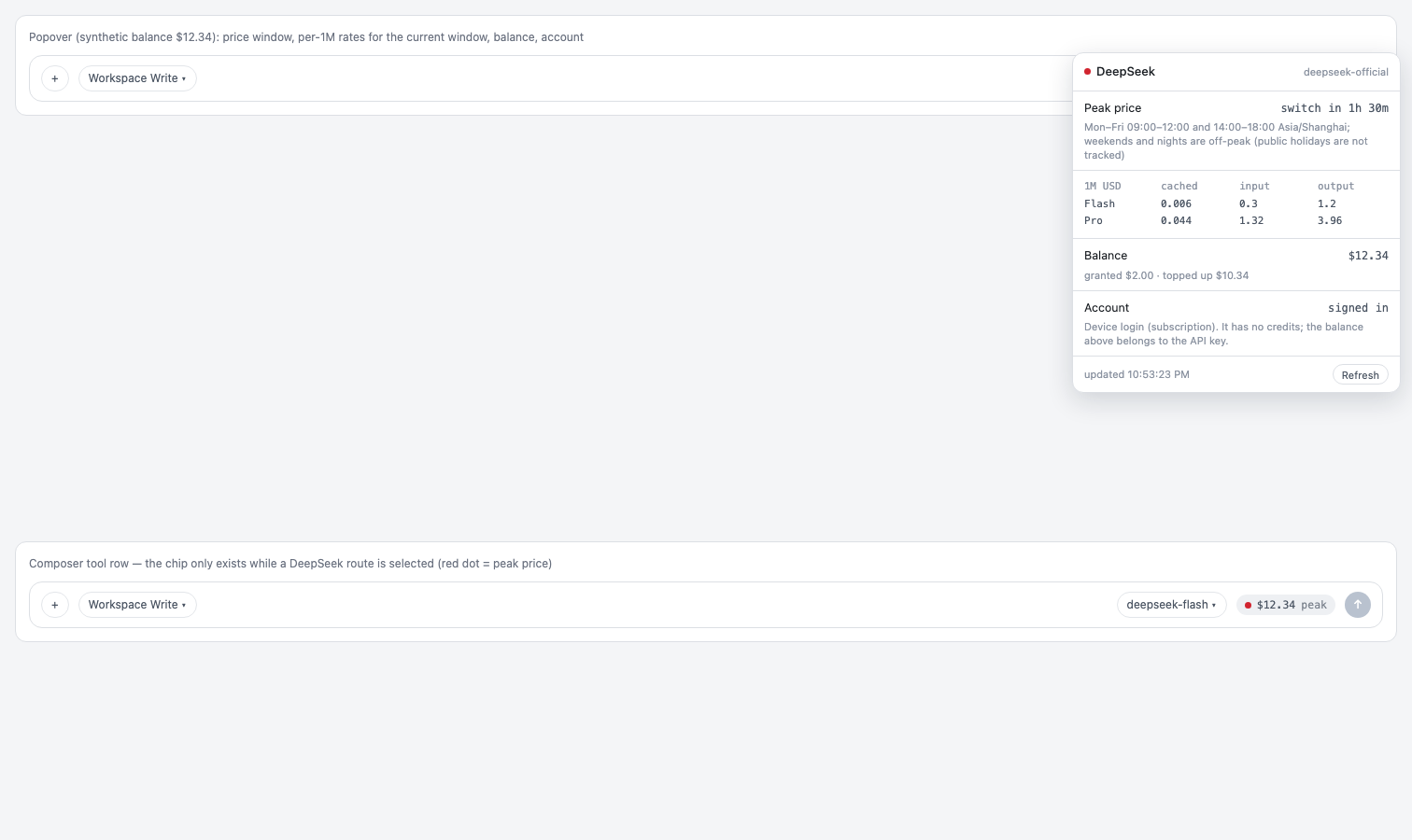
The chip shows a price dot and the API balance:
$12.34 from the API key, or $14.46 from the
signed-in account's Platform wallets; login when the account is signed in but
its wallets cannot be read; no key when neither route is available.The popover adds the window schedule, the next switch, the per-1M rates of the current window, the topped-up/granted balance and the account state.
| Fact | Source |
|---|---|
| price window | computed locally — no network |
| balance | GET https://api.deepseek.com/user/balance with DEEPSEEK_API_KEY |
| account | the deepseek-account-platform/* grant record, and its Platform wallets |
DeepSeek bills half price outside peak hours. Peak is Beijing time (UTC+8), Monday–Friday 09:00–12:00 and 14:00–18:00; everything else — nights, weekends — is off-peak (official pricing page). Chinese public holidays are off-peak too, but they are not tracked here, so a holiday Monday reads as peak.
The popover lists the published rates for the current window (CNY per 1M tokens, USD when the balance is in USD):
| per 1M | cached | input | output |
|---|---|---|---|
| Flash (off-peak / peak) | 0.02 / 0.04 | 1 / 2 | 4 / 8 CNY |
| Pro (off-peak / peak) | 0.15 / 0.30 | 4.5 / 9 | 13.5 / 27 CNY |
Two routes, two sources, one number on the chip:
API key — DEEPSEEK_API_KEY is resolved the way DSH resolves provider keys:
ctx.credentials first, then the environment, then the refs block of
$DSH_HOME/.credentials.yaml. GET https://api.deepseek.com/user/balance returns
{is_available, balance_infos:[{currency, total_balance, granted_balance, topped_up_balance}]}.
Account (device login) — the stored grant in
deepseek-account-platform/default (a token plus its issuer) is sent as
x-dsh-auth-token to GET https://platform.deepseek.com/api/v0/users/get_user_summary
— the very call the app's own Settings card uses. The payload is wrapped twice:
data.biz_data.normal_wallets is the topped-up balance and bonus_wallets the
granted one, both {currency, balance} string pairs. The token never leaves the
host process, and the request is only made when the grant's issuer matches the
configured platformOrigin.
The API key wins when both exist. Readings are cached for a minute, and a failed
refresh keeps the last good value marked stale. With neither route the chip says
no key; a signed-in account whose wallets cannot be read says login.
The login state is read from the credential records
(deepseek-account-platform/default, …/device): their presence means the
device login is stored. Nothing is requested from the network for this.
GET /api/deepseek/meter[?refresh=1]
→ { ok, price, account, api, rates, fetchedAt }
apiBase (default https://api.deepseek.com) can be overridden in the row config.
DSH Desktop: Settings → Plugins → add plugin, type the package name. From the
CLI: dsh plugin --profile <your-profile> add <name>, then restart the harness.
name: dsh-plugin-deepseek-clocknode test/smoke.mjs # price windows at fixed instants, balance route, account detection, chip visibility
node test/preview.mjs # renders the chip + popover for a screenshotThe smoke test pins the clock (2026-10-26 is a Monday) and asserts the window boundaries in Beijing time, the balance normalisation, the one-minute cache, the stale fallback, the no-key case, and that the chip renders nothing for a non-DeepSeek provider.
Two details of the client plugin API are easy to get wrong; both make the chip silently disappear:
inject receives the session id (a string), not a props object. The slot
hands it the id itself, so inject: ({ sessionId }) => … destructures a string
and yields undefined.ctx.inject(["slots", "modelDirectories"], scope => …) and declare remote.session in inject. Resolving a session's model
directory reaches the session scope's wire face; without the dotted service
name every directoryFor() call throws
cannot get property "remote.session" without inject, which a try/catch turns
into "no provider ⇒ render nothing".The directory is read through directory.store (SnapshotStore:
subscribe/getSnapshot), the same object the composer's model seat uses.
CLASSIFICATION EVIDENCE
系统优先读取 GitHub Topics,再与站内分类词典和词根规则比对。当前命中: deepseek-harness。
morluto
Reverse engineer anything with agents, from app behavior down to native binaries.

deepseek-ai
DeepSeek Harness: Everything is a Plugin.

nexu-io
The 1st Collaborative AI Design Agent Workspace. Local-first and open source. Create motion, prototypes, websites, apps, dashboards, presentations, images, and videos with your team and AI agents. Share work, exchange feedback, and iterate together in one workspace.