
其他
完整应用

deepseek-harness
deepseek-ai
DeepSeek Harness: Everything is a Plugin.
PROJECT TOPICS
PROJECT README
The Ideas manager brings an idea backlog straight into the DSH Web GUI. It's
a generic, self-contained backlog: an AI agent captures ideas, each one
becomes a card on a kanban, gets scored and ranked, and flows through a
lifecycle until it's delivered or declined. It also bridges to the
TaskBoard plugin
(@linxin666/dsh-client-ui-task-board,
by linxin666 — third-party, not affiliated) when present.
A Host-authoritative /api/ideas ledger keeps everything consistent and lets
an agent write cards directly over HTTP — no UI needed. Fully usable without
TaskBoard: zero hard dependency on it.
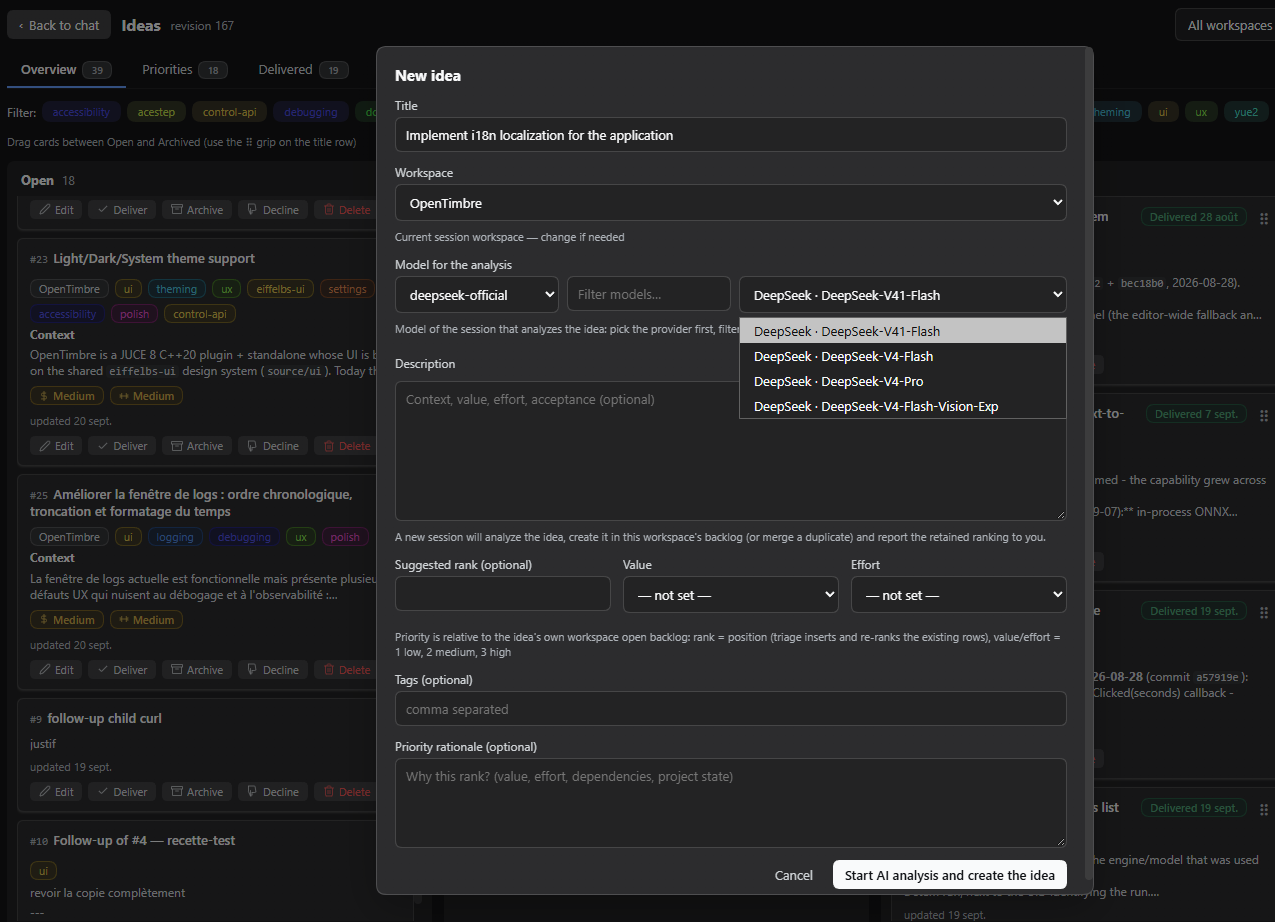
Open · Under review · Archived · Declined.
#N number, workspace chip, tags,
value/effort badges and update date.When the TaskBoard plugin
(@linxin666/dsh-client-ui-task-board,
repo: zhu1090093659/dsh-web) is
present, the Ideas manager mirrors its ledger onto TaskBoard's backlog so
both tools stay in sync — one-way (Ideas → TaskBoard).
The mirror is detected at runtime (GET /api/task-board/state); if TaskBoard is
absent the Ideas manager simply works standalone.
| Ideas action | TaskBoard mirror |
|---|---|
| Create idea | New read-only card in backlog (bound to the idea id) |
| Update idea | Card updated |
| Decline / drag to Archived | Card archived |
| Restore | Card restored |
| Delete | No-op (closing to done stays manual) |
Task-Board card reaches done |
Idea auto-moves to Under review (the recette gate) |
Triage (scores, rationale, rank) is ideas-only and is never mirrored — it's a backlog opinion, not a board state.
Card weight: the card description carries the idea's summary (<= 300
chars, produced by the ideas-analyst; a derived body excerpt otherwise) while
the full analysis rides the card prompt (the run instruction) and the ledger
— the body is never stored twice in the snapshot.
Card ids are deterministic (idea- + the idea id), so re-running any
mirror path re-touches the same card instead of minting a twin. A bound idea's
card is only rebuilt when a non-empty task-board snapshot proves it was
deleted out-of-band — every ensureTask decision (idea id, binding, snapshot
size, branch) is logged, and an empty or unreadable snapshot keeps the binding
and attempts the patch, never a create. Mirror operations are serialized per
idea id, so a create always completes (and binds) before a following update
runs — "update" can never silently mean "create".
Two scripts close the loop:
node scripts/reconcile-taskboard-mirror.mjs [--url …] [--apply] — detects
orphan duplicates (unbound card whose exact title matches a bound idea) and
archives them, always keeping the bound card; dry-run by default.node scripts/validate-mirror-cycle.mjs [--base …] — live recette against a
test instance: create → re-analyze → analyst rewrite → decline must end with
exactly one card.Note for agent-driven workflows: the capture → triage → lifecycle protocol and the full wire contract are documented in
SKILL.md, so an agent can author cards directly over the HTTP API without the UI.
The Host exposes a REST API so scripts and agents can read the board and write
ideas. Prefix /api/ideas, same-origin fence (loopback socket + browser
markers), JSON envelopes { requestId, action, initiator? }.
| Route | Purpose |
|---|---|
GET /api/ideas/state |
{ schemaVersion: 1, revision, ideas[] } |
POST /api/ideas/action |
create, update, move, decline, deliver, followUp, triage, restore, delete, reanalyze, reorder, import, export |
GET /api/ideas/events |
SSE { revision } |
Every action is deduplicated by requestId (fresh id per call), and a
mutating action returns the whole board so the caller can confirm the result.
Full contract (verb table, mirror mapping, PowerShell gotchas) lives in
SKILL.md.
dsh.engines.dsh in package.json).sessions.scope(id) became a pure read there (a just-created session is no
longer visible through it until its scope is retained), so the AI capture /
re-analyze launcher first calls retainAgentScope(id) — which materializes
the scope — takes the context from the reference's binding.ctx, prompts,
and always releases the retention (success, prompt rejection or missing
session face).scope(id) materializes the scope on demand).From npm (recommended):
dsh plugin --profile web add dsh-plugin-ideas-managerPinned to a version:
dsh plugin --profile web add dsh-plugin-ideas-manager@0.2.6From a local checkout (no registry needed):
dsh plugin --profile web add link:/path/to/dsh-plugin-ideas-managerFrom a git URL (fallback, pinned to a released tag):
dsh plugin --profile web add github:EiffelBS/dsh-plugin-ideas-manager#v0.2.6dsh plugin runs pnpm add in the profile directory, then reconciles
dsh.profile.bundles: because this package declares a dsh.bundle, it is
auto-appended as a profile layer. Restart the web instance (or open a fresh
page session) for the bundle change to take effect.
Verify installation:
dsh web --profile web --no-open # then look for the Ideas entry in the sidebarTo pick up a newer revision after a release (versions follow the package's
version field; releases are tagged, e.g. v0.2.6):
dsh plugin --profile web add dsh-plugin-ideas-manager@latestthen restart the web instance.
Uninstall / disable:
dsh plugin --profile web remove dsh-plugin-ideas-managerMaintainers: bump
versioninpackage.jsonon each meaningful push so an installed profile's version stays observable (e.g. viadsh plugin lsorpnpm listin the profile directory).
pnpm run typecheck   # tsc --noEmit
pnpm test            # vitest (protocol gate, ledger persistence, export golden, mirror, markdown parser)
pnpm run build       # tsc -p tsconfig.build.json (types -> lib/types) && tsdown (lib/index.js + lib/client.js)

# isolated test profile (never the production profile of a live instance)
dsh --profile ideas-test --from-default-profile web --dump-config
dsh plugin --profile ideas-test add link:C:/path/to/dsh-plugin-ideas-manager
dsh --profile ideas-test --port 3099                # omitting --no-open opens the browser with the token URL
The browser half is served at /plugins/<id>/client.js (re-resolved per
request); the host half registers the /api/ideas routes at boot.
src/
  index.ts            # apply + mountOnce + Config + guidance section
  protocol.ts         # /api/ideas prefix, types, parseActionEnvelope (exactKeys)
  host-service.ts     # apply + mirror scheduling
  host-ledger.ts      # persisted ledger, dedupe cache, lock, internal bind
  host-routes.ts      # state / action / events + loopback guard
  taskboard-bridge.ts # runtime feature-detect + one-way mirror (no hard import)
  export-markdown.ts  # unidirectional ledger -> markdown (golden-tested)
  http.ts / loopback.ts / mount-once.ts   # shared discipline
  core/ideas.ts       # IdeaRecord, statuses, tag validation
  client/             # sidebar entry + kanban + Priorities/Delivered + workspace scoping
tests/                # vitest suites per module
  SKILL.md / README.md
Persistence lives in ~/.dsh/ideas/ledger-v2.json (atomic tmp+rename writes,
corruption quarantine, single-writer lock, restart-safe request-id dedupe).
MIT — see LICENSE.
CLASSIFICATION EVIDENCE
系统优先读取 GitHub Topics,再与站内分类词典和词根规则比对。当前命中: 无有效分类标签。
deepseek-ai
DeepSeek Harness: Everything is a Plugin.

anywhere-labs
为 DeepSeek Harness (DSH) 插件生态打造的现代化桌面端解决方案。万物皆「插件」,桌面本身也是「插件」。

awesome-dsh-plugin
A curated list of plugins for DeepSeek Harness (dsh) · DeepSeek Harness 插件精选列表